
Destination Michigan
Destination Michigan 1704
Season 17 Episode 1704 | 27m 50sVideo has Audio Description
Celebrating America’s semiquincentennial
We’re celebrating America’s semiquincentennial! We’ll meet three Michigan “Rosies the Riveters” and take a trip to Greenfield Village, where we’ll explore role in the civil rights movement. Then, we’re off to Clawson to celebrate the Stars and Stripes at American Flag and to Fort Mackinac and meet a CMU student who has turned who has turned a passion for history into a unique summer job.
See all videos with Audio DescriptionADProblems playing video? | Closed Captioning Feedback
Problems playing video? | Closed Captioning Feedback
Destination Michigan is a local public television program presented by WCMU
Destination Michigan
Destination Michigan 1704
Season 17 Episode 1704 | 27m 50sVideo has Audio Description
We’re celebrating America’s semiquincentennial! We’ll meet three Michigan “Rosies the Riveters” and take a trip to Greenfield Village, where we’ll explore role in the civil rights movement. Then, we’re off to Clawson to celebrate the Stars and Stripes at American Flag and to Fort Mackinac and meet a CMU student who has turned who has turned a passion for history into a unique summer job.
See all videos with Audio DescriptionADProblems playing video? | Closed Captioning Feedback
Where to Watch Destination Michigan
Destination Michigan is available to stream on pbs.org and the PBS app.
Providing Support for PBS.org
Learn Moreabout PBS online sponsorship- Hi, and welcome to a special edition of "Destination Michigan."
On July 4th, 2026, America officially celebrated its 250th birthday.
Events, moments, and revelry have rung through parts of the country all year.
Coming up, we pay tribute to America with those who have had a front row seat to the past and those helping shape our future.
- What are we gonna do?
Who's brave?
Who's strong?
Who changed the world?
Rosie changed the world.
- [Stefanie] Like every nation in the world, America's past is both beautiful and complicated.
- I think we're at an interesting moment where people are seeing the challenges that are being laid at the feet of complex American stories as a way to look deeper into who we are.
- [Stefanie] Stories passed down from generations.
Literature, images, objects, music, and film act as a compass to help navigate our nation's future chapters.
- People come in and they're patriotic people, and it's everything.
It's been my entire life.
We're actually honoring the Betsy Ross flag.
- [Stefanie] History guides, teaches, and inspires us.
- My job is to present the history of Fort Mackinac, Mackinac Island, and the straits of Mackinac in general in a engaging and educational way.
One of our catchphrases is, "We make history come alive."
And I think that is a great description of what we do here.
(cannon fires) (cheerful music) - Hi, and welcome back.
Today, we're coming to you from Veterans Freedom Park in Harrison.
Well, Rosie the Riveter is one of the most iconic images to come out of the Second World War.
She represents the millions of women workers and volunteers who stepped up to fill the roles of the men who went off to fight.
And as Jamie Mankiewicz shows us, many real Rosies played an important role in the war effort from right here in Michigan.
(gentle music) - [Announcer] Wake up, Miss America.
Wake up, Mrs.
America.
Friendly planes may not always cast their moving shadow on you.
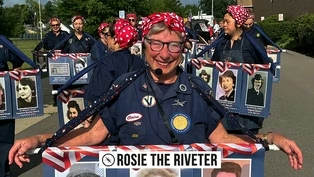
- [Jamie] With her flexed arm, a red and white polka dot bandana, dark blue coveralls, and a worker's badge.
- Rosie the Riveter represents any woman who worked in any job, in any factory, in any city for any amount of time during World War II.
She is embodied by the poster, "We Can Do It," but she was any woman who did it during the war in the factories or keeping her communities alive.
- [Jamie] Claire Dahl is a resident Rosie expert at the Michigan Flight Museum in Belleville, home of Willow Run History, and the Women Answer the Call exhibit, about 25 miles from downtown Detroit.
- Back those trucks up, get those parts in, and then on the assembly line, two assembly lines.
It was done, it was miraculous, it was an experiment, complete assembly here.
The military knew it needed to start looking for the future.
- [Jamie] The government had already started converting plants across the country to transform into a war economy.
- To make a great big bomber plant, which was planned the biggest in the world, they needed a name, they needed money, and they needed land, and they were able to get all three from Henry Ford.
- [Jamie] World War II began in 1939 when Hitler's Army invaded Germany's European neighbors.
The United States did not formally enter the war until 1941.
- December 7th is the attack on Pearl Harbor, and the Philippines, and Guam, and Wake, and Midway Island.
December 8th, we declared war on Germany.
December 11th, Germany and Italy declared war on us.
You know, we declared war on Japan, of course, but then Germany and Italy because of alliances.
And then five months later, Rosie is needed, because so many men are in the service.
- [Jamie] Rosie became the face of what's considered to be the most successful government public relations campaign in American history.
- [Announcer] They wore a new badge, a badge not only of courage, but of achievement.
These women who had never worked outside their own homes before.
- The women had to be convinced to do it.
If you can use a sewing machine, you can use a riveting gun.
If you can iron your clothes, that's a drill press.
If you've ever folded your laundry, you can fold a parachute, and the women responded, because they knew they had to do it, and they knew they could.
And so when we talk about that time period, we were touching the souls of the grandmothers, the mothers, the wives, the sisters, the daughters, the girlfriends, wanting to make a difference, wanting to bring those soldiers home, wanting to help end that war, wanting to travel, get off the farm.
- [Jamie] An estimated six million women stepped up to fill critical roles in countless ways.
- You've got nurses, you've got teachers.
We had the best childcare we've ever had in this country.
The Lanham Act, for the first time ever, bring your kids to work.
We need you to work, and we'll give you flex time, and we'll give you daycare in your little cities wherever.
So you name it, any job that needed to be done was done at Willow Run.
- [Jamie] Some of these real Rosies are still alive today.
In 2024, the United States government collectively honored each and every one of them with a congressional gold medal, including 101-year-old Agnes McKenna from Carson City.
The Rosie the Riveter Association of Michigan recognized her and continues to highlight Rosie's past and present.
- [Jeannette] She worked at AC Spark Plug in Ionia, Michigan during the war, and she assembled spark floats on a machine.
And then she worked at REO Motors in Lansing.
She waterproofed wires and instruments in the dash on the military trucks that were built there and were sent overseas.
How did you feel about the war?
- I felt bad for all the soldiers that had to go leave and go.
That was what I was more concerned about than myself.
- [Jamie] 103-year-old Vera Gobeski was just 18 when the war started, with a baby at home when her husband went to fight.
She moved back in with her parents in Bay City and went to work at the Dow Chemical Company, which famously developed magnesium bricks to build smaller, faster bombers and bomb casings.
- We were helping.
Yeah, we figured we were helping the war effort by working here, which we were, and they had a real need for the small bombers at that time.
- [Jeannette] What does it feel like to be a Rosie?
- Oh, well, I'm just surprised that they waited so long to give people recognition.
(laughs) No, I think it's wonderful.
See the pictures on the wall?
I tell everybody to look and look at them.
- [Jamie] Not every Rosie was working in a factory.
Betty Sharrer, now 103, was a young phone operator when the war broke out.
- I worked at Bell Telephone Company in downtown Detroit and was dating Bob Sharrer.
We were teenagers in high school.
December of '41 was Pearl Harbor.
- [Jamie] The pair married in 1943, and left Michigan for Camp Swift in Texas.
- In a very short time, he became assistant commanding officer in charge of 3,000 German prisoners of war and 900 Russian prisoners of war.
I was told that there were nearly a half a million German prisoners of war in this country during World War II on American soil, and nobody knows it.
And the Library of Congress contacted me a while back and said, "This whole prisoner of war endeavor was the best kept secret of World War II, that very few people knew about it."
- [Jamie] At the camp, American soldiers discovered many of these young prisoners, some still teenagers, had unique talents like painting, wood carving, and tinkering with technology.
Betty says her husband decided to get them the tools to do it, believing if Americans showed the prisoners respect, they would return the favor.
- So as a result, that's why that camp was peaceful, because Bob had taught them, and they learned a whole new side of America that they might not have known otherwise.
- [Jamie] Decades later, Betty still has some of the gifts given to her and her husband from the prisoners of war.
- Rosie the Riveter invited me to be part of their group.
I said, "I never worked in the factory.
I never did anything that Rosie the Riveter was known for."
And somebody said, "The fact that I worked with the German prisoners and also I worked for the telephone company and I put calls through."
- [Jamie] The contributions of these Rosies and millions more helped change the world.
- It's a nice little song.
You want me to sing it?
- [Interviewer] Absolutely.
♪ All the day long, whether rain or shine ♪ ♪ She's a part of the assembly line ♪ ♪ She's making history, working for victory ♪ ♪ Rosie, (buzzes lips) the riveter ♪ ♪ Rosie's got a boyfriend named Charlie ♪ ♪ Charlie, he's a Marine ♪ ♪ Rosie is protecting Charlie ♪ ♪ Workin' overtime on the riveting machine ♪ ♪ When they gave her a production E, right there ♪ ♪ She was as proud as a girl could be ♪ ♪ Oh, there's something true about ♪ ♪ Red, white, and blue about ♪ ♪ Rosie, (buzzes lips) the riveter ♪ (Claire laughs) - Thanks so much, Jamie.
Now, the famous We Can Do It poster featuring Rosie was created by J. Howard Miller in 1943 for the Westinghouse Company.
It was only displayed internally in certain factories for about two weeks.
The print was then rolled up and sent to a brand new museum in Washington, now known as the National Archives, and it was kept in storage until the 1980s when the image was used during the Feminist Movement.
To register a family member who served as a World War II home front worker, you don't need official work documents.
You only need to provide her name and wartime service.
You can learn more about it by visiting michiganrosies.org.
Now, the Henry Ford Museum in Dearborn has created its own legacy in keeping the past alive.
Its newest edition in Greenfield Village takes us back to the Civil Rights Movement inside a home that very much still feels like it's in the present moment no matter when you walk inside of it.
- Elements of that Voting Rights Act were drafted at the dining room table in this house, right?
Conversations between Dr.
King and President Lyndon B. Johnson happen all throughout this home, but especially in that back bedroom.
- [Reporter] If these walls could talk.
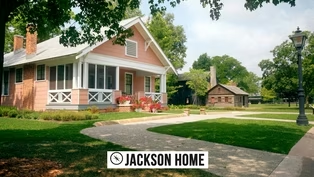
- Once they walk into the home, which is restored to its 1965 facade inside and out, people will experience the home as it looked in March of 1965.
So March 15th, 1965 is the day of two major events.
One, it is the funeral of Reverend James Reeb, who is the second martyr of the Selma movement.
Dr.
King delivers his eulogy earlier that morning, and then that evening, they all listened to President LBJ deliver his We Shall Overcome speech on the television set that people will be able to hear when they come into this home.
And the photos that we have that really bring this story to life are of everyone in that room watching that, that delivery.
- [Reporter] The Jackson home looks like a house that could very well still dot the streets of America today, but this quiet, unassuming house played an extraordinary role in the Civil Rights Movement because of one ordinary family who lived there.
- I think what's really core to this story is that the Jacksons were everyday people.
Dr.
Jackson was a dentist.
He's a World War II veteran.
He lands at the beaches of Normandy in June of 1944, and is told that you do not have the right to vote despite going overseas to fight for democracy in some other place.
So that doesn't sit well with him.
- [Reporter] The right to vote wasn't a guarantee despite the Reconstruction Amendments added to the US Constitution between 1865 and 1870.
They abolished slavery, defined citizenship and equal protection under the law, and protected voting rights regardless of race.
- Prior to the Voting Rights Act of 1965, African Americans had very little access to the right to vote in the United States.
On paper, we had the right to vote via the 13th, 14th, and 15th Amendments, but of course, in practice, that looks different based off of time and place, especially in the former Confederate states across the South, but definitely up North as well.
Access to the vote was not just a Southern problem.
By this point, there was no longer any sort of negotiations happening around who gets the right to vote in the United States.
African Americans at that point, or at least these activists had said, "Enough is enough and we're ready to push forward in a deeper, deeper way."
Throughout the course of January to June of 1965, tons of people came through this home, all kinds of both well-known folks like Dr.
Martin Luther King Jr., future Congressman John Lewis.
- [Reporter] It's important to note the relationships formed between these important historical figures would not have happened without strong women friendships bringing everyone to the table, including Dr.
Jackson's wife, Richie Jean.
- His wife, Richie Jean, who is also a native of Selma, she is born into a very well-connected family whose connections are really the reason why Dr.
King is in this home and why they have a long-term friendship.
It's her childhood friendship with Coretta Scott, later King, who is born in Marion, Alabama, which is about 30 minutes away from Selma.
It is her relationship with a future Reverend Ralph Abernathy, who is Dr.
King's second in command at SCLC, as well as his wife, Juanita Jones Abernathy, as well as another woman named Jean Childs Young, the wife of a future ambassador Andy Young, who are all organizers as part of SELC.
It's these friendships between these women who are very well connected both here and nationally throughout the United States that build a link in a different kind of way for movement making.
- [Reporter] The Jackson home transports you back in time, while also feeling like the present day.
It is a testament to what can be accomplished by everyday people working together for the greater good of a nation.
- I think we're at an interesting moment where people are seeing the challenges that are being laid at the feet of complex American stories as a way to look deeper into who we are.
And I think by learning who we are, we learn who we can be.
- Well, the American flag is something most of us see every day, and they've become even more popular during the semi-quincentennial celebration.
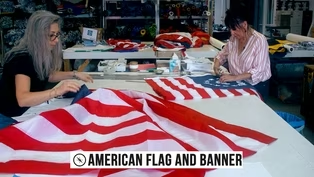
American Flag and Banner has been making flags, including the red, white and blue, for over 100 years.
Chris Ogozaly takes us to Clawson.
- We do anything anybody wants, pretty much.
We kind of pride ourselves in thinking we can make anything if you can think of it.
We're very unique, and there's no place else you can walk in and watch a flag being made.
We'll let people stand and watch.
We'll custom make you a flag no matter how difficult it is.
You can get a flag for your boat, you can get a flag for your club, you can get a flag for your dog.
Nobody else appliques.
Sewing is getting to be very hard to find anyone who sews.
So the fact that we can still sew and make your flag is very unique.
You can't go anywhere else to do that.
You can get a computer dyed flag sitting at your computer or laying in your bed on your laptop, but you can't get an applique flag anywhere else, certainly not in Michigan.
There's a couple shops in other states that are doing the same thing we're doing, but we're a very dying breed.
We don't use a computer other than for invoicing.
All our art is done with an opaque projector and a pencil.
We're very old school that way.
We're doing things the old way.
We still stamp and stencil paper patterns, whereas anyone dyeing is just telling the computer what to do, and it goes off and does it.
You push a few buttons.
This is still making it hands-on by hand.
So we are quite unique that way.
Applique is still a viable thing and a much nicer flag than a dyed flag.
Much heavier, more vibrant colors.
It shows it's got quality behind it.
They're beautiful.
School banners, all those gym banners that say they won a champion in all the years, we do all those.
We do a lot of corporate flags, arena flags, sports flags.
- [Chris] Jane has scrapbooks filled with memories of flags and banners that she and her team have created, like those red, white, and beautiful Red Wing Stanley Cup banners.
I vividly remember the 96 - ' 97 one being hoisted to the rafters at Joe Louis Arena.
But recently, many Michiganders have come in with a different celebration in mind.
- Everyone's coming in looking for the 250, and there's several.
There's maybe five or six made in America ones.
There are many if you go online.
All our flags here are made in the US.
Annin made 10,000 limited edition Betsy Ross flags with embroidered 250 in the middle.
They're beautiful.
They came with a certificate.
They came with tissue in the box.
It's a present.
You should never fly it, I guess.
They got sold immediately.
I ordered an additional, I ordered initially 24 of them, so I called to get more.
Well, they're gone.
They're all gone and they're not, that's it.
It was a limited edition.
That's it.
But now that's the look everybody wants, and you can still buy a Betsy Ross flag and you can applique a 250 in the middle.
It's not an limited edition, but it's the same flag, and we're pumping those out as fast as we can.
We have the dyed variety, but people come in and they see the embroidered and the dyed, and they pretty much pick the embroidered.
The flag is so associated with politics that, term to term, it fluctuates.
This year, I think people are really rallying around the 250 rather than associating it with politics.
We're happy that 250 years, we're still here, and we're still free, and we're still the best place to be in the world, I'm quite convinced.
And people that have never bought a flag are wanting the 250 as a celebration.
So it's just brought out a new audience of buyers.
- [Chris] For Jane, Old Glory carries meaning, both personally and professionally.
- It's everything.
It's been my entire life.
I've been doing this for 48 years now, and it's clean, it's wholesome.
People come in and they're patriotic people, and it's also a luxury item.
You know, not everyone can afford one, but more and more people are buying flags that haven't before, so I think that's a show of patriotism.
- [Chris] There are moments in history where Americans seem to rally around and unite under the flag, like the tragedy of September 11th, 2001.
- Besides bringing out everybody who'd never had flown a flag before in their life, we couldn't get flags.
They shut down all the airplanes.
UPS couldn't deliver.
We sold out of what we had in stock in the first couple days.
People were still calling and lining up.
We had lines outside and down the street.
One day it rained, and there was a picture of all the umbrellas of people waiting in line to buy a flag.
It was like never before.
We had two sewers directing.
Nobody was sewing.
They were directing traffic, and then you have to go out and say, "We only have eight more flags, so sorry, all go home."
Our stuff was sitting in a UPS truck at the airport waiting to come to us grounded, so we met a truck here, parked right in the front at like three in the morning.
My husband and I unloaded.
Every table here was cleared.
We threw boxes all over the place, poles, everything we needed came in and sold those in two days.
And when people, they'd be in line for half an hour, and they're finally done, and they turn to the person behind them and say, "Well, I hope the wedding goes well," or "I hope your mother's feeling better."
And they had all this time to chit-chat and become friends, and everyone was really rallying around the flag, which we do when we're in trouble.
It's not just a cliche.
- Thank you so much, Chris.
Now, if you're a Michigan history buff, the original location of American Flag and Banner was on Front Street in Detroit.
All right, well, now we head to Mackinac Island to meet up with Christian, whose journey with Fort Mackinac began as a Boy Scout volunteer, but today as a Central Michigan University Chippewa, he's landed what just might be one of the coolest summer jobs in Michigan.
Adam shows us why.
(bugle fanfare music) - After I graduated high school, my mom put the thought in my head of, "Why don't you go try and working up on Mackinac?
It seems like a fun job."
I've been up here since 2023, and loved it ever since.
- At the caretakers.
- [Adam] Christian has found the perfect place to combine his passion for Michigan history, Mackinac Island, and sharing that history with visitors from around the world.
- Fort Mackinac was initially built in 1780 by the British during the American Revolution.
They have a fort over on the mainland at Fort Michelin Mackinac.
However, that is going to be a sort of imperfect post, and the Lieutenant Governor of Canada, Patrick Sinclair, is going to be very unhappy with it.
And in winter of 1779 to 1780, he physically tears down several of the buildings at Michigan Mackinac.
He then goes on to drag them across the ice.
He builds several buildings here at Fort Mackinac, and officially begins construction in 1780.
Fort Mackinac is then handed over to the Americans after the American Revolution.
It goes on to be captured by the British in the war of 1812.
The British are going to hold onto it for the entirety of the war until it's returned to the American government after the Treaty of Ghent is signed.
And from then on, it maintains as an American post.
It's going to be a fairly important station for the fur trade during these times.
Mackinac Island is a very central point for that fur trade.
It's also going to, later on in its history, be used as the headquarters of our nation's Second National Park.
In 1875, Mackinac National Park is established with Fort Mackinac acting as the headquarters and its soldiers in theory acting as the caretakers.
However, the soldiers are oftentimes just are not going to be paid, not going to have the time to actually spend much time out in that national park.
However, Fort Mackinac and Mackinac Island at this time is also going to be a very important place for tourism.
Tourism replaces the fur trade as Mackinac Island's dominant industry in about the 1840s, and we start to see tourists here at Fort Mackinac, even into the 1870s and '80s.
The time period we represent today is about the late 1880s.
That's the way that Fort Mackinac appears as it is now.
The fort is unfortunately going to be shut down in 1895.
The Army sees it as an unnecessary expense, and the fort and the national park are transferred over to the state of Michigan in 1895 and put under the Mackinac Island State Park Commission.
It's the same commission that runs the fort to this day.
- [Adam] The fort and its surrounding land became Mackinac Island State Park, the first state park in Michigan.
More than 130 years later, visitors can still step back in time and experience one of Michigan's most treasured historic places.
- One of our catchphrases is, "We make history come alive," and I think that is a great description of what we do here.
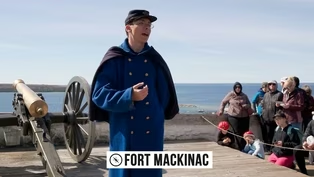
Well, my official title is a military interpreter here at Fort Mackinac.
My job is to present the history of Fort Mackinac, Mackinac Island, and the straits of Mackinac in general in a engaging and educational way.
We run programs like the rifle firing, the cannon firing, and various different tours and demonstrations throughout the day.
(gunshot fires) We try and be very hands-on and very engaging with the public, so trying to make history and learning fun and spark interest in the past.
I am dressed as a field musician, so I get a lot of questions about the music used by the Army with drums, fights, and bugles.
(bugle fanfare music) Wearing the uniform can be something that's very engaging.
It makes us stand out.
It's also just a great learning tool.
I can take my helmet and show it to people and go, "Why do we think that it's so German in its style?"
And we can talk about the US Army's attempts to appear more professional to the public.
We can use the uniforms to talk about the different equipment used by the Army at this time.
And it also is very much often integral to some of our programs, like the rifle firing, where we have our cartridge boxes, and it also just allows guests to get some good pictures and have a very engaging experience.
- [Adam] From touring the oldest building in Michigan, and stepping inside a 19th century military hospital, to watching demonstrations on the parade grounds, (gunshot fires) there's history around every corner, but according to Christian, there's one spot inside the fort that every visitor absolutely has to experience.
- On a beautiful day like today, my favorite spot in the fort is probably the upper gun platform.
That's where we do all of the cannon firings.
- [Shooter] Ready, fire!
(cannon fires) - We have just one of my favorite programs to give up there, and it's just a great environment.
Usually if you're on the upper gun platform, you're going to be having a good time.
(cannon fires) - A little unknown fact now, the rifles carried by Christian and the other interpreters aren't replicas.
They're original historic firearms, so cleaning, maintaining, and preserving them give Christian hands-on experience as a public history and museum studies student at CMU.
All right, well, that wraps up the special edition of "Destination Michigan."
Thanks so much for watching, and have a great night.
(cheerful music)
Video has Closed Captions
Clip: S17 Ep1704 | 4m 32s | We visit Clawson to celebrate the Stars and Stripes at American Flag and Banner. (4m 32s)
Video has Audio Description
Clip: S17 Ep1704 | 5m 8s | We travel to Fort Mackinac and meet a CMU student with a unique summer job. (5m 8s)
Video has Audio Description
Clip: S17 Ep1704 | 8m 8s | We meet three Michigan “Rosies the Riveters”. (8m 8s)
Providing Support for PBS.org
Learn Moreabout PBS online sponsorship New Episode
- News and Public Affairs

Top journalists deliver compelling original analysis of the hour's headlines.
 New Episode
 New Episode
 New Episode

 New Season

 New Episode

Support for PBS provided by:
Destination Michigan is a local public television program presented by WCMU