
Digging Deeper: Timber Trouble
Special | 21m 43sVideo has Closed Captions
Digging Deeper talks about potential problems with trees, tree care, and tree trimming.
Nebraska Extension Educator John Fech joins Digging Deeper to talk about potential problems with trees, tree care, and tree trimming, as well as how assess the risk of a potentially troubled tree.
Problems playing video? | Closed Captioning Feedback
Problems playing video? | Closed Captioning Feedback
Backyard Farmer is a local public television program presented by Nebraska Public Media
Support provided by:

Digging Deeper: Timber Trouble
Special | 21m 43sVideo has Closed Captions
Nebraska Extension Educator John Fech joins Digging Deeper to talk about potential problems with trees, tree care, and tree trimming, as well as how assess the risk of a potentially troubled tree.
Problems playing video? | Closed Captioning Feedback
How to Watch Backyard Farmer
Backyard Farmer is available to stream on pbs.org and the free PBS App, available on iPhone, Apple TV, Android TV, Android smartphones, Amazon Fire TV, Amazon Fire Tablet, Roku, Samsung Smart TV, and Vizio.
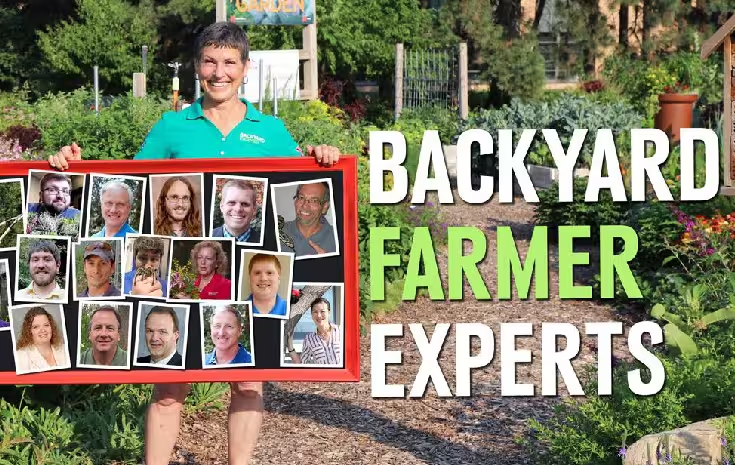
Join the conversation!
Looking for more information about events, advice and resources to help you grow? Follow us on Facebook to find exclusive content and updates about our upcoming season!(bright upbeat music) - Welcome to Digging Deeper with Backyard Farmer.
I'm your host, Kim Todd.
On Digging Deeper, we have in-depth discussions with Extension and industry experts about those important landscape topics.
Tonight, we are talking about risky trees, that risky business, with John Fech.
And John, of course, is a great Extension educator in Douglas-Sarpy County and does a fabulous job with tree risk assessment.
So John, welcome to the program.
We are looking forward to hearing you tell us what to do and not to do with those risky trees.
And let's start with, what is somebody, what does somebody have to do to know how to assess trees for risk?
What'd you have to do for that?
- Well, I had to go through lots of training (chuckling) and lots of experience, you know, they talk about 10,000 hours in any given field.
And that's what I feel it's been for me, is kind of a career-long journey of being able to gain some degree of experience and credibility in learning how to address a tree risk.
They're very complicated.
There's a lot of factors that go into it.
I became a certified arborist through the International Society of Arboriculture.
And then, I went through an Extension training class with, actually, (chuckling) the Pacific Northwest Chapter up in Seattle was kind of a leading edge at that time.
And then, it became more mainstream, and became certified as a tree risk assessor here in Nebraska.
- Well, so how many trees do you actually assess per week?
(both laughing) - Well, it really varies and it's really driven by our clients and what they really want and their need for it.
But on average, I spend a morning or an afternoon a week looking at it.
You have to balance it with all the other things you do for the university, but I think it really helps to keep your skills sharp, to do it frequently, and you have to kind of reach a sweet spot with it, but you do it and you stay fresh with it.
- All right, so John, let's go into exactly what you have to do to identify defects and those kinds of things in risky tree sorts of business.
And let's start with, I think you gave a list of the considerations that are really important, so let's start with that and see how that goes.
- Sure, the first consideration is that which it could fall on if it fails, either a branch or the whole tree.
We talk about a tree part and a tree part can be a branch, a fruit, or the whole tree.
And so it just depends.
And it really, it's the proximity to a potential target.
And a target is a person or something of value.
So a target could be a fence.
Here it's a gazebo, and obviously, there could be people lounging and having morning tea by the gazebo.
(Kim laughing) Here, the entrance to a condominium complex.
So anytime you have a tree within close proximity to a target, that becomes an issue.
- So John, let me bring up-- - It's relative.
- Yeah, well, and wow, look at that one.
So it looks like several of these, we see this a lot, certainly in all sorts of landscapes, people, people want to save that big, great tree, and then they do all this construction around it.
So is that one of the things that you really consider in terms of being right next, you know, the target itself, here's this big old tree that maybe was compromised anyway, during the construction process?
- We do, so the first one is that potential target.
The second one are the site conditions.
And conditions could mean a compacted soil or a soil that has been recently had the soil disturbed with construction or perhaps an adjoining property and the activities on the adjoining property.
There's a famous one that I'm aware of there where there's a sort of a lumber yard next door.
Well, the activities there make a big difference.
Here is the excavation around this tree.
And, Kim, you and I don't like these types of things, these planter boxes that go around trees.
- [Kim] Right.
- [John] Cutting roots and piling up soil around a tree trunk, not very good.
So these are illustrations of site conditions that you should be concerned about.
This one's a little better in that, yes, it's a tree that is in with striking distance of the target, but at least there's a lot of pervious surface.
A lot of that water can soak into, and oxygen can exchange with.
Of course, in the very foreground, there's a sidewalk and a driveway to be concerned about.
So you really have to take a lot of factors into consideration.
- So overall tree health, I think, has to be really, really important here too, John, right?
And that's something we get a lot of questions on that.
We talk about it all the time.
How do you actually assess overall tree health in figuring out the risk?
- So we're looking for reasonable growth, not excessive growth, not stunted growth.
You're kind of looking for, again, a sweet spot there.
Reasonably green color, not excessively so.
In this situation, I'm sure that you've shown this type of photo on Backyard Farmer quite a bit, this is iron chlorosis in a pin oak.
If you have this, the tree is stressed.
And so the overall tree health is a problem in addition to whatever defects that the tree might have.
So it's the obvious problems, as well as the lack of a problem that become important in overall tree health.
- So I would think too, John, that, obviously, I assume that you do some of the tree risk assessment in the winter months when you don't have, or at least when plants are dormant, what do you look at in terms of the trunk or the bark or the branches that gives you an indication of tree health, anything in particular come to mind on that?
- One of the things we're looking for are the amount of growth the tree produced and is it appropriate for that species?
Some trees put out more growth than others.
And so a silver maple, maybe it put out 12 inches of growth in a year's time, and you can kind of tell by comparing the bundle scars and where those are in year one, year two, year three.
And also, is the growth in a spiraling direction or is it headed in the right trajectory?
You pretty much just have to separate all deciduous leaves from the picture because they're not there to give you clues, but that might be a better time to focus more on conifers or evergreens because they're gonna look pretty much the same in the winter as they do in the summer.
And you tend to spend a little bit more time looking at the bark and the places that sometimes the canopy of the tree will cover.
So yes, it is more difficult in the wintertime to look at trees and assess tree health and tree risk assessment, but it also can give you a little bit of an advantage being able to see some of the tree parts that aren't always available to look at in the summer.
- So you mentioned conifers, do you find more or less deciduous trees that you have to assess risk?
Is it usually one or the other, or it doesn't make any difference?
- You know, it really doesn't make that much difference, Kim, it's about the same because any of the tree risk defects can be present on both.
I guess if I, just from experience in doing this awhile, I see a few more on deciduous trees, but I certainly see quite a few on evergreens as well.
- All right, so we wanna make sure that you are watching us on Facebook, giving us all that great feedback, telling us whether you like what we're talking about.
The subject matter, is it something that interests you?
Are you learning from what we are telling you?
Or are you being entertained because those kind of go hand-in-hand, so make sure you respond to us.
We love to do this, but we love to hear from you.
All right, John, are you ready to actually talk about the various defects that these trees can have?
Let's hear some of that conversation.
- Sure, and there are a number of them.
There are probably a dozen at least, that I always look for.
The first are cracks.
And a wise tree climber in New Hampshire once taught me about tree cracks.
And it's the physical separation of bark, sapwood, and sometimes heartwood, and oh my gosh, this thing could come down at just about any time.
And again, a tree climber knows what a safe tree is to climb and what a tree is he or she would not climb.
And so a crack like this is certainly a red flag.
Big crack here.
This is about almost in the point of imminent failure.
This is after a storm, and obviously, there's been a big separation of bark wood, and sapwood, and certainly even heartwood.
- [Kim] Wow, yeah, that just looks like, don't even come close to standing underneath that one.
So what else are you looking at, John?
What else do we see for defects that come to mind?
- [John] Well, we see cracks in bark in branches like we've just seen.
Then we also see cracks in trunks.
Again, that's a big issue because where a crack in a trunk like this, you don't really know, it's kind of hard to tell exactly how far that goes in.
Sometimes it's easier on a branch.
With a trunk, sometimes more of that tissue is hidden.
The factor of one and a half comes into play here in that, the size of the part, generally we think about what is one and a half times the distance of that part away from the part?
So falling on a target, we always think about the landing zone as sort of one and a half times the size of the part.
The same kind of consideration here.
Now here, there's not much of a target present, and really by definition, without a target, there is no risk.
So you have to really keep all, see how complicated this can get?
(Kim laughing) If there's another, - Yeah.
- [John] I guess you could say that is a target, if it's a tree of value, but there's no people, there's no fence, there's no driveway, there's no house.
- Right, but there might be - But these are still, - somebody walking their dog.
- in my mind, a defect.
Yeah, yeah.
- Right.
So these last two pictures, John, it appears as though one thing that contributes to risk later in a tree's life is poor management practices when they're young because it looked like both of these had what we typically would call included bark where rather than growing out, the bark is doing this, kind of like an ingrown toenail.
Is that kind of a correct assumption there?
- It is, and generally, pruning, good pruning in early life.
We have some examples of that coming up here.
Good pruning early in the tree's life within the first few years would have corrected that and prevented that damage, so, or that potential problem.
If you stick with the trunk, we often talk about girdling roots, Kim, I think that's one of our favorite things to talk about, and that's coming up in the next slide or two, but also, just how that tree trunk goes in the ground.
I always look for flat sides.
And this photo I like 'cause it shows both.
We see the flat side on the left side there.
And when you see a flat side, it's flat for a reason.
It's supposed to kind of flare out, but maybe there was some basal damage from a lawnmower, or it was planted too deeply, or both.
(laughing) And the roots have been responding by sort of wrapping themselves around the trunk.
And you can see the same thing here again, flat-sided, basal decay, and girdling roots.
- Oh boy, yeah.
Sort of a perfect triad of things for disaster in the long run, yeah.
So what else, John, what else do you think of in terms of defects or are you ready to talk about pruning?
- Well, what you were talking about before, rubbing branches, they're not necessarily co-dominant branches, but when they are close together and they start rubbing on each other, they injure each other.
And again, some pruning definitely needs to take place there to remove one or the other.
And you're always looking for architecture.
You wanna take out one that's growing outward rather than inward.
Typically, you wanna take out the smaller of the two branches that are crossing each other or rubbing.
And just early on in the tree's life.
And here you can see this.
You have to make a decision.
You're gonna have to probably take out at least one, maybe two of these branches, the smaller, the better.
The more outward growing you wanna leave straight up.
If it is the leader, it's great.
But if it's competing with the leader like it kind of looks like it is here, then it's not so great.
So if I had my druthers, I would have made this pruning decision even earlier in this tree's life, but for sure, something needs to be happening now.
- Right, and you know, I do think, John, that a part of those pruning decisions is people are really not aware of how the tree is growing because they don't pay any attention to it.
It's a tree, it's shading their yard, or it's the place where the swing is.
They don't realize that each one of those branches every year is increasing in girth.
And I kind of liken it to a python.
All of a sudden, (John laughing) you're like that with it, yeah.
- That's a good analogy, I like that analogy, that's good.
- Yeah, so what else do you wanna bring-- - Let's keep going with the co-dominant leader thing that you brought up.
We've got some more photos of that.
- Good.
- when you have a V like this, it's not for victory, they're competing with each other, and they start pushing on each other.
And what happens, one of them is gonna lose.
And in this case, they both lose because, you see this a lot with these clump birches.
They're beautiful, great architecture, great design, great appearance in the landscape, but eventually, they usually lead to problems like this.
And the bark is included, they're pushing, they're causing problems in storms.
And usually, the result is disappointing.
So this tree actually, I heard later from the homeowner, had be removed.
Here, you see it a little bit sooner in this silver maple where they're pushing.
I think it may be a red maple.
- [Kim] Or maybe it's one of those autumn blaze maples.
- Yeah.
(both laughing) Freeman maple.
- One of those.
- [John] Yeah, where they're pushing on each other like that.
Again, you wanna take care of this as soon as possible.
- [Kim] Wow, yeah, and aren't linden's sort of a classic for co-dominant leaders when they're young?
- [John] Lindens definitely are classic.
Now, this is the stage where you wanna take care of that.
- [Kim] Right.
- [John] So you can see where this would be removed about an inch and a quarter in diameter, not much damage.
You can see kind of a warty growth there between the two branches, that's called branch bark ridge.
And that's exactly, just to the right of that, you would take the smaller of those two branches off.
And it would very easily without any damage to the, well, without much damage to the tree.
And certainly, for the better good in the long, long life of the tree, this is that stage.
- [Kim] Right, and that would mean that you would not probably have to come back out and do a tree risk assessment on this one 10 years from now.
- You're probably right, (laughing) you're probably right.
Now, in addition to the cracks, the classic one is decay in the trunk.
I remember a friend of mine, Dave Mooter, used to talk about decay in the trunk or rot pockets.
That was another name we used to use, but that was one of the first things.
And here you can see this, I did this inspection and we've got some damage.
But you can sometimes take a mallet, like you would put hub caps onto a car with, and tap the trunk.
You don't always get a good feel for it.
But if you do you, that helps to confirm it.
And boy, this was just hollow inside like a guitar is hollow on inside.
And that outer shell of the bark is not very thick.
Maybe three inches thick.
Before you went on the air, we were trying to remember what that term was.
It's the outer shell.
Here, extensive decay in the trunk.
And I would recommend pruning this tree, but only one pruning cut and that would be near the turf.
- Exactly, that three inch-- - Not much you can do with that extensive decay there in the trunk and really, really problematic.
- Right.
- Easy decision are leaning trees.
They just kind of lean for good reasons because they're trying to orient themselves towards the sun.
I guess, classically that's called phototropism.
And it's just like a plant growing towards the sun.
You see that in house plants a lot.
But if a tree is leaning like this... - [Kim] (laughing) Oh my.
- [John] Yeah, a pushup of soil on the left side, that's an automatic removal.
This tree is very dangerous.
- [Kim] The first small child that wants to climb that one is gonna be enough weight to pull it right out of the ground, wow.
- [John] Exactly, and this is the same tree, but just further back.
And you can see, the target here is the street.
- [Kim] Right.
- [John] And if it's a frequently occupied street, then it becomes very problematic.
- Oh totally, and you know, we've had so many of these storms recently where they pop up out of nowhere and the wind is 80 miles an hour, just like that, with these trees.
- Yeah.
- Yeah, terrible.
- Another classic no-no are topped trees.
We talk about this commonly.
And I hope that most of our viewers know that you don't top trees, but you still see these trees like this all the time in the landscape.
And when you top a tree, you've really opened up the tree to a lot of internal decay problems.
Plus, you can see just in the color of the wood, they're darker and lighter, the lighter on the top being the new growth that just inevitably resprouts from embedded buds.
And that wood is not strongly attached to the limbs below.
In fact, they're weakly attached.
It's only attached in that outer ring of growth, that outer one year's growth of sapwood, that's it.
And so it's not organically knit down into the heartwood and it's very weak.
And so that becomes a problem.
- [Kim] Oh dear.
(both laughing) - [John] Here's a real hatchet job, but you can see, you can really butcher a tree and it will still grow back.
The problem is it will grow back very weakly and is certainly a hazard.
- [Kim] Well, and I see another one in the background there that apparently had quite a haircut too.
- [John] Yeah, this is bad tree pruning 101.
And then, kind of the opposite is our next example.
And that is just the opposite, it's where you cut all the lower limbs off.
And that's called an elevation.
- Oh boy.
- Now, it's okay if you kind of do it one limb at a time, just enough to get the mower underneath the tree, that kind of thing.
But when you take all of the lower limbs off, as you have here, and you can see, just a recent removal, then the tree becomes very susceptible to windthrow.
Actually, some classic Germans physicists have shown this through their research, that if you look at a tree that is fully leafed, it is much more able to diffuse the energy of a storm than a tree like this.
- Sure, yeah.
- A greater lever, greater leverage is gonna cause more damage, and more potential limbs will break out, and more potential for the whole tree to topple.
- Wow, yeah, and lots of targets there.
- So we don't recommend this at all.
This is bad, yeah, very bad.
Don't just cut all the lower limbs off.
Sometimes you'll hear or see people say, "Well, I'm gonna make it look like an umbrella underneath."
No, you don't want that.
It's not, it's not an umbrella.
It's not like something you buy for your patio.
It's a living, breathing organism.
You certainly don't want that.
- Right, we have about a minute, John, do you wanna leave our audience with any cautionary notes or one really good, bad, fun, awful story about one you've looked at?
- I think I wanna go back to what you said earlier, and that's inspect the tree.
Go out and look for something unusual or something that you have a question about.
And then, you can always take a photo of that.
We all have iPhone, Samsung Galaxy phones.
Snap a picture, send it to your local educator or to Backyard Farmer and just get a first glimpse.
Now, we certainly can't make any recommendations based off a photo, but it's a first glimpse.
And if something looks a bit askew, please ask us about that because we wanna help you.
And that's what, that's what we're there to do.
- Excellent, well, that is all the time we have for Digging Deeper with Backyard Farmer.
And we wanna say thanks to John Fech for coming in and talking to us today about all those trees that we really wanna keep, but probably shouldn't.
We will be back next time with another in-depth discussion.
Do be sure to watch Backyard Farmer Live every Thursday at 7:00 p.m. Central on Nebraska Public Media.
Thank you for Digging Deeper with Backyard Farmer.
(bright upbeat music)


- Home and How To

Hit the road in a classic car for a tour through Great Britain with two antiques experts.












Support for PBS provided by:
Backyard Farmer is a local public television program presented by Nebraska Public Media