
Acts of Forgiveness
Season 25 Episode 7 | 26m 46sVideo has Closed Captions
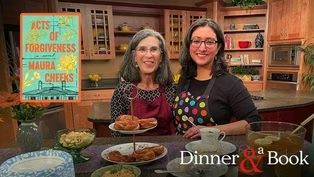
April Lidinsky welcomes back Dalila Huerta for conversation and foods from Philadelphia.
Journalist Maura Cheeks offers a thought experiment in her debut novel, Acts of Forgiveness. Imagine the first woman president of the United States passes the Forgiveness Act, a reparation bill that addresses the generational harms of slavery. What happens next? April Lidinsky welcomes back Dalila Huerta for conversation and foods from Philadelphia.
Problems playing video? | Closed Captioning Feedback
Problems playing video? | Closed Captioning Feedback
Dinner & A Book is a local public television program presented by PBS Michiana
Acts of Forgiveness
Season 25 Episode 7 | 26m 46sVideo has Closed Captions
Journalist Maura Cheeks offers a thought experiment in her debut novel, Acts of Forgiveness. Imagine the first woman president of the United States passes the Forgiveness Act, a reparation bill that addresses the generational harms of slavery. What happens next? April Lidinsky welcomes back Dalila Huerta for conversation and foods from Philadelphia.
Problems playing video? | Closed Captioning Feedback
How to Watch Dinner & A Book
Dinner & A Book is available to stream on pbs.org and the free PBS App, available on iPhone, Apple TV, Android TV, Android smartphones, Amazon Fire TV, Amazon Fire Tablet, Roku, Samsung Smart TV, and Vizio.
Providing Support for PBS.org
Learn Moreabout PBS online sponsorshipDinner and a book is supported by the Rex and Alice A. Martin Foundation of Elkhart, celebrating the spirit of Alice Martin and her love of good food and good friends.
In Maura Cheeks, his debut novel, Acts of Forgiveness.
She invites us into a thought experiment.
The first woman president of the United States has just been elected, and she's a descendant of Andrew Johnson.
Motivated by her family history, President Elizabeth Johnson runs on and passes the Forgiveness Act, a reparations bill intended to address the generational harms of slavery.
I'm grateful to welcome back into the kitchen, Delila.
Huerta The executive director at the Restoration Justice Collaborative Hub to help unpack this fascinating novel.
Thank you for coming back.
Thank you so much, April, for having me.
Oh, it's a delight.
And how did this book come to your attention?
Yeah.
So, a dear friend of mine, Susan Sharp, who sadly passed away in May, recommended it to me.
She and I worked at the Restorative Justice Collaborative Hub together, and we frequently talk about amends, what it means to repair.
And so she thought that this book had a really great message for our society today.
Yeah, really a thought experiment that has really stayed with me.
So, the book takes place in Philadelphia.
So what are we going to make?
Yeah.
So we're going to be starting with pepper pot soup, which according to historical law, was the soup that saved the war.
The Revolutionary War, of course, its actual origins come from West Africa, in the Caribbean.
It was intended to just be this really simple meal.
You can put scraps of meat, lots of veggies, heavily spiced, the pepper and.
Exactly.
Yes.
And today's version is actually going to be vegetarian.
So still all the flavors, but without any of the meat.
It sounds absolutely incredible.
And then later you're going to make a pun.
Yes, a punch.
And I'm getting started with soft pretzels.
If you've been to Philly, you know, one of the great delights of the Redding market is the soft pretzels that are painted with a, a giant brush of butter.
So we'll be making those.
And then later, I'll show you how to make some homemade oyster crackers.
So what I've got started here, is some yeast that's been proofing in some water and a little bit of sugar.
And I'm going to go ahead and show you how to put this together with some bread, flour and a little bit of salt.
And you stir this together to make a pretty shaggy dough and, we'll give that started, and in the meantime, here I'm just shortening some vegetables.
So we're starting with some onion.
I'll soon add some carrot and celery and then come all the tasty herbs.
Okay.
Wonderful.
So.
So let's maybe give the big picture of what this novel is about.
Yeah.
So as you mentioned, this is set in, an alternate, present for us.
So it's not exactly our world, but we can imagine what our world would be like if we had a woman president.
And fantasy.
Exactly.
Yes.
But a fantasy that I would like to live in.
And in this world, there is this reparations Act, as you mentioned, titled, the Forgiveness Act.
And this is meant to provide reparations to descendants of enslaved people.
And we really should see the novel take place.
So there's this in the background, the government action of passing this bill.
But then we really see it unfold through the lens of this family.
So for generations, the main character being Willie, and then we see her parents, a woman.
Willie.
Yes.
Exactly.
Yes.
His daughter.
Absolutely.
And her parents, and her grandfather, and then also her daughter.
So we get to see that unfold in Philadelphia, which is why we're making Philadelphia food today.
Yeah.
And such, I think, you know, there are there are lots of ways to think about this novel, but the, the personal impact of policy, which we think of as happening in the.
Yeah, in the public sphere, we see those impacts and it opens very powerfully.
I'm just going to need this a little bit more till it's smooth.
And then I'll show you how to actually shape the pretzels.
It opens with, Willie's grandfather.
Veteran.
Right.
Seeing all of his, white friends going to the veterans office and getting the benefits to go to school, getting especially the benefits of a mortgage.
Right.
And he is denied.
And so, we sort of see what happens to him.
He loses the house that, he had been renting originally.
And doesn't get the mortgage.
And so we see that fall out of not being able to benefit from some of the same benefits that, his other, friends had been benefiting from.
And so what's interesting is that as this reparations bill is being discussed, we see four very different reactions to it from the family based on some of their, how the world has rejected them, each, individually in different ways.
Right.
So I'm going to, fast forward in time here.
Here's, here's some of this lovely dough that has been rising.
And I'm going to put this over to rise.
It rises for about an hour.
We'll keep that, covered.
But we'll we'll punch this down, and then I will show you how to give it, a soda water bath and, and then how to shape these into Philly style pretzels, which I learned are different than the Bavarian classics.
So.
So part of what happens after the, And of course, it's not just the grandfather who doesn't get a home sort of scars his son Max, who is Willie's father, and he just throws himself into the construction business, literally building and rebuilding Philadelphia.
And the family is always just kind of barely able to kind of stay ahead of the bills.
And they do manage to buy this really beautiful home in a wealthier part of Philadelphia.
And we get the story of, how they're initially react, rejected from, this neighborhood and how much, struggle they go through in order to be able to keep this house in the family because it is this symbol, not just, a symbolic gesture, but it really does.
It's a way of them to prove that they have made it, in a way.
But it's always very tentative, as you mentioned, they really struggle to keep this in the family.
So again, just showing, many of the struggles that African-American communities have gone through because of the lack of access to some of these benefits.
Yes.
And and what it feels like really described to be the first black family in a white neighborhood there.
So the parents are so committed to giving their children opportunities that they didn't have.
So part of this feast is inspired not just by the foods of Philadelphia, but, Lourdes, who is the, who's Willie's mother hosts these parties at her house, to invite the white neighbors and basically people who've been closing their shutters, turning away from them.
She invites them in and pours days and days and days into, you know, knowing that every aspect of their house is going to be under, you know, people will be will be looking carefully at how they're living and, they're both, you know, they're the events are have a political purpose, too.
They want to kind of do good in the.
Absolutely.
Yeah, yeah.
And I really felt her the pressure that she felt one to display that she was, in a sense an appropriate neighbor.
Right.
Right.
In this neighborhood.
But then also this site, you know, these dinner parties become this site of this really rich dialog.
They talk about civil rights, they talk about they plan, they organize.
And so I think, the meals that we're creating today are perfect meals for us to have, as we're holding these dialogs as well today, in our present.
Oh, yeah.
Absolutely.
So and this is work that you do in our case.
Absolutely.
Yes.
Through the hub, we do a lot of dialog circles and have these important conversations.
And then so I've been sorting these right now and I'm just going to add some of the brass now, just enough to cover some of the vegetables here.
So I'm rolling out this extremely springy dough.
So you got to be a little forceful with this.
And I'll show you the you can you can of course, shape these however you like, but the Philadelphia style is more of a twisted eight.
And you can get more of those on a cookie sheet, so I could say.
Or on a, on a pretzel baking sheet.
But you make this into a long rope here with some tapered edges.
And then you make it into a little horseshoe and twist it twice and then pinch it over here.
And while I roll out some other ones, I'm going to do the other part of this, which is a was, going to put some loose, some, baking soda in the water and then these I'll get a little 32nd bath here.
And once they're out and you can put it on a sheet and put some salt, coarse salt on them and bake them for 15 minutes and cook them as soon as they're out of the oven.
So, Yeah.
And I'm just finishing up.
I'm going to put, the rest of the ingredients here in the soup and then just wait for it to boil.
We're going to simmer that for 25 minutes, and then we'll add the final ingredients later.
All right.
It smells wonderful.
So we see also the kind of, Willie is a writer and, she's her you know, her hopes in college are really to be a writer.
She gets a job, in part mentored by the professor Elizabeth Johnson, who ends up becoming the presence of becoming the president.
Right.
So she has this very powerful mentor, her journalism career is just taking off.
And then the family business, the father has a health crisis, and she has to, return to, to help at home.
Elizabeth Johnson is also asked her to be a, to work on her campaign, her Senate campaign, when she starts to rise in politics.
So she's not able to do that.
Yeah.
There are a lot of different storytellers, I think, in, in obviously.
So there's really, who's this journalist who wants to be the journalist, but as you mentioned, feels as pressure, to support the family in the business.
Her daughter wants to be a playwright.
Her mother just like bringing people together to talk and dialog.
Oh, nice.
Yeah, absolutely.
So I think, like, all of the women in the family seem to be very drawn to stories and people, and, I hadn't really noticed that.
That's such a good point.
And then Willie has a has a is a one night stand.
This is not a spoiler alert.
Yeah.
It happens very early.
And she has a daughter, Paloma, who is herself a storyteller.
Yes.
So let's see, I'm going to.
So every pretzel I have been assured is, it's like a child.
They're all different.
So.
Yeah.
But once they come out, we'll sprinkle some coarse salt on them.
And I've made just a half batch here.
We'll have, we'll have six of them.
So there's some tension, early in the book, we know that the Forgiveness Act may or may not pass.
And then, and then it passes.
And the second half of the book is what happens next.
So we're going to take a little break.
I'm going to put these in the oven.
And this is going to keep simmering.
I'm going to show you some pictures from Maura Cheeks’ website and her Instagram so you can see her at work.
We'll be right back.
Right.
Delila’s soup has been cooking down the pepper pot soup.
I got a little taste.
Oh, the spicy, spicy chicken is so fragrant.
I'm sure some of the spices in here that I'm going to take out because they're whole.
So we have two cinnamon sticks, orange peel and some time.
So I'm going to take these out and then we're going to add our final ingredients and kidney beans.
Coconut milk and then some spinach.
Oh, it is wonderful.
And you said the coconut milk is a more recent addition.
Yes.
Is it likely to attract?
No.
To the original?
No, the original one.
Because it had meat.
There was plenty of protein there.
And this just makes it just a little thicker.
Creamier, for the vegetarians.
So, as you can see, I've pulled our soft Philly style pretzels out of the oven.
Part of the where you keep them soft, happily is by painting them with butter, which beautifully, an instruction you should put into most dishes.
So those are cooling, and I'm making, some homemade oyster crackers, which, of course, you can purchase, but I think, Lourdes when she put on these parties, would want to go the extra mile .
And these are I've gone ahead and mixed up the dough so that I could show you how to roll these out, but they're just, like, teeny tiny biscuits.
So these are just, like, baking powder or biscuits with some, you know, salt, flour, butter pinched in, a little bit of water to hold it together.
These are a little sticky.
I'm going to roll it out, fairly flat and then cut it with a ruler and a pizza cutter, which is really fun.
So, so the it isn't really a point of tension in the novel.
We know that the Forgiveness Act passes, but there's a delay, there's a filibuster, there's a lot of lead up.
Once Elizabeth Johnson is elected president, she needs to make good on this platform that she ran on.
And then it gets complicated.
It does very fast.
So, yeah, as you mentioned, it struggles to pass for a while.
It has to pass the House and the Senate.
And we have all of the folks at this gathering watching with anticipation.
And as we mentioned before, there are mixed reactions, right?
So some people are bitter about it and some people want it to pass.
Some don't even think that it's going to pass because they have very little faith in the government.
And then, yes, of course, when it passes, there's a bunch of riots throughout the city, throughout the U.S., the racial racial violence targets black families.
And for them, as well, their house.
Yes, absolutely.
Yeah.
So the the Ravel's house, gets attacked.
And this is reminiscent of when they first moved into the neighborhood.
So it brings back all of those memories.
Yeah, yeah, yeah.
So.
And Willie herself, is now there's a, there's a financial crisis brewing.
So the the reparations, is about money, but it's about more than money.
But the money is substantial.
It's $175,000, which is what she needs to save the family business.
Yeah.
So there are some some moral quandaries to.
For the family.
Not, but trying to decide whether or not they should take certain contracts to save the family.
And that's also wrapped up, in the passing of this bill.
And so, yeah, there's just this tension, ongoing tension, that even though this bill passes, it doesn't necessarily save them immediately.
And there's, there's always this question of, is this money even going to happen even though it passed?
And so there's just a lot of doubt, throughout the entire novel of, of what's going to happen.
The money is just part of it.
So maybe we can talk also the, you know, starting when Willie is in college and has Elizabeth Johnson as a professor, we see this idea kind of being watched as a thought experiment in this class.
Can forgiveness demanded?
Yes, exactly.
And what I find really interesting is that this is a reparations bill.
But it is called the Forgiveness Act, which really puts the onus on the victims.
Right.
And the survivors of this, this terrible legacy of slavery to forgive the oppressors.
Right.
And so it really in my mind that the title of the act undermines the truth of of what repair actually means, because it's not really centering what individual families need.
And it is reducing it to just this monetary amount, which is certainly like we see the real impact of what this might do, especially in addressing the racial wealth gap.
So it's certainly necessary, but it's certainly not enough.
It's certainly not enough to actually make amends for like, how can you actually make amends for something this, horrendous.
And we really see how these individual families are then their, perception on the amount of the reparations that they're going to get.
And then also the work.
I mean, we were talking a little bit about the immense amount of work to prove that, you're even that you even should be owed this amount.
Yeah.
So part of part of the policy requires that families.
And I'm just going to skip this little cuties up and put them on.
Feels like so great little baby biscuits.
Those will go great with the soup.
And you can season them however you like.
But I think just the butter and the salt in these is is enough to make them super delicious.
Right, right from the beginning there is this question of, well then how do you how do you prove that you, should be able to get the money?
And so now there's an ancestry race happening and some, you know, the novel is not without some amusement.
There is, all of these older folks in retirement homes saying, here, come here, the grandchildren, grandchildren, finally wanting to, seek our wisdom to find out what we know about family history.
And I know that archives are near and dear to your heart, so there's a lot of archival.
Yeah.
So I, I have come from a museum and archives background, and my first job after graduate school was actually in Philadelphia.
So this just tied everything nicely for me.
All of my passions.
But, yeah.
So it's it's the importance of, you know, who gets to control knowledge and access to knowledge.
And, you know, there are many times in the book where it's like the, the people who can go and who have the luxury maybe are the ones that don't necessarily need the money.
But then we also see people making assumptions about who needs the money and what that impact could possibly, have on an individual families.
Yeah.
So a lot of judgment.
And I'm just going to get the rest of these later here.
A lot of judgment just even from passers by watching people standing in line how they're dressed.
And yes, so there's Lourdes, who has spent her whole life dressing up, looking respectable.
And now it's actually being thrown in her face.
Yeah, absolutely.
And I think we're all set here for the soup.
So I added the coconut milk and the spinach.
So I'm going to move on to the next one which is our fish house punch.
Another Philadelphia classic.
So this was made in Philadelphia's angling club.
George Washington Marquis de Lafayette, half of the characters from Hamilton, love to go to this angling club during the Revolutionary War.
So I'm going to start just adding some, ingredients here, and then we're going to top it off with some lemon slices.
We have some water and lemon juice and then three types of alcohol.
We have brandy, rum and then also some it should be peach brandy.
Really hard to find.
So I'm using apple brandy and.
Oh, that seems very that seems very appropriate and simple sirup to.
We want it to be a little bit more and a punch bowl worthy of a party at Lourdes, And I'm making here just a simple cheese spread.
Of course, we'll also have mustard for the, soft pretzels, but often there's a cheese dipping sauce.
But I like this better.
It's just some, softened Philly cream cheese, if you please.
Add some sharp cheddar, a little bit of paprika and salt and pepper, and you can add some Worcestershire if you want to add that as well, then some salt and pepper here.
Wow.
That looks like punch that will it will be.
Yes it will.
So Willie of course has a background as a journalist and she really gets into kind of finding the family history.
But there's some history that's actually quite painful that she begins to unearth with the help of these.
I mean, archivists just come across so well, they're really kind of ministering and mentoring these families who are often doing this kind of research for the very first time.
Yeah.
And, yeah.
So she has to go with her mother down to the south.
It has to be in person.
So literally retracing some of these steps and going into, these sites of really terrible pain, so matches.
Exactly.
Yeah.
And I think it's, all of these histories that even though she was a journalist, she hadn't really asked herself.
Right.
Because there was this reluctance from the family to revisit this past.
And it's through this act that she's finally is able to to do that investigative journalism about her own self.
Oh nicely put.
Yeah.
It kind of comes, comes back around to her origins and, you know, absolutely some horrors.
But also, some really wonderful she discovers of her ancestors.
Sort of.
Yeah.
Inspired by IDB Wells, as Maura Cheeks has said in interviews.
And she thinks about, what a difference that would have made to her had she not as a child that she had this, you know, woman who overcame so many odds in order to do what she hoped to do.
And we begin to see that Paloma, her daughter, begins to take that role on as as the writer in the family or one of the one of the story.
I like where you put that so well.
This is all of us have our punch ready to go.
Gorgeous.
And the aroma, this with the there's suppression here, and there's a little bit of citrus in here with the orange peel and, garlic, etc., so we won't give away the, the ending, but I will say I found it very satisfying as a reader to see where everybody lands.
It's not comfortable.
And I you know, I'm not that readers will have to decide if this if the act was a success.
But I do see, you know, once people start to ask for the money, they've got to, change the policy and think about what it means to forgive.
Yeah.
So, I'm excited to try that punch.
We are going to take a little break and set up for our party here.
You're going to see some pictures now, Philadelphia, where this story takes place.
We'll be right back.
Delila Huerta and I have made a Philly inspired feast.
Courtesy of Acts of Forgiveness by Maura Cheeks.
And please describe what you made it is.
Yeah.
So we have a vegetarian pepper pot soup with your oyster crackers, and we also have a fish house punch.
All Philly historical classics, okay.
And lots of citrus and warm notes in here.
Here's, Philly style soft pretzels coated in butter.
So, you know, they're delicious.
And a cheese, a soft cheese spread to go with it, with some sharp cheddar in it.
And of course, to find some mustard, because you need to have this absolutely.
So, so I'm really glad you introduced me to this book.
Why would you recommend it to to others?
Yeah, I think, reparations is certainly been in the news recently for the past few years.
And I think it's a really timely conversation, and I think it's an important conversation for all of us to be having.
Everybody either benefits from our historical legacy, upholds it every day or gets hurt by it.
And so I think it's something that everybody should be concerned about and should have, some dialog around.
Yeah.
Just to think about the way these policies are not outside.
They impact us very personally and generationally, as this makes very clear.
So a story that's filled with writers, wonderful shout outs in this novel to teachers who are mentors and certainly made me think of the people who have shaped me, wonderful inspiration to go to archives and work with archivists who know a lot, and Maura Cheeks in both interviews, and then the afterwards has a really beautiful tribute to the writers who inspired her, including Ida B. Wells, Zora Neale Hurston, James Baldwin, and Toni Morrison.
So she is a journalist venturing into the world, the novel and, in conversation that's very timely.
So I hope you'll read it.
I hope you will, invite your book groups to read it as well.
And we're going to have a little toast of this.
So we hope you, read widely, cook adventurously, and drink adventurously, too.
So, thanks for coming, and thank you.
Thank you for joining us.
We'll see you next time on dinner and a book.
Okay.
See?
This WNIT local production has been made possible in part by viewers like you.
Thank you.
Dinner and a book is supported by the Rex and Alice A. Martin Foundation of Elkhart, celebrating the spirit of Alice Martin and her love of good food and good friends.
I. Journalist Maura Cheeks offers a thought experiment in her debut novel, Acts of Forgiveness.
Imagine the first woman president of the United States passes the Forgiveness Act, What happens next?
Join me as I welcome back, Delilah.
Where to?
For conversation and food from Philadelphia on this week's dinner and a book.
a reparations bill that addresses the generational harms of slavery.
All right.
Well.
So how are we cooking for ourselves as a company?
It's oven.
Yeah.
So it's hot.
They need 15 minutes.
So they accidentally started the timer already.
Okay.
15 minutes.
I could okay.
And it might be actually a little less than that because these are small.
This one, I think it's going to.
Delilah's.
Yeah.
Yes.
Stand by.
Three.
Providing Support for PBS.org
Learn Moreabout PBS online sponsorship















Support for PBS provided by:
Dinner & A Book is a local public television program presented by PBS Michiana