
Babel
Season 23 Episode 6 | 26m 46sVideo has Closed Captions
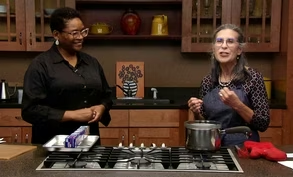
Guest host April Lidinsky welcomes Kathy Burnette to discuss Babel.
The University of Oxford in the 1830s is both dazzling and sinister in R. F. Kuang’s historical fantasy novel, Babel - Or, The Necessity of Violence. Kuang adds a fantastical twist to the university campus - a Royal Institute of Translation, known as “Babel.” Guest host April Lidinsky welcomes Kathy Burnette, owner of Brain Lair Books to discuss historical fantasy novel o...
Problems playing video? | Closed Captioning Feedback
Problems playing video? | Closed Captioning Feedback
Dinner & A Book is a local public television program presented by PBS Michiana
Babel
Season 23 Episode 6 | 26m 46sVideo has Closed Captions
The University of Oxford in the 1830s is both dazzling and sinister in R. F. Kuang’s historical fantasy novel, Babel - Or, The Necessity of Violence. Kuang adds a fantastical twist to the university campus - a Royal Institute of Translation, known as “Babel.” Guest host April Lidinsky welcomes Kathy Burnette, owner of Brain Lair Books to discuss historical fantasy novel o...
Problems playing video? | Closed Captioning Feedback
How to Watch Dinner & A Book
Dinner & A Book is available to stream on pbs.org and the free PBS App, available on iPhone, Apple TV, Android TV, Android smartphones, Amazon Fire TV, Amazon Fire Tablet, Roku, Samsung Smart TV, and Vizio.
Providing Support for PBS.org
Learn Moreabout PBS online sponsorshipDinner and a book is supported by the Rex and Alice A. Martin Foundation of Elkhart, celebrating the spirit of Alice Martin and her love of good food and good friends.
The University of Oxford in the 1830s is both dazzling and sinister in R.F.
Kwan's historical fantasy novel Babel or the Necessity of Violence.
Kuang adds a fantastical twist to the university campus a Royal Institute of Translation known as Babel.
Among the translators are four students born in locations of interest to the British Empire.
The friends bond over their shared experience as outcasts and their discovery that England's rising power seemed to be connected to language.
Those who can manipulate words and enchanted silver bars have almost limitless power to build or destroy.
I'm April Lidinsky filling in this week for Gail Martin.
And joining me today is Kathy Burnette, owner of the inclusive local bookstore.
Brian, their books.
Welcome, Kathy.
Thank you.
April Thanks for having me.
Thanks for saying yes to this invitation.
So I love this book.
So someone were coming into your bookstore asking about it.
Give us the big picture.
What what is this book about and what drew you to it?
Well, I used to be a school librarian and the classroom teacher, and one of my favorite kids books is called Friend Owned by Andrew Clements.
And in the book, The Troublemaker, Nick is trying to kind of waste time so they could get out of class before getting any homework.
So he has this language arts teacher who makes the words, who gets the words in the dictionaries, and she says, You do.
And so he uses it as an opportunity to try to change words and that then led me to babble whenever I saw the it's about using language in a different way.
That was the first time that I picked it up.
Okay.
It's a language.
It is.
And the book is just delicious for those of us who really enjoy language.
And I'll just say here, the pronunciation of the title depends on where you live.
So Babel, I guess, for the Brits and Babel, for those of us in the U.S. and I might say it both ways, and I called it Babble until I heard the audio when they called it Babel because in the book they're called Dabblers.
And so you would think that the tower would be called I Know.
So that will be up to the readers choice.
So in honor of the fact that this is unfolding in the Oxford University, we are making a green tea with sweets and savories, which has a lot of different parts to it.
So tell us what you're going to get started with.
This is kind of the crown jewel of a cream tea.
I'm going to be making cream skulls or actually they're called scones.
very good.
Really good.
And I'm going to make plain so that it will go with whatever you are cooking.
tea later.
So.
And the tea is also kind of a neutral tea, so it picks up the flavor of savory or sweet.
So highly skilled.
All right, so why don't you get started on that?
And I'm going to be making some lemon curd.
So a classic British sweet has just five ingredients.
I've got a double boiler going here and I'm going to put together in my and the little top portion here to two egg yolks, three tablespoons of butter, some sugar and salt.
And I'm going to start by squeezing some lemon juice that has some fresh lemon juice in it.
And this makes for a really tangy sort of spread that I think is good enough to eat with the spoon.
But you're supposed to eat it with scones.
So.
So let's talk about this book.
What is it about besides words, You want to give us kind of the big picture of the plot?
Well, we get kind of a historical fantasy that takes these four kids and each one is from a different part of the country.
The main character, Robin, is from Canton.
You have Rainie.
He's from Calcutta.
You have Victoire, who's French, but also Creole, Haitian Creole.
And then you have Lettie, who's German.
And each of them brings a different value to the university.
They're there on scholarship, right?
And so everything is given to them, and they are living in the lap of luxury.
They are the most revered students in this fake Oxford University.
And it's just kind of they figure out one, how this works and the magic behind us.
And that's why I love magic.
I love fantasy and the magic behind this.
But then they also figure out the sinister ness behind it as well.
Okay.
Yeah.
The.
I want to talk more about the characters in a minute, but let's maybe just help help us understand the genre.
As I was reading it, I was thinking, well, it's a historical novel, but it's historical fiction.
Feels like science fiction a little bit.
There's magic.
So how do you classify it or.
Well, I look at it as a more historical fantasy of historical fiction with some magic, and there's different tropes that go with that.
And trope is just two stories that parts from either book different books have different ways they look at it.
And for me, I call it fantasy because you have this evil bars that make magic, but is also set in Oxford, which we all know about, and she really grounded into what that university was like.
I mean, her notes are extensive on what that looks like.
So it's both it's fantasy because there's magic and that's what fantasy is, but it's also historical.
Yeah, I love in the foreword the way she says.
I mean, she spent a lot of time there, so it has for people who like the 19th century or 19th century novels, it has this very delicious, highly detailed fictional world that she builds.
It's really based on Oxford itself.
So if you've been there, you would absolutely recognize everything except this right.
Story tower that she sets right next to the Bodleian Libraries.
But she says at the end of the intro or the foreword to the book.
All right.
You know, don't come at me with historical inaccuracies.
It's a novel.
So what we do, we take these things so personally, and especially for your Oxford audience.
And yes, we want to quibble with what's there and what's not there.
During the time period that she sets the book, which also makes a difference to what's happening.
But in addition to Oxford, I also think that she describes Hampstead really well.
And Kenton, when he comes to get Robyn there, I feel as if I know kind of what's happening and what that looks like on the dock when he's talking.
So I thought she did a good job of her descriptions.
Yeah.
So this is a nice invitation then to think about how do these four figures, these young scholars get to Oxford?
So you mentioned that Robin Swift, who's our main character there, he's born in Canton.
And how does he how does he end up at Oxford, since he's the one who he who we follow most closely?
I want to make sure I don't give anything away.
Yes, but Professor Lovell, one of the main characters in the book, comes to get Robin from Canton and he brings him back to England and trains him to be a linguist.
Right.
He'd already played him.
We find out before, because Robin had books growing up and he had someone from England there as like a housekeeper with him.
So that was how he got there.
And Raimi, pretty much each each student has a guardian except for.
So each of them was brought to England by someone who's associated with the university.
Yeah.
So it's an interesting tension I felt between these four friends who we really follow being both insiders and outsiders.
So you mentioned they're all scholarship students, so they get a lot of special treatment.
The fancy world of Oxford is again described in such detail.
There's balls and skulls and but there are all outsiders for one reason or another.
And maybe could you talk about that a little bit?
What makes them outsiders?
And in slightly different ways, Robin, is Chinese, is Cantonese, and so that puts them out because we're in Oxford where foreigners are not allowed in the university.
So that's.
So Raimi is Indian and his dark skin is also forbidden on the campus there.
So he stands out that way.
And then you have Victoire, who is black and also French, but then Laddy is actually white, so she is the one white person in their cohort.
And the cohort is what I think helps them build that friendship because they spend a lot of time together.
They're the only four at their level in the university.
They are the only four in that group that are on scholarship because all the students in translation are on scholarship because it's very expensive, but it also endears them to the new diversity and the specific way.
And I think that makes a big difference as well.
So they are outcasts because they would not normally be at.
That's right.
And so they get together as friends, outcasts, like you said, become an insider's and you can be friends together and build their own little group.
I got a friendship, almost like a family.
I am thinking of the flesh and chosen family.
I like that.
So tell me what you're doing here with the with the butter.
Okay.
So the tricky part first let me just say I hate cooking.
I know this is a cooking show, but just it's not my for it.
So I had a friend of mine put together this go and mix for me and I just have to add the wet ingredients.
And so I am cubing the frozen butter so that then I can mix it into the batter.
So that's what I'm doing now.
Okay.
And I have to make it so that it's crumbly.
So you do it by you can use knives and cut it in.
You could use your fingers, which is what I normally use.
And you want to make sure that it becomes like pea lumps, little, little gravel.
Yeah.
There's a one of the definition in the book is when Robin is introduced to shortbread and there are some similarities here that the fat shortens the flour.
Yes, Yes.
For a crumbly treat and the lemon curd.
Right now I'm stirring this over a double boiler so that it doesn't that I hand made here so that it doesn't scuff or burn.
And this is just going to get thick.
It'll get it's almost there right now, the kind of the thickness of hollandaise sauce.
And then I'll cut in a little bit of a little bit of butter here.
So so we've said that there is a the plot has a lot of twists and we're going to be really careful not to not to reveal anything so difficult.
So but before we cut away to a little break here, is there a way that you would describe maybe the the arc of the story or.
Well, they get comfortable.
nice.
And they lead into their life in the university.
They go through all four years.
And as they go, they learn more about the university, more about why they're there and meet more people and they meet a secret society and try to figure out how this is going to work for them.
And then they realize that they can't do both things, can't do both things.
So we'll talk about the Humane Society.
We're going to take a little break while Cathy puts the scones in the oven and we'll see some pictures of historic Oxford and some maps.
We'll be right back.
Welcome back.
I'm here with Kathy BURNETT, a brain layer books.
And we are talking about the historical fantasy novel Babel or the necessity of violence.
We've got two scones in the oven.
They smell fantastic already.
And we're going to be working on the second part of our cream tea.
And of course, the most important part is the tea.
So tell us about brewing the tea that you're brewing for this feast.
Well, this is called Tuscan dreams, and I use my own bags.
I actually have a strainer that separate it.
I didn't have to, so I brought this very glamorous one.
So I use listed all the time and I measure it.
And this is a mild tea where it kind of enhances the flavor, whether it's a sweet or savory that you're having with the good sense.
Well, we're having both.
I usually pour the water and then I wait a minute and I do coffee fresh off the boil.
But I wait before I put it in too steep.
okay.
And we love the beautiful, whims So you're going to be then building a little plate of the biscuits.
So we've got to just digest just like our loves and some shortbread, which Robin Love was introduced to when he moved to England.
And I'm going to be building some cucumber sandwiches.
So classic cucumber sandwiches, it's going to kill me, but I'm going to cut the crust off.
Just sweet cream, butter, some cucumbers.
And then I've got a couple other little savory sandwiches that I'll make with curried creed egg salad and some blue cream cheese.
Reminds me of Remi.
Absolutely.
So the this is some some aspects of this are classic and some are We've given ourselves poetic license, but also nods to the British Empire.
And of course, Curry has been very popular in England, in part because of the reach of the empire.
Yeah.
So let's talk about the the magic and aspects of this novel, and we'll be careful not to reveal too many plot twists.
But the Hermes Society starts to be introduced fairly early in the book and Robin starts to get a sense that not everything is as beautiful and glamorous as it seems at Oxford.
What do we start to learn about the Hermes Society?
Who are they here?
Well, there's a group of professors and students and other people who are concerned that Silver might not be used to his best advantage.
It seems to help the Empire grow, but what does it do for other people?
And Robin stumbles basically across this group, and he helps them instantly, instinctively.
And then he learns more about Hermes and he starts to question what is he doing at the university, but also what has the university done for him and how does he reconcile these things?
So there's a lot about trust.
Who do you trust?
Where do you belong?
And as he and his friends start to feel less and less like the center at Oxford, now, these are smelling pretty good here.
I went there.
I was like, why don't you have a yeah.
So here's a here's a sort of, those are smelling really good to look good, but they need a little bit.
Yeah, we need a lot of things.
There is a smell absolutely delicious, a little bit more golden and maybe 2 minutes.
Two more minutes maybe on those.
Smells great.
So, Robyn are maybe the main protagonist here starts to get drawn into another kind of family and why don't you talk just a little bit about.
Well, I guess we need to say something about silver.
What role does silver play?
It's not just the it's it's not just silver in here.
There's a magic element to it that we start to get a sense of fairly early on.
Well, this is the beauty to me of the book is how she uses the etymology of language to make silver work, so to speak.
It can make things go faster.
It can make things last longer.
And it's not just the language itself, though.
It's not the words.
It's the missing part.
That one word in English is two one word in Chinese.
And going through I think he called it daisy chaining, where you're finding the how to get from this word to this word and what that can do for magic.
I thought that was a beautiful way to use words and magic.
Yeah.
So it's both about the power that is, you know, we all know that empires are built based on things like silver, money, gold.
Who has the most money?
Who has the most money?
Yes, Yes.
And in this case, she boosts it a little bit by giving by connecting the power of of translating to the growth of the British Empire.
So I was I was really kind of moved by how much of the book is also about politics.
So for people interested in history and the rise of the British Empire, can you say just a little bit about the book?
Absolutely, yeah.
So I like what she did where they're going over to China and they are bringing back people that will help them use silver bars basically against the people of China.
And so that they as professor the professors.
Yes.
The only way for them to stay rich, they talk about this a lot in the book as well, is to is to make sure that they are the ones who hold the power of transliteration.
So they keep it within the confines of the Tower of Babel, as opposed to letting anyone be able to do it as a secret.
And so each country that they move into the empire moved to take over because it always leads to some sort of war.
Me one So let me check on these girls in some sort of war and they claim that these are really good.
It's because they do golden well done.
It's because the people aren't ready and they need the empire to come and help them take charge.
This is in the in the narrative of those in power.
So part part of the language of violence.
Right?
The language of violence.
And I love that, too.
I love that.
That's part of the title because she's looking at both language itself, the actual words you use, because we see the use of the civil bath to make fire.
We see it in a garden to last longer and we see one instance where it makes people invisible.
So there's all these different ways to use language to make those things happen, as well as they're using language to keep people in their place.
He talks a lot about gratitude and showing gratitude to different people, and the Burmese society feels as if they should spread this out.
It should not just be in the hands of this one empire to make them stronger.
What about all the people that it displaces?
What about the people who need food?
Like, how else can we redistribute the wealth?
Yes, she she makes it really an adventure for the reader.
I think, in that this is a novel that just kind of gallops along, but there are footnotes and so a little bit about what she does with etymology, which, you know, I was surprised by how drawn in I was by looking at the origins of words.
There was one where he was talking about Dawn, and he shows like the character for Dawn and what that looks like as in Sunrise.
Yeah, that's right.
And what means the horizon.
And I thought that was a really cute, I mean, really neat way to do it.
And she then goes a little bit further and to telling us basically the history is as if this really happened.
And so here we are listening to this story.
But here's also what really happened.
Yes, this place actually was rebuilt eight times because there was a fire.
He was not joking about saying, you want the people at the top if there's going to be a fire.
So I thought that was really well, how she just kind of wove those.
And if you listen to the audio, it's a separate narrator that.
nice.
Really very nice.
Yeah.
And the her knowledge of societies like the Fabian Society or the Luddites, there were kind of rising socialists before Marx wrote The Communist Manifesto.
We think about the Luddites, right?
And I think about the Luddites.
Now, with the debate over whether a not a AI is something that's good for us or is it taking power from people who going to put this over here for about a year before you can go and DonC, however you would like to do that.
And I think about we use me first, I use A.I.
every now and again because I just like to talk to chat GPT like it's a person.
And I always remind people that we've always had because, well, we've had Siri, we've always had Google home and we should have been concerned all the time from what we heard, that Siri can listen to you and then suggest things to you, or they can turn themselves on and off.
But we didn't get too concerned until I started copying things that humans were doing, such as books and music and art and all of that.
So you're really bringing up one of the there's so much richness in this book.
It's kind of packed, like a Victorian novel is packed, which I just thought, there's so much to sink your teeth into.
But it's historical, It's it's speculative fiction, but it really brings up so many topics that are in headlines today.
So the worries about the use of technology and what else maybe rises to the surface.
Well, the underrepresented people and who is a minority and what do they owe people?
So if you had a scholarship to somewhere, what do you owe the university?
Do you know what you have?
You look at affirmative action and then what do you owe that?
And who should have that and what should that look like?
Who is it benefiting?
So just kind of looking at all of those things that are happening right now.
I mean, that's what I love about fantasy in and of itself.
It's it's usually looking at something that's happening in society right now and making it a story that we can all connect to.
Yeah, and such a pleasurable one.
It really just gallops.
I stayed up late watching this, so we're going to take a little break before we get set for the final display of our cream tea.
So take a look at some of the other books that this remarkable young writer has already written.
And we'll be right back.
Welcome back.
We have an incredible tower for our British cream tea.
Tell us a little bit about what you made here.
All right.
So these are mini scones and they're called cream scones that go with the cream tea.
So they're planes.
They could use other things.
So go to match with them.
So beautiful and complements the tea, which is called Tuscan dreams.
And it's a mild tea that then lets the flavor of whatever you're eating go through just delicious here.
And then I've made some classic cucumber sandwiches, some curried egg salad with a nod to the empire, some blue cheese sort of fancy on the plate there.
And then three kinds of spread.
There's our lemon curd, good enough to eat with a spoon, some clotted cream and some classic strawberry jam.
So you have a passage that you thought you might read from the middle of the book.
So again, no spoiler alerts, but this really captures a little bit of the of the plot.
And I think so.
And what language means is this or that you're hoarding knowledge.
Excuse me, that should be freely shared, said Robin.
Because it's the language.
It's free.
If knowledge is free, then why are all the grammaticas under lock and key in the tower?
Why don't we ever host foreign scholars or send scholars to open translation centers elsewhere in the world?
Because as the real Institute of Translation, we serve the interests of the Crown and that seems fundamentally unj A question for the readers of this book, Babel or The Necessity of Violence by R.F.
Kuang A phenomenal young writer.
Let's have a toast to adventurous reading, and thank you so much for joining me.
Kathy Burns is so fun.
Thanks to Gail Martin for letting me host and we will see you next time on dinner and a book.
This WNIT local production has been made possible in part by viewers like you.
Thank you.
Dinner and a book is supported by the Rex and Alice, A. Martin Foundation of Elkhart, celebrating the spirit of Alice Martin and her love of good food and good friends.
Providing Support for PBS.org
Learn Moreabout PBS online sponsorship

- News and Public Affairs

Top journalists deliver compelling original analysis of the hour's headlines.













Support for PBS provided by:
Dinner & A Book is a local public television program presented by PBS Michiana