
Hester
Season 23 Episode 14 | 26m 46sVideo has Closed Captions
Jane Poe joins Gail Martin for a conversation about synesthesia.
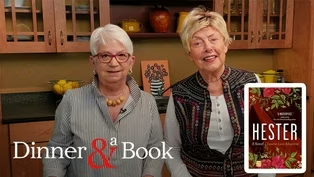
Laurie Lico Albanese writes of many secrets in her novel, “Hester” which is set in Salem, Massachusetts in the 1800’s. Meet Isobel Gamble, a would-be witch who carries secret knowledge from Scotland to the new world. Jane Poe joins Gail Martin for a conversation about synesthesia, sewing and being different
Problems playing video? | Closed Captioning Feedback
Problems playing video? | Closed Captioning Feedback
Dinner & A Book is a local public television program presented by PBS Michiana
Hester
Season 23 Episode 14 | 26m 46sVideo has Closed Captions
Laurie Lico Albanese writes of many secrets in her novel, “Hester” which is set in Salem, Massachusetts in the 1800’s. Meet Isobel Gamble, a would-be witch who carries secret knowledge from Scotland to the new world. Jane Poe joins Gail Martin for a conversation about synesthesia, sewing and being different
Problems playing video? | Closed Captioning Feedback
How to Watch Dinner & A Book
Dinner & A Book is available to stream on pbs.org and the free PBS App, available on iPhone, Apple TV, Android TV, Android smartphones, Amazon Fire TV, Amazon Fire Tablet, Roku, Samsung Smart TV, and Vizio.
Providing Support for PBS.org
Learn Moreabout PBS online sponsorshipDinner and a book is supported by the Rex and Alice A. Martin Foundation of Elkhart, celebrating the spirit of Alice Martin and her love of good food and good friends.
Isabel Campbell comes from a long line of women with secret knowledge.
Her namesake is an ancestor known as Isabel Goudie, Queen of Witches.
But she's been taught since childhood to mask her knowledge, including her synesthesia.
Let's meet today's guest, Jane Poe, to uncover many mysteries in the Hester.
By Laurie Lico Albanese.
Welcome.
Thank you.
I'm glad to be here.
Well, I'm glad you suggested this book.
There is so much in here historically and literally.
And.
Well, would you set the scene for us?
We are in this book either in the period of the Salem Witch trials or 100 years later in this book, story.
Set the scene there.
What's going on in America?
Not a simple question.
No it's not, that that's loaded this.
The witch trials were in the late 1700s, 1790s.
The action of this novel takes place in the 1830s, which predates the great American Renaissance Science in American literature, which is pretty much led off by when Nathaniel Hawthorne publishes in 1850 The Scarlet Letter.
Ooh, that must ring a bell with you, right?
Well, it does.
I taught this book for many years.
I had a grandmother Who?
It's her copy that I first read.
I had a great grandmother who also taught English and loved this book.
So I think I come by it naturally.
You do?
And you do understand it because you've been a professor of literature.
Well.
Well.
So here we are.
We're back and forth, and it's done in a way.
We know we're going back to the time of the Salem Witch trials, and we're in the modern era and we go to 1830s.
And so let's talk about this word... synesthesia that's it!, Perfect.
This girl, this woman has that talent.
And there are some popular singers to date that have this.
Nancy has it.
Yes.
And so does the.
I forgot her name.
She's been winning all kinds of prizes, winning trophies and all kinds of things.
What does it mean?
It means when people say words, you see colors.
And some composers had it.
Some artists have had it.
So when you say a name, she sees a color.
And so this comes out in her embroidery, which is her trade.
She came from Scotland and she was trained as a young girl to embroider.
So whenever she sees color, whenever she sees names, she sees colors.
So this is coded all the way through here.
It's like this became all these colors because whoever made it has that talent, or they followed a pattern or found a pattern.
Yeah, exactly.
Well, this is quite a story.
It's a Scottish background.
But now in the book, we're in Salem, and some of the people that come to the United States find out they're not quite living up to the expectations of our Constitution, our Declaration of Independence.
They came to the new world where they found the old World being recreated.
Yes.
Isabel came to Salem on a boat called The New Harmony, which has some ironic meanings.
And?
But she finds the whole class structure.
She's Scots-Irish, so she's at the bottom of the social ladder.
If you're not one of the old families of Salem, you're a newcomer.
You're off you.
She has also befriended and helped to survive by a free black woman who lives out on the outskirts of Salem who, who keeps her alive with produce and garden.
Yes.
There's so many things happening here.
And again, we're back to this theme of how women were treated, particularly if they were widows or they were never married or they had a nasty disposition.
Yes.
Or they were too clever.
Don't forget that.
Too clever to play the witch.
My goodness.
Well, so we have all this going on and we've decided to make a meal.
I'm going to make a fish stew.
Very simple.
You're just putting in some liquids.
Chopped cod, some potatoes.
I'm making some brussel sprouts.
We're going to have some ginger beer in our mugs.
I would have loved to found some lager of the period.
And Jane, what are you making?
I'm making peach cobbler for dessert because they really like their desserts.
There's a cake shop that's mentioned in the book very often.
And cobbler is an old fashioned recipe where you just cobble together what you have.
And so it's very simple ingredients, and you can make it with any fresh fruit at the time.
So since it's almost August, I'm using peaches.
Wonderful.
So here you've got the scene.
We we've got the food.
We've got the ideas.
We know what happened in the Salem Witch trials.
We did.
I didn't study this in high school, nor did we.
Did we study Hawthorne or we did.
We did memorize the poems of Wordsworth.
So about.
Well, you would have probably memorized Longfellow.
yes.
He was American.
And that would have.
He was also a neighbor of Hawthorne, outside of Concord.
So they all knew each other.
And he was very popular.
His poetry is very moralistic and uplifting.
Hawthorne was concerned with the dark side of man, which is probably why he so inspired Melville to write Moby Dick.
We're talking about the dark side, but that doesn't sell.
That's not popular.
Well, but I can imagine Scarlet Letter was very popular, though, wasn't it?
It didn't sell that well.
No, Really?
Really.
He never made much money from this.
The best seller came two years later when Harriet Beecher Stowe wrote Uncle Tom's Cabin.
Now, that was a block that was upset after.
Well, getting back to our story here, we have this woman who comes with her husband, who turns out to be the word, then a scalawag.
He's a scoundrel.
He takes their wedding money and when they arrive, he leaves and goes back, goes back to wherever he's going.
And he goes back on board the ship, which they came on.
He's an apothecary.
So the captain of the ship credits him with saving his life.
So we didn't have regular doctors.
We had Apothecaries and people that are the native people that knew secret cures from the herbs and whatever was growing in the forest.
Well, I tell you, I have to start melting this butter or I'll be I will start.
I will be in trouble here.
So you've got this setting, and this is a time when women you dare not be a widow.
You dare not be single.
You dare not be pregnant and unmarried because you could, by just a turn of the head, you could be accused of being a witch back at the time of the Salem Witch trials.
And so we have all of this going on.
And I think who appears in this story of the 1800s with Isabel, the day she lands in Salem, walking the deck, not deck pier is a very mysterious, handsome young man with dark hair.
And his name is Nat Hawthorne, but she doesn't know that.
But she's intrigued with him because there's something about him he's a little mysterious.
He's very quiet.
Yes.
And when her husband goes back on the boat absconding with her money and she's left destitute, she's drawn to hot to Nat, they meet several times in a museum where she sees exotic things brought back from all of the captains who've sailed the world.
And this inspires her embroidery.
She gets her designs from looking at these exotic things, and she and Hawthorne strike up a friendship which later, of course, we know at least become more than a friendship.
Yep.
And of course, she gets pregnant.
And of course, her husband's not there.
Of course he will show up at the most inopportune time and the child will be ostracized because it is an illegitimate child.
Yes.
And this Nathaniel Hawthorne is based on Nathaniel Hawthorne.
He is he's charmed with her.
And he's sort of seduced by her intellectually and emotionally.
So what we have is she thinks this is going to go somewhere and he has other thoughts.
And I think he's looking at the fact that he's old English sort he's old Salem back generations.
In fact, what he's covering up is his great great grandfather was one of the judges at the Salem Witch trials.
Yes.
And he's changed the spelling of his last name to distinguish himself from this.
But they're still old Salem.
They're all society, but they fall in on bad times because Nathaniel Hawthorne father died at sea.
And so the mother's left rather impoverished, raising three children, but trying to keep up appearances all the time.
Well, you see, we have all this going on.
And of course, the woman writing this book, she knows about the history of Nathaniel Hawthorne, but she's writing her own version of this.
And it's very interesting.
Now, this her mother had told Isabel never to talk about your condition.
Yeah.
You or your synesthesia, right?
Yes, because people will.
that's not normal.
She must be.
Of which.
And of course, she had to keep this quiet.
But she tells Nathaniel, and we don't know what he's going to do with that information, but he kind of abandons her and she's sewing and she's embroidering, and she's living on that as an income.
But a lot of the women in town, they're very annoyed with her.
Here's I think you're doing well there.
Yes, they are.
Well, she of course, she and Hawthorne.
Hawthorne have an affair.
And we know from the Scarlet Letter that there will be an affair.
There will be an illegitimate child.
The husband of the adulterous will show up at a very inopportune time.
We know that.
yeah.
So we'll leave that.
This book can be enjoyed on several levels.
You can just read it as an historical romance and it works fine.
Or you can go back and put it in the times, dig a little deeper, right, and dig a little deeper and find out what this was all about.
Well, we're going to keep talking here.
We're going to take a little break.
We're going to show you the menu and then we'll be right back.
See you soon.
Okay.
We're coming back here with our cooking.
You're doing your peaches, your cobbler, your cobbling, your peaches.
I am making I'm cooking potatoes and I'm going to add some milk and I have some vegetable broth.
I've already made the Brussels sprouts.
I ran out my little kitchen garden and will add a little lemon juice.
And now I'm going to add the fish, the cod.
And I had it frozen.
And it's very easy to cut when it's frozen.
So they're flipped right in there and we'll cook this for about 10 minutes and we will have a nice fish stew, which you could have in Salem, you know, any day.
So now we have our story.
We know that Nathaniel Hawthorne and Isabella are well, I don't know, she's in love.
We're not sure what state he's in.
I think he's in raptured.
He's in rapture.
He's bedeviled.
And you know that.
That's another thing.
A woman wasn't supposed to bedevil a man, because that was the sign of a witch.
So, you know, they couldn't win it all.
It was just a horrible time.
But in any case, were going to get this heated, heated up a little.
This is a simple way to make a fish stew.
And you can add vegetables.
You can add a can of vegetables, mixed vegetables are fresh and you've got a wonderful fish stew and some white wine.
I'm going to put in some salt and pepper and so we know that Edward finally comes home.
That is the husband, the what would you call him?
We've got to give him a name.
He's a real I would call him the cuckold husband.
Yes.
Home to find his wife is she's pregnant.
Pregnant.
And of course he's angry about that.
And and then he's he's drinking all the time.
He he's also drug addicted.
yes.
Which is poppy.
Which is handy if you're an apothecary.
Yes, exactly.
And it's gone back for centuries.
Even today.
It can happen.
So I think I'm going to add a little bit more of the broth.
And so he comes back and he's very angry, of course.
And we're also following what some of the people are doing in the underground Railway Railroad to get people out of the south.
Remember that we had the Fugitive Slave Law.
So even if there was a runaway in the north, yes, the law said you must return them.
And so the woman in the woods, Mercy, the freed slave, is involved with her brother in camouflaging runaways so that they can finally make it into Canada.
And this is all going on in the outskirts of the little cottage where Isabel is staying.
In the meantime, Nathaniel's trying to sell books.
He's trying to be published.
He's glum, Nothing works, Nothing works.
He's just writing his short stories.
And as Isabel tells him, you need to write about happier things.
People want to read about love and triumph.
And he's focused on the sins of the dark side of Puritanism.
Very dark side.
You know, the old ministers that got sinners in the hands of an angry God.
Jonathan Edwards Yes.
Yep.
And so you've got all this going on and I think would been a horrible time to live in the United States.
Actually, here's a little secret.
The English people, they lived in the area where the Pilgrims and the Puritans came from were so glad to get rid of them.
Let's get them out of here.
Well, in the richest man in Salem who's pregnant.
Daughter?
Unmarried?
Yes.
Her father.
They made their money in the slave trade.
Yes.
And Isabel is called in to make a wedding dress for this girl who's been kept hiding in the house so nobody will know.
And she designs a dress which covers the condition very cleverly.
And of course, it's said in the very beginning her mother teaches her that clothes are a way to cover everything.
And you hide your flaws with clothes and you think of sin, too.
Yeah.
And you think about how that was.
You kept your head covered.
Of course you kept your hands covered with gloves.
So Isabel is making her first claim to fame by embroidering gloves, which she's paid $0.60 a pair to embroider.
And the local store in town sells them for $2 a pair, which she finds to be a little unfair.
So we're also talking about capitalism and the exploited underclass, because, of course, Isabel, being a Scots Irish, is not invited into society.
And yes, now Hawthorn is society and this is America.
So, you know, this has always been going on and this comes out in this book as well.
I am going to cut the heat a little bit because I don't want my milk to curdle.
You can also add that what's the liquid milk you get in, it can evaporate, it evaporated milk.
But I don't really want to do that.
Some people had whipping cream and then they add some wonderful herbs.
But this is a simple you can use water, you can use vegetable.
It's a lot of used goat meat.
Goat milk.
Goat milk.
Exactly.
So now we are at the point where she doesn't see Nat.
He doesn't come around anymore, does he?
And she is absolutely befuddled by this.
And of course, she's more and more pregnant.
And how do we at this point come to the idea that Nathaniel is using this experience as the basis of his book?
Well, critics have always wondered what he was hiding because his visage changed in age dramatically.
There's a belief in the times that whatever you're hiding inside comes out in either illness or in your face.
I was taught once you'll have the face you deserve by the time you're 50, so you better not be hiding things.
Yeah, but Hawthorne's hiding his sin, and he does it very well.
But it gets away from him 20 years later, when he writes the Scarlet Letter, he writes.
And of course, it's.
It's.
You said it wasn't a big hit, but I think people were passing the book around and reading it.
You know, And they were they were disappointed because there's no sex in it.
The sex happens between the chapters.
between the chapters.
That's how you do it.
Keep it safe.
Anyway, so we have the influence of this event between Isabel and Nathaniel Hawthorne, which leads Nathaniel to write his book, The Scarlet Letter.
And that is, I remember seeing the movie and I just thought, how horrible.
The acting was marvelous.
And I just I think the movie gives it a happy ending, as does the book.
However, in The Scarlet Letter, as written by Hawthorne, the ending is Dimsdale.
The father of little Pearl hides his sin and it kills him.
Hester has to wear hers on the Scarlet letter on her bodice, and she's out in the open and she survives.
my gosh.
Well, I think it was the modern version.
The movie done by Arthur Miller.
Are you in The Crucible?
yes.
Yes, that that too.
He, Arthur Miller knew everything that was going on, didn't he?
He really he really could take an old story and use it in another setting.
But getting back to the book, I enjoyed it.
But that was muddled for a while, trying to get this straightened out between the Hawthorne and then the book that he was writing based on this book that we are reviewing today, it's called Hester, but the woman who is the focus is called Isabel.
Isabel, who came from a long line of witches.
So we're going to take another break now.
We're going to tidy up our food.
We invite you to come to a Salem meal right, Salem, watch your PS and Qs.
And so we'll be right back.
And in the meantime, we're going to show you some pictures of Hawthorne, the young man and Hawthorne, the older man.
And he was when the second pictures were taken.
He was in his fifties, which I do not consider old.
No, it's not.
It's not so many.
We'll be right back.
Don't go away.
Stay there.
You're invited for dinner.
Well, we've come to the end of dinner and a book, but we just have a few more comments we want to make, especially about, well, so many things.
Let's talk about your book here.
Tell us about this book.
this was my first exposure to the Scarlet Letter.
I found this in my grandmother's upstairs after I'd read a Hawthorne short story in high school.
So I thought it was about adultery, and I would learn something steamy.
Well, it wasn't at all, so I didn't really understand it.
But I treasure this first experience with the Scarlet Letter.
The Scarlet Letter?
and you have taught this period.
And of course, this makes such a to do about pregnant women that aren't married are are left by their would be lovers or too openly sexual.
Yes.
And you've taught it in modern day life here.
Now, how did the students react to all the fuss about this book?
That was a job to overcome that I would try to bring them in with Hawthorne's language, with the description, with what's behind all of this.
And usually it worked, but they still thought Hester and in The Scarlet Letter, Dimsdale should just move to another town and tell everyone the A stands for awesome.
That would be a typical response.
They didn't understand why the child of this adulterous affair would be an outcast.
And so I'm not sure if I would teach it today because all of this would be very controversial.
it would be very controversial.
And and half the audience would say, what's the fuss?
What's the fuss?
And the other half would be judging you for bringing out the story in this book.
And the thing is, this woman who wrote the book today of the she calls her character Hester, she I don't know if she thought about Isabelle.
Isabelle.
I think she does because of her description of all the embroidery.
So I brought some embroidered gloves.
These are leather from Italy.
They're not linen from New England.
But I was intrigued with how Hester took all of this inner turmoil and took it out in her embroidery, which is what women have done well, and men women have done this to create art and stead of getting internally.
Right.
And so I really loved her descriptions of that also because I don't so so this intrigued me.
Well, and let's talk about our food, too.
the food.
Yes.
Tell us about your dessert.
This looks delicious.
It's just fruit cobbler.
It's nice.
Nice and brown.
You've got the sirup and the peaches.
Everything is cooked, ready to serve.
You've cobbled together beautifully, you see, because the Good Wife would have cobbled it together in 30 minutes.
And that's about what it takes even to cook, right?
Yes.
And we have some seafood stew, a fish stew.
It's actually cod.
And I have some potatoes and onions, butter.
And there are some secret ingredients that people use.
There's nothing secret here.
There's secrets in the book.
Nothing's hidden, but not in the stew and some brussel sprouts.
So we're glad you joined us.
Thank you for suggesting the book and for coming today.
You're welcome.
Thank you for the opportunity to talk about Hawthorne .
Yes.
And thank you for watching.
Remember, good Food, Good Friends, Good books Make a very good life.
Not a cobbled one.
A very good one.
Thank you.
Can be.
Yes.
Yeah.
We'll see you next time.
This WNIT local production has been made possible in part by viewers like you.
Thank you.
Dinner and a book is supported by the Rex and Alice A. Martin Foundation of Elkhart, celebrating the spirit of Alice Martin and her love of good food and good friends.
Providing Support for PBS.org
Learn Moreabout PBS online sponsorship

- News and Public Affairs

Top journalists deliver compelling original analysis of the hour's headlines.













Support for PBS provided by:
Dinner & A Book is a local public television program presented by PBS Michiana