
Surely You’re Joking Mr. Feynman
Season 25 Episode 1 | 26m 46sVideo has Closed Captions
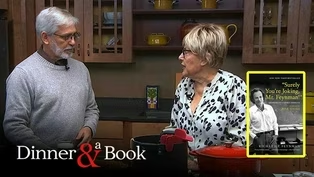
Gail Martin and Doug Farmwald discuss "Surely You’re Joking Mr. Feynman."
Richard Feynman thrived on physics, his bongo drums and painting. It was a life of eccentric glory - a combustible mixture of high intelligence, unlimited curiosity and raging chutzpah. Gail Martin and Doug Farmwald reveal the hilarious and brilliant remarks from physicist and Nobel prize winner Richard Feynman his remarkable book, Surely You’re Joking, Mr. Feynman.
Problems playing video? | Closed Captioning Feedback
Problems playing video? | Closed Captioning Feedback
Dinner & A Book is a local public television program presented by PBS Michiana
Surely You’re Joking Mr. Feynman
Season 25 Episode 1 | 26m 46sVideo has Closed Captions
Richard Feynman thrived on physics, his bongo drums and painting. It was a life of eccentric glory - a combustible mixture of high intelligence, unlimited curiosity and raging chutzpah. Gail Martin and Doug Farmwald reveal the hilarious and brilliant remarks from physicist and Nobel prize winner Richard Feynman his remarkable book, Surely You’re Joking, Mr. Feynman.
Problems playing video? | Closed Captioning Feedback
How to Watch Dinner & A Book
Dinner & A Book is available to stream on pbs.org and the free PBS App, available on iPhone, Apple TV, Android TV, Android smartphones, Amazon Fire TV, Amazon Fire Tablet, Roku, Samsung Smart TV, and Vizio.
Providing Support for PBS.org
Learn Moreabout PBS online sponsorshipDinner and a book is supported by the Rex and Alice A. Martin Foundation of Elkhart, celebrating the spirit of Alice Martin and her love of good food and good friends.
Richard Feynman thrived on physics.
His bongo drums and painting.
It was a life of eccentric glory, a combustible mixture of high intelligence, unlimited curiosity and raging hood spy.
For me, Feynman stood out when he was one of the scientists to discover why the challenger space shuttle blew up in the late 1980s, killing all on board.
Our book is surely you're Joking, Mr.
Feynman.
Adventures of a Curious Character, a series of essays by Feynman.
And joining me is Doug Farmwald.
Hey, welcome.
Good to have you.
There's nobody better to describe this man.
Feynman.
And you suggested this book?
I did.
I've always kind of liked Feynman.
He got.
He was famous not simply as a physicist, although he was a Nobel Prize winner for his work on quantum electrodynamics, which I know how to say it, and I don't know anything else really about him.
And then quantum chromodynamics, which I know even less about.
But he was also famous as a teacher at Caltech.
His lectures on physics for incoming freshmen have been recorded and transcribed and are fascinating.
So he found as much value in teaching as in research, which is a little unusual for for novelists.
And I think his subtitle of the book, adventures of the Curious Character, really describes him.
So he's a curious character in that he has really fits the stereotype of an eccentric professor, but it's because he has, as you said, unlimited curiosity.
So his character is to be curious about every everything thing.
And you see somebody and if they're doing something, he's curious and asks them, what are you doing that for a bit and how does it work?
Yes.
And his whole life is like this.
And I find I found him fascinating.
I imagine he could be a bit of an irksome person to be.
Could he?
Especially to people in hierarchy, in positions of authority.
Because he didn't automatically oppose every rule.
But if it didn't make sense to him.
Yeah.
And I followed it even when he was talking about his Nobel Prize.
Right.
Certain things he didn't want to talk about because it didn't make sense and it wasn't important.
It's not interesting.
Yes.
So he really drove his own show and and his next book, the yeah, takes the second half of his life, is called why Do you Care What Other people think?
And that is sort of his guiding principle.
And he does live that.
I mean, my mother used to say that to me, but I couldn't I couldn't just throw it out.
Is one of my concern.
But he does.
And it's been a while.
Yeah.
He talks about that in the book because he's going through college, and everything.
You know, he it's important to him that he seems like a manly man, not a, not an egg head, not a sissy, not a nerd.
And so I guess today would call it toxic masculinity.
And so he does things that he doesn't really want to do.
So he seems like one of the guys.
Yes, yes.
No, I didn't really get that out of the book.
It's interesting that you found that.
Now you're starting to mesh.
Tell me what you're doing.
Well, first, I'm just, cutting out some garlic, and I've got my pasta water going.
So, Feynman, was never a foodie.
He liked simple dishes, but he did, like, Italian food pastas, and he likes spicy curries.
So I'm starting on pasta, put in Oscar, and I am doing a curry.
It's a it's a new book.
It's written by an Indian woman who lives in England.
And it's very popular.
This is where you find some of the best Indian food is in England.
And, so we've got quite a combination here.
Italian and, and it's simple food, just simple thing.
It was never the culture of cuisine was never of interest to him.
He liked to eat so he could think about calculus and physics just to keep going and think about ants.
Oh, yes, he would.
He would study and.
Yeah.
And you.
And he just didn't want to fuss about food.
But I also like this because the one great problem that Feynman didn't solve in his lifetime that that he's worked on for years was the spaghetti problem, this spaghetti problem.
And so when you take spaghetti and break it, it was always in half.
It breaks in 3 or 4.
And he wondered why.
That is a good question.
And it was solved by a group of, researchers at MIT in 2005.
Oh, that's quite a and number of years after he died.
After he died.
You know, not that long ago.
Right.
But this, this problem that he'd been working on since and I've, I've never pondered this.
Right.
But that's the sort of thing.
Yeah, that fascinated him.
And in 2018, another group of researchers figured out how to break it in half and twist.
You simply twist the spaghetti first and then break it.
Now, when you do it today, I'm actually using linguine because I like that a little better.
So it's flat.
It breaks a different.
I like it, but you see the same thing.
If it breaks, it breaks in several pieces.
Well the third piece went flying out here.
Yeah.
So it doesn't just break in half, but where it's fascinating.
Absolutely.
So you're going to start with that.
And I am going to continue with my chicken curry.
And I have I have chopped the chicken into pieces.
And but first of all I want to add some of the paste, the ginger and garlic I have smashed in my, my masher here.
And, we're going to add that.
And then my olive oil hot.
So I'm just going to simmer the garlic in there for a little bit.
I'm going to put in some anchovy filets.
I think this is why puttanesca is not as common in America, because people are they're like a little scared of anchovies.
This is not going to be a really good dish.
I'm scared of them.
But this adds your mommy in the same way that fish sauce would in Asian cooking and the filets are going to break down, there's not going to be chunks of fish.
I'm relieved for this dish.
I'm putting in some tomato puree, and that's the first time I ever found a can of tomato puree.
So I am not a, absolute purist here.
And we'll add that.
And then I'm going to add some of the, I love the tomato paste.
About two tablespoons I just love oh, I can smell them all right there.
I really can see they're already breaking down.
So we're just going to do that until the garlic is nice and golden brown and the anchovies are starting to break down a little bit.
And here's our tomato paste for two tablespoons.
This makes it nice because you don't have that can with the wobbly lid.
And you're putting it back in the refrigerator and wondering when whether they're usually, okay.
So we have our tomato in here, a tomato sauce, and we have onions that we've cooked.
And I have some ground I'm going to add some ground.
Cayenne just a little bit.
This stuff is surprisingly strong.
And some some capers and kalamata olives just let them sizzle just a little bit.
And this is the sort of the briny element that we're gonna put in a can of crushed tomatoes.
And you can use chopped tomatoes, diced tomatoes.
They'll break down as well.
But I just like crushed.
It's a little quicker.
And we're just going to let that simmer a little bit.
And somehow my turmeric has worked off the table here.
But anyway we will find it and add a little later.
So we've added some paste to the onions tomato paste and some pureed tomatoes and then ground cumin.
And then I find my turmeric.
It is hiding and then we'll add some yogurt.
Oh, there it is.
Thank you.
Yes.
I love turmeric.
And I'm going to add that to the rice and make a golden turmeric.
Yeah.
Right there.
That's a nice earthy flavor as well.
It's not simply the color and it's good for you.
It's a good healthy spice.
All right.
So now, we start with him in his early life, Rockaway Bay in New York.
And he, he seems to go to every very, every good school.
He's he's at MIT.
That's his first college might be Princeton praise.
Cornell.
He was, for his first professorship was at Cornell.
He was offered a position at the Institute for Advanced Study with, Einstein and that level of physicist.
So he was no Trump.
You know, if you're offered a job with Einstein, that's pretty good, isn't it?
Yeah.
And in fact, and, he tells a story in his book, his first lecture, as a grad student, that he had to give, as a seminar.
Einstein showed off, he was very intimidated, but he got what what he said.
Once you start talking about physics, it was okay.
It was okay.
But Hans Bethe was there.
Howard's brother was sort of his mentor.
Another famous physicist.
So he met Oppenheimer.
Yes, he met Enrico Fermi.
They all were.
He was working on the Manhattan Project, the Manhattan Project.
So he was a junior researcher there.
That wasn't.
That was before he, Had finished his degree.
What I think is really interesting is he was deferred from the draft because he was working on the Manhattan Project.
That's interesting, doesn't it?
Yeah.
After the war, he had to register for the draft and had to get a physical.
He tells a story in the book.
He ended up being deferred, for psychiatric reasons.
He was forced off for psychiatric reasons.
And how did that happen?
Because he didn't really want, to join the Army.
And he told them he had psychiatric problems.
No, he just answered the questions in such a way.
In such a way that that's what they presumed.
So he was very short with his answers.
It was clear he didn't want to be there.
He said he actually sent a note then later into the Army that he was so crazy that they shouldn't, draft him.
But I'm telling you this so that you'll know.
And they said, yeah, he's not.
Well, he was, but he was kind of charming.
Nuts.
But it worked in his way.
We're going to continue cooking.
We're going to take a little break.
In the meantime, we want to show you some pictures of this man and.
But think more about this.
How you get out of the military by saying you're you have.
Yeah, problems, psychological problems.
Anyway, it worked for him.
We'll take just a short break.
Don't go away.
We'll be right back.
That's looking very nice.
Yeah, I can see the sauce thickens up a little bit.
Yeah.
You know, I think Americans don't think this or they don't adopt this as often because it uses unusual ingredients.
The anchovies and the capers.
Yes.
But those just build the flavor base.
So I cook my pasta.
We're just going to put that right.
In there and just toss it.
That's pretty nice.
You've got it all in one.
Well, that's a very quick and easy recipe.
I am adding the rest of my chicken in this to be cooked in the sauce.
It is heating up.
Oh, that is beautiful.
That really is.
It's quick and it's simple.
It's very flavorful.
Now, what kind of pasta did you say that was?
I you can use any kind of linear pasta.
I kind of like linguine, but spaghetti, fettuccine, bucatini, bucatini all work well, okay.
I like the angel hair.
Won't work as well.
It's just too thin.
Okay.
Because it gets roughed up there in the sauce.
And you haven't been sure you have a good, sturdy pasta, right?
That looks beautiful.
I am adding the chicken here.
And we're going to let this cook for a while.
And I've saved some of the pasta sauce and I always save some when you might need something like this is maybe too dry.
And so here we go.
Now this is going to cook for about 20 minutes.
So it's going to gently kind of get to put the lid on.
And I'm just going to leave mine on low heat.
Well that does all have a bit of refreshment.
Oh let's refresh it.
Foreign.
Didn't drink much.
I could see that.
I went back to read the stories once in a while.
He did, but generally it was only a beer or two.
Now, he did like to kind of hang out in bars because people are interesting.
And he, he he would talk to the what do you call the women there that worked in the bars?
Some of them were, entertainers.
Right.
So he, he liked to sketch women.
Yes.
And we would hang out at strip clubs.
Yes.
He also hung out, you know, in other places.
And he did like to eat out.
So he actually came up with another formula to determine what, just to try on the menu.
Oh.
So, he he had it.
He saw the problem was if you go in to a restaurant, that you regularly go visit, they've got 25, 30 dishes on the menu.
Yeah.
How do you get the best one?
Because all you know is what you tried.
Yeah.
So if you try two dishes, you know.
Okay, I like better than b do.
You have to try every dish and then you, you end up eating all the ones you don't like to find the best one.
He actually came up with a formula to determine how many to try.
That's his restaurant problem.
And it involves, integrals and more, more effort that I'm willing to put into a restaurant.
But basically it comes down to you try about a quarter to a third of the menu and then out of whatever of those that you like best, just come back in order that I think is mine was active all the time and he needed to be solving things.
And cheers to you.
And you're wonderful.
Oh, he didn't go.
Yes, nice pilsner I checked, which goes well with, put in US cup.
And because this is kind of rich, as a hearty flavor, this takes it on, clears the palate and clean on the palate.
That's what we want.
Yes.
And this is a good one.
This is a Czech pilsner I love Czech pilsners which is where their style originated.
Yes.
And the neighborhood in Chicago where we often go, which is now Hispanic.
But it was Pilsen and it was the center for the Czechs who had come over from Europe to live.
And there's one Czech bar left there, and the rest now is Hispanic, and there's a wonderful museum.
And so I love the remnants of the people coming from here.
As you watch the neighborhoods evolve over time.
Yes.
Which is always happened to every city.
Yes.
You know, sometimes people get that they find that somehow offensive, but it always happens and it should happen.
I think it should, too.
I mean, some places they do it too much and they don't have much planning.
But I do think they are successful in, in Pilsen.
I don't know if they call it now a little.
I'm not sure.
But it's a wonderful place to go in Chicago now it is Hispanic.
The houses are lovely, clean, neat, wonderful museum of, Mexican fine arts.
And five minutes to go here.
Doug, how are we doing?
Well, this is fine.
So I can start on.
You're going to do a little salad out of your salad to go with this good pasta first.
So the salad doesn't wilt.
So let me and I have some rice I have cooked.
And I think I'll open the bag and add some turmeric.
Turmeric is good for your health too.
My husband takes it periodically.
And so if you put some in your rice, just about a teaspoon, it adds color and it adds a good natural ingredient for your health.
Now, I have to worry about getting this out of the bag.
I thought it would slip out of the bag.
It's slowly coming, but I usually do it in a pot and I just grab these and they were cooked them another way.
So, what would you talk to him about if you met him?
What would you say to him?
Besides, hello, I'm Doug Farm.
Whoa.
Look, I'm not even sure I would say that because I like.
I mean, I don't like to.
Yes, but you're interested in me.
I yeah, I know, I'm interested.
I would ask him, what is the one problem you most wanted to solve but have been unable to, good.
And would you an offer, a suggestion if you had one?
Well, I guess I would have to hear what it is, because he was always thinking of a lot of things.
When you read this book, you just run into that, like, he.
He wonders if he can ask a woman to go home with him.
What is the probability that she'll say yes or no?
Right.
He works out everything.
Everything is mathematical.
His natural language was kind of calculus.
And so he applied it to pretty much everything.
And it tell us how you arrived at that for that there was calculus.
So I just chopped a little shallot to put in the salad.
And I'm just using spinach and arugula.
Good.
Noodles are easy to grow at home if you want, but this being November and in Indiana, you have to buy it.
And this is kind of stuck together, so it's pretty easy.
What I'm adding to make for this is the vinaigrette.
You're going to make is sort of like the French way with you're using rice vinegar.
I'm using rice vinegar just a little more tart.
And then you have the, German or Swiss Dijon mustard.
And they always make it hard to open those, don't they?
They do.
So I cheat.
So I'm trying to break this up because this sat for a while.
It was a nice bar of rice.
And then I will add I added some of the, the, liquid from the pasta.
Make sure this isn't burning.
Okay.
I wanted to turn it down somehow.
I don't trust any heat near my food.
Now, I just wanted to get that broken up a little bit, and we will put it in about an eighth of a teaspoon of turmeric.
This is long grain, and I really like the brown grain better.
I like a, basmati rice.
But let's see what we can do here.
Let's see what kind of damage we can do.
So, as I said, about an eighth.
This is a so I will stir it and you will see it will be colorful.
It adds a nice flavor.
And, you know, you can sue.
Would you serve this as passing it around or a buffet?
I would serve a sort of family style, which means passing it around.
You know, I've gotten to the point where I don't do that anymore.
I like people to get up and go to my.
We say, yeah, and it makes it easy.
Now, this isn't much color as I thought.
So I'm going to add some more.
So I am just stirring up the vinaigrette.
Now you notice I don't measure a lot.
Just keep the proportions the same.
So about three parts oil to one part vinegar or citrus.
Yeah, we'll get you about the right right balance.
I keep adding tomatoes because I want a bright orange.
And then we'll just add the vinaigrette right over the top.
I think we're in pretty good shape, don't you?
We've got about a minute, and we're going to take a look at some pictures.
And we're going to take a look at the menu.
And then we'll come back to talk more about Richard Feynman.
And I think I would stare at him if I met him.
I can't imagine I haven't taken all these advanced mathematics courses, but even even Feynman himself, would often say that you have to go back to the basics.
So he really kind of believed that there was no dumb question.
Oh, yeah, that's great.
We're going to take a short break, take a look at our menu, and then we'll invite you to our meal, get ready First of all, Doug, I want to thank you for suggesting this book.
Thanks for having me on.
It's.
Feynman's is an interesting character.
He is a character.
He is.
He truly is.
He's smart.
And I like the word, but I'm curious.
That defines him more than anything.
Yeah, curiosity.
I know how things work.
And fortunately he knew, you know, he he chaired that committee that tried to decide what happened to the and really more confirmed at the engineers knew what the problem was.
They were just overruled by executive executives.
The wanted and Feynman confirmed it.
They were right.
It was the O-rings.
It was, in fact, too cold.
And we're talking about the explosion of the challenger back in the late 80s.
Anyway, I, I loved the book.
I find him fascinating.
There are several other books that I want to read, and the next book that he wrote was, why do you care what other people think?
He wrote one called The Pleasure of Finding Things Out, which defines him.
And then really interesting is his lectures on physics to incoming freshmen at Caltech.
Because that's where he's teaching.
And so when he writes autobiographies, he's self-consciously writing about himself, knowing that someone else is going to read it.
When he's teaching physics, he forgets himself, and you can just see the love of the subject come through.
Well, I do, I do want to, listen to those.
I want to be imbued with physics.
I, I took it in high school.
It was no friend of mine, but I got through it, and I got extra credit for becoming an operator of Morse code to to pass physics.
So anyway, that's the story.
And here's our wonderful food, and I think I thank you so much for ingesting the food and the book.
And I think Feynman would enjoy the menu.
I think we should have had him here.
Oh we can't, he can't.
But in any case, thank you so much and thank you for watching us.
And I'd say, read this book.
You will be delighted and we'll see you next time.
Bye!
This Wnit, local production has been made possible in part by viewers like you.
Thank you.
and a book is supported by the Rex and Alice A. Martin Foundation of Elkhart, celebrating the spirit of Alice Martin and her love of good food and good friends.
I. Join me and my guest.
Done some world as we reveal the hilarious and brilliant remarks from physicist and Nobel Prize winner Richard Feynman's remarkable book.
Surely you're joking, Mr.
Feynman?
On this week's dinner and a book.
This removes some of the talk.
Okay.
That's fine.
Yeah.
Really?
That again?
Or maybe just a few.
What?
What action.
Over here.
My action is working in here.
Okay.
Tell me when you are ready.
To.
Okay.
You.
Can you put that in there?
Sure.
Great.
Remember your cue.
My.
When I am three.
Oh.
Yeah.
Jumps out at me.
So I think what I'll do is put the chicken in first, then before we have the beer.
So are we going to start pretty soon?
Yeah.
She wants me to.
Good.
It's kind of messy.
Let's just take this.
Yeah, and put this over by the sink.
Yeah.
There we go.
So.
Does this man have a high IQ?
Did you ever find out what is like.
You didn't think that was relevant and so never had it measured.
And and in fact, I agree with him.
The IQ only tells IQ test only tells you if you're well above average or well below.
So the difference between, say, a 140 and a 150 is meaningless.
Yes.
Meaning meaningless.
But it is different.
It would be different if it were 120 in 150.
Yeah, but even then, not that much.
Not that much.
You know, it was designed, around the time of the First World War to screen out people of very low cognitive development.
But people love to attach numbers to stuff.
It's.
Oh, well, I'm a 142.
You're only a 138.
I'm clearly more intelligent than then.
They all want to join Mensa.
Right.
Then they either flunk out of that or they they get to join.
And it doesn't really tell you anything.
Doesn't tell you anything about whether you can come up with anything original.
Yeah.
It doesn't tell you about processing speed.
It doesn't tell you about language fluency.
So it's really sort of a meaningless number.
And you want.
Yes.
Us.
Until you can actually define what you mean by intelligence.
You can't actually quantify it.
And there is no agreed upon definition of what intelligence is.
We had Australian friends and they couldn't wait to move from Elkhart to go to back out east before they went back to Australia, because they wanted to join a mensa club.
And so that was, that was that was there.
And they did they did, oh, no.
Drink up.
All right.
I'm going to throw you out here.
Just a second.
You better get this under control.
All right.
We're going to come out.
And I said, we're going to do what?
First, I'm going to throw the beer.
You know what I'd like?
Did you save some of that?
Some stuff.
I'm going a little bit.
Oh, I got a cup on the counter.
Are you using it for?
Probably not.
I don't think I'm going to need it.
This is.
I'm going to start with this.
When we come back.
But, yeah, you always save a little bit of the pasta water for this kind of a reason situation.
And here's a little of this hanging down.
Ooh this Oh, right in here.
Okay.
We're ready.
Don't forget your tossing the menu.
The end of the second.
Thank you.
Yeah.
All right.
Standby.
Okay.
Come on in.
Three.
and we will see you in about oh five, ten minutes at the most.
Okay.
Surely You’re Joking Mr. Feynman Preview
Preview: S25 Ep1 | 19s | Surely You’re Joking Mr. Feynman Preview (19s)
Providing Support for PBS.org
Learn Moreabout PBS online sponsorship














Support for PBS provided by:
Dinner & A Book is a local public television program presented by PBS Michiana