
The Art Thief
Season 25 Episode 5 | 25mVideo has Closed Captions
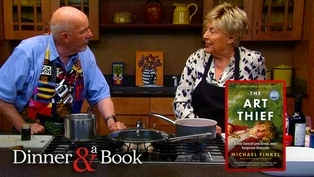
Tuck Langland joins Gail Martin to discuss "The Art Thief."
Tuck Langland joins Gail Martin to discuss "The Art Thief."
Problems playing video? | Closed Captioning Feedback
Problems playing video? | Closed Captioning Feedback
Dinner & A Book is a local public television program presented by PBS Michiana
The Art Thief
Season 25 Episode 5 | 25mVideo has Closed Captions
Tuck Langland joins Gail Martin to discuss "The Art Thief."
Problems playing video? | Closed Captioning Feedback
How to Watch Dinner & A Book
Dinner & A Book is available to stream on pbs.org and the free PBS App, available on iPhone, Apple TV, Android TV, Android smartphones, Amazon Fire TV, Amazon Fire Tablet, Roku, Samsung Smart TV, and Vizio.
Providing Support for PBS.org
Learn Moreabout PBS online sponsorshipDinner and a book is supported by the Rex and Alice A. Martin Foundation of Elkhart, celebrating the spirit of Alice Martin and her love of good food and good friends.
Why do people steal priceless art?
And how do they do it?
And what are the results?
Let's find out how Stéphane Brei and Anne-Catherine did it and why.
in Michael Finkel’s Fascinating book, The Art Thief.
Tuck Langland joins me to discuss one of the largest art heists in history.
Welcome to you all.
See you here.
Yes.
And what is this?
This is a London fog ring coat.
Well, it's very handsome.
It is handsome, isn't it?
Yes.
And what do you do?
What are you doing in the kitchen here?
Oh, I'm going to be cooking things.
I mean, like you're doing things over there.
Yes.
And.
And you're doing things to the Indians.
Flopping, slipping on the floor.
Excuse me.
I'm still doing things.
Okay.
That's.
Now we know he is here to hide.
Are you going to carry that around in your coat?
No, no, what I'm demonstrating is the way Stéphane Breitwieser did it, Breitwieser did it.
He wore voluminous coats.
His girlfriend had a big bag.
He would go into a museum.
They would look at something that he really wanted.
They would look for a distraction.
What's that?
Boom.
And he would get a case open, you know.
And he had already looked at it, and she had looked at it, and he had figured out how to open that case.
He had a little Swiss Army knife with a screwdriver on it.
And he was very adept at just pulling a screw up and opening a case and putting it back.
He was a very young man.
His girlfriend was young, and they did this all over the country.
We talked about it.
I mean, it was Austria.
It was the Netherlands, Belgium, France.
Well, I think they even got into Germany and they made such a practice and they became so wealthy.
Did they enjoy their wealth?
That was the whole point.
He did not sell a thing ever.
He thought that was a very, very bad thing to do.
They stole the art because they thought it was very beautiful.
And it ought to be in the home of someone that appreciated it.
Not in a dusty museum with people trudging past.
Half closed eyes.
No, that's why they stole and that's that was that was his reasoning throughout his life.
So in any case, we are going to be cooking some food from the regions where he and his girlfriend would go maybe twice a month for a couple of years, and they had ways of going into museums.
They would they would scope it out.
They'd look for the first thing.
Would they look for.
Well, the first thing they would often do.
First of all, you just scope out a museum and find out what they wanted to steal at a later visit.
Yes.
Then they also checked out escape routes.
How do you get out of here?
They would go into a museum.
There'd be a person at the desk at the front.
They'd have a little chat with them, maybe buy a ticket if they needed to.
Then they'd go in and he'd find the room with the thing in it.
She'd stand at the entrance to the room, looking around, and if she saw anybody coming up, she'd go off like that.
And they would.
And he would just don't know he have.
He has his coat on.
But that was the end of the heist.
So she was the lookout.
She was the lookout.
And she's the one that either said, let's go ahead with this.
Or she'd say, something's wrong here.
Stop.
Let's stop.
Let's don't even get started.
But once they took the piece and either put it in his coat or in her big bag, or even occasionally stuffed it out a window and then went round later to get it.
Once they did that, they were just as casual and call as could be.
Once they even went an eight in the the museum's restaurant for lunch, and they said to the guard, do you know where the restaurant is?
Yeah.
So they created even a trail of their, their doings.
And this book is so well-written.
The Michael Finkel is is really a good writer.
He's fabulous.
Right.
And it's this is simple, but you move with them to every heist.
You know how he does it.
How he unscrews the the.
Yeah, the Pyrex or whatever.
The doors are plexiglass.
Plexiglass?
Yeah.
And, so if they get something in the car, where does it go?
Well, they put it in the trunk of the car.
They drive off very slowly.
No screeching tires.
None of that.
Nothing to draw attention.
They want it to behave as unlike a typical thief, if they could.
So the people who say, well, they're not the thief, you know, and we'll get back to how they dress.
But I just want to talk about what we're making and let's get started.
I am making a small cassoulet.
I'll add a little bit of chicken tenders to it.
And the second part I will do a red cabbage.
Shoot croute, sauerkraut.
And you're making.
I'm making a French cream of mushroom soup.
I've got a good French knife here and a mushroom soup, like so many restaurants.
It starts with an onion.
Oh, yes.
Most, most, soups do start with an onion, don't they?
So many dishes do.
Well, I've got some oil in the pot here.
And we're going to, first of all, we're going to heat the, olive oil.
And then I'm going to add garlic, a little bit of garlic.
Oh you know, garlic always comes in right away.
And some onions.
Here we are.
I right now I have the onions in first.
And then we'll add a little garlic and, put that in.
And I'm dropping an onion of coarsely chopped onion.
This is going to have a lot of garlic.
But I like garlic in food I really do.
Growing up we never had garlic at home.
So when I got older and tried foods from other countries that had garlic, I said, wow, that's a kick in this food.
It's really good.
So I'm going to do this.
And then I'm going to add the wine.
Yes, we're going to add let's see.
Probably just a little bit here.
Well I should yeah I took the lid off.
That's the first thing you do a little red.
And then I'm going to add some time leaves.
Who's up over there.
Can you smell it?
No.
What?
It will.
It does.
Oh, it smells good to me.
And then we're going to put in three bay leaves.
And actually, some odd reason I have lost my dried rosemary.
So we'll just think about dried rosemary.
I didn't steal it.
I think you did.
I think it's not still there.
But in any case, we're going to start this meal.
And this is Tuscan.
I discuss where Castle leaves from and I've always had it in mind.
It's in the Alsace region of these various countries that come it together, that he steals in.
And we're going to add, after this, we're going to add some carrots and we're going to add celery.
You can add potatoes if you want.
Actually, it would be a good idea to have the potatoes chopped up.
You know, I've seem to have lost my spoon.
I'm not sure if it's bowl.
Here it is.
Yeah.
Right in my pocket.
You stole it and then you got punished.
You didn't have.
He could.
He could put fairly large, lumpy things in his pockets.
We'll talk about the tapestry that he steals.
He stole a tapestry.
A great big one.
He stole a rug by rolling up the rug and finding a window that he passed it out up into the bushes.
And then.
Just walking out casually find the rug put in the back of the car and away they go.
He was cool as a cucumber.
He really is.
And I'm putting tomatoes in here, chopped up, and then we'll chop up.
We've chopped up some carrots.
And it was that employed.
He lived in an attic above his mother's house.
With food.
Yes.
With whom?
With and with.
And saffron, his girlfriend.
And, she was his lookout.
And, you know, they they lived together, as you know what?
You know what that means?
Yes.
And so the went on these trips, he kept going on trips and they go all over France, Switzerland and, well, all the countries.
You name?
Yes.
Not Australia and any place they could drive.
They never had much money.
His mother would supply him with money.
And she and Catherine had a job in a hospital, basically emptying bedpans and cleaning goods.
But she was not a nurse, but not a nurse.
You did earn her money.
You earned a little money.
Yeah.
I'm adding some cannellini beans and goop and not the lid, though, and and then I'm going to add some kidney beans.
The beans kind of give it away to me that it's from that region.
So we have that in here.
And, the only thing I forgot to bring with some mustard.
But a lot of people don't like the taste of mustard.
However, this is our cassoulet, and it's going to cook for a while, and I'm going to remove this heavy rain coat.
I've demonstrated how he put things in his pockets.
And look at this.
Now you look like a peacock.
You look like a piece of art yourself.
Well, it's fresh from Kenya.
This, it's very, very, very nice.
So now we are talking about their lifestyle.
Why didn't they go into big museums?
Well, they did to a few big museums, but not very many.
The big museums have a more gardens, be better technological security such as cameras, motion detectors, things like that.
But what he would do, he realized that guards like to eat lunch.
They're also late lunch together, leaving very few smaller museums and smaller.
Yeah.
Yes.
Yeah.
And that's where they would scope out whether they had good security systems.
And when they had lunch, did they all go together?
I mean, you just don't walk in and say, no, no something you figure it out, you work out the heavy stuff.
Yeah.
We sound like we're we're ready to go.
But he was able to go.
For example, there was a but largest museum.
It was having a gigantic reception because they've gotten a great new painting by, by, what's his name?
The German guy, a great new painting.
And it was there in the lobby.
There were police all over and guards and lights and cameras and everything.
And he went in there and all of that crushed people and stole that painting.
Yeah.
And the way he did it was somebody shouted, thief!
See, if there was another gallery over there and some guy was trying to steal something.
And one of the things that, he always did was seize the moment.
Yes.
Do what happens.
Do it now.
Yeah.
Bang, bang.
He's able to get that painting down before anybody even noticed he's out the door.
And the thing that the the reception is all about is gone.
And very often nobody kind of looked around and follow.
They kind of fell asleep in these small museums.
We're going to take a short break.
We're going to continue cooking here.
And when we come back, we're going to talk a little bit about how they how this piece became such an obsession.
It did him in and in the meantime, let's take a look at some of the items that he stole from our book.
They're beautiful.
He loved the Renaissance, and they come back with these miraculous items.
So take a moment to look at these items and we'll be right back.
And I'm here with Tucker.
And we are discussing Michael Frankel's book, the Art thief.
Thief is right.
He's a good one, isn't he?
It's an amazing book, an amazing story.
Because it's all true.
He's alive now.
Yes.
Yeah.
This is all takes place in the late 90s and early 2000.
Yes.
And he's probably in his early 50s now.
The book started when he was in his 30s.
I want to start one last thing for my area.
That of, France and Germany.
Not a Germany.
He was in Germany, too, but he spent more time where the security was the most lax.
That's where they found out how to do this.
Small museums generally, that did not have big budgets for either guards or the technology with cameras or the motion.
Right?
Right, right.
They didn't have that.
And so and you know, these guards have been doing it for years and they'd fall asleep and oh my gosh, I'm going to put a little red onion in here some slices.
And this is red sauerkraut.
It's sure coat but I'm adding red cabbage this time I'm going to add some I'll get it some white wine I put it in the refrigerator.
Yeah.
And, Chuck, what are you making?
Well, I'm just finishing up the soup, and then I'm going to do dessert.
And to finish the soup, I want to add something you should always put into mushrooms.
And that is nutmeg.
Oh, yes, a fair bit.
You don't want just a little crumb or two.
And then what I'm going to do with it is do the last bit of the blending, which will be very noisy but very fast and do both smooth.
Okay.
And Perfecto.
Now you want to thin or do you like it thick?
How do you do it?
Which the cream.
The part of the soup.
Do you like it?
Real thick.
Well, the creamy taste.
Or not like it?
About like this.
That's just kind of okay.
Yeah.
All right.
And I've added some white wine to my red cabbage, and I'm going to just put in a little dollop of this vino rosso just to give it a little different flavor.
And we have red onion.
We have garlic.
And we're going to let this cook.
This is part of our Alsatian recipe.
Try this.
Sometimes instead of white cabbage it really is good.
And I remember one time we put in some great jelly to the sweetness to some of this stuff.
Just territorial.
Now, but still attract Orioles here.
Royal Orioles.
All three of the birds keep that jelly.
But they want jelly.
They don't want jam, so they want the jelly.
If you want to see them, don't one.
Welch's a schmuck.
There's no monsters.
Well, he's a lot of Welsh.
Is that absolutely the place you want?
Now, if you're making this mushroom soup and going to serve it to guess you want to look nice.
Here's a nice little trick.
You use the other end of the spoon.
Or in a little bit of cream and you can give it a bit of a swirl.
It snaps really, really well here, but it'll do it a little bit.
A little, little finding swirl.
Two little tiny pieces of garlic.
And voila, there is your mushroom soup I think person that garlic.
Did I say garlic?
Yeah.
Yeah.
What I meant pastor, you know.
What are you watching it right.
There you go.
Now, see, this is easy to do.
It's something different.
And they do eat red cabbage in Europe.
Oh, yeah.
And I, I think it's great.
So I am just steaming and cooking my cast away.
I do have a butter.
We call these what we call a casserole dishes.
And I could pour this in there and put it in the oven for 45 minutes.
I'm cutting that cooking time down by cooking it on the stove.
But we could put this in the casserole for the age, and we would have that ready.
So we're going to let this cook a little bit longer.
Now we find out that Catherine and Jeff on the phone, they have this huge bedroom.
Yeah.
And nobody is allowed up there, not even his mother, who?
It's in the top of his mother's house.
Is that big?
Her house.
And so nobody knows what's in there.
And they do what's in their bedroom.
There has so much art in there.
There are hundreds of pieces, paintings, sculptures, things of beauty, like cigaret boxes, tobacco boxes that Napoleon would have had made to please Josephine.
Things like, I'm very historic stuff, very valuable stuff, very bad.
And they would he would take guns, weapons, flint locks, swords, musical instruments.
Anything that caught his fancy and that he thought he could get out the door with.
But and he didn't buy it.
He didn't steal it to sell.
Never.
He hated that.
The Isabella Stewart Gardner Museum in Boston had a fantastic Rembrandt and a fantastic Vermeer.
Men with Masks and guns came in and took them.
So he didn't like that style.
He liked his style, you know.
Like what?
Oh, oh, it's gone, you know, and they haven't gotten the back yet.
But what happened is the guys who took the Rembrandt took a knife and cut it.
The canvas out of the frame and rolled it up so the paint cracks, etc.. And he just hates them because he knows they're doing it for money.
He's doing it for love.
Well, and that's the whole point here.
He's I'm not saying he's to be excuse, but he did it for love of beauty.
Yeah.
And she enjoyed going with him.
I don't know why she ever stayed with him so long.
She knew they were going to be in trouble.
And and you know, she finally got a little tired of this Bonnie and Clyde lifestyle.
And he kept protecting her.
He he would get arrested.
He'd get, questioned.
And what about her?
Oh, she had nothing to do with.
No, no, she had nothing to do with that at all.
Where are you feeling that?
Yes.
And we're revealing that.
Yes, he was arrested, but he was so smooth talking and he was so sincere about loving art.
Yeah.
And she just he protected her.
She wasn't allowed to be interrogated.
And I don't know if she split from him then she did.
Yeah.
And at a later time he was in a court and they brought her up and they asked her things about herself.
And she said, of course, I'm the mother of a nine month old boy.
That's a different father.
Who's that?
That ass.
And sit up straight.
That was a real wrinkle at the end there.
Well, I don't want to be a, give them too much plot away.
We don't want to say exactly what happens to him.
And actually, we don't know her.
Catherine and we don't know what happened.
Well, right now, today, she.
This happened about 8 or 9 years ago.
Yeah.
And, and if you try to Google it, you will see pictures of him and a pictures of her, but they don't say where they are now.
We don't know if they're in jail or out.
Well, he was in jail for he was in jail for quite a while.
Yes.
Oh, yeah.
And, in fact, the jailers enjoyed him because he was so knowledgeable.
An artist in some of the cities would come and visit him because he knew someone and they would send in the catalogs to these various exhibitions of things that he couldn't steal because he wasn't there, you see.
Oh, yes.
So, you know, we continue with this.
If the book moves fast, it's quick.
It's wonderful vocabulary.
I've read it three times and I never, never get bored with it three times.
Yes.
I don't get bored and it's just a wonderful book.
You're going to have the cover.
I know this is one of the things that he just adored.
This little boy sleeping, and, What?
It's the what?
Boucher.
Boucher is a French, a French artist.
I'm bringing up dessert, and he sort of felt like a king doing all this.
And he didn't think that just rich people should enjoy art.
So here is a very, very typical French dessert, a particularly a family dessert.
And particularly when the main course is a bit heavy, which the castle is a little light.
On the heavy side it is a lighter dessert, and it's got some cheese and a bit of fruit.
And that would be, that would be it.
Now I want to talk a little bit about this cheese.
It's, it's a you know, you think of cheese is very old.
This cheese began in 1980 was invented in 19 ancient.
Ancient.
So tell us 45 years old.
It's called Campbell's.
Zola.
It's a mixture of the words Camembert and Gorgonzola.
Camembert is French from Normandy.
Gorgonzola is Italy.
It's.
I don't word gorgonzola.
And, it's a German cheese.
So we have a little German cheese.
We have a little French at there.
And we have these grapes.
So wonderful.
This is usually the end of a French dinner.
And they have something sweet.
Before that, it could be a creme brulee.
It could be a little bit of chocolate.
And, Yeah.
You want a little bit of this?
I certainly do want a little bit.
Ooh.
That's it.
That's a big bite.
Oh, you you can do it.
I can do it.
All right, we'll try it.
It's got a kick.
Very good.
Here's your mushroom soup.
This is the first course.
Then we would have, we would plate up the capsule.
And then we would also played up the cabbage, the red cabbage.
We'd have some French bread and we'd have dessert.
Then we'd end with the cheese and the grapes.
And this is a very mild cheese.
It looks like a creative rumble but it's fairly mild.
This is mild.
Very nice.
It's a, it's a blue camembert.
There are others.
There was a cheese you could buy in the South Bend area for a long time called saga.
And it was this.
Oh, good.
There's a blue camembert and there's one called Blue Dress.
The town of Brest, Bourgogne, Brest, eastern way, eastern France makes a cheese like that.
And I can never find it.
I can hardly find it in France.
You've got to go to the eastern France.
We're coming to the end of this wonderful program, this wonderful book, and I. I just think it's a real pleasure to read about this unusual life.
And we hope that you will read the book.
You'll enjoy it.
The library has it.
And we hope you will make a French meal, a German meal, Swiss meal, and, enjoy your food.
Remember, good food, good friends, good books make for a great life.
And good friends.
Did I say that I. I think you did.
Yeah, yeah.
I'll say to you now, by the way, I've got your purse in my pocket.
Oh, I knew he was going to do something, I knew it.
So thanks for joining us and we'll see you next time This Wnit, local production has been made possible in part by viewers like you.
Thank you.
Dinner and a book is supported by the Rex and Alice A. Martin Foundation of Elkhart, celebrating the spirit of Alice Martin and her love of good food and good friends.
Providing Support for PBS.org
Learn Moreabout PBS online sponsorship















Support for PBS provided by:
Dinner & A Book is a local public television program presented by PBS Michiana