
The Color of North
Season 25 Episode 4 | 26m 46sVideo has Closed Captions
Shahir Rizk joins April Lidinsky to discuss "The Color of North."
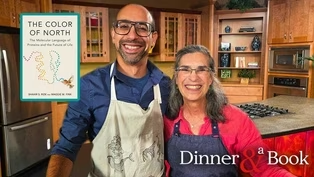
Proteins play a vital role in every aspect of life, including the food we eat. Indiana University Biochemistry Professor Shahir Rizk, co-author of The Color of North: The Molecular Language of Proteins and the Future of Life, joins April Lidinsky to explore how stories, creativity and food can deepen our understanding of the world around us.
Problems playing video? | Closed Captioning Feedback
Problems playing video? | Closed Captioning Feedback
Dinner & A Book is a local public television program presented by PBS Michiana
The Color of North
Season 25 Episode 4 | 26m 46sVideo has Closed Captions
Proteins play a vital role in every aspect of life, including the food we eat. Indiana University Biochemistry Professor Shahir Rizk, co-author of The Color of North: The Molecular Language of Proteins and the Future of Life, joins April Lidinsky to explore how stories, creativity and food can deepen our understanding of the world around us.
Problems playing video? | Closed Captioning Feedback
How to Watch Dinner & A Book
Dinner & A Book is available to stream on pbs.org and the free PBS App, available on iPhone, Apple TV, Android TV, Android smartphones, Amazon Fire TV, Amazon Fire Tablet, Roku, Samsung Smart TV, and Vizio.
Providing Support for PBS.org
Learn Moreabout PBS online sponsorshipDinner and a book is supported by the Rex and Alice A. Martin Foundation of Elkhart, celebrating the spirit of Alice Martin and her love of good food and good friends.
Proteins shape us and all organisms on our planet.
Scientists can help us understand our world through stories, creativity and, yes, food.
Doctor.
Shahir Rizk.
I U South Bend professor of biochemistry.
Joins me in the kitchen today for an inspirational and delicious discussion of everyday science.
Welcome Shahir.
Thank you.
I'm so glad you said yes.
So, And our book is your book.
So what inspired you to write The Color of North?
Well, I'm a biochemist, and I love studying proteins.
And because they bring me a lot of joy to to learn about them.
And I just wanted to bring that joy to a wider audience.
It is a joyful book, I got to say.
So inspired by this book.
Let's talk about what we're making today.
So what dishes are you making?
I'm making a dish that I used to make with my grandmother when I was a child.
This is it's a very simple fried fish.
We're using tilapia today, which is something that we use a lot.
I grew up in Egypt and the Nile tilapia is something that's very common.
And, we use a recipe.
All right.
Good.
And you're going to be talking a little bit about the, the actions of garlic in here.
And later you're going to be making a tomato salad.
That's correct.
Okay.
So and I'm getting started with a, it's sort of like Egyptian rice-a-roni.
I think it's pretty common to have, for many cultures to have a combination of grains.
So this is a rice dish that has a little broken up, and browned vermicelli.
It's delicious.
And later, I'll be making a fruit salad.
So, so this is a really unusual science book.
So why don't you talk a little bit about how you decided and why you decided to write this book?
That would be, you know, about proteins.
There's a lot of science in here, but really accessible and engaging to just, a regular reader.
That's what we hope to do.
We you know, there's obviously a lot of scientific information in this book, but it's also not quite a science book in the sense that it's just a bunch of information.
It is really a collection of stories.
So, my coauthor, Maggie Fink and myself, we wanted to really just talk about some personal stories as a gateway to introduce, the audience to a wide range of topics on what we love to talk about, which is proteins.
Yeah.
So it's, it's kind of a genre mix, isn't it?
You've got stories, you've got, drawings.
Yeah.
So that we can see what proteins look like.
See here.
And, Maggie, you're also artists, also a published poet.
This guy's got a lot of talents.
And personal, you know, bringing your personal journey into these, into these chapters as well.
So can you talk just a little bit about the structure of the book, which is really for people who enjoy novels?
This is clearly nonfiction, but there's a lot of, narrative links in here.
So how did you organize it and why?
Yeah.
So, the book is organized in chapters that start from origin, birth, awakening, and then all the way to death and then resurrection.
And each one of these topics, you know, kind of is, is a gateway to studying about one or several aspects of protein biochemistry.
Yeah.
So we use a bit of a, memoir ish typewriter.
Yeah.
Where we write about our stories, not just our stories in the lab, but also some of our personal stories in fact, one of the stories I talk about is cooking this very dish with my grandmother.
So tell us what you're doing to this innocent garlic.
Yes.
So what?
I'm telling them.
So warm up every time.
Every time I made this dish with my grandmother, she insisted that you had to crush the garlic.
You couldn't do it any other way.
And, of course, she was not a biochemist.
But now we know that crushing the garlic actually releases a protein.
It's an enzyme.
You may have heard of the term enzyme.
While enzymes are proteins, and they do all kinds of cool chemical reactions, this enzyme, in particular, carries out this chemical reaction that releases all the aroma that you smell.
That is that characteristic aroma of garlic.
And I'm going to add a little bit of cumin here by a little bit, of course, I mean a lot because, you know, you kind of add from the heart here.
All right.
And salt as well, for those that just add grit or does that also do work some magic.
The salt is for taste, the salt is for taste.
And salt really helps bring out the taste.
And one that's another another interesting segue into protein.
Yeah, yeah.
Because, you know, you proteins might seem like food and they are in fact, most of what we eat or a lot of what we eat contains a lot of proteins that are important for us to help us grow and do all kinds of things.
But then as we digest those proteins into their basic building blocks, then we're able to make our own proteins.
And those are essentially the worker bees in the cells.
We mentioned enzymes in garlic.
Well, we also have enzymes.
These enzymes are proteins that help us digest our food, help us move our muscles.
And even in our eyes, we have proteins that are photoreceptors.
This is how we see things in color.
We have a few of these proteins.
So many, many copies of them, that help us perceive color in the different ways that we see them, so that every part of our bodies.
I think there's so much conversation right now about how important it is to eat protein, but this book just kind of opens up all these other ways that proteins, work in the world.
In the opening chapter, you have this very appealing.
And they kind of really watch this because these the vermicelli browns very, very quickly.
Yes.
And then I'll just mention here this uses, Egyptian rice is short grain rice.
So I'm using, arborio rice, which I've been told is just fine.
You soak it in a little bit of water and salt, which kind of gets some of the, softening started, and then you saute it for a little bit before you add the water and salt for cooking.
So, so in your opening chapter, you have this very charming tripartite structure where you say, you and Matt, you say we're scientists, but we're children at heart.
We're scientists, but we're artists.
We're scientists, but we're storytellers.
And you've already mentioned Joy a little bit, but say a little bit about what that means for the kind of science that you do and what you're inviting us to enjoy.
Well, you know, humans really love story.
Yeah.
Growing up with my grandmother, I really enjoyed listening to all the stories that she told me as a child.
And it's much easier to get the message across from a story than from, you know, data plots.
Yeah.
We are just not wired that in that way.
In fact, it takes a lot of training for us to kind of move away from storytelling and then go into kind of the data point version.
And so what we wanted to do is just go back to our roots, our human roots in terms of just telling stories.
And really, science is a bunch of stories that we tell ourselves.
And it's it was really important for us to use that storytelling technique and then combine it with some art as well.
So we illustrated the book ourselves because as students, when we first saw the structures of proteins, you might see some of this.
I'd love it on your apron.
Right.
You're actually, this is the structure of a protein from whales.
It is called myoglobin.
Myoglobin is their way of storing, oxygen.
We also have myoglobin in our bodies, and we also use it to store oxygen in our muscles.
And it helps gives us a little boost when we are, out of breath, if you will.
Okay.
Well, whales do that to help them dive, and they have a lot more myoglobin than we do, which means they can dive a lot longer underwater.
And so we fell.
We fell in love with these protein structures.
They're just fantastic.
They look like abstract art.
Yes.
And we wanted to bring that to a wide audience, because oftentimes to get to protein biology, to understand the biology of proteins, you have to take several college classes just to get to study it.
It's not those who were English majors.
You missed out on a lot of this.
It's not very accessible.
And so we wanted to make that knowledge more accessible and really focus on the joy that it brings us.
Yeah, that is wonderful.
That is great.
So so so what you're about to do.
Yeah.
So what I did is just very simple.
I, I took the, garlic and crushed it.
Of course, you have to crush it.
Added a bunch of cumin and, some salt.
And I made this paste right here, essentially.
And what I'm going to do is I'm going to put the paste on the fish and just kind of cover it up it in and just rub it.
Is there protein reaction happening right now?
Oh, most likely.
So the the fish filets are basically fish muscle.
Okay.
You may know that muscle is protein.
I do know that, and in fact, you may have heard of proteins named actin and myosin.
These are proteins that are in our muscles and the muscle of many, many different organisms.
They're kind of like, long ropes that pull against each other.
And that's kind of how we move our muscles as these proteins move along each other, across each other, then we're able to move our muscles, bend or kick a soccer ball or do whatever it is that we need to do.
So as you're talking, I'm just reminded there's so many moments throughout this book where there are helpful metaphors that kind of rope and pulley system just reminders that every movement that we're doing is fueled by protein.
So, really accessible.
Interesting.
I think the more science, you know, the more exciting and curious, curiosity inducing the world is.
So I think that that joy just comes through in the acts of discovery that you invite us to participate in as well.
So how long do you marinate this before you cook it?
You let it sit around for a little bit.
It's really valuable.
I think you can let it sit for maybe 20 minutes to 2 hours.
Okay.
You can let it sit for longer if you want.
Okay.
What did your grandmother, too?
She let it sit all day because cooking was never about rushing anything.
Yeah, this is why, you know, the the cooking shows where you're racing with somebody else.
That's kind of very bad idea.
Yeah, it's kind of against everything I grew up with.
Yeah.
Cooking was something that is designed for tea breaks.
Yes.
Oh, love it, love it.
And I just love that you're sharing a dish that you that you learned from your grandmother.
So I'm just going to let this steam.
Wonderful.
While that is marinating, we're going to take a little break and you'll see some of these wonderful, I would say, whimsical line drawings from the book.
We'll be right back.
All right.
Chartier is going to finish his, fish dish here and tell me what you've been.
What's been happening in this bowl?
So it's been marinating.
And one thing I failed to mention is that we should add, some lime juice to add some acidity and really help with the marinade.
So that's been marinating.
Okay.
While.
And then while that's going, I'm going to make a quick tomato garlic salad.
This goes really well with the fish okay.
Delicious.
And you're actually using some of the rest of the paste.
Yes I think so okay.
So I didn't use all of the garlic paste that we crushed in the mortar and pestle.
So I'm going to use some of that for the salad.
And by the way I should mention these tomatoes come from the garden of my wonderful coauthor Maggie Fink.
Maggie's tomatoes.
That's great.
A collaboration in so many ways.
Collaboration is her contribution to the show today.
That's great.
And I'm just adding a little bit of parsley.
Fresh parsley for color here.
You can see this is, gourmet rice-a-roni.
Beautiful.
And it does give you kind of all sorts of different little toothsome, textures.
I'm gonna let this, cool down.
Maybe I'll actually put this on here and we'll serve that with the fish.
And I have a very easy task.
Easier than yours for this one.
She here has said that the, very common to just have fresh fruit, especially citrus, for dessert with Egyptian meals.
So I'm going to make it fancy by, using some goblets to layer some fruit in here.
And we'll top it with a little bit of ice cream for a nice fresh, taste at the end here.
So, so the book is full of, figures.
It's a very generous book in that way that you talked about, kind of mentors past and present.
And so many of them are women, which really struck me, with delight, I have to say.
So can you talk a little bit about some of these figures from, from the world of science, who has influenced you and the field?
Well, so the book talks a little bit about our stories.
So it's a bit of a memoir in that sense, but also talks about very influential people who were our teachers, one of whom is Professor Gretchen Anderson, who passed away in 2019.
She taught us biochemistry.
And, really, her story is amazing because she was someone who is an enabler.
She enabled us to do many things.
And she was, you could say, a catalyst for change.
And I was hoping you'd say that.
That in fact, the catalyst is, you know, kind of another name for an enzyme.
And so we're using this connection to a personal story about someone that we really respect, and someone who has really been a catalyst for change in our life to talk about how enzymes are catalyst for change within our bodies and within the lives of all living things.
And so while I do that, I'm going to show you how, I take care of the fish.
So you have to wipe off the excess here, and then I'm going to dip it in flour.
This is just some regular flour.
And then, I have some oil here.
Heating up medium high is fine.
Okay.
I have it on high for now.
And it's about, what, a third of an inch or something like that?
Yeah, it's about a third of an inch so that we can get a nice even fry on both sides.
Okay.
And so we decided to talk about some of the influential people in our lives, but also some of the influential people in the field of biochemistry.
We talk about enzymes as catalysts and all of living things.
And one of the main figures in understanding enzymes is a woman by the name of Maud Menten, who lived in the early 20th century.
She took a boat to, study enzymes all by herself, just a year after the sinking of the Titanic, to go to Germany to, study with another, scientist there.
His name is Michaelis.
And now we have something called the Michaelis Menten Kinetics model, which is something that we teach to this day because they're work with just within that one year.
It's something that we still talk about more than 100 years later.
Wow.
And, you know, just to kind of give you an idea about what they were thinking at the time, they had no idea that enzymes were proteins.
They were just these natural phenomena.
Oh my goodness.
So it's beautiful that something that she and Michaelis studied is something that we still talk about to this day.
And it really helps our understanding.
And not just on how enzymes work in a natural setting, but also how can we engineer new enzymes, how can we take what nature gave us and then do something else with it?
And that really takes us to kind of the final chapter in the book where we talk about protein engineering.
Can we take what nature gave us and then make some changes to proteins and then make them do new things that nature has never seen before?
All right.
Give us some examples of that.
There's some really cool examples.
Of course, we know how much plastic waste we've been spewing out into the planet.
Well, one of the things that some scientists have done is they've taken some enzymes and they've engineered them to chew up plastics that.
Wow.
Yeah.
So and there are some bacteria out there.
They're engineered with some really cool proteins and enzymes that will basically chew up plastics.
There are engineered enzymes or engineered proteins that will help detect pollution in our environment and will help us even break down these pollutants.
There's some that are involved in carbon capture.
So CO2 capture so that we can help with, global warming.
But there's so many that are also used for human health.
So you may have heard of something like Humera.
Yeah.
It's used for the treatment of many, many diseases.
Like a lot of autoimmune diseases.
That is an engineer's protein.
You know, so many of the biologics you may have heard of.
Yes, are actually proteins that are engineered to do a certain function.
And they are so good at what they do because they can be very, very precise, far more precise than our chemotherapeutic.
Okay.
Wow.
So so there's you can see there's just so many ways for readers to kind of, you know, get our hands around why this science matters.
These are really go into town here at this.
Yeah.
Fantastic.
Thank you.
I was a little afraid to fry, so it's good to be near someone calm who's doing it?
You know, I work in a chemistry lab, so safety is the top priority all the time.
This is a very safe set.
So while this is frying, I just want to show you what I've done with the tomato so I could.
Whatever the leftover, paste here from our garlic that was crushed with cumin and salt.
And I added a little bit more lime, and I'm going to just finish it off with a little bit of olive oil here.
Also, you like spicy food?
I do.
Excellent.
Me too.
I love spicy food.
So I cut up some jalapenos there and I'm just going to throw in to give an extra little bit of color, but also some depth and a little bit of spice.
Yeah.
So this is going to be our tomato salad right here.
So you've talked about current research.
But there's also you're going to flip these.
Yes I'm going to flip you see.
Oh gorgeous All right buckle up okay.
So we'll wait a little bit on these two.
Totally beautiful.
There is some nice history actually about smallpox and inoculation.
So what does that have to do with protein, proteins and.
Yeah, so there's a really great story that's in the book about, Lady Mary Montagu.
She was a, an English woman who lived in the Ottoman Empire late 1800s.
And basically she noticed a kind of technique that the Turkish women were doing was called a new to her.
Right.
But it's ancient technique that's called inoculation.
Smallpox was really just ravaging the world, and it was really destroying people's lives.
Something like one and three people died from it if they got it.
And and some of them who survived that were disfigured, fertilized.
Yeah.
Faced and terrible.
Terrible, really terrible disease that was really not eradicated until the 1980s, or 1979, I believe.
And so, what she noticed is that they would basically introduce children to, a small amount of the smallpox virus itself in a wound on a skin.
And what happens is that, in a sense, that protected them because it allowed their immune system to see it.
Now, of course, it wasn't without its dangers because you're actually introducing them to the real smallpox virus.
And so some people died, but not as many as the people who got it from a respiratory infection.
So it was much better.
And she tried to push that practice in Europe, but it got a lot of pushback, you know, for various reasons.
But again, another woman who was on the forefront of science, and I, one of the, culminating, well, I don't know, one of the themes in the book is how important it is for scientists to be able to speak to the general public.
This book is, again, so accessible.
So can you talk just a little bit about your work in helping other scientists communicate?
Yeah.
So we've noticed that a lot of scientists kind of have to have a lot of problems with communicating with the public, because we use so much jargon.
You know, we kind of invent our own language and then we expect people to just understand it.
So one of the things that, my coauthor Maggie and myself have done is develop some of these, workshops that help what we call untrained as scientists to become kind of more like, you know, the rest of us.
So this is one of our many efforts in science communication.
And, one of these is is, you know, basically carrying out workshops for young scientists to help be better communicators.
But we also have a podcast, great, Rust Belt Science, where we just talk, ooh, talk to scientists.
Look gorgeous.
Oh my gosh.
Well, we we talked to scientists about their research, and many of them do things that we don't know anything about.
So we're curious.
We're acting like little kids, which is, which is, the spirit of the book, for sure.
So I'm going to finish this with just a little bit of ice cream and we're going to, take a little break.
And, what are we doing for this bumper?
We're looking at pictures of your, your family.
And also she here at work with students.
I you saw that?
That's going to be right back.
So let's talk about these beautiful dishes.
That doctor she here risk and I have made inspired by his book coauthored with Maggie Fink, The Color of North.
These are personal dishes and also dishes that have to do with protein.
So what did you make?
So we made some Egyptian fried fish with garlic and cumin and lime.
We made some Egyptian rice with vermicelli.
And of course, there's, you know, you can't have fish without green onions.
And, my favorite salad is the tomato salad.
We use a very similar garlic and cumin marinade with, a little bit of lime and olive oil and some hard Pinas for just smells like summer here.
And I made a very, simple, but hopefully elegant, fruit salad with just a little scoop of ice cream on top that is sure to make anybody feel loved.
Which is, one of the feelings of this book is just joy and love.
You can feel it throughout.
So who who should read this book?
We really wanted to this book to be for anybody, and each chapter is kind of its own thing.
So if you really don't have time to consume an entire book, it's something that you can really, you know, put up and then put down.
You can really read one chapter at a time.
Yeah.
As they're kind of separate but continuous stories.
Yeah.
So science that is sewn through with personal stories that are both unique to you and Maggie, but that connect with all of us at any different stage of our lives.
Filled with beautiful line drawings and metaphors that make science accessible and exciting to any reader, it would be great for a book group.
So we've got some mint tea here.
I'm going to toast you for your inspiring work.
And this beautiful dish.
We hope that you will read widely and cook adventurously and think of science as something that belongs to all of us.
That is the spirit of this book.
Sure.
And we'll see you next time on dinner.
And a book.
Cheers again.
Cheers.
This WNIT local production has been made possible in part by viewers like you.
Thank you.
Dinner and a book is supported by the Rex and Alice A. Martin Foundation of Elkhart, celebrating the spirit of Alice Martin and her love of good food and good friends.
Providing Support for PBS.org
Learn Moreabout PBS online sponsorship















Support for PBS provided by:
Dinner & A Book is a local public television program presented by PBS Michiana