
The House on Mango Street
Season 25 Episode 12 | 26m 46sVideo has Closed Captions
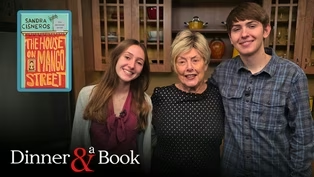
Gail Martin welcomes her grandchildren Ava Reedy Martin and Jude Reedy Martin this week.
Told in a series of vignettes, by acclaimed writer, Sandra Cisneros, The House on Mango Street is a novel of a young girl growing up in a mixed neighborhood in Chicago. Sometimes joyous, sometimes heartbreaking, this coming of age story tells the life of Esperanza Cordero who does not want to belong to her rundown neighborhood. Gail Martin welcomes her grandchildren Ava Reedy M...
Problems playing video? | Closed Captioning Feedback
Problems playing video? | Closed Captioning Feedback
Dinner & A Book is a local public television program presented by PBS Michiana
The House on Mango Street
Season 25 Episode 12 | 26m 46sVideo has Closed Captions
Told in a series of vignettes, by acclaimed writer, Sandra Cisneros, The House on Mango Street is a novel of a young girl growing up in a mixed neighborhood in Chicago. Sometimes joyous, sometimes heartbreaking, this coming of age story tells the life of Esperanza Cordero who does not want to belong to her rundown neighborhood. Gail Martin welcomes her grandchildren Ava Reedy M...
Problems playing video? | Closed Captioning Feedback
How to Watch Dinner & A Book
Dinner & A Book is available to stream on pbs.org and the free PBS App, available on iPhone, Apple TV, Android TV, Android smartphones, Amazon Fire TV, Amazon Fire Tablet, Roku, Samsung Smart TV, and Vizio.
Providing Support for PBS.org
Learn Moreabout PBS online sponsorshipDinner and a book is supported by the Rex and Alice A. Martin Foundation of Elkhart, celebrating the spirit of Alice Martin and her love of good food and good friends.
Told in a series of vignettes by acclaimed writer Sandra Cisneros.
The House on Mango Street is a novel of a young girl growing up in a mixed neighborhood in Chicago.
Sometimes joyous, sometimes heartbreaking.
This coming of age story tells the life of Esperanza Cordero, who does not want to belong to her rundown neighborhood.
This is a story of a young girl coming into her power.
Let's meet my guests, Ava and Jude Reedy Martin, who are also coming into their power.
Welcome.
Glad to have you.
Glad to be here.
Here.
And have you two back again.
This is kind of like what we did before, isn't it?
What were the books we did in the past?
We've done a Long Walk to Water and Percy Jackson and the Lightning Thief, and I think I can tell me children are still reading those books.
They're very good books.
And they were excellent.
And I just wanted to say that these are vignettes.
And you tell it tell everybody why she's using vignettes or what is a vignette.
Well, ultimately it reads almost a little bit like little journal entries where the vignettes really can capture the essence.
They're just very short little stories that are like chapters of 1 or 2 pages and then kind of capture the essence of a character or an event or a place.
Excellent.
Yes.
For those of you who think we think, well, I know what a vignette is, but to have it said and defined, I think is, is very helpful.
There are still many, many books waiting for us to read and to carry on, and I think I think this is a good program for going over books that make sense and help us in our living.
So you are now a junior in high school, and you are a sophomore at William and Mary, William and Mary.
And so you're building your power, aren't you?
You're also building your power.
And I'm still trying to build my power, too.
You know, we all have to define ourselves, but it takes a while for us to kind of stand up and say, this is what I want, this is who I am.
And that becomes your power and I can.
It took a while for me to kind of work that out in this story, but I think it does make sense.
Jude, is this is this girl that we're going to be talking about?
Esperanza, is she the author?
Is she a composite of people that the author is putting together, or is she the author herself?
Yeah.
So Esperanza is is the author in a lot of ways, but she's also distinct in order to tell this story.
So Sandra is known as the author.
She wanted to tell the stories not just of herself growing up, but also the people in her neighborhood and also people she met later in life when she was a teacher in her 20s.
So she didn't want it to just be a memoir.
She wanted to create a new story.
So she says that all of the emotions that Esperanza has are her own.
But there's also things that are different about Esperanza that kind of divide them and make Esperanza a distinct character.
For instance, Esperanza has a sister, and in real life, Sandra Cisneros did not have a sister, and that was kind of an important part of her childhood.
So there are definitely distinct aspects to the two of them.
Good.
We have that straight because sometimes I was getting confused.
But I think we we, we, we create based on our experiences too.
And right now I'm going to create experience by turning on the water here.
And I'm going to cook.
I'm going to put in some rice just to get started because this is an important part of our meal.
And the rice had a little moisture.
And it's like working with clay here now.
So we're going to put this together.
We're going to let this cook for about 12 minutes.
But what I'm going to do is let this boil.
And when it starts boiling, then I'll turn off the heat.
And we know automatically that that works.
Of course, as soon as I say that we'll have exceptions.
And I do want to turn this down a little bit because this is a very hot unit.
There we go.
And if you see that starting to bubble and I'm babbling on, let me know.
All right.
Now, and, so Esperanza.
Well, is there anybody holding her back?
And she is.
She moves through life.
Would you say either one of you.
Well, she kind of is holding herself back because she wants to escape Mango Street.
But in one of the vignettes, they talk about the three sisters.
These visitors that she's met with, they ask her to make a wish, and then they tell her, make sure to come back to Mango Street.
And she's kind of ashamed that they're able to guess that she wants to leave Mango Street, and she wants more from her life.
So, you know, she's a little bit ashamed, and she feels like she's a little selfish for wanting to leave Mango Street so she doesn't initially let herself.
Follow her dreams of wanting to leave.
She's a very she's a very, kind person.
And she studies the neighborhood and her family, and she.
But she wants to keep going and doing things that she wants to.
And I applaud her, because sometimes you can be so nice.
You don't get anything done for yourself.
And we see how she develops and develops her power.
And I wanted to say that, she is, she's a kind person, like you said.
She's kind, but she also is a is slightly critical because she wouldn't want to leave them.
I want to make sure this doesn't start cooking and boiling over.
What is she looking for?
As she gets older?
What is it that she is interested in?
Do you.
Do you remember?
What is it that really develops in her as a young girl?
I think she just really.
She starts to really want to have a house of her own.
And she she becomes more interested in her poetry and the stories of people around her.
And they're kind of, to a certain extent, serving as stories of what she doesn't want to become.
Yes.
You want to add anything to that?
Also, like I was saying before, you know she wants to leave Mango Street.
She wants to do more.
She doesn't want to just be confined to this neighborhood.
She wants more than what she's seen from like the other people around her who have stayed in Mango Street.
And like, Jude was saying, she wants a place of her own.
She wants, like, a nice house where she can, you know, write.
And she can continue her stories.
Do you think this book.
Well, I know there's a question I want to ask.
It's it's about what was the reaction of this book when it was published?
Were people, were they impressed?
Were they scandalized?
Do you have any sense of that?
I don't think they were scandalized, but she was a strong person and people that had never thought.
And young girls 35 years ago, determined to march on and do what they want.
What is it she wants to do?
Iva?
Esperanza?
Yes.
Esperanza.
Well, like we were saying, she wants to leave Mango Street.
You know, she wants to house it from.
Yes, yes, yes, she wants to become a writer.
And, And she is just so imbued with this idea, and I think I think it's amazing how she's directed her.
How does her family react to that?
Does her mother think it's a good idea?
What about her father?
How do they handle this ambitious young girl?
His girls were doing that back in the 50s.
60s?
Yeah.
Well, we'll talk about this more as well later.
But her mother is generally supportive.
But we don't hear much about her father and and and Sandra Cisneros his life.
That was sort of a very real thing where her mother was supportive and was a reader and wanted her to make sure she went all the way through school.
But there were different.
It's kind of a different set of expectations coming from her father.
And I think I think I must answer that question.
Yeah.
What do you think about her father or Sandra's father?
Good question.
Well, he is, at the time probably a normal, a typical father, immigrant father, very protective of his children, one of them to grow up in the same way that he and his wife had grown up, in back where they lived.
And I think it's Mexico, wasn't it?
Yes.
And that meant the girl stays home.
She takes care of the things in the house.
She marries a boy who takes care of all the money making.
And, the girls didn't even question what their roles are going to be or what they were able to accomplish.
And this young girl, she's not going to go with that, is she?
She wants to be a writer, and she really is desperate to become a writer.
And that's where that question of, she uses the line from Virginia Woolf, A woman must have a room of her own.
And what kind of room does she want?
Jude?
Well, so the author so the the character Esperanza is kind of still developing these ideas.
She's she's mainly focused on her poetry and kind of throughout the book, she's approaching that point of wanting a room of her own, and that reflects how the author in real life really wanted a room where she could just be herself, think about what she needed as a writer, and kind of develop her own personality and expression as a writer, which you really need to do well.
And she did.
She was amazingly directed, and I just can't believe how she came out of a kind of a tough area.
Her parents loved her.
They really didn't know what to do with a daughter that was so strong.
The mother was it couldn't believe her daughter would be this strong and wanted to support her.
The father thought, oh my goodness, what do we have here?
She wants to go live in a rundown house, and I spent all this money buying a an old house that we had to fix up.
And she goes.
Anyway, it's an interesting start for this life in this story.
We're going to take a little break right now, and then we're going to look at the menu for today's program, and then we'll continue with our cooking.
We'll be right back.
Okay.
We're going to start this food.
We're going to start moving it.
You're going to do what.
Now here I'm going to start heating up the barbacoa and the sauce We have and I want to tell you this is done by a restaurant named Esperanza which is in Elkhart.
It's on, Jackson.
And, what is the other street?
Oh, why do I have a blank?
I'll get that name, but it's in Elkhart, right on Jackson Boulevard and Prairie Street.
And they.
Since this takes eight hours to cook, they volunteer to do it.
And then I want to thank them.
Jorge, you were absolutely wonderful to work with.
And now what are you going to be doing here?
I'm also going to start cutting up some radishes that we can put on top when we're done.
All right.
It's a decor.
And tell us what you have done already.
So I will mince the garlic and I'm cutting up onions.
I'm going to sauté both of those.
And then I'm going to add beans and just cook all of that together.
And then you'll add some spices.
Spices come in good.
And then we'll squeeze some things like lemon juice not lemon juice lime juice.
And then we'll put some pico de gallo and oh, we'll just have a wonderful topping for some of this.
And, it I wanted to do it, but I thought, how do I do it?
Eight hours.
I could have cooked it during the night and then not slept very well.
But anyway, we are moving on, and I would like to say that we went to the show in Chicago this summer.
It was in September.
They have a book fair every year, and they were honoring this writer, Sandra Cisneros.
She is from Chicago.
She had a mixed life growing up.
She came back, they honored her.
They asked her about what she liked about Chicago and what she didn't like.
She was very generous about her feelings.
And she she, she just had to get away because it was a hard life.
And everybody was expecting, particularly the girls, to do what all the other girls had done and what they were going to be doing for the rest of the life.
And she knew she had to get away to avoid that kind of life here.
All right.
We've got this.
It's it's starting to simmer here.
I'm going to turn down a little bit.
So I had another question for you.
Why do you think this book was so highly regarded when it first came out?
Well, I think it was an eye opener for people who had not read very much about Hispanic neighborhoods and Hispanic girls and boys, and it cast a light on people coming to this country, and they're mixing with other people and their acceptance.
I mean, she she did think about where her life was going to go, and she wanted it better than her mother's.
And if you would talk to immigrants from other countries, you would hear some of the same stories.
I wish I could have done what my daughter did, or I wish I could have done what my granddaughter did.
And, this young girl just did it.
She did it.
And fortunately, her parents were smart enough to accept what she wanted.
She was smart enough to know that she should do the right things.
And I think the reading public was just sort of flabbergasted by her talent and her ability to write such a lovely book.
She has written many since then, and she was honored at this book fair.
So we got to see her talk about life in Chicago, and she still has that sound in her voice.
If this is my town.
But I needed to get away.
Hey, how are you doing here?
Stirring.
Stirring.
Yeah, right.
And you've got it all chopped up.
This is going to be sort of decoration, isn't it, when we get this all together.
And what's your next thing you're doing?
I'm also going to cut up some avocado that we can also put on top once we're done.
Good.
You do this at home, don't you?
You like to help out?
Yeah.
And you're a baker.
Oh my goodness.
And so is this one.
Is this is is the heat on?
Not yet.
I'm just putting it in.
Okay.
You can turn to medium or medium high.
I'd be delighted to do it and get the right burner.
You think after many years I would know this?
Very good.
So do you put the onion and garlic in together?
Yeah.
You put the onion in first for a few minutes because the garlic cooks much quicker and we don't want it to burn.
We?
Yes.
And then we'll add the beans later.
Good.
I wanted to ask about you said that, you know, this isn't a story necessarily unique to Hispanic Americans and Americans.
It's also something that many immigrant groups experience.
So can you tell us a bit about a woman in our own family in Chicago who had a somewhat similar story?
Well, I would say, my aunts and my my grandmothers, they all worked and they loved working.
They were kind of the backbone of the family.
And, I was amazed at, how clever they were.
And they just didn't sit home and make nice little pastries and things.
They were working hard, and their daughters were working hard, too, and they all joined in.
And I think, I'm trying to think if there's one particular story, I know my mother saved money so that when the depression changed, she could buy back the house that her in-laws owned that was lost during the depression.
She had saved $4,000 from that bought back the house.
So it became acceptable to do these things because the family saw that the women were strong and should do this and should help the families.
But I think it it might have caused a little bit of a ruckus.
To who do these women think they are?
They're coming in and they're running the household and they're doing this and they're doing that.
And, there was some pushback.
And I think this book, you know, unfortunately ended up on the list of 24 that banned books, banned books.
So why do you think, do you think it was too generous for women to give women all this power?
I think it's just it's a, it's a coming of age story.
And so that's always kind of controversial.
Like how how should that be portrayed?
What sorts of themes should be included?
And so, yeah, sometimes, you know, people are just going to be unhappy if they think something they don't want any change.
We get kind of scared and we want to protect themselves from this change.
You are all set here, aren’t you You've got your avocado radishes over here.
Is cilantro, onion pico de gallo and we even have some more cilantro if we need it.
Our our food is heating up.
How are you doing here?
Oh, you can add the garlic.
No.
Yeah.
So far, so good.
There's no one's burned.
No one's been stabbed.
Very good.
Nobody cut their fingers.
So.
Okay.
And I'm glad you've got a witness.
Food that's perfect.
Now, do you and your your, items here, right away?
No, no, I'm going to wait until I see the beans and and then put in the spices and some little water.
Look at where.
You know what?
I'm going to turn this down.
See how those edges of the onions are already starting to turn.
And this is just they cook back.
Yeah.
This is good.
Now I just want to say you will see this on menus in most in many, Mexican restaurants.
And you ever seen barbacoa on a Menu.
Yes.
Oh, you're way ahead of me, you two.
Yes.
Yeah.
Barbacoa.
They have one.
They live in Washington, D.C., and you have a favorite restaurant, the Spanish restaurant.
What was that called?
you remember we all went there one time for breakfast, and then we went, I think a Paraiso, El Paso.
And, it was very nice.
Wasn't?
Yeah.
Colorful.
It was friendly.
And I thought it was great.
I'm trying to think where we are in the time here.
You're going to put in your beans, and, And we might even decorate this platter here.
Oh, we have just two minutes to go.
Do you want to get your beans in here?
Yeah, you are good.
And I'm not going to lift the lid.
The.
I don't want to break the, excitement under this here.
I think this business of power, it sounds more harsh than it is.
What it means is your self-discovery, your strength, your inner strength.
And for some people, it's a trip that they took this.
They found that they could survive on their own, or they met people.
They knew how to ask questions, or it was with work they were doing with other people.
You develop this personal power.
We never talked about power.
Did you feel you you are, you are.
And this is your time.
It's our time to talk about power.
This is your time talking about that Jude.
How do you recommend students develop their personal power?
I think that it can just kind of pursuing your interests and listening to those around you.
I think kind of teachers and adults can can do a lot in the story, Esperanza as mother, reveals that she to her daughter that she she dropped out of school because she was worried about the clothes she was wearing.
Yeah, she kind of says sarcastically.
I was one smart cookie then, and so I think that's important to be able to kind of reveal your mistakes and weaknesses so they can teach your children or just kids that, you know, things don't have to go a certain way.
There's a there's a better path that you can take.
Yeah.
Well, I'll tell you, we're going to start putting this on the platter.
Let me bring the platter over here.
You can put the meat on and you're still going to cook this for a while, right.
Yeah.
You want to stir that up.
So you get that coming over and all the beans.
This is really a favorite dish.
Many people.
And today, as I said, I may have said it already, Mexican food is the most popular food in the United States.
Did you know that?
I don't think I did.
Yeah, you do, don't you?
Yeah.
This looks great.
Is that a good job?
We're going to take, we're going to just take a moment to, get ourselves ready for the final segment, and then we'll be right back.
And so you see the book.
It's been wonderful.
It has taught us so many things about people surviving and being appreciative of their background.
And coming back, fulfilling their life dream.
And I just want to say, I think this food looks terrific and barbacoa and you're going to add the final touches, aren't you, for this, barbacoa with the rice and the ribs.
And look at all these nice extras.
You're going to be a decorator, right?
You need a sprinkle around.
Oh, yes.
Lovely.
The you both cook at home.
When you're at home with your family.
That's why they love this kind of food and this kind of prep in this kind of, of activity.
And we have a nice.
Oh some onions to sprinkle.
And avocado.
Yeah.
Yes.
Okay.
We have all this but I think we also have something else for dessert.
Oh really I hadn't planned on anything.
Okay.
Let's see.
And we can also put a little gravy on a little sauce a little sauce, they call it sauce.
Yes.
And just kind of drizzle it on the meal.
We have dessert!
Excuse me.
Mother, thank you for sharing this wonderful story and for your 24 years of Dinner and a Book and sharing all these wonderful stories with the WNIT audience.
Oh, good.
Thank you.
We had a good time.
Yeah, we read a lot of good books, and there are more good books to come.
So join us and read, read, read.
It makes for a great life.
Thank you for this cake.
It's such a delight.
Look at this food.
Thank you.
Wonderful and thank you for watching Dinner and a Book.
We're so glad you're here.
And remember, good food, good friends, good books, good family, make for a wonderful life.
We'll see you next time.
Thank you.
Thank you family.
Thank you.
This WNIT local production has been made possible in part by viewers like you.
Thank you.
Dinner and a Book is supported by the Rex and Alice A. Martin Foundation of Elkhart, celebrating the spirit of Alice Martin and her love of good food and good friends.
Providing Support for PBS.org
Learn Moreabout PBS online sponsorship

- News and Public Affairs

Top journalists deliver compelling original analysis of the hour's headlines.













Support for PBS provided by:
Dinner & A Book is a local public television program presented by PBS Michiana