
The Island of Missing Trees
Season 25 Episode 3 | 26m 46sVideo has Closed Captions
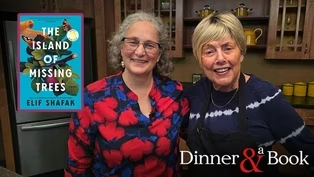
Laura Horst joins Gail Martin to discuss "The Island of Missing Trees."
The Island of Missing Trees by Elif Shafak is a story of two teenagers from the northern part of Cyprus who meet and fall in love during a disastrous war that leaves them separated for years. Laura Horst joins Gail Martin to make a meal representing Greece and Turkey and both sides of Cyprus.
Problems playing video? | Closed Captioning Feedback
Problems playing video? | Closed Captioning Feedback
Dinner & A Book is a local public television program presented by PBS Michiana
The Island of Missing Trees
Season 25 Episode 3 | 26m 46sVideo has Closed Captions
The Island of Missing Trees by Elif Shafak is a story of two teenagers from the northern part of Cyprus who meet and fall in love during a disastrous war that leaves them separated for years. Laura Horst joins Gail Martin to make a meal representing Greece and Turkey and both sides of Cyprus.
Problems playing video? | Closed Captioning Feedback
How to Watch Dinner & A Book
Dinner & A Book is available to stream on pbs.org and the free PBS App, available on iPhone, Apple TV, Android TV, Android smartphones, Amazon Fire TV, Amazon Fire Tablet, Roku, Samsung Smart TV, and Vizio.
Providing Support for PBS.org
Learn Moreabout PBS online sponsorshipDinner and a book is supported by the Rex and Alice A. Martin Foundation of Elkhart, celebrating the spirit of Alice Martin and her love of good food and good friends.
Two teenagers, one Greek and one Turkish, from the northern part of the island of Cyprus.
Meet and fall in love during a disastrous war that leaves them separated for years.
I heard about this war when I was in high school and have met many people from both sides.
The food there is excellent.
No matter what side you represent.
And I have enjoyed no loved both Turkish and Greek foods.
Let's meet my guest, Laura Horst, to discuss today's book, The Island of Missing Trees by Elif Shafak.
Hey, welcome.
Thank you.
Good to have you here.
And your colorful shirt.
Give us some energy.
Oh, great.
Well, I love to be here.
I wanted to tell you that I have been marinating chicken in all kinds of spices and creams, and I want to put them with some potatoes in the oven because it looks great.
It does, doesn't it?
Yeah.
It's not so colorful, but it's supposed to be tasty.
And we'll get right back to what you are going to do and tell them what you're going to do.
Well, I'm starting off by setting some onions and a little garlic, to get ready to make what they call a day, which is basically sort of like a, Turkish flatbread.
So this is going to be a different sort of, topping for it than what we would think of.
But it's kind of like a French flatbread.
Sounds good.
Yeah.
I have you have used a special dough to make this.
Well, yeah, I kind of cheated.
That was like a raised dough and all of that kind of thing.
And so instead, what I did was I got some frozen bread dough rolls, and I bent.
I put two of them together to get a big enough piece to roll out four for the base.
So I have a couple that I have on the way, and we'll add in some chicken and, a few peppers to this and put on top of it with a little feta cheese and put that on top of that.
Don't forget, this is some of the best food, most healthy food in the world.
You are going to see Laura.
Put it together here.
Now when you say cheeses, I don't think you cheated.
I think you used your smarts to overcome some things.
It would take longer.
And that's true when you don't have a lot of time.
It is.
It is that is that frozen bread dough is very handy.
I just threw it in the, Threw the frozen pieces in the refrigerator.
And then when I was ready for them, they were already raised and ready to go.
They're they're raised waiting for you.
We also brought some.
Not.
Well, they're orders.
Okay.
Together.
And for example, right here in front, we have a dish here of some, not crudites, but orders.
What's your method, man?
So messy plate is what kind of call a wish anyway with.
Yes.
And you know what we're making.
There's a Turkish word for it.
And the Greek word for it.
If you look at the dough here, this is the rows of three planes with food in them, usually rice, cooked rice.
And then you cook it in the oven.
And this is the stuffed, grape leaves.
And I have made them, you know, from scratch.
And it's fine.
And, but, you know, we have so much going on here and we don't have it all the time to give it more.
Row unrolled and rolled up and then baked again.
But I have marinated, some chicken with some potatoes in the oven, and that's going to be our main course.
And it's a very typical Greek chicken dish.
And of course, we have our, appetizers.
Start with and this is something you would serve.
You know, it's the beginning of the meal, and I just wanted you to know that in this part of the world, when you talk about Serbia and you talk about Romania and Bulgaria, and you talk about Greece, you talk about Turkey, this is where they make the dough.
Not all of the stuffing Greek leaves.
And I'm using the Greek word so it's a typical for girls in that part of the world.
Nothing better.
I suggest you go to Greece, you climb up to the Parthenon and you eat this wonderful food.
And we have some Greek wine here.
And this is offered by Captain Janice Line.
Living love Greek wine.
And I don't have any Turkish wine, but, you know, that's a muslim country, so they don't really sure drink that much.
But of course all the tourists do.
So you are now putting your chicken in.
Yeah, but the onions and the peppers, it didn't take very long to just sort of get a little transparent, and I'm just putting some, some chicken.
It's just shredded chicken.
But I had, you could use a, rotisserie chicken.
Yes.
It was leftover from you.
Registered chicken for day two, maybe.
Yeah.
So.
And this is just this is just kind of getting to be the topping, and, you know, you you learn as a child the mothers need in the kitchen how to make food from scratch.
There you go.
And now you are learning.
Since you work full time, you have found shortcuts here.
And and you don't have to apologize if you're using shortcuts.
Or you can find something because we can't be in the kitchen for three hours after we work nine hours and this sort of thing.
So you're doing a great job, and this is going to go on top of your, rolled out, rolled out dough.
They call it a PD, pd, pd, and it's a typical Turkish.
Yeah.
The Turkish food sounds good to me.
And what did you think of this book, Gail book?
I loved it.
Yeah, we have to talk about the book.
Yes I do, this is a historical.
This is.
This will help you understand trees better.
The father is a botanist, and he in another he other things.
His name is Constance.
And the mother?
Daphne.
She she tragically, passed away.
Yeah.
And we start sort of hearing from Ada the daughter, and she's sort of dealing with life and grief, and then, ends up finding out more about her mother and father and how they met.
And the mother is Turkish and the father is Greek, which is this kind of a big no no, this is a huge no no.
In the 70s, 80s, probably even today, I don't not I hope not, I hope I'm wrong, but, and then we have wonderful foods from both sides, but we have wonderful drinks.
We have flavors.
And don't forget, this is our area of the blue.
The song food where they.
It's the blue zone.
Japan and Greece.
This area knows how to eat well and carefully.
So, So this now this is.
I turned it off.
We'll be able to put it on, on, on top of these, and then they'll pop in the oven for a little bit.
I was you said to me, you read the book three times.
So tell me again, because you said you read it three times and learned something every time.
Every time you heard about it was such a wonderful book.
And you learn about songbirds and you learn about monarch butterflies.
You learn about parrots that live with people, and it makes life so interesting the way they conduct themselves.
And and of course, they really get to the heart of what living is like through living and eating.
And but they have this horrible time of the the warring between the Greeks and the Turks.
And that is so sad.
I did read it every time I read it, I found something new.
Yeah, yeah.
And and I thought, oh my gosh, how I could remember all this.
And the first time I read it, I was, I thought it said fig tree.
And then it was talking away and I it I at first I didn't realize that it's the fig tree talking.
Yeah.
So it's the from the perspective of the tree of the tree and what an interesting thing.
That the fig fig tree is the main character or a main.
They're very important.
It knows all about the history of what happened, how her parents met, all kinds of things.
Because this fig tree was growing in the middle of a bar in Cyprus.
The happy thing, the happy fig.
Yeah.
And the people had a good time before the war.
You had a mixture of people coming in and enjoying this place, and I think they were happy going there.
And the fig is a central character, there's no doubt about it.
Yeah.
We learn about how the ants live in the tree.
We learned about how the monarch butterflies come in and settle in the tree.
We learn about so many things, about fig trees and, and, I have to say, some people have them in the United States.
You have to live in a certain climate so they don't freeze today.
But my children had a fig tree.
They moved into a house with a fig tree, and it was already starting to die.
And this book said, when it's dying, you have to almost help it along the way.
Oh.
Interesting.
Yes.
Yeah.
But this and we also learn how to transport and grow a fig from a little cutting, a cutting.
And you're right, you they took a cutting and they put it in their suitcase when they moved to London.
And we wouldn't be able to do that.
Oh, heavens.
There's no way you can transport Iceland north into the into a van or something.
Yeah, yeah.
And, so this was, so this is, I was just going to say I put the topping on.
I just put it kind of randomly, and then I added a little bit of, a little bit of feta cheese, and then I'm just throwing a little bit of parsley on top and a little cook for, I don't know, 10 or 15 minutes.
So something so we're going to unveil it in the second part.
And we're going to continue with our presentation and what we're doing.
In the meantime, we want you to take a look at the menu for today.
And we'll be right back.
So don't go away.
And we're back with our wonderful book, The Island of Missing Trees.
And Laura has nothing missing.
Right here.
Tell us what you just pulled out of the oven.
The Turkish pita.
It's like a flatbread, kind of.
And I think I'm just going to move them right here onto our plate.
And these can be ready for us when we're ready for it.
Now, is that go with the main course or is it part of the mesa?
The, I bet it's part of the Mesa or the festive plates.
Yeah, which would be an order sort of thing.
And it's the same thing we have on the dish here, the mesa here with the stuffed leaves, and then we have the figs, and now we've got to move on to the chicken.
I want to pull it out, and I want to add another bit of, the dressing, the Greek dressing.
And we will pull it out and then put it back in again.
And it really is coming along very nicely.
I'm going to come this way.
Sure.
And now that is coming along really nicely.
Yes.
And you know, what I'm going to say about this is I'm going to add, of course, the this is part of the, marinade.
We don't get rid of anything.
You see.
You keep it and then you put it back on and it's back in the oven for 20 minutes.
The potatoes are roasting.
You don't waste a thing.
Use it.
You said.
Oh, so there we are.
Oh, that'll be really delicious.
So it's going back in and I'm going to make a second, second dish for our sort of our messy, our meal.
And it's, Turkish pea salad, so it can be warm, or it can be cold, or it can be room temperature, sort of whatever.
Whatever.
You would like to do it.
And I actually think it's better after the second day, after the herbs and things have marinated in it really nicely.
So I did, I fried up a few more onions and some garlic and a few little fresh herbs, and now I'm going to add our tomatoes, some fresh tomatoes.
All this fresh food.
Yeah.
Yes it's great.
Oh my.
The same foods.
But they're just so good for you and so tasty.
Right.
And we're going to just start cooking down you can kind of see I ended up I had a yellow tomato and some red tomatoes.
So it makes it really nice and colorful.
It is colorful.
And then I'm just going to add some of these I went easy frozen peas and carrots.
And I'm just going to put those in as well.
And this will just start cooking together.
And this is part of our kind of our order of our messy means the middle of the day I think.
Yeah.
And so you can have this food all day long I think.
But it's.
So you're going to do that.
Here's what I'm going to do for my salad.
Now this Greek or Turkish salad does not have lettuce.
It's chopped tomatoes.
It's chopped olives cucumber.
And now we're going to put in well I want to put in some of the fellow feta has some tomato in it too.
And sometimes they use a farmer's cheese which I think you have.
Do you have.
That's farmer's cheese.
I have goat cheese.
You have goat cheese.
She might.
Yes, but I like I like the cheese.
I like the fact that this is all packed with vegetables.
And then the dressing.
Oh, this is the real killer.
You just take a squeeze.
A lemon.
And I'll take another half here.
And we're going to squeeze some more lemon.
And I put some salt and pepper on here.
And we're going to add olive oil.
And that's our dressing lemon juice and olive oil.
And more and more people are starting to use this as a healthy salad dressing.
No more all of that kind of fatty salad dressing that we seem to love.
And so here this is salad dressing.
I have two servings.
This is one of my favorite foods.
From the section of a blue country that has the best food for you.
And remember, Greece is one of those countries, right?
They always say the Mediterranean diet is what you should.
And that's what we have here.
Look, this is just coming on.
And, and you were saying you could eat it for breakfast or for lunch or for dinner for a late night meal or kind of whenever it suits you.
You know, there's just so much going on in these countries.
But this foods stays forever.
I mean, they try other foods from other countries, but they have figured it out.
Greek and Turkish food is second to none and they love it.
And I like it too.
I really I really think it's amazing.
So we have our amazing here.
We have our salad, one for each one of us, and we have our cute little pita.
Yeah.
And you're doing your vegetables.
My chicken is still cooking.
We have probably another five minutes to go on that.
And I have added a French dessert.
I mean, we could have made baklava.
I mean, I'm glad that I, you know.
But anyway, baklava is served.
It's made.
It served in about 20 countries, all with a little different twist.
So I decide I will make well, I will present these wonderful I can't remember a clear.
Yeah.
Clear eclair.
The French are very popular in Greece.
They like their food as well, because the French like healthy foods.
They've gotten away from a lot of the fatty sauces and so anyway, we have our salad, we have a dessert.
Now we just need our main courses.
And we're going to keep preparing here and some more yogurt here Greek yogurt I'm going to put it here so you don't forget.
It's good for you.
And what do you want to say?
Well, I just wondered what you saw it about for the book, there is a period of time we start out sort of in the 70s, where they are falling in love.
We already said that.
And then, the war is happening, and then Costa, the father, the father.
But then they're just a couple, a young girl, he gets sent away to London to be with a uncle, and she is there and sort of feels abandoned.
I mean, I think he still a no, they're not even Daphne.
Daphne the wife?
No, she's not.
You know, at that point, they're just sort of a couple.
And so but then it's years later, years later, till he for some reason comes back to the island.
I don't remember why, but she has.
And he and he finds her, she is working.
It has a person that's helping volunteers.
And they're digging up the bones of people that have died in this war, buried during that war.
And they were buried somewhere, and their families don't know where they're buried.
So they're doing all of this sophisticated identification DNA stuff so that they can tell the families the this is the person that was missing for your family, and Daphne is the one that is doing this.
Right.
And I think this really doesn't say in the book, but I think this really affects her.
She and she's born with a very melancholy streak.
So all of this adds up and just presses on her.
And there's some things we aren't telling you.
We want you to read the book.
Yeah.
So you discover it.
It?
Yes.
Oh, this is this is so good.
I mean, it's at this point then we start talking about aunts, I think, and how, how important they are for the tree.
For that tree.
This tree always is in the story.
And, so, yeah, this tree is just a main character.
And we learned so much about botany, but I like how to identify people that have died in war.
How do we get the families back together?
The sister of Daphne.
Mariam.
She's.
There she is.
She comes to meet Ada.
Ava.
Yeah.
Yeah.
Right.
Then she's never heard his niece.
And this is the daughter of Cosette and and Daphne.
Right.
And and so it is complicated in ways.
But all of a sudden, you sit there and you go, oh, I get it.
Know works together, right?
Right.
And, yeah, it it's such a good story.
It's just really good story.
It's kind of a gripping book.
And it's just got so much in it.
It's really every time I read it, I read something more.
I focused in on either the ants or I focused in on.
And the fig tree in this fig tree, you know, part of it, a little sprout is taken to England and it's planted in England.
And maybe there'll be a follow up.
Maybe.
And I know I'm gonna add a little dill weed to this, to sort of.
Why not?
I love I love dill.
Yeah, yeah.
And you have your little garden over here and you're in your house.
I was the Greek all right?
And relatives.
And each one of these dishes has a little twist, depending on whether you're a Greek or a Turk.
Right, right.
And this is a beautiful part of the world, and it's not a place you just go to break plates.
We always hear about people in restaurants in Greece breaking plates.
There's so much more.
Oh, we are gathering ourselves together.
And I just had a minute warning here.
And can I take my chicken out?
The chicken will be ready probably in a little while.
And, we'll gather all of our food together.
Right.
Spencer?
It's it is, it is.
And it's your choice of book.
Yeah.
I think about where you found this book, because we're going to come back and do a little more.
We're going to take just a little break.
And then when we come back, we'll put our meal together and we'll reminisce and we'll talk about more important things.
So stay right there.
We'll be right back.
Laura Horst and I welcome you to our lunch, our dinner and our messy all three meals here.
And, I just think this is been a wonderful experience doing all this cooking.
Yeah, it really kept us busy, didn't it?
It did.
But.
So why don't you start with your presentation?
So I made, chicken, pita.
And it's a Turkish flatbread and with some feta on it.
And then I also made a pea salad, Turkish pea salad that can be eaten room temperature or hot or cold.
And it can be part of that long table of matzah presentation.
And, and actually, I think it looks wonderful.
And I've added here a part of the order or the masa, which could be served as a course itself or at the table.
People have, fresh fruit drink with it.
And if you're in Turkey, you probably have that in, Greece you could have that or some wine like our retsina here.
And I made the, the, the salad from that part of the world that's made a little bit differently depending on what country you're in.
If you're Romanian, it would look one way.
If you are Serb, it'll look another way.
In any case, I thought I could be all things to all people here in this salad.
And then, let's see, we have the chicken dish.
Oh, my gosh, this is a turkey, a Greek recipe with the roasted potatoes.
And I have marinated the chicken overnight.
It should be for 24 hours.
I think mine was about 16.
And, I think it'll survive.
So this will be beautiful with the vegetables.
You see, we have the sound.
We have a real feast.
We have a feast?
Yes.
It's beautiful.
And, I think I have my French éclair.
And we are going to say that we loved the book.
Absolutely.
Really loved it.
I highly recommend it.
I do too, it will.
You will learn so much and you will enjoy the romance and their sadness too.
But that's life, isn't it?
Yeah.
We're glad you joined us today.
I'm glad you said yes.
Thank you, Gail, for inviting me.
And thank you for finding the book.
Yeah.
You're amazing with these book signs.
And we're glad that you're watching.
Stay with us.
Come back next week, and we want to say thank you.
And good food, good friends, good books make for a terrific life.
We'll see you next week.
This WNIT Local production has been made possible in part by viewers like you.
Thank you.
Dinner and a book is supported by the Rex and Alice A. Martin Foundation of Elkhart, celebrating the spirit of Alice Martin and her love of good food and good friends.
The Island of Missing Trees Preview
Preview: S25 Ep3 | 19s | The Island of Missing Trees Preview (19s)
Providing Support for PBS.org
Learn Moreabout PBS online sponsorship

- News and Public Affairs

Top journalists deliver compelling original analysis of the hour's headlines.













Support for PBS provided by:
Dinner & A Book is a local public television program presented by PBS Michiana