
Uses for Obsession
Season 25 Episode 2 | 26m 45sVideo has Closed Captions
April Lidinsky to discuss the present - and future - of innovative cooking.
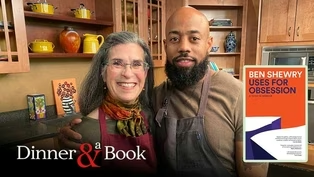
New Zealand chef and restaurateur Ben Shewry’s memoir, Uses for Obsession, is both the story of his career and a manifesto for reviving local food traditions. Chef de Cuisine Dont’e Shaw of Post Boy restaurant in New Buffalo joins April Lidinsky to discuss the present - and future - of innovative cooking.
Problems playing video? | Closed Captioning Feedback
Problems playing video? | Closed Captioning Feedback
Dinner & A Book is a local public television program presented by PBS Michiana
Uses for Obsession
Season 25 Episode 2 | 26m 45sVideo has Closed Captions
New Zealand chef and restaurateur Ben Shewry’s memoir, Uses for Obsession, is both the story of his career and a manifesto for reviving local food traditions. Chef de Cuisine Dont’e Shaw of Post Boy restaurant in New Buffalo joins April Lidinsky to discuss the present - and future - of innovative cooking.
Problems playing video? | Closed Captioning Feedback
How to Watch Dinner & A Book
Dinner & A Book is available to stream on pbs.org and the free PBS App, available on iPhone, Apple TV, Android TV, Android smartphones, Amazon Fire TV, Amazon Fire Tablet, Roku, Samsung Smart TV, and Vizio.
Providing Support for PBS.org
Learn Moreabout PBS online sponsorshipDinner and a book is supported by the Rex and Alice A. Martin Foundation of Elkhart, celebrating the spirit of Alice Martin and her love of good food and good friends.
New Zealand chef and restaurateur Ben Shewry's memoir uses for obsession, is both the story of his career and a manifesto for reviving local food traditions.
I'm so excited to share the kitchen with chef de cuisine.
Don't shore of Post Boy restaurant to New Buffalo to discuss the present and future of innovative cooking.
Yes, welcome, Chef Duncan.
Thank you for having me, I appreciate you.
Thanks for saying yes to this.
So thank you so much.
You already knew about this book.
Yes.
Do you know about uses for obsession?
Oh, actually, I already knew about the chef for many, many years.
He was very on top 50 of the list.
San Pellegrino years ago.
And usually when chefs come out with, cookbook, they also come out with the memoir, usually later on.
So his, approach to food and everything that you want to know about that's not actually in the cookbook.
You can actually see where his, obsession comes from in the memoir, which is actually great.
And his his whole theory of this.
So, yes, inspired by this, what are, we making today?
We're doing sort of local foods.
Yes.
Tell us the dishes that you're making, and then we'll talk about what?
You're good.
Okay.
So.
Okay, so the local dishes that I'm making, is that what I wanted to do at the, reading the book again?
We talked about local news and local produce.
So what I did, in a season where we are in right now is the fall was basically grab those ingredients from different farms and around the land we could actually use.
So what we have here today, we're going to be doing, a dandelion, Honeycrisp apple, delicata squash, black walnut and apple butter vinaigrette, salad, which all of those ingredients are from the regional area of South.
You know, you want to say just to me, a West in general.
And then after that, we're going to be doing, cauliflower soup, is with, pine called essence, I should say, with a nice Brussels sprouts that are dressed in a little bit of balsamic vinegar and honey.
Oh, yes.
You know, your usual some.
Yes, yes.
Oh, that sounds great.
Yes, I am making, a stovetop squash pudding.
Okay.
That's thickened with some cornstarch.
And then later I will be making some locally inspired appetizers.
Yes, bread and some locally made cheese.
So, tell us what you're getting started with.
Okay, so what I'm getting started here right now is that we're going to be making the apple butter.
A lot of people make apple butter different.
I make my actually kind of different tool.
You have your own type of way.
As long as it tastes like apple butter.
So what I have right here is a little bit of brown sugar is light brown sugar.
You get dark brown sugar.
Depending on the depth of the apple butter you want to have it as okay.
So it has a little bit of like warming spiciness of it has a little bit of cardamom, has a little bit of nutmeg, has a little bit of cinnamon.
Also has a little bit of allspice in there and some clove.
So this is going to just definitely reduce down for you.
And it's going to I should say caramelize and appear as it's caramelizing in the pan.
We're going to be actually working or slicing our apples.
So what I have here, you can keep the peel on if you want to, sometimes like to keep it on, but we're going to be using these, Honeycrisp apples, which actually came from, from his farm out there in Michigan.
Like I said, is local.
Gorgeous.
So you can actually just, Yeah, you can actually just cut these however you want to.
You can, chop them.
You don't have to do a nice slice to because he's going to basically just reduce down in the pan and be cook and then you're going to blend it up already.
All right.
So you can take look so festive.
Yes.
And what you got going on over there okay.
Thank you for asking.
So very harmonizing spices.
This is a lot like the, spices in a pumpkin pie.
Yeah.
Okay.
So starting with that and the corn starch and a little bit of salt.
So nutmeg, cloves, ginger, all spice.
Okay.
Got some friends here.
Okay.
So a little bit of brown sugar.
Some vanilla extract.
And then this is a half a cup of, you know, I'm using organic canned pumpkin, which I think is often really butternut squash.
Yes.
And sometimes a lot of pumpkin is.
But in this car, sometimes when you get it.
Yeah, you could of course, make this yourself.
But you, Yes.
Mix all this together here.
A little bit of, vanilla.
So this is, so this is going to be something that would be easy to burn.
Yes, it can be.
But what are we going to do?
Is, as this caramelizing in the pan for ourselves, we're going to just make sure it doesn't burn.
You move it around a little bit.
Now, the secret to my apple butter is that I actually get Honeycrisp apple.
Apple juice from the market that I actually use to basically help.
That reduces down.
And what happens is that as it reduces down in the pan, you're going to kind of get it to where it's kind of like syrupy a little bit.
And then that's when you actually blend it, add a little bit of salt to that, and then you come out with this nice, apple butter right here.
Right.
So we have fantastic.
So let's talk a little bit about Ben Shari's yes approach here.
He so he's from New Zealand.
Yes.
He's trained in sort of French cooking calls.
And he had a, so, so for people who just like food or restaurants, there's so much to glean from this and pay attention to.
And one of his insights is, gosh, everybody is trained the same way.
The food tastes the same way.
And he's interested in something, you know, making use of of local and indigenous food.
So how I was curious how this rhymes with or how it's similar to your own experience.
How did you get started?
In the world of, of food, and were you trained in a similarly kind of classical way or, trained in a similarly classical way?
But I never went to school for any of this.
More so with me, I just jumped around kitchens.
I have been around in, say country club casinos, three Michelin star restaurants, fine dining steakhouses, things like that.
For me, it was back in the day where we didn't really have YouTube as much.
You know?
So it was me I actually learned.
Yeah, I had to actually learn.
So we had to go to the library, we had to read, and we actually had to stay.
So I would be at home just literally turning vegetables like, learning in my room was just actually out of cookbooks and things like that.
And how old were you when you start?
Oh, when I started to do this, I was about 17 years old, actually.
So, yeah, 17 years old.
Started off cooking and it just took it from there.
And I, fell in love with it.
Yeah, I just kept on going on with it.
Plainly, plainly, yes I did, yes, I did.
So, going on with the apple butter, there are a few things that we're going to cook here, but we're going to make it definitely easy.
We're going to take a delicata squash.
It's a winter squash, which is good.
I already sliced it.
I don't want to, like, cut it like on a on a board here.
So, we've taken everything, scoop out the seeds, and then with this, the skins are definitely edible.
So you would definitely want to, like, keep the skins on.
And definitely.
Yeah, this is like, my new favorite squash.
And eating the skin on this helped me realize you could eat the skin on butternut and all sorts of other ones.
It's actually, often crisp and gives just a nice little texture.
Most effectual difference here.
Yes.
Most definitely.
So what we're going to do here is the delicata squash.
We're going to turn it on this and make sure we have everything scooped out of here okay.
I'm going to just basically cut through it.
All right okay.
And you get a serious knife there I can hear.
Yes.
Serious knife.
Yeah.
Always sharp knives in the kitchen.
Just remember that.
Yes.
Yeah, yeah.
The danger is the is the not sharp one.
Yes.
And what are we going to do.
We're going to add a little bit of oil to this okay.
Just dress the way this is going to go in the oven at 350 degrees.
And we're going to add a little bit of salt and pepper to it.
You can also add a little bit of cinnamon spices for spices to it if you want to.
But for me for this, since we already have like the apple butter and the fall spices, I want to just make sure that I get a little bit, just salt and pepper to keep it more natural in its natural state and form.
And then at the natural state over a squash.
That's great.
And then after you get done with it, it should come out just like this.
Yeah.
Lovely.
So then squash should be roasted, toasted.
It goes in the oven for about 15 minutes.
And you can get these nice crispy edges on the end of it.
Wow.
Inside of it it'll be soft, chewy and nice for that.
So on the salad it's warm.
This is going to be more you would like this to be warm in the salad.
Definitely warm on a salad.
And then we have the dandelions.
And the reason why I chose dandelions.
Because these you can actually find anywhere.
Oh around in the area.
So basically we have the dandelions.
You just want to chop those really really nice.
Those are some gorgeous leaves.
Yeah.
Anywhere that people don't use poison on their lawn.
Yes.
And I'm just very glamorously whisking until it thickens on the stove.
But yes.
And then what I did is, we took some chopped, black walnuts that want to grow in the Midwest specialty and stuff.
Mint is local, too.
So we got chopped walnuts here, and then we just told them in the oven at 350 for about five, 5 to 10 minutes.
And then we're going to toss that in there.
And they have a different kind of flavor profile.
Yes.
Regular walnuts.
Yes.
They do it very death, very in-depth.
I would say it's one of those like if you would it's like you have light brown sugar and you have dark brown sugar.
That's a good example.
The more you think about the walnut, you know, is more intensity when it comes to that.
So what we're going to do is cut some of these nice apples okay.
Yep.
Take that off.
And while you're while you're doing that, maybe we could talk a little bit about sure.
The idea of terroir.
I sort of love this.
We often hear about terroir in terms of, yes, wine.
He talks about it in terms of potatoes.
Yes.
Yes.
Which, of course, makes sense as soon as you think about it, that root vegetables grow in soil and soil is different everywhere.
Yes.
So how did that kind of strike you as a reader and a chef?
And do you think about terroir?
I definitely do.
So living in Florida is, completely different than it was living in the Midwest.
And you have the vegetables.
I have had some things that are better, and our apples are 100% times better in Florida.
But yes, apples up here in the Midwest are really nice.
Not like in Washington, but in the Midwest.
Definitely.
Okay.
Yeah.
When you go down to Florida, the apples are sometimes they can get a little bit of sure, I should say.
So ours are local.
Yeah.
And ours is.
Ours is local too.
And apples they go down is kind of different.
Also two down in Florida they have I would say the strawberries are a little bit better, you know.
So so we give them strawberries.
So it's one of those things that definitely in certain regions the food is I mean, the less they produce or vegetables are definitely different when it comes to that.
So you're a chef here in Michigan.
This is finally, starting to thicken just a little bit.
I'll probably finish cooking this up a little bit and then you chill it and it'll be it'll be.
Yes.
And then what I'm going to do I have the dandelion greens in here.
I also have the Honeycrisp apples and the black walnuts.
And I'm going to toss it with the other kind of squash in here also too.
Okay.
I'm gonna have that in there.
Okay.
That smells.
And this is now just smelling calmly.
This is.
Oh, yeah.
In a snoot.
False.
Yes.
And also to what we have is the banana squash already made?
We're going I mean, but I mean, apple butter already made for this.
We're going to pour it in here, and then we have a little bit of marigold that you can actually find around here in the area, that grow out out here.
And the only thing these add a nice little snip flavor to it.
Very floral, but they're really, really good with this.
Sally.
Okay.
And we're going to take this and we're going to just dump this all in here, okay.
Give it a little bit more accent.
Something that's different.
What people will not expect you should say.
All right.
So we're going to take a little break here.
And we'll show you some images from Venturi's Instagram of him at work.
And then we will be right back.
All right.
By putting is chilling in the fridge.
And I'm here with chef Don Shaw.
We're having so much fun making, local foods.
And you got to tell me the story of this pan.
What are you making in this section?
So what I'm making in this is a roasted color and a pie essence.
Soup.
You should say, so what I did was actually take, some pine cones, which you can forge around the area.
South Bend, actually, you can get off the street.
And these are the green.
Yeah.
This is a green pine cones.
Yes.
And then what I did was actually just take some cream and in that simmer did for about a good 30 minutes.
And then you just let it steep overnight, inside of the cooler so you can get some of that pine cone essence.
And then we took roast going to cauliflower.
We basically made a soup and then infused a cream, blended it so you can get kind of the essence of the pine and then also have a little bit of a floral flavor inside it.
It's something just different, you know.
Yes.
That sounds amazing.
Yes, I'm making a modest dish, but with all local flavors.
So this is, I'm using, Lauren's beautiful elder bread, this acorn sour dough loaf, which I just love.
And I'm going to use some local two K Caprio, the Kasper Camembert.
Okay, mom.
And, you some local pears and some time and some honey to make just a kind of a simple appetizer.
Okay, so you're working with onion.
So we just talked about onion.
Yes.
Early in the book.
Yeah.
Century talks about being trained by, by a chef who says, the onions should be invisible.
Yes.
What does what does best mean and why?
I mean, he ultimately disagrees with that.
Yeah.
Sometimes I think just people don't like to see onions.
Sometimes lot of people like to see onions.
Sometimes, you know, but, but it definitely makes it definitely makes a lot of sense.
You know, this is like the flavor is there is definitely, unique.
A lot of people don't like onions.
It's just be real about it, okay?
When the flavor is actually there, they don't taste it, but it definitely complements it.
I definitely believe onions, garlic, things like that.
So for me, I try to hide the onions because I try to do the same thing also.
So that also means you've got to have technique to cook them really to cut them really finely.
They really finely.
Yes.
Me.
Yes.
But I think one of the things that he talks about and we talked about a little bit about his idea of terroir, but I love that he takes sometimes very humble vegetables like, or humble ingredients like potatoes and says, yes, why should these be a side dish?
They should be the center of they show.
Yes.
So, cauliflower here is not just a no.
A side dish.
No.
It's actually made to be the center of the show and actually to do something with it to make it very, very unique, which that's why the pine is actually just give it another depth of flavor.
It has a little bit of bitterness that basically came from the pine instead of the cream.
So what we're going to also do is throw some Brussels sprouts that have bitterness also too.
But we're going to make a honey balsamic, honey blossom vinaigrette that's going to dress inside of the Brussels sprouts when you put it in there with the cauliflower.
So you can get a little bit of that sweetness and you can get a little bit of that saltiness.
So the whole dish is not just bitter, it's basically a play on flavor.
So you have some acidity, you have some bitterness, you have some sweetness to it, and it has a little good, mommy flavor.
And so there are also two okay.
And I'm doing this, the junior chef version of that with, this really hearty, the sour dough has a lot of flavor, a lot of punch.
This, Camembert, locally made camembert is got a nice little stink on it.
Yes.
And we let us think we love this thing after, but then some local honey, some pears.
So it's going to be, a play on flavors here as well, while I carefully toast my bread.
Note my technique.
Yes.
So.
And also I have also you're making a regular pesto.
Yes.
So tell us so of that.
So what I have right here with their regular pesto, I have a little bit of arugula, some almonds, some coffee, garlic.
I have some individual cheese.
And then I have some limits.
So we're going to basically position in that.
And what you can do all of these ingredients with a little bit of olive oil.
We're just going to blend it up.
So it adds another depth and flavor.
Has a little bit of pepperiness from the regular.
It's going to be ended up in there.
So you can get a lot of good notes from the soup when you, try it out.
And when you say very casually sweetened garlic, what does that, basically that mean.
So basically that means that we took garlic and we cooked it under the water bath at a normal of, at a reasonable temperature.
And we let it go for a while.
The soft, nice, not very pungent.
And you can actually use the oil to actually season things.
We make vinaigrette sweet.
You can also, use the oil to saute with it if you wanted to.
Okay, okay.
And I'm just going to say these that these, pears.
Look, they're very, very, Right.
So you maybe wouldn't want to eat them just on your own.
But part of part of sure is idea is also just using everything.
So they're perfect.
A really meltingly, juicy pear is just perfect for this kind of appetizer.
Yes.
So what I have going on next here, is the Brussels sprouts.
So the Brussels sprouts, you want to just put a little bit of oil inside of the Brussels sprouts so you can dress them a little bit.
That's just olive oil.
Yes.
It's just olive oil and a little bit of salt.
Seasoned them however you want to, but just a little bit of salt.
And then after that they should come out nice golden brown out of the oven all ready to go touch crispy on the edges you know.
Oh gosh they're beautiful.
Everybody to see crispy on the edges.
Nice golden Brussels sprouts.
And what we're going to do with these.
These are going to be the components are going to be dressed with balsamic honey.
So you can have that flavor on yourself.
Won't be so bitter when you have the soup.
And then what I have right here is the onions.
I have a little bit of time which is going to come out with the bay leaves, and it has some fennel in there.
And we're going to add the chicken stock to it.
So basically let it reduce down a little bit okay okay.
That's great.
And I'm just kind of stacking these up like little shingles here.
We do have very harmonizing flavors.
I've got some also time and some, some honey as well.
So part of the, part of this book is also is kind of manifesto for what restaurants should be like.
He has some real critiques of abusive restaurant, dynamics of the sexism that he's seen of the coldness.
You know, business owners not really understanding what it is to be a chef.
So can you talk a little bit about how that resonated with you as somebody who's been a, chef is a chef and has been a restaurant tour.
Yes.
Owner as well.
I can definitely say that I've been in different atmospheres in the industry, so I can definitely speak on that.
Me per se.
I am more of a, calm chef, but stirring.
I should say, you know, in a way where combat stirred there, which I even which, I mean, is that, you know, take pride in the work that you do.
If you can't do it, I'm not going to yell at you.
I'm not going to scream at you.
I'm going to just say, you know what?
Try it again another day.
Come back if you need to.
Because sometimes people, being in this industry can be definitely difficult for them.
So sometimes people just need a day, you know, to basically be nice.
And kindness is one of his.
Yeah.
Yes.
One of his hallmarks there.
And also that's really nice to hear you say that.
He talks about giving, giving people a chance to shine.
He has these little speeches that he allows people to, you know, just the servers to kind of have a stake in, their own vision of the restaurant.
Yes.
For example.
So, and he also talks about kind of making it through the, the pandemic, which you had to weather.
Yes as well.
Yes.
So when I opened up my, well, the only place that I opened up because I was doing pop was before, Benton Chicken and Seafood, we opened up in the pandemic, and it was one of those situations, whereas we had backing, but it kind of fell through because of the fact the pandemic happened.
So me and my business partner, we just bootstrapped whatever we had and we just went for it.
As a two and a half years having a run, it was one of those situations where it was like, what do you want to do?
You know, you can keep on going on with this if this is what you want to do, but you can just shut it down and figure out what, what's the next goal.
And for me, the fried chicken thing wasn't what I actually wanted to do.
It was one of the second restaurants, what I wanted to build.
And I wanted to go, even more, into how I actually wanted to cook, being in the business and just being around it.
So I decided to just close it, okay?
I just decided to close it and then move to Florida.
On to the next adventure.
The next adventure.
So that's what, led me to, move around a little bit and come back up here.
And I ended up at, post POI, which is just, if you haven't been up there yet, this, in New Buffalo, it is absolutely exquisite and lots of really adventurous food.
So.
Sure is really interested in indigenous foods.
He talks about cooking saltwater crocodile.
Yes, but you two are Mister Innovation.
Yes.
So what?
Yes.
Behold.
What other kinds of, ingredients do you really enjoy working with?
Well, in the Midwest, most definitely.
Elk is one that I'm, I'm pretty much of a meat eater, I should say.
Yeah.
So I like things like alkaline things like venison.
I like a lot of gamey things that, a lot of people don't tend to actually, I don't want to say eat, but don't really see, like something that they, like, eat on a day to day basis, even though it's slow, even though it's locally.
Yeah.
Oh, definitely.
Venison.
Definitely.
They have farms all around here.
And then also, I like to actually get my meat from the butcher instead of getting it from a store, because it's just a lot better, you know?
You know, things are, definitely, treat it better.
The animals are treated better.
They, know how to preservatives, things like that.
More than any kind of call.
So.
And you sound just, like fun.
Yeah.
So I'm going to chop up some of this, maple and vanilla violet sky chocolate.
We'll put that on top of the pudding, and, we'll let some stuff cook down.
We will be right back, and we'll show you some pictures of Chef Dante Shaw at work.
Thank you.
We'll be right back.
Shut down shot and I have made a feast inspired by Ben Jerry's uses of obsession.
These are such beautiful dishes.
Tell us what you made.
So what I made here is, cauliflower infused pine cone, soup.
We have a little bit of, water pesto around it.
We also have some Brussels sprouts.
Is basically been dressed a little bit or something.
Vinegar and honey.
And then we have a little manchego cheese and some toasted almonds.
And then to your right we have the dandelion Honeycrisp.
And that delicata squash, salad with a little bit of apple butter, vinaigrette and some black walnuts.
Oh my gosh, everything.
I love pudding.
We have some, stovetop squash pudding that I have topped with, candied ginger and toasted nuts on one.
And then Hans Western's wonderful violet sky chocolate.
This is maple and, dark chocolate and some elder bread toast with, local Jake Caprio, cheese and some, herbs from my garden.
So what will resonate with you most?
What sticks with you from this book?
How you should be always authentic.
Also understanding how to treat people.
And even though you want to be authentic to the business and be very, very creative, you got to understand that it is a business and everybody's counting on you to actually for work or to be to inspire them and help them grow.
The ethics of all of this is so clear in here.
And for those of us who are not chefs, which is most of us, there's a wonderful call to action to be an ethical patron and to really support restaurants, especially local restaurants who are doing maybe taking some chances, making innovative food like this that we can support them with, word of mouth and our own business.
So it has been such a delight having you on the show, and it touched you with some local apple cider.
And to all of you for joining us here.
We hope you continue to read widely.
Cook very Adventurously we've given you some good tips here and we will see you next time to dinner and a book.
Thank you, thank you, thank you.
Cheers.
This WNIT, local production has been made possible in part by viewers like you.
Thank you.
Dinner and a book is supported by the Rex and Alice A. Martin Foundation of Elkhart, celebrating the spirit of Alice Martin and her love of good food and good friends.
Providing Support for PBS.org
Learn Moreabout PBS online sponsorship

- News and Public Affairs

Top journalists deliver compelling original analysis of the hour's headlines.













Support for PBS provided by:
Dinner & A Book is a local public television program presented by PBS Michiana