DO YOU HEAR THE “EW” IN CHEW?
7/22/2024 | 56m 37sVideo has Audio Description
LET’S LEARN all about us! Calculate the value of your name. Meet changemakers.
LET’S LEARN all about us! Solve “The Case of the Not-So-Tranquil Town.” Read THE CARPET. Calculate the value of your name. Meet changemakers. Learn how rat snakes and vultures are helpful. One-hour programs help children ages 4-7 learn while having fun. Content provided by Brooklyn Preschool of Science, Feel Your Best Self, Fyütch, Houston Zoo, Meet the Helpers.
See all videos with Audio DescriptionADProblems playing video? | Closed Captioning Feedback
Problems playing video? | Closed Captioning Feedback
Let's Learn is a local public television program presented by THIRTEEN PBS
DO YOU HEAR THE “EW” IN CHEW?
7/22/2024 | 56m 37sVideo has Audio Description
LET’S LEARN all about us! Solve “The Case of the Not-So-Tranquil Town.” Read THE CARPET. Calculate the value of your name. Meet changemakers. Learn how rat snakes and vultures are helpful. One-hour programs help children ages 4-7 learn while having fun. Content provided by Brooklyn Preschool of Science, Feel Your Best Self, Fyütch, Houston Zoo, Meet the Helpers.
See all videos with Audio DescriptionADProblems playing video? | Closed Captioning Feedback
How to Watch Let's Learn
Let's Learn is available to stream on pbs.org and the free PBS App, available on iPhone, Apple TV, Android TV, Android smartphones, Amazon Fire TV, Amazon Fire Tablet, Roku, Samsung Smart TV, and Vizio.
Providing Support for PBS.org
Learn Moreabout PBS online sponsorship[uplifting music] - [Narrator] Ready to learn?
- Come, I have with me here, my friend.
- Melina.
- [Narrator] It's time to share a story, read, and write.
- What's this word going to be?
- [Narrator] Discover science.
[teacher puffing] - Whoa!
- Sing.
♪ Dude, how you going clean up the Earth ♪ ♪ If you don't clean your room ♪ - [Narrator] Play and so much more.
- We solve word mysteries!
- Word mysteries!
- [Narrator] Stay tuned for lessons and activities.
- Oh, okay.
[student in purple chuckling] [uplifting music continues] - [Narrator] Funding for this program was provided by The JPB Foundation.
[uplifting music continues] - Did a word that's important to you go missing?
- And now all you can feel, do, or think is the opposite of that word?
- Then call us!
I'm Sly.
- And I'm Gabby!
We're Word Detectives, and we solve word mysteries!
- Word mysteries!
Together, we run the Wordsville Online Detective Agency.
- We'll find your missing word fast.
- Not to mention briskly.
- And swiftly!
- Yeah, we're really good with words.
- [Gabby and Sly] Wordsville!
[gentle music] - You're doing great, Gabby.
- Thanks, Sly.
The key is to be as calm and quiet as possible.
- Copy that, but for some strange reason, I'm starting to feel so excited!
Go Gabby!
[cheers] [cups clattering] [Gabby sighing] - Why?
Why are you talking so loud?
And why do I also feel so excited?
[gasps] Could this be a word mystery?
[video call beeping] - Probably, Vet Wilder's calling.
- Word Detectives, the word tranquility has gone missing!
- [Sly and Gabby] Yes!
It's a word mystery!
- Tranquility means when [mouse clicking] things are pleasantly quiet and calm.
- That's exactly how I wanted my clinic to be for Pet Adoption Day.
That's why I put up the sign.
It says, "Tranquility please," to remind people to be quiet and calm for the animals.
But someone tore off the "Tranquility" part.
- So now we're being loud and rowdy!
- And boisterous, according to the dictionary, those words all mean the opposite of tranquil.
- We're not the only ones.
All the animals at my clinic are full of energy!
[goat bleating] [dog barking] [mouse squealing] [cat mewing] [elephant trumpeting] Can you hear that?
- Vet Wilder, tell us everything that happened, and I'll animate it.
Recap time!
- I was putting up my sign to get ready for Pet Adoption Day when Scientist Cosmo and Firefighter Ember came in.
They were both being loud and boisterous.
I pointed to my "Tranquility, please" sign, since most animals need quiet and calm so they don't get nervous.
Then I went to go get some more pets for them to meet.
But when I got back, Scientist Cosmo and Firefighter Ember were both gone!
And so was the word tranquility.
I shouldn't be excited, but I am.
- We get it!
Vet Wilder, can you show us the scene of the mystery?
- Of course, take a look.
[button beeping] - I'm saving this for our case notes.
[camera clicking] Woo-hoo, let's solve this word mystery!
- Please hurry, even my goldfish are being energetic and boisterous.
They're doing somersaults.
[water sloshing] - It's time to start our case notes.
When I say case, you say note.
Case!
- Notes!
- Case!
- Notes!
- Boom!
What do we know so far?
- [Gabby] We know what happened.
Someone took the word tranquility, and to everyone, it's the opposite of tranquil.
- [Sly] At the vet clinic is where it happened.
Vet Wilder went to get some animals for adoption.
- Animals, so Scientist Cosmo and Firefighter Ember are suspects.
Now, to figure out who did it, how, and why.
Let's look at the clues.
- [Sly] There's a sound meter and a pet-sized firefighter helmet.
- Oh, that helmet is so cute.
- I bet the sound meter belongs to Scientist Cosmo.
Let's call him.
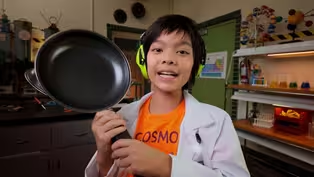
[video call beeping] [pans clanking] - Word Detectives, hello!
- Scientist Cosmo, why are you banging on pots and pans?
- I'm doing a sound experiment that measures loud sounds.
- Vet Wilder told us you are being loud at Pet Adoption Day.
- Yes, I asked Vet Wilder if he had any loud animals that went [barks] for my sound experiment.
- Is that when Vet Wilder pointed to his "Tranquility please" sign?
- Yes, he told us most animals need quiet and calm, then ran off.
That's when I had another idea for my sound experiment.
So I left, accidentally leaving my sound meter behind.
- Were you annoyed when he left?
- A little.
Now, if you excuse me, I have important work to do.
[pans clanking] - Being quiet and calm wouldn't be very helpful for Scientist Cosmo's loud sound experiment.
- And he was annoyed.
I bet he did it!
- Let's interview Firefighter Ember before we make our conclusions.
[video call beeping] [bell tolling] - Word Detectives, hello!
How can I help you?
- We heard you were at the vet clinic today, being loud and boisterous, which is the opposite of tranquil.
- I was, but only because I was so excited to adopt a pet and have a buddy to drive around within my fire truck.
- That does sound exciting.
- Right, I even had a special helmet made for my future pal.
I was bursting with excitement.
- Is that why Vet Wilder pointed to his "Tranquility please" sign.
- Yes!
He said, "Pets need quiet and calm, or they get nervous."
And I often talk loudly so people can hear me over sirens!
- That's a good point.
- Right?
Plus there's lots of fun stuff at the fire station that makes me super excited.
Like, when I slide on the fire pole and jump.
[cheers] - We're getting off track!
- 10-4, after Vet Wilder told me, "Pets need quiet and calm," he left without asking me about adopting!
I guess he didn't think I should adopt a pet.
Anyways, I really need to ring this bell.
[bell tolling] - Now, we have all the facts, let's review our case notes.
- [Gabby] Scientist Cosmo couldn't do his loud sound experiment at the clinic because it made too much noise.
- [Sly] And Firefighter Ember was being boisterous and loud because she was excited to adopt a new pet.
- Wait, Scientist Cosmo could do his experiment someplace else.
He didn't need to take the sign.
- But Firefighter Ember couldn't change that she often talks loudly or that she really wanted a pet!
- A pet she thought that Wilder didn't want her to adopt.
[gasps] [party horn trumpeting] - I think it's time to reveal who did it, how, and why.
[video call beeping] Now, presenting the word mystery animated reenactment of The Case of the Not-So-Tranquil Town.
- We need to be calm, quiet, and tranquil for Pet Adoption Day.
- Good morning!
I'm doing an experiment on loud sounds.
- And I wanna adopt a pet.
Woo-hoo, check out this super cute helmet.
[Vet Wilder shushing] - Tranquility, please.
Most animals need it to be quiet and calm so they don't get nervous.
- Wait, aren't you gonna ask me about adopting a pet?
- I have an idea for my sound experiment.
I'll go to my lab, where I won't have to be quiet.
- I guess I don't get a new pet unless... [sign ripping] - Firefighter Ember's who did it!
- I'm shocked.
- Firefighter Ember, you tore down my sign?
- When she was alone, that's how she did it because she really wanted a pet, that's why!
- They're right.
I'm sorry, Vet Wilder.
You said, "Pets need quiet and calm," and I'm so loud, and so is my fire station.
And that's why you rushed off without asking me about adopting a pet!
- But- - I thought if I took the word tranquility, pets would be okay in a loud and boisterous place, and I could get a new buddy.
I understand why you did it.
Having a pet is amazing.
Bring me the word tranquility back.
I have an adorable surprise for you.
[video call beeping] Thanks for returning the word tranquility.
I wasn't mad when I rushed off before.
I went to find a pet for you, like this guy.
His name is Ace.
[button beeping] - Aw.
- Aw.
- He'll be perfect for you because he's boisterous, and he likes living in a noisy place.
- I love Ace.
He's going to look so cute in his new helmet.
Thank you, Vet Wilder.
I promise Ace will have some calm and quiet times too.
- But when he's loud, I can use his sounds for my experiment.
- Thanks, Word Detectives.
- Thanks, Word Detectives.
[Sly sighing] - Case closed.
- In the quiet over the last few minutes, let me finish doing this.
[faint upbeat music] - Cool, can we be boisterous to celebrate solving our case?
- Absolutely!
[Gabby cheering] [Sly cheering] [uplifting music] - Well, hello, friends.
So nice to see you today.
I was just thinking about traditions, family traditions.
So things that you do repeatedly with your family.
They could be yearly, they could be each month.
But I was starting to think about the special things when we do those traditions.
So sometimes there's special clothing you wear.
Sometimes there's special food.
Well, there is a book I was reading with my daughters, and I was gonna share it with you today.
Would you like to hear it?
It's called "The Carpet: An Afghan Family Story," written by Dezh Azaad, illustrated by Nan Cao.
And this goes through the day of a life of an Afghan refugee boy and this special carpet that is there for all of their family events.
Let's see, let's read it together.
"The Carpet: An Afghan Family Story" written by Dezh Azaad, illustrated by Nan Cao.
We sip our tea and talk together.
Ruby cushions of goose feather.
The carpet is for sitting.
[serene music] We gather greens, fresh and crispy: basil, mint, dill, and parsley.
The carpet is for prepping.
[serene music continues] First comes washing, then it's soaking.
Stems from leaves need mindful splitting.
The carpet is for helping.
Folding out a red waxed cover; mother, father, sisters, brothers.
The carpet is for sharing.
[serene music continues] "Don't bring crumbs into the kitchen, spread them out across the garden!"
The carpet is for caring.
[serene music continues] We hop from cliffs, hot lava here.
"Quick, watch out, a shark is near."
The carpet is for playing.
[serene music continues] Rooks are fast, pawns are slower.
"Your king's stuck, the game is over."
The carpet is for learning.
[serene music continues] We read tales of buried treasure: flying Simorgh, born of fire.
The carpet is for listening.
[serene music continues] My parents speak of family they had when they were young and free.
The carpet is for remembering.
[serene music continues] Their smiles fade behind closed doors.
Our lives crushed by others' wars.
The carpet is for standing.
[serene music continues] Though I'm small, I know it's wrong to never fit, never belong.
The carpet keeps me strong.
The carpet is for dreaming of a place that I have never known.
The distant land we call our own.
The carpet is a piece of home.
[serene music fades] Did you see all the ways that they used that carpet?
It was literally woven into everything they did, whether it was sharing, caring, prepping, and just playing together.
Talk with your family members.
See what are those special things that maybe you use and you don't even realize you use it all the time, and it's just kinda woven into the awesome things that you do each day.
Well, I hope you enjoyed "The carpet."
Until next time, bye.
[uplifting music] My name is Anna, and I was just about to do some work with sounds.
Would you like to join me?
Awesome.
Okay, before I introduce the new sound, I wanna make sure our ears are ready to work with some sounds, okay?
So let's do a sound exercise.
I'm going to say a word, okay?
Then I'm going to change just one sound, the initial sound in the word, and I want you to come up with a new word.
Sound tricky?
Not at all.
Watch, I'll do the first one for you.
If I said the word handle, repeat handle.
Now change the h to a k. What would be the new word?
Well, before it was h-andle, handle.
Now, I took away the h, and I made a k. So now it would be it k-andle.
The word is candle, you see?
All right, let's do one more together, ready?
The word is cousin.
Say cousin, okay?
Change the k to d. What's the new word?
D-uh-z-n, dozen.
Okay, I'm not gonna help you on these next ones.
You ready?
Okay, the word is habit.
Change the h to r, what's the new word?
Rabbit!
Okay, the word is pickle.
Change the p to n. What's the new word?
Nickel.
Okay, last one.
The word is kettle.
Change the k to s, what's the new word?
Settle.
Awesome job, okay.
So I think we're pretty ready to work on our sound for today.
So our sound for today actually is quite complex.
That means it can be a little tricky because there are so many ways to spell this sound.
Now, for today, we're only gonna focus on three ways to spell the sound, but let me not get ahead of myself.
Don't you wanna know what the sound is?
Of course, you do.
All right, today, our sound is ew, like chew, okay?
Everyone, say ew, chew.
Okay, so the first way we're gonna talk about the spelling of the ew sound is E-W. Now, most times when we see this E-W spelling for ew, it's at the end of a word.
If I had the word few, like to not have a lot, few, I would have the f sound at the beginning.
So f, what letter says represents that f?
F, and then I would have the ew sound.
Few, okay?
So let's see.
What about ooh, how about flew, right?
The bird flew into the tree.
Okay, well, f, I'm starting off with that same initial sound.
So now, we have f, l. That's right, it's an l. Thanks for your help.
And then that ew sound again.
E-W, flew.
How about the word grew?
Like, you grew way too much this year, okay?
Grew, so g, r, and then what is making the ew that we're hearing at the end of the word?
You got it, E-W.
Okay, so that's one of the spellings of this ew sound that we're working on today.
[eraser scratching] Now, the reason I chose these other two spellings is because they actually represent more than one sound.
So you may have learned them as one sound, and now, you're gonna see them and be like, "Wait a minute, wait a minute, wait a minute."
Those make this sound.
And then I'm gonna tell you they actually make two sounds.
Okay, so the first one we're gonna look at is O-U, ou, like in soup, okay?
Now, some of you may have learned that O-U says ou, and it does, like out and trout, but O-U can also say ou, like in soup.
So let's work on our O-U, ou, okay?
Now, for O-U, ou, usually, you're gonna see that ou in the middle of a word.
So for example, our keyword that we're using is soup, right?
So we hear s-ou-p.
Okay, so what's that first sound?
S. And that's represented by...
Very good, my s. So I have my s, ou, and then my final sound p, p. Soup.
Okay, what about the word, ooh, I like this word, group, right?
I like to hang out with a group of friends.
Okay, so group.
Ooh, you hear that blend in the beginning, right?
G-r-ou-p.
Okay, so g. All right, so g is being represented by that g. R, r. Now my ou sound, O-U.
And then p, group, we have our p again, okay?
So notice, like I said, many times, our O-U, ou, will be in the middle of words, okay?
It's not always, but this is a kind of a good little trick for us, right?
'Cause a lot of times when we're reading and writing, we do, we flex the vowel.
That means we kinda swap the sounds to see which one sounds right, okay?
So in this case, we have our O-U, ou in soup and group.
[eraser scratching] Okay, ready for the third and final spelling for today?
All right, so we did E-W, like chew.
We did O-U, like soup.
And now, we are going to do, here we go, U-E, like my favorite color, blue, okay?
So U-E, blue.
Okay, so let's spell blue.
So blue, b-l-ue.
Okay, b, l, ue, okay?
Now, you'll see with this one, it tends to be at the end.
Now, once again, not a finite rule, not always, but many times when I'm hearing that sound ue at the end of a word, it might be represented by U-E, okay?
So besides the word blue, how about we use the word ue.
I like using this in school when I'm making my arts and crafts, glue!
Do you like using glue?
Yeah, all right, so let's spell glue, g-l-ue.
Okay, so what's that first sound, right?
And what letter represents that sound?
G. That's right, g, g. All right, next sound, g-l-ue.
Now, we need that l. You got it, l is representing that l sound.
And now, in this case, how are we going to write the ou sound in glue?
That's right, we're gonna use U-E, glue.
So now we have blue, glue, U-E, ue.
Good job, okay, so what we're gonna do now is I'm gonna show you guys some words.
And I wanna see, first off, if you can read the words, okay?
Then you'll get a chance to see if you can figure out which spelling of ue would go into some of those words.
I know you're up for the challenge.
- [Announcer 1] Remember, we are reading O-U, U-E, and E-W, like ou as in group and soup.
Read the words on the screen.
Did you say group, flew, blue?
Let's try a few more.
Read the words on the screen.
Did you say soup, grew, true?
Okay, let's try some spelling.
Which spelling for the ue sound is needed to complete each word.
O-U, soup.
E-W, flew.
U-E, blue.
- You all did an amazing job practicing reading and spelling using our different spellings of ue.
We have E-W, U-E and O-U.
So now remember, when you're trying to read or write words, see if these sounds kind of appear in your words, and then kind of flex them, right?
Work on them and see which one makes sense.
Because the only way you're gonna get this is through lots of practice, practice, practice.
But I know you got this.
Well, until next time, friends, bye!
[uplifting music] ["I Am Love" by Fyutch and Aura V] - [Announcer 2] Hello, Fyutch!
♪ A-U-R-A V ♪ - [AI 1] Scanning.
- [AI 2] Welcome.
♪ I am love ♪ ♪ I am love ♪ ♪ I am light ♪ ♪ I am light ♪ ♪ I am smart ♪ ♪ I am smart ♪ ♪ I am bright ♪ ♪ I am bright ♪ ♪ I am patient ♪ ♪ I'm patient ♪ ♪ I am kind ♪ ♪ I am kind ♪ ♪ I'm unique ♪ ♪ I'm unique ♪ ♪ One of a kind one ♪ ♪ One of a kind one ♪ ♪ Oh yeah ♪ ♪ Oh yeah ♪ ♪ That's right ♪ ♪ That's right ♪ ♪ I love ♪ ♪ I love ♪ ♪ My life ♪ ♪ My life ♪ ♪ I love myself ♪ ♪ I love myself ♪ ♪ I love myself ♪ ♪ I love myself ♪ ♪ I love me, I love me ♪ ♪ I love me, I love me ♪ ♪ I love me, I love me ♪ ♪ I love me, I love me ♪ ♪ I am safe ♪ ♪ I am safe ♪ ♪ I am brave ♪ ♪ I am brave ♪ ♪ I am worthy ♪ ♪ I'm worthy ♪ ♪ I'm deserving ♪ ♪ I'm deserving ♪ ♪ I am grateful ♪ ♪ I am grateful ♪ ♪ I am thankful ♪ ♪ I'm thankful ♪ ♪ I work hard ♪ ♪ I work hard ♪ ♪ I am helpful ♪ ♪ I am helpful ♪ ♪ I'm blessed ♪ ♪ I'm blessed ♪ ♪ I manifest ♪ ♪ I manifest ♪ ♪ I'm proud ♪ ♪ I'm proud ♪ ♪ I'm confident ♪ ♪ Confident ♪ ♪ I'm beautiful ♪ ♪ I'm beautiful ♪ ♪ I'm powerful ♪ ♪ I'm powerful ♪ ♪ I am me ♪ ♪ I am me ♪ ♪ I am free ♪ ♪ I am free ♪ ♪ I am love ♪ ♪ I am love ♪ ♪ I am right ♪ ♪ I am right ♪ ♪ I am smart ♪ ♪ I am smart ♪ ♪ I am bright ♪ ♪ I am bright ♪ ♪ I am patient ♪ ♪ I'm patient ♪ ♪ I am kind ♪ ♪ I am kind ♪ ♪ I'm unique ♪ ♪ I'm unique ♪ ♪ One of a kind ♪ ♪ One of a kind ♪ ♪ Oh yeah ♪ ♪ Oh yeah ♪ ♪ That's right ♪ ♪ That's right ♪ ♪ I love ♪ ♪ I love ♪ ♪ My life ♪ ♪ My life ♪ ♪ I love myself ♪ ♪ I love myself ♪ ♪ I love myself ♪ ♪ I love myself ♪ ♪ I love me, I love me ♪ ♪ I love me, I love me ♪ ♪ I love me, I love me ♪ ♪ I love me, I love me ♪ ♪ Yeah, I woke up worthy and deserving ♪ ♪ Of the good things coming my way ♪ ♪ My way ♪ ♪ My plate is full of happiness ♪ ♪ Like I went to a joy buffet ♪ ♪ Living my life like it's Golden Corral ♪ ♪ Melanated and I'm chosen, wow ♪ ♪ Well, I'm just basking in the glory ♪ ♪ Yeah, like the sun kissed my forehead ♪ ♪ My mind is my greatest asset ♪ ♪ Any test, I can pass it ♪ ♪ And failure is still a win ♪ ♪ 'Cause even then, I learned from the process ♪ ♪ Fear has no place in my heart ♪ ♪ It just got evicted, don't pay no rent here ♪ ♪ In the morning, I awaken ♪ ♪ And repeat these affirmations ♪ ♪ I am love ♪ ♪ I am love ♪ ♪ I am light ♪ ♪ I am light ♪ ♪ I am smart ♪ ♪ I am smart ♪ ♪ I am bright ♪ ♪ I am bright ♪ ♪ I am patient ♪ ♪ I'm patient ♪ ♪ I am kind ♪ ♪ I am kind ♪ ♪ I'm unique ♪ ♪ I'm unique ♪ ♪ One of a kind ♪ ♪ One of a kind ♪ ♪ Oh yeah ♪ ♪ Oh yeah ♪ ♪ That's right ♪ ♪ That's right ♪ ♪ I love ♪ ♪ I love ♪ ♪ My life ♪ ♪ My life ♪ ♪ I love myself ♪ ♪ I love myself ♪ ♪ I love myself ♪ ♪ I love myself ♪ ♪ I love me, I love me ♪ ♪ I love me, I love me ♪ ♪ I love me, I love me ♪ ♪ I love me, I love me ♪ [uplifting music] - Are all snakes venomous?
Are bats really blind?
Can owls really turn their heads all the way around?
Let's take a look at these animal myths and stories.
Now, a myth is something that many people believe is true, even if it's not.
Many of these myths were created to explain how the world works before we really understood what was going on around us.
Also, many people can't tell you when or where they first heard a myth.
One common myth is that you can get warts just by touching a frog or a toad.
Who came up with that?
Now, the myths today are about animals you might think are scary, gross, or creepy.
But these animals actually have amazing adaptations that help them and us too.
With some cool science and fact-checking, we'll see if we can learn more about these animals and dispel some of those myths.
To do that, I ask that each of you keep an open mind.
For me, when I keep an open mind, I like to pop my mind open [imitates popping] and take out all the negative thoughts and opinions I have that aren't based in fact, things like snakes are slimy.
It's not a fact, just gonna throw that away.
Bats are creepy because they come out at night.
Don't need that in there.
Vultures are gross because of the food that they eat.
Once I've tossed all those negative thoughts away, my mind is now open and ready for the facts we're gonna share.
While we may not change your mind about some of these animals, hopefully, with a little bit more information, we can help you find a way to still appreciate them.
Let's start exploring.
[dreamy music] - [Announcer 3] For all the fear and hate that snakes evoke, they inspire fascination like few other species.
And here in Houston, Texas, rat snakes are the most common long snake in our area.
At up to seven feet long, these snakes have dark blotches on lighter-colored skin.
Because of their coloring, many people confuse rats snakes with rattlesnakes, and that's just what the rat snake is hoping for.
This non-venomous snake defends itself by using a fake-out.
Like some other snakes, they can rapidly whip the end of their tails back and forth against anything nearby to create a rattling sound.
They're also very good climbers.
So if you see a snake in a tree, it's most likely a rat snake.
And it's up there doing its job.
And boy, do these guys have an important job.
Rat snakes help keep the local population of rats and mice in check.
You'll find it snacking on small mammals, birds, and reptiles.
And if you find one in your yard, you're lucky.
That means you have your very own personal pest control officer.
This is Ferdinand, and he's named after the man that discovered rats snakes in Texas, one Mr. Ferdinand Jacob Lindheimer.
Whenever he is in training for his ambassador job, he likes to lay on his heating pad or sleep under his water bowl.
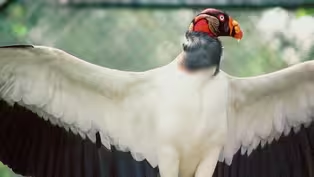
[dreamy music fades] Vultures are very beneficial birds that help the environment and people.
In North America, we have three species of vulture you may have seen or heard of: turkey vultures, black vultures, and California condors.
[blissful music] They are commonly found in large groups near relatively open and clear spaces for scavenging and wooded tree areas for nesting.
Turkey vultures have great eyesight and a good sense of smell to detect fresh carrion, which is a remarkable trait for a bird.
Carrion is the term for carcasses that vultures eat.
Most birds lack a strong nose.
Black vultures are often seen nearby because they cannot smell the way turkey vultures can and will follow along to find carcasses.
Their diet and preference for eating fresh carrion allows them to dispose of or consume meat that would have otherwise become a breeding ground for disease as it decayed.
Vultures help keep the world a much cleaner place.
If you have ever seen a vulture flying in circles, you may have wondered what they were doing.
Some people think they hover over a sickly or dying animal waiting for them to pass for a free meal.
This is a common misconception as we often see it and don't know how to explain the behavior.
What is really happening is an example of static soaring, a really neat technique that some birds have to use rising thermals or air currents to stay up in the sky without having to flap their wings so much.
It just so happens that the spaces vultures do this might seem to look desolate out over an empty field or a hot stretch of desert because of how air currents work.
You don't usually get good lift right by the tree line.
Here at the Houston Zoo, we have a black vulture, Dudley, who lives in the Children's Zoo, and two king vultures.
[uplifting music] [Nico growling] [Nico imitates beeping] [CJ laughing] - Alfie, come here, Alfie.
Over here, Alfie.
[laughs] [Alfie panting] - It's gonna be the highest building in the city.
[CJ laughing] - Alfie, over here.
[Nico imitates whizzing] - And... [building blocks clattering] Oh no!
I can't believe it that [whimpers].
- Nico?
- I can't believe after all that work, it just fell over.
- Nico, what's wrong?
- I went to put the last block on my block tower, and the whole thing fell over, and now, I don't have my block tower, and I never wanna build a block tower ever again.
- Oh, I understand.
It's awful when the things we work hard on just fall apart.
- Yeah, I feel so mad and so sad.
I don't know what to do.
- I think I know something you could try.
- You do?
- Yes, it's called belly breathing.
- Belly breathing?
- Yes, belly breathing.
It's what I do when my feelings are heavy.
Like, if I'm scared to try something new, it helps me feel my best self.
- Well, how can I do it?
- Watch this.
[soothing music] [CJ sighing] Okay, now, put your hand on your belly, like this.
Now, I fill my belly up with air, like a big balloon.
[CJ inhaling deeply] - Oh.
- Now, I hold the air in and count to five.
[soothing music continues] [CJ exhaling heavily] - Wow.
- Then I blow the air out gently, like making a wish on a dandelion, until all the little fuzzies fly away.
- I wanna try it, CJ.
- Okay, let's try together.
- All right, I put my hand on my belly and take a deep breath in.
- Exactly.
[CJ inhaling deeply] Can you feel your hand move as your belly fills up?
- Mm-hmm.
[CJ inhaling deeply] - Hold it.
[soothing music continues] Now, blow out gently.
[Nico exhaling heavily] [Nico sighing] - Thanks, CJ.
Wow, after belly breathing, I feel more like my best self.
- Wonderful, it can make your feeling so light like a bright sunny day.
- Instead of heavy and stormy, like mine were before.
Thanks, CJ, I think I will give this black tower another try.
[spirited music] [magical twinkling] A smile for CJ.
[spirited music continues] And a smile for me.
Oh.
Oh, Alfie!
Oh no, my picture is ruined.
I can't give it to CJ looking like this.
[Nico panting] Wait, I know what to do, belly breathing.
I put my hand on my belly like this.
Then take a deep breath in over five seconds and blow it out slowly.
Here we go.
Deep breath in.
[Nico inhaling deeply] [lighthearted music] [Nico exhaling heavily] Ah, much better.
I'm so glad I learned belly breathing.
[lighthearted music continues] Oh, that's okay, Alfie.
I'm sorry I got so mad.
[lighthearted music continues] Did you see how belly breathing helped me feel lighter?
You gotta try it next time you wanna feel your best self.
[uplifting music] - Hi, I'm Evie, and I'm from New York City.
Advocacy is a public support for a specific cause.
One way to be an advocate is to write an advocacy letter.
Your letter can be written to anyone that can make a change, from your school principal to a local official or even the president.
Here's one example.
[letter rustling] "Dear Assembly Member, I'm respectfully requesting that John Jay Playground open an hour earlier.
This would be a great option for families in which parents have to arrive early for work.
This might be the only opportunity in the day to take their kids to the park.
Thank you for your consideration.
From Evie."
Letters are important because if you don't express your views, people might not know a specific opinion exists.
One person can make a change and one voice can start a movement.
[uplifting music continues] - I'm here today with- - Lily.
- Lily, thank you so much for joining me.
Okay, so we are working on three-digit place value.
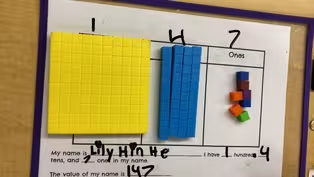
And the activity we're gonna do today is called What is the Value of Your Name?
So Lily is going to help me today.
We're gonna find out how much her name is worth.
We already know that names are unique, that they're special, and they're valuable because they make us special.
So what we're gonna use are base-10 blocks and some centimeter cubes to build her name.
So Lily's gonna start off by building her first name, Lily.
And then she's gonna build her middle name.
- Because my first name is very short.
- Yes, so go ahead, Lily, and start building.
These blocks here are our ten-sticks.
So there's 10 cubes here.
This makes a 10.
And then the single cubes are worth how much?
- One.
- One, so she's gonna go ahead and build her name.
- And these.
- Yeah.
- This one is the hundreds.
- Our hundreds, right?
Which is if we had 10, 10 ten-sticks, we would have a hundred.
- But it doesn't mean that we have 100 letters in our name.
- It does not, it just might mean that we have 100 cubes.
But we're gonna find out when she finished building her name.
[gentle purposeful music] So I noticed that for the second L in your name, you're just using 1 ten-stick, right?
- Yeah.
- 'Cause that's the lowercase letter.
Okay, that works.
[gentle purposeful music continues] - [Lily] And every single name has a special meaning.
- It does, right?
Every name has a story.
All right, great.
So let's see.
I'm gonna just move this a little closer so we could see.
So Lily, can you say your full name again?
- Lily Hin He.
- Very good, so Lily, you used a combination of ten-sticks and some of our one-cubes to build your name.
So now, what we're gonna do is we're going to find out the value, right?
Wait, this is a math, so we're gonna actually find out what the value of your name is.
And how we're gonna do it at is we're going to use our hundred, tens, and ones place value chart to do that.
So Lily, you can go ahead and move that board out the way.
Thank you.
And what we're gonna do now, Lily, is you can put this down in front of you, you can go ahead and write your name here.
It says, "My name is"...
So you can write your first and middle name there.
And then we're going to figure out how many hundreds, how many tens, and how many ones we have to figure out the actual value of our name.
[gentle purposeful music] So now, Lily, what I would like for you to do is I would like for you to take all of the one-cubes from your name and place them in our ones place on the place value charts.
[gentle purposeful music continues] Now, we're gonna take all of our ten-sticks and place them in what column?
- The 10 place.
- In the tens place, let's do that.
So now, Lily, let me ask you a question.
The way we have our cubes in the ones place and the tens place, is it easy to count this way?
- No.
- Not really, right?
We need to organize it.
So let's organize first by counting how many ones we have.
Now, Lily, when we get to, how many ones do we need now to make a 10?
- 10.
- So 10 ones.
So every time we get to 10, we're gonna switch out her 10 cubes for 1 ten-stick.
- We exchange it.
- You were gonna exchange it, okay?
- One, two, three, four, five, six, seven, eight, nine, 10.
Here, there's 10.
- Great, so you can put that right here.
And I'm gonna give her a ten-stick.
All right, which she's automatically put right into the tens place, right?
Because it's no longer a one.
Can we keep counting those ones and see if we need more?
- Definitely.
[Tahese chuckling] One, two.
- Great, we have another 10.
So, so far, we have done two groups of 10, which is 20, right?
We just added 20 more to our tens, wow.
[gentle purposeful music] - Yeah, that's 10.
- Great, here's another ten-stick, ooh.
[gentle purposeful music continues] Okay, another group of tens.
So now we have four tens.
Four tens means that we have 40.
Okay, so how many ones do we have left now?
Do we have another group of 10?
- No!
- No, how many do we have there?
[gentle purposeful music continues] - [Lily] Seven.
- Seven, so we can leave that there, right, in our space?
Do you wanna write down the number that we have so far so we don't forget?
You can put a seven there, okay?
So, so far, we have seven in our ones spot.
Okay, now, we're gonna count our tens, okay?
Now, Lily, how many tens do we need to have to make 100?
- 10.
- So if we have 10 ten-sticks, then we're going to replace it with our hundreds, right?
All right, Lily, go ahead.
Let's start counting our ten-sticks.
How many ten-sticks we have?
- One, two, three.
[puzzling music] Nine, 10.
[sticks clacking] - Wow, so 10 tens equals... - A hundred.
- 100, so we're gonna go ahead and exchange these for the yellow.
And she's gonna place, where are you gonna place it on your map?
- [Lily] The hundred place.
- [Tahese] Hundred place.
- [Lily] It doesn't even fit.
- Okay, and did we have any more?
We don't have another set of 10 tens, do we?
- No.
- How many tens do we have now?
- Four.
- Four, so what is four tens equal to?
- 40.
- 40, great, and then we have one 100, right?
So let's write on our chart, our digits, okay?
So what number would we write above our hundreds here?
What number would go here?
- [Lily] One.
- [Tahese] One, okay.
And then what would we write above our tens?
- [Lily] Four.
- [Tahese] Four, because we said that four represents 40.
And then over our ones, I think we already wrote the number, but let's write it again.
We're gonna write the number... - [Lily] Seven.
- Seven, so Lily, this is the number that Lily has gotten for her name, okay?
How would we read this number?
We have three digits, and we know that this is the hundreds place, the tens place, and the ones place.
How would we read this number?
- 147.
- 147.
So Lily, we're gonna finish filling in our sentence.
It says, "My name is Lily."
Can you say your middle name for me again?
- Hin He.
- Hin He, I have blank, 100.
So how many one hundreds do you have?
One.
One 100.
- One.
- [Tahese] How many tens?
- [Lily] Four.
- [Tahese] Four tens, and how many ones?
- [Lily] Seven.
- Seven ones in her name.
So the value of your name is... - [Lily] 147.
- Okay, and we would say 147.
Now, we could also, this is what the number looks like, right?
We can also write it in words.
So if we were to write it in words, we would say one hundred forty seven.
That's how.
That's the same as the number 147.
And basically, like Lily told us, it means we have one group of a hundred, right, four groups of 10, which equals 40, and seven ones left over.
I hope that you guys enjoyed learning all about three-digit place value.
I hope that you enjoyed our activity of finding out the value of your name.
You can do this at home at any point, just for fun, right?
But it also helps with math.
So thank you again for joining us, and we'll see you next time.
Bye.
- Bye.
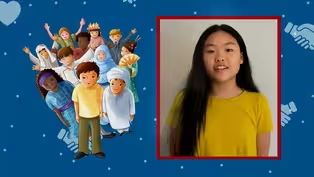
[uplifting music] - Hi, helpers, you know that you can be a changemaker.
Changemakers work to make the world a better place.
Every person can make change by standing up for what is right, like making rules fair for everyone, keeping our Earth clean, and helping people in need.
Changemakers can be activists, nonprofit workers, volunteers, and even kids.
Some famous changemakers are Martin Luther King Jr., who helped make rules fair for people of all skin colors, Jane Goodall, who helped protect chimpanzees, and Malala Yousafzai, who helped girls around the world to go to school.
Kids can help make the world better too.
We are never too young to be changemakers.
[hopeful music] - Hi, my name is Mariely.
My husband, Camilo, and I have three kids.
Maxwell and Sebastian, who are seven, and Mateo, who's five.
Being full-time working parents, we have very busy schedules, but learning is a priority in our family.
I'm always looking for fun ways to incorporate learning into our daily activities.
We love to cook, and cooking reinforces what they're learning in school.
Looking at the recipe allows them to build their vocabulary and reading skills.
- Cup dry milk.
- [Mariely] Is it milk?
- [Max] Mix.
- There's also so much math involved.
Now, I need 1/2 of a cup.
What two numbers make 10?
- Six and four.
- We are a bilingual family, and we practice our second language at home.
[Sebastian speaking in foreign language] - Yes, good job, buddy.
High five.
Love it.
On a daily basis, we reflect upon our gratitude, and it helps with reading and writing.
- I am thankful for the park.
- We love to be creative as a family.
Drawing is a great way for my kids to express themselves visually and verbally.
And it's just a fun time for us to bond together as a family.
[hopeful music continues] [uplifting music] - Hello, everyone.
Welcome to the Brooklyn Preschool of Science.
My name is Krystal, and I'm here with my friend, Sahil.
Sahil, can you please say hello?
- Hello.
- Together, we will do some hands-on science activities.
I love science.
Science is so important in today's life.
Studying science encourages curiosity and an attitude of discovery.
Together, we're gonna do some hands-on science activities and for our first ones, Sahil, are you ready?
- Yeah.
- I would like to start talking about those tiny ridges found on the tip of our fingers, those lines.
Can you take a moment, look at the tip of your fingers?
What are those lines called?
Do you know?
- Our fingerprints.
- Good job, Sahil.
Fingerprints, high five.
[hands clapping] Ah, you're so strong.
[chuckles] We are going to learn about our fingerprints, what they are, the different patterns, how to collect them, and how to identify them.
Our fingerprints are so unique.
No two people in the world have the same fingerprints, not even identical twins.
Our fingerprints never change even as we get older.
Every time we touch something, we leave prints behind.
There are three main fingerprint patterns.
I'm going to show you a closeup of each one.
Are you ready?
- Yeah.
- Okay.
So the first pattern is called the arch.
Do you see this?
- Yeah.
- Arches slope upward and then down, like very narrow mountains.
Can you see the narrow mountain in there?
- Yeah.
- Ooh.
Arches, okay?
So that's the first fingerprint pattern.
- Yeah.
- The second, loops!
- Loops!
- Yes.
Loops begin on one side of the finger, curve around or upward, and exit on the other side.
And the third main fingerprint pattern is whorls.
- Whorls.
- Yeah.
Do you see that?
Kind of like a whirlpool in the middle there?
- Yeah.
- Whorls form a circular or a spiral pattern.
Today, you know what we're gonna do, Sahil?
- Yeah.
- I'm going to show you how we can take the fingerprints, your fingerprints.
- Yeah!
- We're gonna lift them.
We're gonna put them down on a piece of paper, and then you'll be able to identify each pattern.
- Yeah.
- If you're ready, say oh, yeah.
- Oh, yeah.
- Okay, scientist, let's look at the materials we have here at the table, okay?
I have some, what is this?
- Pencil.
- Pencils, yeah.
- Pencils.
- And this?
- Tape.
- Some clear tape.
- And this tool.
Do you know what this is called?
- Magnifying glass.
- Good job, a magnifying glass.
A magnifying glass, it helps us closely observe things that are so small for the naked eye alone.
And we have our fingerprint identification sheet.
Do you see what's on the sheet here, Sahil?
What are those?
- [Sahil] Hands.
- That's right, right hand, left hand, the three main fingerprint patterns, and there's a square right here on the side.
- Yeah, square.
- Yeah, okay, for first step, we're gonna choose which hand.
So do you wanna choose your left hand or your right hand?
- Right.
- Right hand, okay.
- Okay, the pink.
- You wanna start with your pinky, okey dokey.
Okay, so we're gonna, first step, before we even look at your fingers, we're gonna take this pencil here.
Now, the pencil- - And I'm gonna rub it.
- That's right.
Look, I'm gonna show you real quick.
We're gonna take the graphite from the pencil, and we're going to rub it on the paper right inside the square box.
[pencil scratching] Would you like to help me, Sahil?
- I, yeah.
- There you go.
[pencil scratching] Good job, okay, so now- - Next, my pinky.
- Well, first, I just wanna show the graphite that is in the box right there in the square.
Now, we're gonna take Sahil's pinky finger, and we're going to rub it right onto that graphite right there.
We're gonna rub the graphite with his finger.
Rub, rub, rub, rub, rub, rub, rub.
- Rub, rub, rub.
- And now, let's look at the finger.
[gasps] Whoa, see?
- Ooh.
- And now look at the graphite on his pinky finger.
And the next step is, I'm gonna take a piece of tape, [tape reel ripping] and I'm gonna put it right on his finger, right above the graphite, okay?
And I'm going to carefully lift the tape now.
And if you look closely at the tape, look, Sahil, your fingerprint is on here.
- Yeah.
- We just lifted your fingerprint.
And we're gonna paste it down on the paper like that, you see?
[paper rustling] - Yes.
- And we're gonna do the same thing with the other fingers, okay?
- We need to do it.
- We're gonna move on to the ring finger now, okay?
- Yeah, the ring.
- So what's the first step?
Do we put tape on first?
- But- - Do we put tape first?
- No, we rub the pencil.
- We actually, so here you go.
Take the pencil, add some more graphite.
[pencil scratching] Good job, and now, we're gonna take your, the next finger, which is your ring finger.
- My ring.
- Yes, and can we rub it on here, please?
I'll help you, okay?
Rub, rub, rub, rub, rub, rub, rub, rub, rub, rub, rub, rub.
Awesome, and now, I'm gonna take another piece of tape, [tape ripping] put it on your finger.
Just like that, press and then lift.
And there we go.
We have another fingerprint.
And just look at your fingerprints.
- Wow.
- Whoa, look.
And now, now that we've collected the fingerprints, let's identify them, okay?
So which tools should we used?
Oh.
- The magnifying glass.
- The magnifying glass, yes.
So Sahil, I would like you to closely observe each fingerprint, look at them.
And now, if you want, would you like to use this one?
- Yeah.
- Sure.
[jovial music] Yes, let's closely observe each fingerprint.
And now, let's see, we're gonna start with one finger, okay?
- One.
- Let's try the middle finger right here.
You see this print here, Sahil?
- Yeah.
- So actually, we're not gonna look at your finger.
I would like you to look at the fingerprint.
Look closely.
Which pattern do you think that is?
Do you think that pattern, do you think this print looks like the arch, the whorl, or the loop?
- This one.
- The whorl?
- Yeah.
- Good job!
Give me five, you're awesome.
So Sahil- - Next.
- What's next?
Which finger's next?
Do you wanna try- - This one.
- Well, remember, we used the right hand.
So did you wanna check your pinky?
- Yeah.
- Okay, so here, take your magnifying glass and look closely at that.
Look at that fingerprint.
What do you think?
Do you think it looks like the loop, the arch, or the whorl?
- This.
- The arch?
Can you say that?
Arch.
- [Sahil] Arch.
- Good job.
So now Sahil, really quickly, we're gonna just take a moment, we're gonna pause, and let's just review everything that we just learned, okay?
- Yeah.
- We learned that the fingerprints are the tiny ridges located on the tips of our fingers, right?
- The lines?
- Yes, we learned that there are three main fingerprint patterns: arches, whorls, and loops, right?
- Yeah.
- And now, you also have learned how to lift them, lift your own fingerprints, paste them down onto a paper, and now you can identify your fingerprint patterns.
At home, Sahil- - Yeah.
- You can try this on an adult at home, a friend at home, a family member, or maybe even at school.
- I.
- You can, your classmates.
And you know what?
- Yeah.
- Something fun to do afterwards, maybe collect some toe prints.
- Oh.
- Would you like to do that?
- Yeah.
- All right, do you think science is cool?
- Yes!
- That's right, if you think science is cool, say oh, yeah.
- Oh yeah.
- See you soon, bye-Bye.
[hopeful music] [Mariely speaking in foreign language] [Mariely continues to speak in foreign language] [Mariely continues to speak in foreign language] - Cup dry milk.
- [Mariely] Is it milk?
- Mix.
[Mariely speaking in foreign language] - 1/2 of a cup.
What two numbers make 10?
- Six and four.
[Mariely speaking in foreign language] [Sebastian speaking in foreign language] - Yes, good job.
Buddy, high five, love it.
[Mariely speaking in foreign language] - I am thankful for the park.
[Mariely speaking in foreign language] [hopeful music] [uplifting music] - [Narrator] Funding for this program was provided by The JPB Foundation.
[uplifting music continues] [uplifting music continues] [uplifting music continues] [uplifting music continues] [bright music] [no audio] [no audio]
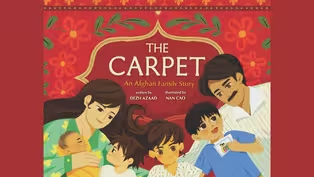
THE CARPET: AN AFGHAN FAMILY STORY
Video has Audio Description
Anna Scretching-Cole reads THE CARPET: AN AFGHAN FAMILY STORY, written by Dezh Azaad. (3m 44s)
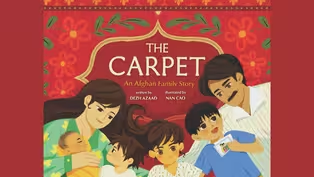
THE CARPET: AN AFGHAN FAMILY STORY ASL
Video has Audio Description
Anna Scretching-Cole reads THE CARPET: AN AFGHAN FAMILY STORY, written by Dezh Azaad. (3m 44s)
Video has Audio Description
Learn how animals that may seem creepy – like rat snakes and vultures – do important jobs (5m 22s)
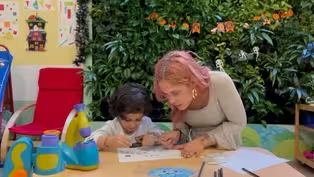
Video has Audio Description
Learn how everyone has unique fingerprints with Brooklyn Preschool of Science. (8m 26s)
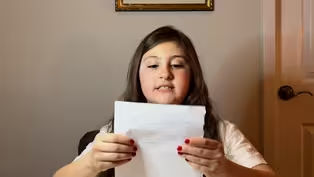
EVIE WRITES AN ADVOCACY LETTER!
Video has Audio Description
Evie writes a letter to an assembly member asking for a playground to open earlier. (55s)
FEEL YOUR BEST SELF: BELLY BREATHING
Video has Audio Description
Use a strategy called “belly breathing” to feel better when you are mad or sad. (5m 2s)

Video has Audio Description
Sing “I am Love,” a song of affirmations, with Fyütch and his daughter. (2m 41s)
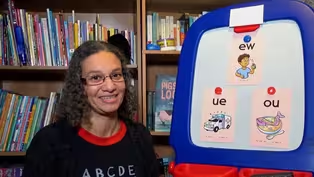
Video has Audio Description
Learn about the long "oo" sound with Anna Scretching-Cole. (9m 46s)
MEET THE HELPERS: BE A CHANGEMAKER!
Video has Audio Description
Meet a changemaker! Changemakers work to make the world a better place. (47s)
WHAT IS THE VALUE OF YOUR NAME?
Video has Audio Description
Tahese Warley plays a math game with three-digit place value. (8m 8s)
WORDSVILLE: THE CASE OF THE NOT-SO-TRANQUIL TOWN
Video has Audio Description
Vet Wilder's "tranquility" sign disappeared from his clinic, making Wordsville boisterous! (7m 26s)
Providing Support for PBS.org
Learn Moreabout PBS online sponsorship














Support for PBS provided by:
Let's Learn is a local public television program presented by THIRTEEN PBS