
Do You Hear the Long “e” in Sweet?
5/19/2023 | 55m 38sVideo has Audio Description
LET’S LEARN about plants! Make trees with tangrams. Experiment with fruits & vegetables.
LET’S LEARN about plants! Make trees and flowers with tangrams. Do an experiment with fruits and vegetables. Draw a picture of a plant. Sing a song in Spanish about the seasons. Read RAINING and words with long e. One-hour programs help children ages 3-7 learn in school and at home. Content provided by Studio in a School.
See all videos with Audio DescriptionADProblems playing video? | Closed Captioning Feedback
Problems playing video? | Closed Captioning Feedback
Let's Learn is a local public television program presented by THIRTEEN PBS
Do You Hear the Long “e” in Sweet?
5/19/2023 | 55m 38sVideo has Audio Description
LET’S LEARN about plants! Make trees and flowers with tangrams. Do an experiment with fruits and vegetables. Draw a picture of a plant. Sing a song in Spanish about the seasons. Read RAINING and words with long e. One-hour programs help children ages 3-7 learn in school and at home. Content provided by Studio in a School.
See all videos with Audio DescriptionADProblems playing video? | Closed Captioning Feedback
How to Watch Let's Learn
Let's Learn is available to stream on pbs.org and the free PBS App, available on iPhone, Apple TV, Android TV, Android smartphones, Amazon Fire TV, Amazon Fire Tablet, Roku, Samsung Smart TV, and Vizio.
Providing Support for PBS.org
Learn Moreabout PBS online sponsorship[upbeat music] - [Host] Ready to learn?
- Hi!
- Hi friends.
- [Host] It's time to share a story, read and write.
- Let's take it from the beginning!
- [Host] Discover science, sing.
[piano playing] - Hello, friends.
- [Host] Play, and so much more.
- We're exploring with light.
- [Host] Stay tuned for lessons and activities.
- And the keyword is: - Apple.
- Awesome!
- [Host] Funding for this program was provided by the JPB Foundation.
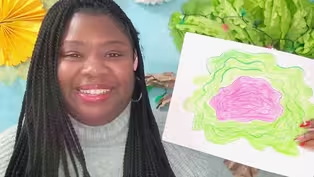
- Hi friends, my name is Darlene Thomas and I'm so excited to read a story for you today.
The title of the book is called "Raining", written by Pingping Xu and illustrated by Graca Lima.
Plus, after the story, we'll talk about the importance of rain and how it helps the plants to grow.
And I'll show you how you can make your own picture of your favorite plant.
So, let's get started!
"Rumbling, rolling thunder.
Cheep cheep cheep!
The chick shelters in the hen house.
Meow, meow, meow.
The kitty shelters in the baskets.
Bow wow.
The puppy shelters in the dog house.
Baa!
The lamb shelters in the sheep pen.
Moo, moo, moo.
The calf shelters in the barn.
Oink, oink, oink.
The piggy shelters in the pigsty.
Neigh, the pony shelters in the stable.
Squeak, squeak, squeak.
The little mouse shelters in the burrow.
Tweet, tweet, tweet.
The little bird shelters in the nest.
Chirp chirp chirp.
The cricket shelters in the grass.
Buzz, the bee shelters in the flower.
Croak, croak, croak.
The frog shelters in the pond.
Ah, the baby shelters in the house.
Why?
Splish, splash, patter, patter.
It's raining!
The end.
I hope you enjoyed that book as much as I enjoyed reading it to you.
Now, in the story, the author asks, why does the baby shelter inside the house when it rains?
Do you know why?
Well, that's because most humans and land animals prefer to stay inside when it rains to keep dry.
But plants love when it rains because plants need water to grow.
When it rains, the water goes down into the ground and the plants soak up the water that they need through the roots and the stems of the plants.
You know, when I look outside the window or I'm walking around in my environment, I always notice the plants around me.
Do you notice the plants around you?
What do you see?
You can look out the window.
Maybe you have a house plant, or maybe you just know the plant that you really like.
Today I'd like to invite you to draw that plant.
You can ask a trusted adult to print one out for you on the internet.
So maybe you can copy and draw what you see.
Or you can go on a neighborhood walk and take pictures of plants outside and use those pictures to draw your favorite plants.
Now I'm going to show you how I draw a really awesome plant that I found in my neighborhood.
It's called an ornamental cabbage.
And what's so cool about it is that it looks like a vegetable, but it also looks like a flower and comes in one of my favorite colors, a nice mix between purple and pink.
So I'll show you how I draw my ornamental cabbage flower.
And then you'll be invited to draw your own flower at home.
Let's get started.
All you'll need for this activity is some white drawing paper and a picture of the plant that you'd like to draw and some crayons.
So I'm going to look at my photo and I notice the colors that I'm going to need are mostly dark pink, some purple and some green, 'cause I'm gonna draw up the first one I see.
Okay, so I'm gonna start first with my leaves.
I'm going to take my darker green crayon because when I fill it in with my lighter green, you'll be able to see the outline better.
So what I notice is that I have big leaves on the outside and it keeps going like in a spiral.
So I'm gonna do the same thing on my paper.
I'm gonna make a big leaf And keep going around like a spiral.
And I'm gonna do that a couple of times 'cause there's lots of green leaves.
And I'm gonna stop here 'cause I wanna make some room for that purple.
I'm gonna go in with a darker purple first.
And I'm gonna do the same outline like I did for my green leaf.
And I'm gonna make about 1, 2, 3, about three of these, so two, and three.
Wow.
So now I'm gonna go ahead with my lighter colors and I'm going to color that in.
And so I'm just finishing up adding my lighter shade of purple.
And it looks like maybe I'm taking like a bird's eye view, like I'm looking directly down into the center of the plants, which I love.
In real life, these plants have so many layers.
It's such an awesome plant, in my opinion.
And I'm all done.
Wow, I think my drawing looks just like the ornamental cabbage that I see growing in my neighborhood.
I hope you have as much fun drawing your plant as I had drawing mine.
And the next time it rains, think of all of the beautiful plants on earth that are getting what they need in order to grow and be healthy.
And a healthy earth means a healthy environment.
And a healthy environment means a healthy you.
So enjoy the rain.
Goodbye.
[upbeat music] [inhales and sighs] - Isn't it great to see flowers blooming when spring starts to come?
The sweet smell of flowers always puts me in a good mood.
Which is actually pretty great because the words see and sweet actually have our sound for today.
Can you guess the sound?
Listen carefully.
See and sweet.
That's right, the sound is long E. But before we get into our long E work, let's get our ears ready with some sounds.
What's gonna happen is we're gonna do some deleting of words.
I'm gonna say a word and I'm gonna ask you to take off a part of the word, leaving only a word behind.
And I wanna see if you can figure out that new word.
Sounds confusing, but it's not.
So for example, if I say the word cardboard.
Now say cardboard without card.
What's the word left?
Well, we had card board.
I took away card, now board is left.
So you would say board.
All right, let's try a few of these.
Ready?
Say butterfly without butter.
That's right, fly.
Say pancake without pan: cake.
Say football without foot: ball.
Say rainbow without rain: bow.
All right, now listen carefully.
I might try to trick you, say toothbrush without brush.
Aha, this time, tooth.
I left the first word.
Okay, last one, say starfish without fish.
That's right, star.
Awesome job.
Today we're going to be working on two ways of spelling the long E sound.
So the long E sound says it's name, or E. Can you repeat that after me: E. The two spellings we're going to work with today are E E for E and E A also for E. Now, there is no trick or rule to know when to use either of these spellings.
The only way you're gonna figure it out is really just through lots of practice and exposure.
So reading lots of books, practicing writing lots of words.
And when people use words that have like that long E sound asking them, how do you spell that word?
Okay.
So today what we're gonna do is we're gonna practice reading some long E words spelled E E and E A.
Let's practice with E E first.
So we're gonna blend through these sounds and we're gonna read the word, okay?
So blend and read with me.
Beep like horn, beep beep.
How about this word?
Let's blend and read together.
Deep, deep.
Good.
This is one of the words that started our lesson.
Let's blend it.
Sweet.
Sweet.
Let's do one more, okay.
Tweet, tweet, like the sound a bird makes.
Tweet tweet!
All right, let's go over to our E A side for a little bit first, okay?
So E A is still going to make that E sound.
Okay, so let's start with this one, ready?
Eat, eat, oh, I'm getting hungry.
How about this next one, let's blend it.
Beat, beat, okay.
So this beat is like the beat of the drum.
[taps hands and hums] beat!
Okay, how about this word?
Heat, heat.
Oh, it's getting hot, heat.
All right, how about this one?
Treat, treat.
Okay, now remember how I told you there's really no trick or rule to know when to use E E versus E A?
Well, that's because some of these words are gonna be homophones where they sound the same, but they're spelt differently.
So let me give you some examples where you can see the same words spelt differently.
Okay, but they sound exactly the same.
So let's look at this first one.
Well we know E E is going to say E. So let's go, meet, meet.
Well come over here and blend this word with me.
We know E A says E. So meat, meat.
Wait a minute, didn't we just say this one was meet?
Meet, meat.
Okay, so in this case, this meet means like when you first see someone, like it's nice to meet you, you shake hands.
This meat is like the meat that you eat like a hamburger meat, okay?
Same thing with, take a look at this last one.
We have cheep, cheep, like a birdie tweet.
Cheep, cheep, cheep, cheep, cheep.
And then we have cheap, cheap, like when something's not expensive or not worth a lot of money, okay?
Cheap.
Excellent job reading these words with me.
All right, now it's your turn to read a few more long E words all by yourself.
It's time for the lightning round.
You're gonna see a whole bunch of words come up on the screen.
Do your best to blend the sounds and read the words.
And remember, our focus sound is that long E spelled either E E or E A.
Ready?
Let's go.
So how did you do?
Did you say: eat, tee, beep, seat, feet, wheat?
If you got all six, right, give yourself a high five.
Time for round two.
A little faster this time.
So how did you do?
Did you say: sweet, tea, treat, eel, neat, peel?
Did you get all six right this time?
Awesome job, friends.
You did a great job today working with the long E sound spelled E E, and E A.
See how many more of those long E words you can see when you read.
Because remember, the more you practice, the more you're gonna know that.
Well, I'm gonna go get me a sweet treat.
Until next time, bye!
[upbeat music] - Hi, my name is Zuri, and today I'm gonna teach you how to draw a flower.
I've already drawn the circle for you.
Draw a circle like this.
Then for the petals, you just have to do little curves like this.
And repeat until you get to the same end where you started.
Then for the stem, you just draw a line down.
You can add the floor like me.
Then you just have to draw draw the leaves like this.
And it's okay if you mess up.
Make sure you also draw with the pencil so in case you mess up you still have something to erase with.
And add lines.
Same thing for the bottom one.
And that's how you draw a flower, bye!
[upbeat music] - Oh, remember that trip we took with our class to the community garden?
Let's build some of the things we saw there.
- Ooh, yeah.
Oh, I remember we got to push that wheelbarrow full of soil.
Could we build that wheelbarrow?
- Yeah!
[inquisitive music] Great, oh well, and of course there were so many flowers like this one.
- And then we saw the koi pond with so many fish.
Let me show you.
Oh, and on that pond there were water lilies.
- Yeah.
[laughs] And there were so many beautiful trees.
Oh, but wait, we've not made a tree out of shapes yet.
- Hmm.
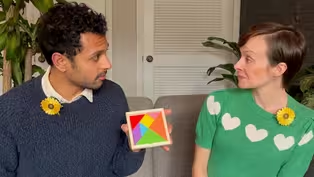
Friends at home, these shapes that we've been building with, they're called tangrams.
Tangrams are a type of puzzle.
They were invented long ago in China.
They traveled by ship all over the world.
Soon people everywhere were playing with tangrams.
- Yeah, because they're so much fun.
- And because the possibilities are endless.
You can build so many things with these seven shapes.
- Well, let's show our friends about the shapes.
- Yeah, let's do it.
What you need to know about Tangrams is that they're made up of seven specific shapes.
[buoyant music] There are several triangles.
- And we know they're triangles because they have three connected sides.
Let's count all the triangles.
- [Omar] 1, - [Lily] 2, - [Omar] 3, - [Lily] 4, - [Omar] 5, 5 triangles.
And there's a square.
We know it's a square because it has four sides that are all the same length and four square corners.
- [Lily] And a parallelogram.
I love parallelograms.
They have four connected sides and the opposite sides are parallel.
- And look how all seven shapes together form a larger square.
Friends, what do you notice about this larger square?
What do you notice about the triangles inside of it?
How are the triangles the same?
How are they different?
- Fun, well, let's start creating.
What about that tree?
- Well, I bet there are many ways to make a tree using tangrams.
Let's try.
[inquisitive music] - Lily, I have a tangram challenge for you.
Yesterday I made an apple.
Here you go, I outlined all of the shapes for you.
- [Lily] Ooh, look at that big square on the bottom.
Oh, lemme see.
I think it's made of two triangles.
Let me fill them in.
Oh, since I did the large triangles, maybe I'll keep going with the rest.
Looks like the medium triangle goes above that big triangle.
Then the one little one goes above the medium.
Hmm.
And the last little triangle goes on this side.
Oh, I think that's a square.
I better rotate it to fit it in.
Oh, it sit perfectly.
And to end, the parallelogram.
A cute stem made out of a parallelogram.
- Wow, Lily, great job filling in the apple.
I think you're ready for more of a challenge.
This time, I won't outline all seven shapes, just some of them.
A rose for my Lily.
- [Lily] Ooh, that looks hard.
But I can't wait to see how I can figure it out.
Okay, well I think those big petals are the big triangles.
So let me start with that.
Oh, and this cute stem, it has to be a parallelogram.
So now for the center of the rose, I see some corners on top.
Maybe this is the top of a triangle.
Lemme see if the small triangle will fit.
It does.
Let me add the other one.
Hmm.
Wait, that won't work.
Let me start again.
What if I put the square in the center.
And then, maybe the small triangles for the top of these petals?
Oh, and look what's left.
One more space for a triangle.
I did it!
- Nice job, Lily.
I really like how you started with an idea, realized it wouldn't work, and then tried something else.
Great problem solving.
- Thanks, Omar.
Well, what if I make a puzzle for you?
- Oh, okay, that sounds fun.
- I'll make this one super hard.
I've only made the outline of the puzzle.
[playful music] - Hmm.
This is tough.
Friends at home, help me out.
Okay, I see the dog's tail.
Yeah, that's a parallelogram.
Okay, so we have the tail.
What about the body?
I think the back of Dewey's body, it looks like a big triangle.
Yeah, that fits nicely.
Ooh, and his legs, those look like two small triangles.
Hmm.
Something doesn't look right about that front leg.
Let me try a medium triangle.
Yeah.
That's better.
Okay.
And I see that a large triangle would fit right here for Dewey's body.
And then for the head.
Do you see it?
Yeah, a square.
In the final spot, a triangle.
We did it, good job.
Tangrams are so fun, Lily.
Friends at home, if you wanna build the things you see around you using shapes, you can make tangrams too.
You can print or draw a set of tangrams like this and then ask a trusted caregiver to help you cut it out.
That's when the fun begins.
That's when you get to start building with these seven amazing shapes.
[uplifting music] - [Lily] You can make so many things, like a fairy.
- [Omar] A person leaping.
- [Lily] A horse.
Neigh!
- Friends at home, we're gonna keep building with tangrams.
We hope you have fun with tangrams too.
See you later.
- Bye.
[upbeat music] - Hi friends, my name is Cassondra and these are my helpers, - Noel - and Emery.
- And we're here today to do a fun science experiment with you.
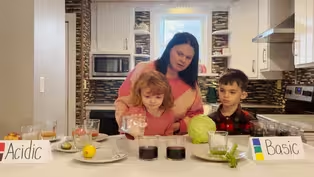
Today, we are going to be doing some science in the kitchen and we are going to be using some fruits and vegetables that maybe you have at home and maybe you eat them sometimes.
So today we are going to be starting with some really pretty liquid here.
This liquid looks purple and we made that liquid using a purple cabbage.
Now this is a green cabbage.
This is the cabbage that maybe you see more often at the store, but there are also purple ones.
Now we used purple cabbage and we boiled it and it made this water nice and purple.
And we're going to use that water that is now purple from when we boiled the cabbage to do our experiment today.
We are going to be mixing this water with some juice from some fruits and vegetables that maybe you eat sometimes.
So the first thing we're going to be looking at is this.
Now friends at home, what is this?
Noel and Emery, what do we have here?
- A lemon.
- A lemon.
- A lemon.
Now have you had a lemon before?
- Yes.
- Yes.
- Yes, what does a lemon taste like?
- It's like sour.
- That's right, a lemon tastes sour.
It tastes sour because a lemon is acidic.
Can you say that, say acidic.
- Acidic.
- Acidic.
- Good, a lemon is acidic.
Now today in the experiment that we're going to be doing when we pour a liquid into our purple cabbage juice that is more acidic, it is going to turn the purple red.
Or it might just stay more purple.
That will mean that our liquid is acidic.
Now on the other hand, something like celery.
Have you had celery before?
- Yes.
- Yes.
- What about you friends at home?
Have you had celery before?
I really like celery.
But is it sour?
- No.
- No.
- No, celery is not sour.
Celery is going to be more basic.
And when our fruits and vegetables are more basic, they are going to turn our purple cabbage water over here blue, green, or yellow.
So we are going to be pouring these juices that we made using our blender into the purple cabbage water.
And we're gonna see what happens.
Do you wanna give this a try?
- Yeah.
- Yeah.
- All right, so we're gonna make some predictions.
All right, so let's think about the purple cabbage water here.
And let's think about the lemon juice.
Okay, we said that the lemon juice is going to be more: - Acidic.
- Acidic.
- Acidic, good.
So what color do we think our water is going to turn when we pour the lemon juice in there?
What color do you think?
- I think red.
We think it's probably gonna, probably gonna be either red or a purple color because that means it is acidic.
So I am going to put this A for acidic over here because that's our prediction.
We think that the water will turn red or maybe stay a color of purple.
So let's see if we are right.
I'm going to leave this here so that we can just see what it starts out like.
And then let's, woo.
Let's get another one and pour the lemon juice in there.
Oh, let's see what happens.
Emery, do you think you could help us out with that?
- Yeah.
- Okay, come over here, Emery.
Can you get that lemon juice?
Okay, let's lift you up a little bit.
And can you pour it into the first cup?
Yeah, pour it in, let's see what happens.
Oh, whoa.
Okay, thank you, Emery, wow.
Friends at home, look at that.
Can you see the difference?
So were we right, did it turn a red or purple color?
- Yes.
- Wow, we were right about that one.
So our lemon, and let's put that here.
Our lemon turns the water red or red colored.
Let's put that over there on the acidic side.
Let's try another one.
Which one do you wanna try next?
- Tomato!
- The tomato.
Okay, friends at home.
Here we go, we have a tomato.
We made some tomato juice with our blender.
So let's give it a try and see what happens.
So Emery, can you pour the tomato juice into the first cup for us?
And let's see what happens.
All right, take a look at that one, friends at home, that one definitely changed colors.
Look at what it started at.
But look, it didn't change as much as the lemon.
Look at that.
Not as much, but it did definitely change on the red side.
So what does that mean?
If it turned more red, does that mean that the tomato juice was more acidic or more basic?
What does that mean when it turns more red?
Look at our signs.
If it turns more red is it acidic or basic?
- It's acidic.
- It's acidic, yeah, that's right.
Okay, so let's put an A for acidic on our tomato juice.
All right, now let's try another one.
Let's try the apple?
You wanna try the apple?
Okay, let's try our apple.
Friends at home we have an apple.
We have some apple juice that we made.
Let's see what happens.
Noel, can you try this one for us?
Noel, what do you think?
Do you think it's gonna be more sour like the lemon and the tomato?
Or more basic and turn blue, green or yellow?
- I think it's gonna be basic.
- More basic?
All right, let's see if it is basic.
And turns blue, green or yellow.
So, Noel, can you give it a try?
- Yes.
- Go ahead.
Okay, it kinda did change.
- Yeah!
- Oh, look, it did change.
It is more blue.
Interesting.
That one's pretty.
Look at the difference.
Oh wow, look at that, that's so pretty.
Wow, we're getting a rainbow over here.
All right.
Now we have some more that we don't have time to try right now, but maybe you could try them at home.
Maybe you could try some pickle juice.
Maybe you could try some carrot juice and see if your purple cabbage water turns more red, or more blue, green or yellow.
Thanks for joining us today, friends.
- [All] Bye!
[upbeat music] - Hi, everyone.
- Hi.
- Hi.
- Today we are going to draw a beautiful plant and see the lines and shape they have.
- I like shapes.
- [Lia] You like shapes?
- I like shapes.
- Now let's see what we have to draw this plant.
We have the paper, the pencil and the special plant.
Yes?
Now let's look closely at the plant and see the lines and shapes.
Hmm, what did you notice?
- I noticed that it has a vine coming up where it drink water from, and the other one's bended.
- [Lia] This one is bended.
- Yeah, and there's a new one coming out.
- [Lia] And how is the other that is coming out, is big or small?
- It's small, the other one that's coming up too.
It's the smallest one that only has the vine, but when it starts like that one, means you can see the leaf.
- I love your words.
You say that they have the vine.
And this is smaller because it's new.
It's coming out.
Now, let's see.
You notice that this one is bended, so it's a curved line, right?
Okay, now I think I'm ready.
I'm gonna get my paper and pencil ready.
It's gonna be my turn, I'm gonna draw.
You're gonna help me and then it's gonna be your turn, okay?
- [Both Children] Okay.
- All right, so I'm going to put it on this side.
And let's see.
I'm going to look closely and look at the lines and shapes.
Okay, I noticed that the stem is curved.
I'm gonna start in here, gonna make it really big.
And it's curved, and it's going up.
So at the end of the stem, I see that this, this shape that is kind of like an oval and it's pointed.
Gonna draw like this and come back to the stem.
I'm going to do the other leaf.
It's coming close to the other one.
And it's curved, and it's kinda like an oval, but it's pointy at the end.
Ooh, I like this one.
I'm going to do the one that you see that is bended.
It's kind of going on this side.
And what shape is that?
- So you have to curve it.
- Curve it like this?
And I'm gonna do the other one that is behind the oval.
That is going all the way at the lips is pointy.
It's like a triangle at the end.
And I'm gonna see the new one that you see that is the smaller.
So I'm going to do like this, pointy and come back.
Should I do the pot or no?
- No.
Yes.
- So I'm going to draw like a curve.
Woo.
Are you ready to do yours?
- [All] Yes.
- I wonder what lines and shape you gonna use to make your own plant.
I like how you going carefully drawing the leaves.
Two lines for the stem, that's a good idea.
- The other one has a little, a lot more gray.
But this one has a little bit of white.
- Let's just do like that, so better.
- That's how much this one has, but this one has a little bit more.
- I made this one.
- Ah, you did the plate that is under the pot.
- No, I see a plate all way like that.
- [Lia] Yeah, look, amazing.
- This one's gonna curve like glass.
- Wow, you're making the soil?
Very important for a plant, right?
Very important, I like this.
You are making like a little mark up and down.
- Just making one more little plants.
- Jay, Jay?
- What?
- Look.
- Everybody's so concentrated doing their own plant.
You are putting more details that I'm putting on mine.
Really.
I think I need to do some white on the leaf.
Are we done, yes?
- No, no.
- [Lia] One more second?
One more second.
- Oh yes!
- Wow, those plants are amazing.
- I put the heart.
- What did you put inside?
- I put a heart.
- That is amazing.
Jay, what did you notice when you were drawing your plant?
- So I added a few hearts and I added a spiky thing over there.
'Cause that's a spiky plant, it's that fun too.
- So you used like a shapes or line to make the spiky?
- I used some triangle to make it spiky.
The spiky cones.
- Beautiful.
Now Ava, I noticed that you did some dot on your leaves.
And what shape did you use to make your plant?
- I put some dots on there, 'cause they're very pointy.
And I put some flower on the leaf.
- You add flowers on your plant, that is amazing.
I love flowers.
Beautiful.
[all applaud] You did awesome.
Now it's your turn to make your own drawing of a plant.
You can choose the plant in your home or you can go outside to look for one in nature.
Try drawing different kind of plants to find out all the lines and shape they have.
Have fun, Artists.
[upbeat music] - Hola Amigos, my name is Diane.
Hola, soy Diane.
And today I'm going to teach you something very nice about the four seasons.
And also very nice song that you can sing at school.
And also you can sing it at home with mom and dad.
With mama and papa.
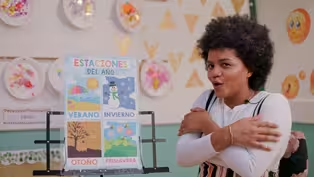
Here I have my amazing pictures.
Can you see it?
Well, if you notice we have different seasons.
These are the seasons of the year.
We have five, hmm, do we have six?
Let's count them.
So we can use my little friend here to just point everything.
Uno, Dos, y Tres Uno, Dos, Tres, Cuatro, We have four seasons during the year and every season brings amazing things to do, amazing things to have fun with.
So we gonna just learn a few things today.
Get closer.
First, you have verano.
Can you say verano?
Verano.
This is summer, do you like summer?
This is my favorite because summer is so hot, oh, you get a lot of calorcito.
You also have senior sol.
Sun is always shining.
Look, you have the water.
You can go to the the beach to the ocean.
You can go to the playa, that's the ocean.
You have your umbrella so you don't get a sunburn, you have sand, arena, and look!
A very tiny starfish, estrella de mar You can see all of that during summertime.
And also you can have your lemonade, ice cream, icy pops.
You can wear your sunglasses and swimsuits to go to swim with your amigos, with all your friends.
Then we also have Otoño.
Can you say Otoño?
Otoño.
Good job.
Here you have all the leaves are falling ♪ caen, caen, caen, caen, caen.
♪ and all the leaves start turning brown and orange and red and yellow.
Amarillo, naranja, marrón And they fall because they're gonna grow up again.
But first, they need to fall so we complete a cycle.
Sometimes we see pumpkins, calabazas.
We also have Halloween and the jack-o-lantern.
And we have so many things that we can do during the season.
But we also have another season after that one.
And this is invierno, wintertime.
It is very frio, very, very frio.
Super cold.
And we have some elements that we can see that are in winter, I'll teach you.
First you see my friend here, right?
Well we have a hat, you have to wear sombreros because it gets very, very cold.
You also have your scarves, your bufandas.
Can you say bufandas?
Bufandas.
Good job.
Sometimes we get very, very cold in our hands.
And we need some gloves, the mittens.
We need guantes, can you say guantes?
Guantes.
And look, you have the snowflakes.
Oh, these are copo de nieve, copo de nieve.
Let's see how many copo de nieve we have here.
Uno, dos, tres, cuatro, cinco, sies, siete copo de nieve.
And do you recognize this white thing on the bottom?
This is the snow, es la nieve.
And I want to ask you, is the snow very, very frio, or it's very, very hot?
It is frio, it is very, very cold.
So that's winter.
It's all about snow and scarves and snowflakes.
We love that.
And then after snow and winter, we are going to have our primavera.
Can you say Primavera?
Primavera, good job.
This is spring.
And we have the most beautiful flowers.
We have flores, we have the abejas, we have the buzz, buzz, buzz, the bees are here.
And look, this is so beautiful.
Clouds, blue sky, amazing.
Let's count, how many abejas do we have, ready?
Uno, dos, tres.
And how many flowers do you see, do you see flores?
Uno, dos, tres, yes!
You got four seasons.
Cuatro estaciones del ano.
So cuatro estaciones, and today I'm going to show you a very nice song about estaciones.
We have primavera, verano, Otoño, invierno.
Primavera, muchas flores, can you say muchas flores?
Muchas flores.
♪ Primavera verano.
♪ And in verano we have, calorcito, is so hot.
We need something to drink, right?
And then you have invierno, oh, frio and you have Otoño, Otoño, las hojas, the leaves change colors, cambiar de color.
So now we're gonna put everything together to sing this amazing song.
Here we go, follow me amigos, uno, dos, y tres.
♪ Las estaciones del año ♪ ♪ son cuatro, son cuatro i¡si!
♪ ♪ Las estaciones del año ♪ ♪ Son cuatro ♪ Do you know estaciones del año?
♪ Primavera, verano ♪ ♪ Otoño, invierno.
♪ You got em, let's try it again.
♪ Primavera, verano ♪ ♪ Otoño, invierno.
♪ And what we have in Primavera?
Primavera, muchas flores, you have flores, flores, flores.
And you also have abejas, abejas, abejas.
And what about verano?
Verano calentito is so hot.
You have water and ocean.
You go like this.
Ooh, and you have the starfish, estrella de mar.
Ding, ding, ding.
And then you have Otoño, invierno.
♪ Primavera muchas flores ♪ ♪ Verano calentito ♪ ♪ Otoño caen las hojas ♪ ♪ Invierno mucho ♪ ♪ Frío ♪ Are you ready?
Okay guys, you are very smart.
You have this, this is easy.
This is facil, and it's so much fun, let's go.
Uno, dos y tres.
♪ Las estaciones del año ♪ ♪ Son cuatro, son cuatro i¡si!
♪ ♪ Las estaciones del año ♪ ♪ Son cuatro, son cuatro i¡si!
♪ ♪ Primavera, verano ♪ ♪ Otoño, invierno ♪ ♪ Primavera muchas flores ♪ ♪ Verano calentito ♪ ♪ Otoño caen las hojas ♪ ♪ Invierno mucho frío ♪ Por eso recuerda que ♪ Las estaciones del año ♪ ♪ Son cuatro, son cuatro i¡si!
♪ ♪ Las estaciones del año ♪ ♪ Son cuatro, son cuatro i¡si!
♪ ♪ Primavera, verano ♪ ♪ Otoño, invierno ♪ ♪ Primavera muchas flores ♪ ♪ Primavera muchas flores ♪ ♪ Otoño caen las hojas ♪ ♪ Invierno mucho frío ♪ Brr, i¡mucho frío!
I know, amigos, now which one is your favorite?
Let's see.
¿Cuál es tu favorito?
¿Cuál te gusta mas?
Do you like verano, like me?
See, why do you like verano?
Is it hot?
You can wear your shorts, you can wear your sandals, and you can eat lots of ice cream, right?
What about invierno, do you like invierno?
Why do you like invierno?
Oh, because it's so cold and you can make a very big snowman?
Or maybe because you can just wear your mittens everywhere.
Hmm.
And what about primavera?
Do you like Primavera?
Yes, why?
Ooh, I see, you love the flowers.
You love how to smell them.
And you know that you can just give them to mama and papa.
That's beautiful.
And what about Otoño?
Do you like Otoño?
Mmm, I see.
Why do you like Otoño?
Oh, I see, you love the leaves.
They're so amazing.
So many shapes and so many colors.
And also what, oh, you see the pumpkin, right?
You see the calabaza, yep, you can make a pumpkin pie.
Do you like that?
Yes, me too.
So that's what we have, this amazing seasons that you can enjoy and do so many things with your familia, with your family.
So remember that you can always pick one and you can celebrate or you can celebrate the whole year round.
Let's sing the song one more time so you can practice at home with your friends, ready?
Uno, dos y tres.
♪ Las estaciones del año ♪ ♪ Son cuatro, son cuatro i¡si!
♪ ♪ Las estaciones del año ♪ ♪ Son cuatro, son cuatro i¡si!
♪ ♪ Primavera, verano ♪ ♪ Otoño, invierno ♪ ♪ Primavera muchas flores ♪ ♪ Verano calentito ♪ ♪ Otoño caen las hojas ♪ ♪ Invierno mucho frío ♪ i¡Adiós amigos, hasta luego!
See you later!
[upbeat music] - [Host] Funding for this program was provided by the JPB Foundation.
♪ ♪ ♪ ♪ [theme music]
Video has Audio Description
Clip: 6/12/2023 | 7m 31s | Darlene Thomas reads RAINING by Pingping Xu with illustrations by Graca Lima. (7m 31s)
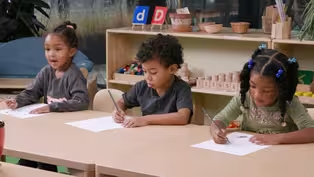
Video has Audio Description
Clip: 5/19/2023 | 7m 49s | Lia Zuilivia from Studio in a School draws the lines and shapes of a houseplant. (7m 49s)
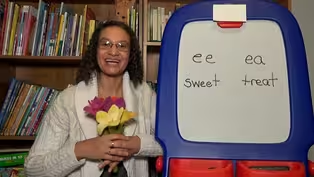
LONG E SOUNDS SPELLED EE AND EA
Video has Audio Description
Clip: 5/19/2023 | 8m | Anna Scretching-Cole explores long e vowel sounds spelled with ee and ea. (8m)
Video has Audio Description
Clip: 5/19/2023 | 7m 31s | Darlene Thomas reads RAINING by Pingping Xu with illustrations by Graca Lima. (7m 31s)
Video has Audio Description
Clip: 5/19/2023 | 7m 59s | Cassondra Easterling and her children use cabbage water to test the acidity of fruit juice (7m 59s)
Video has Audio Description
Clip: 5/19/2023 | 11m 37s | Diane Sanlatte teaches a song about the four seasons in Spanish. (11m 37s)
USING TANGRAMS TO MAKE FLOWERS AND TREES
Video has Audio Description
Clip: 5/19/2023 | 9m 57s | Omar Etman and Lily Fincher show how to use tangrams to make flowers and trees. (9m 57s)
ZURI SHOWS HOW TO DRAW A FLOWER!
Video has Audio Description
Clip: 5/19/2023 | 59s | Zuri shows how to draw a flower. (59s)
Providing Support for PBS.org
Learn Moreabout PBS online sponsorship















Support for PBS provided by:
Let's Learn is a local public television program presented by THIRTEEN PBS