Do You Hear the Short “u” in Summer?
4/24/2023 | 56m 54sVideo has Audio Description
LET’S LEARN about babies! Play with rock babies. Find out how much water diapers can hold.
LET’S LEARN about babies! Play with rock babies. Find out how much water diapers can hold. Dance like baby animals. Read ONE SUMMER NIGHT and words with short u. One-hour programs help children ages 3-7 learn in school and at home. Content provided by Education Through Music.
See all videos with Audio DescriptionADProblems playing video? | Closed Captioning Feedback
Problems playing video? | Closed Captioning Feedback
Let's Learn is a local public television program presented by THIRTEEN PBS
Do You Hear the Short “u” in Summer?
4/24/2023 | 56m 54sVideo has Audio Description
LET’S LEARN about babies! Play with rock babies. Find out how much water diapers can hold. Dance like baby animals. Read ONE SUMMER NIGHT and words with short u. One-hour programs help children ages 3-7 learn in school and at home. Content provided by Education Through Music.
See all videos with Audio DescriptionADProblems playing video? | Closed Captioning Feedback
How to Watch Let's Learn
Let's Learn is available to stream on pbs.org and the free PBS App, available on iPhone, Apple TV, Android TV, Android smartphones, Amazon Fire TV, Amazon Fire Tablet, Roku, Samsung Smart TV, and Vizio.
Providing Support for PBS.org
Learn Moreabout PBS online sponsorship[upbeat music] - [Narrator] Ready to learn?
- Hi.
- Hi, friends.
- [Narrator] It's time to share a story, read and write.
- Let's take it from the beginning.
- [Narrator] Discover science, sing.
♪ Hello, friends ♪ - [Narrator] Play, and so much more.
- We're exploring with light.
- [Narrator] Stay tuned for lessons and activities.
- And the keyword is... - Apple.
- Awesome!
- [Narrator] Funding for this program was provided by The JPB Foundation.
- Hi, friend.
How are you today?
I hope you're having a wonderful day.
My name is Catherine Rodriguez, and I'm so excited to be reading a story with you today.
And then we're going to be doing an activity following right after the reading.
I wanna introduce you to my little helper today.
- Hi, my name is Genevieve.
- Genevieve is here to also read this wonderful story along with us and to then take part in an activity.
Let's get started.
The book that we're reading today is called "One Summer Night."
The author is Tammi Salzano.
Illustrator is Rob Sayegh Jr. You ready, Genevieve?
- Yeah!
[soft piano music] - [Both] "Crack, crack, crack crack, scratch, scratch, scratch.
The sand is stirring; the time has come.
The eggs begin to hatch."
Wow.
"A tiny head pokes through the sand, then two, then all the rest.
They climb and pull with all their might, out of their cozy nest."
- [Catherine] "Lightning flashes in the sky while rain falls all around.
Thunder rumbles overhead and shakes the sandy ground.
Baby turtles gather clues upon the gritty sand, each about two inches long, no bigger than a hand."
- They're about hand size.
- Yeah, they're so small.
"The turtles need the Moon to find their way into the sea.
The bright light guides them to their home, to where they need to be.
But on this night, the Moon is dark, hidden in the clouds.
The turtles know they need to move away from seagull crowds!"
- They look, ah!
- Ah!
How do you think they feel?
- Scared.
- They look a bit scared and worried.
- One is hiding behind the book.
- Mm-hmm.
"One turtle thinks she sees the Moon, her flipper in the air.
This must be right!
she thinks, then turns to lead the others there.
So all the turtles follow her, heading towards the light.
They trudge through the sand, a massive group this dark and stormy night.
Farther and farther down the beach the tiny babies scurry.
All around them danger lurks, the turtles need to hurry.
At last, the babies stop their trek in the humid August air.
Tired, hungry, they look around, no water anywhere!"
[Catherine gasping] Oh, my goodness.
They must be so worried.
[suspenseful music] "They realize now with growing fear that this way isn't right.
The turtle babies need some help to find their way tonight.
The hatchlings huddle near a porch, unsure of what to do.
Slowly, slowly, time ticks by, it is now well after two.
[Catherine gasping] Then through the heavy summer air, the turtles hear 'Bark!
Bark!'
Suddenly the lights went off and everything is dark.
The turtles watch as shadows move across the cool wet sand.
One of them stops near the gate, an object in her hands.
[upbeat music] She points the flashlight towards the ground and switches on the light.
A steady beam cuts through the fog, lighting up the night.
People line up side by side and form a line 20 strong to guide the turtles towards the beach back home where they belong."
[Catherine gasping] So what are they doing, Genevieve?
- They're leading the turtles back to their home.
- They're leading the turtles.
They're helping them.
"'This way, turtles!"
says the girl, walking towards the sea.
'We're here to help you find your home.
Come and follow me.'
The baby turtles see the light, that's where they need to go!
They push each other through the sand, the smallest ones in tow.
Turtle flippers slap the ground, picking up the pace.
Everyone watches as they move, a smile on each face."
- Why are they wearing coats?
- Why are they wearing coats?
Well, the people could be wearing coats because it could be a cold day.
So it looks like it's a dark, so it might be nighttime.
So for this reason, they're probably trying to stay warm themselves.
"Ocean waves break on the shore and line the stand with foam.
The restless water reaches out to take the turtles home."
- It's like come here, turtles.
I'll bring you back to your mom.
- Yeah.
Come here, turtles.
Let's go back.
"The storm has passed.
The rain has stopped.
All is quiet and still.
The only sound is seagulls' cries beyond the sandy hill."
- Why are the seagulls crying?
- Oh, maybe that's what they're hearing at the moment.
So why are the seagulls crying?
Could be the noise that they're making, right?
It sounds kind of like a cry.
- Like wah!
Wah!
[Catherine laughing] - Yeah, what you hear seagulls say at the beach.
So let's see.
"The full moon shines upon the night, it's marbled, hazy glow no longer hidden by the clouds.
A spotlight for the show."
Look at those happy turtle faces.
They're big, wide smiles.
They're so happy.
Why do you think they're so happy?
- They're at home.
- They're at the home by the water.
- And this is [indistinct].
- Yeah, they're giving big white smiles.
"All at once, the helpers gasp as flippers flip the air.
The turtles wave with heartfelt thanks to those who brought them there.
Then they dive into the wave and disappear from sight into their vast and watery home.
This magical summer night."
- Night.
- That's so beautiful.
So now we're gonna take this time to show you how you can make your own turtle at home.
So me and Genevie have some pre-done crafts that we did earlier.
Yes.
We have a piece of paper.
So you have a piece of paper at home.
It could be a a big paper or a small paper.
- Any kind of paper.
- Yes.
And you're gonna take some crayon, some markers, maybe a pencil too.
And you're gonna draw your own turtle.
So take a look at this one that we made.
So we made a turtle.
We did some ovals over here and we colored them in with marker.
We also did another one over here with crayon.
So these are some examples of our turtles.
If you have some paper plates or bowls that you might have had left over from a party or from an event- - Or a cupcake filter.
- Or a cupcake filter.
That's another really good one, Genevie.
Thank you for that idea.
- Or a cardboard box.
- Or even a cardboard box.
Absolutely.
If you have a cardboard box, you can make your own.
And so we wanna show you over here.
You can make your own little turtle out of this paper plate.
Or you can make your own from a piece of paper.
- Or you might make your own from a stencil.
- Or you can even have, if you have stencils around that have turtles.
Feel free to make your very own.
We actually have some pluses over here that look like turtles so we're gonna copy them a little bit.
We have a circle.
And then another circle.
And I'm gonna make the eye over here in the shell.
You can take a look at how mine looks like.
Thank you so much for joining us today, friend.
We look forward to seeing your turtle.
Say bye, sweetie.
- Bye!
- Bye, friends.
[upbeat music] ♪ Ah, ah, ah, ah ♪ ♪ Ah, ah, ah, ♪ - Hi, friends.
My name is Isabel and welcome to my learning corner.
I've been waiting for you!
Today we are going to be learning all about the short U sound.
That says, can you guess what that says?
That's right.
Uh.
The short U sound says uh.
Can you repeat that?
Great job.
We're going to be building words, reading words, and writing words all with the short U sound that says...
Uh.
Are you ready?
Let's get started.
Our first activity of the day is going to be a phonemic awareness activity.
Phonemic awareness activities are listening activities.
So before we even start, we have to get our ears ready.
[soft bell music] Don't forget this one.
[horn honking] Good job.
Now you're ready.
Today I'm going to say a word, you are going to repeat the word, and then we are going to say all the sounds we hear in that word.
Let's try it.
The first word is bun.
Bun.
Ba.
Uh.
Nn.
Good job!
Let's try another word.
Tub.
Te.
Uh.
Ba.
Good job.
The next word is spud.
A spud is a potato.
Spud.
Ss.
Pa.
Uh.
De.
Good job.
Last one.
Lump.
Ll.
Uh, Mm.
Pa.
Lump.
Good job!
Are you ready to build some words with me?
[kids cheering] I really need your help today, friend.
This word, I'm not sure what this word is.
I know.
We should sound it out.
Cah.
Uh.
Te.
Hmm.
Cuh.
Tt.
Cut.
Cut!
Oh, thank you guys.
But what would I, what would happen if I needed to change cut to cup?
Which letter am I going to change in the word to make the word cup?
What do you think?
Cup.
I definitely have to change that last letter from a T to a, cup.
P!
Thank you, friends.
Let's see.
Does this work?
Cup.
Cup!
Cup!
What if I wanted to change cup to sup?
Sup is when you eat supper, right?
If I wanted to sup.
What would I do?
Sup.
Sup.
Oh, I should change the first letter to ss.
S!
Let's see if this works.
Sup.
Sup.
Thank you.
You guys are really good at this.
What if I wanted to changes to sup to sun?
Sup to sun.
What has to change?
The P has to change!
And what is the P going to change to?
The letter N!
Sun!
Now I was thinking sometimes when I'm out in the sun, the sun will stun me or it will shock me because it's so bright and so beautiful.
How can I change sun to stun?
Stt.
Uh.
Un.
Tt.
Oh, I've gotta move this over.
Uh-nn.
Stt.
Uh.
Nn.
What's the missing letter?
You guys are really good at this.
I think you're right.
Let's try it out.
Stt.
Did you see how I blended the two letters together?
Stt.
Uh.
Nn.
Stun!
Yay.
I think we're ready to read some words together.
Do you think we're ready?
[children cheering] Okay, let's get started.
Now we're ready to read some words together.
We're gonna take all of the skills that we used in the previous section and we're going to use them to read these words with the short U sound that says...
Uh, very good.
It says, uh.
Ready?
Lug.
Pug.
Mug.
Rug.
Run.
Good job!
These words on the second line begin with a blend.
Okay, they begin with a blend.
That's two sounds that blend into each other.
So this is how we would read it.
Ss.
Nn.
Blend them together.
Snn.
Snub.
Snub.
When you snub someone, you ignore them.
Stt.
Stub.
When I stub my toe, I bump it against something.
Stt.
Stun.
When you stun someone, you shock them.
Spun Spun.
Spun is past tense for spin.
Spud.
Spud.
Potato.
Let's read these words together.
Snub.
Good job.
Very good.
Blends can also happen at the ends of words.
Gust.
That's wind.
The word is gust.
Buh.
Bust.
Da.
Dust.
Mm.
Must.
Rust.
All right, let's take it from the beginning.
You read it out loud, as loud as you can.
And I will whisper it.
Okay?
Let's go.
Lug.
Pug.
Mug.
Rug.
Run.
Snub.
Stub.
Shun.
Spun.
Spud.
Gust.
Bust.
Dust.
Must.
Rust.
Yay!
Good job!
Now let's take all of our decoding skills and use them to read this sentence.
Read this sentence with me.
The gust of wind made me jump.
Who knew wind could make someone jump?
Good job.
Now, before we begin our next activity, which is our dictation activity, I'd like you to get a paper or something to write on and a pencil or pen or something to write with, and come right back so that we can write some words that have the short U sound in them.
[upbeat music] You're back!
Hi, guys.
[children cheering] Okay, so this is how dictation works.
I will say the word, you'll repeat the word, we will tap the word out or segment it, like we did at the beginning, and then you guys are going to write down the words, and then I'll write down the word right after you.
The first word is tusk.
The elephant has a long tusk.
Okay?
Tt.
Uh.
Ss.
Ka.
Tusk.
Go ahead and write that now.
Okay, let me go ahead and write tusk as well.
Tt.
Uh.
Ss.
Ka.
Did you write this?
Did you notice the blend at the end?
You did?
Great job!
We have one more word that we're gonna write today.
The word is snug.
I bury myself under the covers so I can be snug.
Snug.
Ss.
Nn.
Uh.
Ga. Go ahead, write it.
Write it.
Write it.
Mm-hmm.
Uh-huh.
Yes!
Okay.
So you should have written... Ss.
Nn.
Uh.
Ga. Snug.
Did you write that?
You did?
Awesome!
I am so proud of all of your hard work today, friend.
You have worked so hard today.
You have built words, read words, written words.
You are awesome.
And after today, what I'd like you to do is I'd like you to start looking for all of the words, looking all around you for words with the short you sound that say uh.
You can play I Spy only using uh sounds.
I spy a bright yellow ball in the sky and it gives off light.
You would say, "Sun!"
I hope you have fun playing I Spy today and I can't wait to see you again soon.
Bye, friend.
[upbeat music] - My name is Divine, and I'm making a cake for you guys.
[upbeat music] And these are my ingredients.
And watch me.
I poured in the cake mix and now I'm going pour the water.
Watch me.
I put in all my ingredients.
Now we're going to mix.
[upbeat music continues] I know how- - Take your time - Ooh, peanut.
I finished mixing the cake and now we're gonna put it in the bowl.
Watch me.
Now we're going to put it in the oven.
We're going to come right back.
The cake is done baking.
And now we're going to decorate.
Watch me.
[upbeat music continues] I finished my last product.
I can't wait to taste it!
Thank you for watching!
I hope you like this video.
[upbeat music] [upbeat music] ♪ De, de, de, de ♪ ♪ Do, do, de, de, de, do, de, de, do ♪ ♪ Do, do, do, do, do, do ♪ - [Lonny] Hey, Zoozy, wanna come over here and spin with me?
- [Zoozy] Hi, Lonny, I would love to spin, but [yawning] I'm so sleepy.
[Zoozy yawning] - [Lonny] Well, I guess I'll spin all by myself until she wakes up.
[upbeat music continues] [clock ticking] - [Zoozy] Ah!
That was a good sleep.
Now I'm ready to teeter-totter.
Come on, Lonny.
Teeter-totter with me.
- [Lonny] I wish I could, but [Lonny yawning] I'm just too tired.
♪ Beep, boop, beep, boop ♪ [clock ticking] - I feel refreshed.
Now I want a box step.
- Oh!
[laughing] That looks so fun, Lonny, but, ooh, wow.
[Zoozy yawning] That teeter tottering wore me out.
[upbeat music continues] [clock ticking] Omar, wait, I noticed something.
Our rocks kept falling asleep and waking up and falling asleep and waking up and falling asleep and waking up.
That's a pattern.
- Huh.
Yeah, that's right.
It is a pattern.
But the patterns of our rock babies, they aren't synced up.
When Zoozy was ready to play, Lonny was going down for sleep.
- Yeah, and when Lonny was waking up, Zoozy was going down for sleep.
Omar, that's a problem.
I want our rock babies to play together.
- Yeah, me too.
Maybe they need a routine.
- Routine?
- Yeah, a routine.
Like me and you, we have a routine.
We sleep at the same time so we can play at the same time.
We sleep, we play, we sleep, we play, we sleep, we play.
- You're right and that routine, it helps us play together because when we're sleeping at the same time, we're awake at the same time so we can play together.
- That's exactly it.
Maybe a routine could help our rock babies in the same way.
- Great idea.
So where should we start?
- Well, I know Lonny is really tired, so maybe we should put our rock babies down for a nap.
- Okay.
Good idea.
♪ Go to sleep ♪ ♪ Go to sleep ♪ ♪ Go to sleep little rock babies ♪ [Lonny yawning] - Okay, so they napped.
[bell dings] What's next in the routine?
- Ooh, I know.
Lonny's hungry.
Let's give him a snack.
- Okay.
[bell dings] [both imitating eating] [clock ticking] - You know, I think Zoozy wants to dance.
- Well then that's the next part of our routine, dance time.
[bell dings] [upbeat music] [clock ticking] Okay.
So our rock babies, they've napped, they've snacked, and they've danced.
What's next for Lonny and Zoozy?
- I know that Zoozy loves to act out stories.
- Well, then that's what's next, time for pretend.
[bell dings] [upbeat music] [both imitating speech] [clock ticking] Okay, friends at home.
What is our rock baby's routine so far?
Yeah.
Nap, [bell dings] snack, [bell dings] dance, [bell dings] pretend.
[bell dings] - What a great routine we have, Omar.
But Zoozy's been telling me that she's getting tired again.
- Yeah, Lonny too.
Which means that we get to start our routine all over again.
- Yeah.
Here we go.
Nap time again.
[bell dings] [clock ticking] They're up!
What came after nap time last time?
[Omar gasps] - Snack.
[bell dings] [both imitating eating] [clock ticking] - You know, it's time to groove.
- You know Lonny is down.
[upbeat music] [clock ticking] Okay, now Lonny has a great story to tell.
- Time for pretend.
[bell dings] [upbeat music] [both imitating speech] [clock ticking] - Friends at home, do you notice what I'm noticing?
The routine we're making to try to get our rock babies on the same schedule, it's a pattern.
- It is a pattern.
Friends at home, what do we keep repeating?
- Yeah, we nap.
- Snack.
- Dance.
- Pretend!
- Nap.
- Snack.
- Dance.
- Pretend!
- Nap.
- Snack.
- Dance.
- Pretend!
- Did you see that?
Did you see how a routine is a pattern?
- Yeah.
And you know what else I noticed?
The pattern helped our rock babies play better together.
And Zoozy seems a lot happier because she's getting the sleep she needs and getting time to play with her friend.
- Yeah, that's what I like about routines in my life.
They help me know what to expect.
Sometimes when I don't have a routine, I feel like, ah!
What's gonna happen next?
- I know, I can feel that way too.
But you know what?
What if Zoozy wants to change the routine?
Is that okay?
- Well, that's the good part about routines.
They can and should change to meet your needs or the needs of whatever you're caring for.
- Oh.
Good!
Because I know that Zoozy wants to learn how to play the trombone.
- Well, let's add some music time.
Friends at home, do you have a pet rock that you can pretend with?
Think.
What does it need each day to connect and play?
- Hmm.
Does your rock need time to sing?
Time to build?
Or extra dance time?
- I know me and Lonny do.
[upbeat music] [upbeat music] - Hi, I'm Maria.
My husband is Barry.
We have three kids, Malia, who is nine, and our twins who are six, Davis and Brooklyn.
Malia and Davis are both autistic.
Our children experience a wide range of emotions throughout the day so it's very important that we teach our children about their emotions and also how to express them appropriately.
Davis soothes himself by spinning in his chair.
Brooklyn calms herself using deep belly breathing techniques.
Malia, like many kids who are autistic, uses cards and visual supports to vocalize her needs and her emotions.
It was very challenging finding cards that represented who my children are in their skin tone and in their hair so I created my own for them.
At school sometimes she finds it easier to communicate with her cards rather than speaking out loud.
You used I am finished.
When did you use I am finished today?
In science.
- It's very important that she knows what she's feeling and that she can communicate it.
That leads to her being able to advocate for herself.
We do daily check-ins with her feelings and have a conversation around it.
And how did that make you feel?
- Sad.
- Made you feel sad.
Why did it make you feel sad?
- I also think it's very important for parents to make time and give themselves space to process their own emotions.
That way when you're with your children, you can be fully present.
My goal is for my children to learn how to manage their emotions now with me so that they can use this skill throughout their lifetime.
[upbeat music] - Hi, friends.
My name is Cassandra and these are my helpers: - Noel.
- And Emory.
- And we're here today to do a fun science experiment with you.
Today we are going to talk a little bit about babies.
Do you have a baby at home, friends?
Or maybe in your neighborhood?
Did you know that you used to be a baby?
Noel and Emory, did you know that you used to be babies?
- Yes, but sometimes I forget.
- Sometimes I forget too.
[laughing] So we all used to be babies at one time.
And when we were babies, a lot of us might have worn something like this.
[soft upbeat music] Friends at home, do you know what this is?
Noel and Emory, what is this?
- It's a diaper.
- A diaper!
That's right.
Now, tell me something that you know about diapers.
- I know that sometimes babies wet themselves, so a diaper absorbs the water so the pants don't get wet.
- Oh, that's really good!
I also know that diapers come in different sizes because babies come in different sizes.
So today we have three sizes of diapers.
So we have a small diaper, like this one, for a small baby.
We have a medium diaper.
- Like this one.
- That Noel is going to show us.
- That I'm holding up.
- And large diapers that Emory will show us.
All right.
Now, let's make a hypothesis about these diapers.
A hypothesis is what you think is going to happen in our experiment.
Can you say that word?
Hypothesis.
- Hypothesis.
- Hypothesis.
- That's a hard word to say.
Let's try it again.
Hypothesis.
- Hypothesis.
- Hypothesis.
- Hypothesis.
- Hypothesis.
- Hypothesis.
- Oh, you got it.
Good job, friend.
So today we're going to make a hypothesis.
That means that's what we think is going to happen in our experiment.
So we have three different sizes of diapers.
We have some colored water so that our friends at home can see it.
What do we think is going to happen in our experiment?
- I think the bigger diapers, because they're for bigger babies, we'll be able to hold more water.
Then [indistinct], the small diaper will be able to hold less than the medium and large diaper.
- Oh, I think that's a really good hypothesis.
Do you agree with that, Emory?
- Yeah.
- What do you think, friends at home?
Do you agree that maybe this small diaper won't hold as much water as the medium or the large, and maybe the large one can hold the most?
Does that sound like a good hypothesis?
- Yeah, I think it sounds really good.
- Okay.
So should we do an experiment and try it out?
- I think we should.
- Yeah.
- Yeah?
Okay, so I'll go first and then maybe Noel, could you do the medium diaper?
- Yes.
- And Emory, could you do the large diaper?
Okay.
Now, friends at home, if you wanna try and experiment like this at home, make sure you put something on your table to absorb any spills that might happen just in case you spill any water or if the diaper might leak.
We will know that the diaper can't hold all the water as it leaks.
That means it will start spilling out in the diaper.
So I'm gonna give it a try with this small diaper.
I'm gonna take this one cup of water and I'm gonna pour it on the small diaper.
And let's see if it can hold all of this water.
Are you ready?
- Yeah.
- Are you ready, friends at home?
Let's see.
[upbeat music] Whoa.
It looks like it held it all.
- Look at that.
It's kind of, maybe can't hold it all, but it's pretty close.
Look, friend.
It's pretty close.
It looks like a li... Oh, a little bit's going.
Oh, it can't hold it all.
It was really close though, friend.
I thought it might hold it off, but it ended up leaking.
So we're gonna put a sad face for that one because it did leak.
It wasn't quite able to hold that whole cup of water.
Now, what do you think?
Should we try the medium diaper?
- I think we should.
- Do you think it can hold that whole cup of water?
- I think it can.
- Let's find out, friends at home.
Let's pour that cup of water on the medium diaper and let's see if it's able to hold all of that water.
[upbeat music continues] Hmm.
Okay, let's see.
Let's see, friends at home.
Hmm.
- It looks like it works.
- You think it worked?
- Yeah, I think it did.
- Do you think that?
Pick it up.
[gasping] It doesn't leak!
- Oh.
- No.
It leaks.
- Oh, it leaks a little bit.
- Just a tiny, tiny bit.
- A tiny bit.
- It absorbs better than- - Oh, what were you gonna say?
- It absorbs better than the small, but still doesn't absorb as well as I thought it would.
- Oh, wow.
So let's put a hmm, eh, it kind of works.
It kind of held that cup of water, but it leaked a little bit, but not as much as this one, right?
This one leaks more.
Okay, so should we try that large diaper?
- Yeah.
- Yeah?
- All right, so let me get some more water.
Do you think it will be ale to hold a whole cup of water?
- I'd think it might actually be able to hold a whole cup, and then like it will just spill not too much.
Like let's say there's a medium, it was like a middle ground here.
That's how much it would spill.
Okay, let's give it a try.
So go ahead.
[upbeat music] Pour it in.
Ooh.
- It might be able to hold it.
- Let's see.
Give it a second.
Okay.
We could pick it up.
- Wait.
- It's not leaking!
- Nope.
Not leaking.
- That one's not leaking at all!
Ooh.
So let's give that one a happy face.
Now, do we think it can hold another cup of water?
- Yeah.
- Do you think so, friends at home, could that large diaper hold another cup of water?
- I think it can.
- Do you think thumbs up or thumbs down?
- Thumbs up.
- Thumbs up.
- You think he can hold another cup?
Oh my goodness.
Should we try it, fiends at home?
Yeah?
Okay.
Emory, it's you.
Pour in another cup.
Let's see what happens.
[upbeat music continues] Pour it in.
Pour it in fast.
Okay.
Give it a second.
Give it a second to soak in.
What do you think?
- I don't think it's gonna spill.
- Oh, let's see, let's see.
Let's see.
- It's not spilling.
[Catherine gasping] - It worked!
It held two cups of water!
Let's put another smiley face.
- Should we try a third cup?
- Do you think it can hold a third cup?
- Yeah!
- Do you think so?
Oh my goodness.
Let's try it.
Let's see.
Let's see.
Oh, let's see what happens on the third cup.
Okay, Emory, remember, pour it in fast.
Good job.
Wow.
Do you see how puffy the diaper's getting?
- Yeah.
- Wow.
- I think it can, no.
- I don't think it can hold this one.
- 'Cause I don't think it's like submerging.
- It can't absorb the rest of the water.
- I don't think it can either.
- If not, let's try one.
- Okay.
Let's see, let's see.
- I think it's gonna spill.
- Yep.
- Oh!
It's leaking!
- It spilled a ton.
- It spilled a lot.
Okay, so that sounds like that gets a sad face for that one.
All right, let's put that over here.
So let's do a little recap.
What happened with the small diaper?
- It didn't hold any water sadly.
- It didn't hold that cup of water.
What happened with the medium?
- It was okay, but could be better.
It could hold whole cup.
It leaked just a little bit.
- Just leaked a little bit.
And what about that large diaper?
Emory, can you tell us about the large one?
- It hold two cups.
- It held two whole cups!
And then what happened on the third cup?
- It wasn't able to all submerge.
- It wasn't able to hold all of that third cup.
That's right.
Wow, friends at home.
So our hypothesis was right.
We thought that that large diaper would hold more water than the medium and the small.
And we also thought that this small would hold the least water.
So I think that we were right in our hypothesis.
Thank you for joining us for this experiment, friend.
If you would like to try this at home, make sure you ask a trusted adult to help you with some water, maybe getting some diapers, and make sure you protect your floor and your table from any spills.
Thank you so much for joining us, friend.
- Bye!
- Bye!
[upbeat music] - Hi, I'm Maria.
[translator speaking in Spanish] [translator speaking in Spanish] [translator speaking in Spanish] You used I am finished.
When did you use I am finished today?
- In Science.
[translator speaking in Spanish] - And how did that make you feel?
- Sad.
- It made you feel sad.
Why did it make you feel sad?
[translator speaking in Spanish] [translator speaking in Spanish] [upbeat music] [upbeat music] - Hello, everybody.
Welcome to this music time!
I am Mr. Martinez.
I am so glad that you are here.
It's time to say hello, but this time we are gonna use our spider fingers.
May you please try your spider fingers to get together.
Yes.
Not too fast.
Here we go with the piano.
♪ Ready, ready, ready ♪ ♪ Ready, ready, ready ♪ ♪ Here we go ♪ ♪ Hello, friends ♪ ♪ Hello, friends ♪ ♪ Hello, friends ♪ ♪ It's time to say hello.
♪ ♪ Hello, friends ♪ ♪ Hello, friends ♪ ♪ Hello, friends ♪ ♪ It's time to say hello ♪ Yay!
That was great.
I want invited to guess which language we're going to learn today.
Hmm.
Maybe.
Which one?
Which one?
Which one?
Today is the day to learn Italian.
And in Italian we have a special way to say good morning.
We say buongiorno.
Buongiorno!
Are you ready?
Why not you try with me.
Buongiorno.
Do not forget your spider fingers.
Your spider fingers.
One, and two, and lean on me, go.
♪ Buongiorno ♪ ♪ Buongiorno ♪ ♪ Buongiorno ♪ ♪ It's time to say hello ♪ [upbeat piano music] ♪ Buongiorno ♪ ♪ Buongiorno ♪ ♪ Buongiorno ♪ ♪ It's time to say hello ♪ Whoo!
Welcome to this wonderful music time with my friend, the piano.
And for today's activity, we are gonna have a new song.
Are you ready to learn a new song?
Okay.
This is a really fun song.
We'll start to say, "A ram sam sam."
Try it again.
Alon, son, son.
What about if you try to do knees, clap.
Knees, clap.
A ram sam sam.
A ram sam sam.
A ram sam sam.
A ram sam sam.
Guli guli guli guli guli ram sam sam.
Okay, keep it going.
Do not stop.
Let's ask our friend, the piano, to help us.
Ready.
Go.
♪ A ram sam sam ♪ ♪ A ram sam sam ♪ ♪ Guli guli guli guli guli ram sam sam ♪ ♪ A ram sam sam ♪ ♪ A ram sam sam ♪ ♪ Guli guli guli guli guli ram sam sam ♪ Are you ready to sing with me?
One and two, and everybody go.
♪ A ram sam sam ♪ ♪ A ram sam sam ♪ ♪ Guli guli guli guli guli ram sam sam ♪ ♪ A ram sam sam ♪ ♪ A ram sam sam ♪ ♪ Guli guli guli guli guli ram sam sam ♪ But this song has a second part.
Are you ready for the second part?
Okay.
Of course you're ready.
Remember to.
Knees and clap.
Pat and clap.
Ready?
But this will be a little bit different.
Let me see who's ready to tell me what is the huge difference.
Are you ready?
♪ A rafiq, a rafiq ♪ ♪ Guli guli guli guli guli ram sam sam ♪ Ready.
Here we go.
♪ A rafiq, a rafiq ♪ ♪ Guli guli guli guli guli ram sam sam ♪ ♪ A rafiq, a rafiq ♪ ♪ Guli guli guli guli guli ram sam sam ♪ ♪ A ram sam sam ♪ ♪ A ram sam sam ♪ ♪ Guli guli guli guli guli ram sam sam ♪ ♪ A ram sam sam ♪ ♪ A ram sam sam ♪ ♪ Guli guli guli guli guli ram sam sam ♪ ♪ A rafiq, a rafiq ♪ ♪ Guli guli guli guli guli ram sam sam ♪ ♪ A rafiq, a rafiq ♪ ♪ Guli guli guli guli guli ram sam sam ♪ Whoo!
Okay who's ready to tell me what is a huge difference between the first part when we say, "A ram sam sam, a ram sam sam a ram sam sam," and the second part when we say, "A rafiq, a rafiq, Guli guli guli guli guli ram sam sam"?
Maybe you, maybe you, raise your hand if you want to participate.
Let me hear your thoughts.
And you are right.
The first part was really slow and the second part was too fast.
Oh, yes.
Have you seen any animal that is is really slow when it's moving?
Of course.
A snail.
Oh, yes.
The turtle.
Those animals are really slow.
And in music we have a special word when the music goes slowly, that word is largo.
Yes.
Everybody say it with me, largo.
That is an Italian ward.
Yes.
It's another ward in Italian.
And we go largo.
Largo, when everything goes slow.
And for fast moves, like which animal goes really fast?
Which animal goes really fast?
Yes, you're right.
The cheetah.
Yes, you too.
The tiger.
Oh, the chicken?
Okay, chicken.
I know how tough it is to catch some chicken.
The bunnies?
Oof.
Yes.
Some bunnies are really, really fast.
And in music, when something goes really fast, we say presto!
Can you say with it me?
Presto!
Presto, presto, presto, presto, presto, presto, presto, presto, presto!
Yes!
Now I would like you to play with me four different movements with our body.
Number one, knees.
Number two, clap.
Number three, chest.
Oops.
This is a little bit tricky.
Chest.
And a splash of water.
One, two, three, and four.
And knees and clap and chest and splash.
Yes.
You got it.
Here we go.
One more time.
Slowly.
Knees and clap and chest and splash.
And knees and clap and chest and sing!
♪ A ram sam sam ♪ ♪ A ram sam sam ♪ ♪ Guli guli guli guli guli ram sam sam ♪ ♪ A ram sam sam ♪ ♪ A ram sam sam ♪ ♪ Guli guli guli guli guli ram sam sam ♪ Then we'll change the speed.
Ready?
♪ A rafiq, a rafiq ♪ ♪ Guli guli guli guli guli ram sam sam ♪ ♪ A rafiq, a rafiq ♪ ♪ Guli guli guli guli guli ram sam sam ♪ Whoa.
That was awesome.
That was really fast.
It's time to say... ♪ Goodbye, friends ♪ ♪ Goodbye, friends ♪ ♪ Goodbye, friends ♪ ♪ It's time to say ♪ ♪ Goodbye ♪ See you next time.
[upbeat music] - Hi, y'all.
My name's Aaron and I'm here to get you moving.
Now today we're gonna work on our jumps!
Now can you think of any baby animals that might jump?
How about a baby kangaroo?
Or maybe a baby bunny?
How about a baby frog?
They all jump, right?
Well, today we're gonna act like those animals.
We're gonna act like a baby kangaroo, a baby bunny and a baby frog while I sing a song.
Every time I say the word "jump", you're gonna jump.
But you have act like that animal.
Are you ready?
Here we go.
First, let's do the baby kangaroo.
The baby kangaroo goes jump, jump, jump!
The baby kangaroo goes jump, jump, jump!
The baby kangaroo goes jump, jump, jump!
The baby kangaroo goes jump, jump, jump!
[gasping] Baby bunny!
The baby bunny goes jump, jump!
The baby bunny goes jump, jump!
The baby bunny goes jump, jump!
The baby bunny goes jump, jump!
[gasping] Baby frog.
The baby bunny goes jump!
The baby bunny goes jump!
The baby bunny goes jump!
The baby frog goes jump!
[gasping] Great job, everybody!
Thanks for moving with me.
[upbeat music] - [Announcer] Funding for this program was provided by The JPB Foundation.
[upbeat music] ♪ [dramatic music]
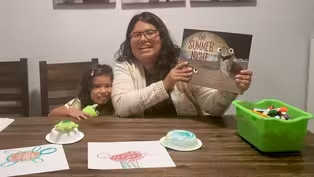
Video has Audio Description
Katherine Rodriquez reads ONE SUMMER NIGHT by Tammi Salzano, illustrated by Rob Savegh Jr. (10m 23s)
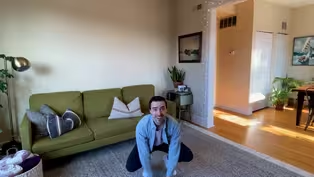
Video has Audio Description
Mimic the movements of baby animals with Aaron Umsted. (2m 1s)
Video has Audio Description
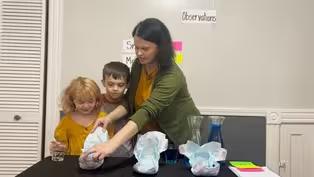
Cassondra Easterling does an experiment to figure out how much water diapers of different (9m 48s)
Video has Audio Description
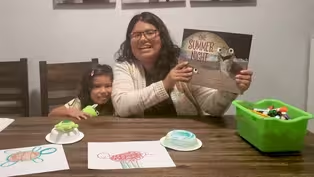
Katherine Rodriquez reads ONE SUMMER NIGHT by Tammi Salzano, illustrated by Rob Savegh Jr. (10m 23s)
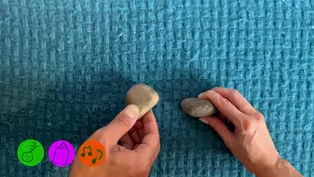
Patterns of Babies’ Daily Routines
Video has Audio Description
Omar Etman and Lily Fincher explore the patterns of a babies’ daily routines. (8m 6s)
Video has Audio Description
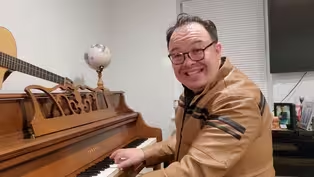
David Martinez explores the terms “presto” and "largo” with music and movement games. (8m 28s)
Video has Audio Description
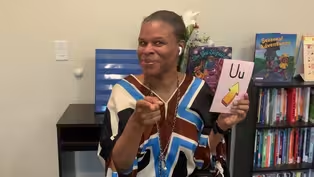
Isabel Simmons helps children build, read and write words with the short u vowel sound. (11m 54s)
Providing Support for PBS.org
Learn Moreabout PBS online sponsorship














Support for PBS provided by:
Let's Learn is a local public television program presented by THIRTEEN PBS