Smart Start: A KET Special Report
Donna Grigsby, M.D. (Full Interview)
Clip: Episode 1 | 33m 32sVideo has Closed Captions
Full Interview with Chief of Division of General Academic Pediatrics.
Full Interview with Donna Grigsby, M.D. the Chief of Division of General Academic Pediatrics at Kentucky Children's Hospital.
Problems playing video? | Closed Captioning Feedback
Problems playing video? | Closed Captioning Feedback
Smart Start: A KET Special Report is a local public television program presented by KET
Smart Start: A KET Special Report
Donna Grigsby, M.D. (Full Interview)
Clip: Episode 1 | 33m 32sVideo has Closed Captions
Full Interview with Donna Grigsby, M.D. the Chief of Division of General Academic Pediatrics at Kentucky Children's Hospital.
Problems playing video? | Closed Captioning Feedback
How to Watch Smart Start: A KET Special Report
Smart Start: A KET Special Report is available to stream on pbs.org and the free PBS App, available on iPhone, Apple TV, Android TV, Android smartphones, Amazon Fire TV, Amazon Fire Tablet, Roku, Samsung Smart TV, and Vizio.
Providing Support for PBS.org
Learn Moreabout PBS online sponsorshipDr. Grisby, it's good having a chance to talk to you.
Thank you for having me.
No, the pleasure.
Blame is all mine.
Let me ask you.
A lot of us think the starting line for cognitive and functional development of a child is its birth.
The child is here.
Now they're going to develop those cognitive and social skills.
But doesn't it really kind of start a little earlier than that?
Yes, it does.
Yes.
So that's why prenatal care is so important, because so much development occurs when the mother's carrying the baby.
So, so much happens before that baby is even born.
And that can positively impact or negatively impact that child's long term development.
Mm hmm.
So when I think of things that are occurring and a lot of it is before a woman even knows that she's pregnant.
Mm hmm.
So what are some of the things you kind of recommend for women in reproductive age group, if you will, to prepare the ground?
So several things.
If you think about a lot of wome for a while after development starts, things like taking folic acid, that's something that we've seen make a tremendous difference in the incidence of neural tube defects or spine bifida and things like that.
And that started, you know, many years ago.
So I'm an older pediatrician.
I remember what it was like before we did that.
Just good nutrition.
You know, thinking about your own nutrition, if you're thinking about getting pregnant, not using any unnecessary medications or any substances, including alcohol, if you're anticipating getting pregnant, you don't want any of those things to affect your fetus.
And so I talk a lot when I you know, sometimes I get a chance to talk to folks that are anticipating pregnancy.
And we talk a lot about these are the things you need to think about because these are things that can affect your child development long term in the brain development in utero.
Nutrition, sleep, just staying physically active, taking good care of your own body so your body can take care of that growing fetus.
You talk about things that are within the realm or control of the individual, but there are some things that are external to that mother that they can and cannot control.
Tell me a little bit about how you view things like pollution, be it from the air or water that we're getting, and also stresses that occur.
Like what impact is that going to have?
So it's interesting you bring up stress because we talk a lot about stress not only in pregnant women but also in young children and the effects of stress.
Now, as you know, our bodies were set up to deal with stress.
They were but they were set up to deal with brief episodes of stress, not endless, unrelenting, what we call toxic stress.
And so there are things we all have stress in our environment, but there are folks we know they have much more stress, whether it be, you know, food insecurity or toxic living environment or violence in their community.
We know all of those things have an adverse effect on families.
And and so to address those things as a community are really important in terms of the overall health long term of all of our citizens, children and adults.
So when I talk about, you know, the effects of stress, there are also things that we know that can lessen those effects.
So having nurturing supportive relationships with people in your household or people that you work with her friends or people in your in your neighborhood, those help lessen those negative effects of stress.
Interesting You talk about some of the things that we may lessen, something that may be good for the baby, but also good for ourselves or that new parent reading.
Now I hear people talk about, oh, I'm going to play Mozart for the baby.
Well, the why people choose classical all the time.
I think jazz would be a good one.
Oh, bluegrass and sweet turkey.
But just reading and things like that.
Do they play a role any way as far as in the developing fetus, or are we just fooling ourselves?
No, it's really interesting to me as someone who sees newborn babies, that things you say it around the baby voices that they hear or they can recognize.
And you notice in the newborn nursery or in the, you know, the mother's womb after birth, the father, the mother, the grandmother, someone that's been around that fetus a lot, you will see that fetus react to their voice.
So we know that babies can hear.
We know that that they can respond to things in that environment.
And so just talking and, you know, there are people who read to the baby.
And what I tell folks is talking is really important so that they can hear your voice.
Music is important because it's just pleasant, too.
And it's something that the baby will get used to hearing.
But it books sometimes or many times enhance the language that we use.
Oh, really?
I'm not going to probably use the word pterodactyl when I'm talking to you today, except in this example.
So there are so many words that we get from books that we would never get just in our everyday language.
Is it so much the word or the manner of which we're saying the words?
Is that what's comforting to the child?
Certainly after birth, there's there's that whole package of I'm interacting with you and interacting with another human being, and they're responding to my attempts at vocalization or they're responding to my wiggling or my looking at them.
And so that's that sort of give and take that we see between human beings is extremely important in the development of the human brain.
Mm hmm.
How important is once that child is out?
Mm hmm.
And for interactions that social interactions be at the family group by any name, be it immediate relatives or just the chosen family that we have.
Mm hmm.
It's extremely important, because what we know about language pathways is that it's that give and take between the person that you're interacting with and you that reinforces those language pathways.
And so and if you think about it, we talk a lot about reading and the importance of reading.
But I suspect if you think back to your favorite book as a child, you not only think about that book, but you think about that situation or that person that used to read that book to you.
And that's all wrapped up.
You know, if you think about it, we were sitting on probably somebody lap or sitting in the floor with them in a very loving, nurturing environment and that person sharing that book and they're showing us pictures and we're touching the book and we're you know, if we're a baby, we're probably putting that book in her mouth and tasting that book and all of those that whole experience is really important in how the brain develops.
Interesting.
I wonder if that's why I prefer still reading a newspaper or reading a book as opposed to looking at it.
On a computer.
Exactly.
Exactly like that.
Yeah.
How important is it in terms of later social development, but also academic performance and even health in interaction with the criminal justice system?
Some of this early interaction, these kinds of things, you're talking.
Yes.
So when you talk about brain development and you talk about getting children ready for school, you know, most of our academic success is during our school years.
But the ability to have that academic success starts, as you said previously, prenatally, but also in those first years of that child's brain development in their life.
And so reading to children, singing to children, interacting and helping those little brains develop, make a huge difference in how ready they are to be successful for school.
And we know a lot of those changes and a lot of the differences that we see in children when they get to school occur in those first three years of life, not just right before they start kindergarten or after they start kindergarten.
So it's crucially important for those first few years for that baby's brain to be stimulated in very positive ways with reading music, singing, playing, interacting with their environment and the people around them.
Which begs me the question of what's the difference then between preschool and early childhood education?
What are we doing differently?
So early childhood education really starts at home, or who that primary with that primary caregiver.
And so they're the ones that are actually building those wonderful pathways in the brain that involve language and memory and learning and our ability to regulate our emotions.
And all of those things occur very early on.
And we know that if there's a gap there, you can start to overcome it.
But you may never be able to completely overcome a gap that you see.
I'm sorry.
You're saying that if we have this gap in learning.
Yes.
Early it may in that pre three year old, it may manifest itself down the road.
Absolutely.
And so and you may while you can make gains in that learning, you may never catch up to those peers that were already at a higher level because if you think about it, they're progressing more, too.
So that's why early childhood is so important.
And of course, I'm going to be a little biased in my in my discussion about that because I feel like if we do a really good job with early childhood and we have those children ready for school, they're going to have a much better chance at success in school and long term.
And you may know this, but prison rates, prison needs are estimated on third grade reading levels in a community.
So they predict how many beds they may need or how many people they may have in in the prison in future by looking at third grade reading levels.
That is a rather disheartening.
Yes.
Perspective.
Yes, it is.
Malcolm Gladwell in his book Outliers, made an interesting point.
They looked at hockey players.
Mm hmm.
40% of all hockey players in the NHL were born between January three and March.
Another 30% were born April to June.
Mm hmm.
Which suggests that those young people were getting training in maturity.
Mm hmm.
Earlier.
And which the later kids weren't getting.
So it suggests to me that a child who in this case, not necessarily with their time they're born, but if they're born into an environment or into an economic situation in which they can get some of these is going to have an advantage over that child who wasn't born into that social strata where they would get this.
And that's where we come in as a community.
Okay.
So you're going to get me going a little bit on what I'd like to talk about, which is, as a community, don't we have a responsibility to to lift all of our children out and make sure all of our children have the opportunity for success?
And so while children that are born into privilege are going to have an easier time, isn't it important for us as a community to make sure that those children that aren't born into privilege have those opportunities to learn and and those parents have an opportunity to understand the importance of how their interactions are going to set their children up for success.
Well, which Annie Casey Foundation in October of 23, came out with a paper on low preschool in Raymond.
Enrollment rates threaten to worsen student achievement, and they point out that less than 50% of kids are in these preschool environments.
Where are we?
How are we missing the mark?
Given what you've already stated, that by eight by third grade, we can predict who's going to go to jail.
So now tell me, where's the disconnect?
What are we doing wrong?
So I think sometimes we don't get the message out to people about the importance of early brain development and what a role parents and caregivers play.
So you're talking about children who are cared for at home, but only but in addition to that, children who are in quality child care centers are going to have an advantage to that positive interactions, those more opportunities for learning, more opportunities for interactions with their peers, and with the ability to learn through play and through reading and through quality child care programs.
And so we some people can't afford a quality child care program.
And so they're dropping their children off with a relative who may or may not be in a good position to help that child learn.
Not saying relative care isn't a good thing, because I like to tell people I went to my kindergarten, so I. I didn't go to formal kindergarten.
I went to kindergarten with my grandmother who sat and read to me.
And we learned letters playing Scrabble.
And so you can have a very enriched experience at home.
But people need to have the tools and they need to have the the the support part to have things in that home that children can learn with and and to understand that it's not just reading a book which is important, but it's the fact that you're talking to your child through every activity.
So if I'm in the grocery store, I'm talking to my child about, hey, we're going to go get some some cereal, let's look at this cereal box.
And what do you see on this cereal box and what color is this box?
And let's look for something green or let's look for a fruit that's yellow or let's let's look over here and let's talk about everything we're doing, because we know that if parents talk to their children, even in trivial times, supposedly trivial times, like doing menial chores, like doing the laundry or changing a diaper, if that parent's talking to that child in that process, they're it's much more enriching to their vocabulary long term.
And so people people who have chatty families have larger vocabularies.
So it's a matter of just talking to that child, even if it seems like it's insignificant, talking to them about, hey, I'm going to put the clothes in the laundry.
You want to help me put some the shirt?
This is a shirt.
Let's put this in the in the washer.
And and while it may slow you down a little bit and parents are saying, you know, I have time to talk about everything, but if you have time to do it, you have time to talk while you're doing it.
And so that child can hear you talking about we're going to put that, you know, I'm going to put the detergent in and I'm going to put the clothes in and they hear all of that.
And that just reinforces all of that in their brain.
You know, my mother finished nursing school in 1947.
She joined the visiting nurses in public health back in Washington, D.C. One of her jobs was to go into the family at home, Family health after a child was born to teach the mothers how to be a mother.
Mm hmm.
Somehow, another.
I get the feeling that you as a pediatrician has to patients not only the child, but also the parent.
How do you handle it?
Because you've already talked about if we're not addressing the mother or father or whoever it is, is we we're missing the boat.
Right.
So how do you do that?
And so in all of the things that we talk about in there are a lot of things for us to talk about.
We talk about nutrition, we talk about safety.
You know, we talk about those crucial things we take.
I always take 2 minutes out of the out of the visit at least, and say, hey, are you reading to your child?
How often are you reading to your child?
That's a new book.
Do you think, do or does your child enjoy reading?
Do you enjoy you know, what kind of things do you like to do with your child?
And sometimes when I walk in with that book in her hand and the baby takes it, you can tell immediately.
And I say to the parent, I can tell this is something they're used to doing.
Or if I talk to a baby and the baby starts trying to talk back to me, I point out to the parent, you talk to this baby a lot.
I can tell because they know what to do when I talk to them.
So it also gives you an opportunity to praise parents and parents.
A hard job.
Yeah.
And and in this day in time when people are working and they're trying to take care of their children and they're trying to do everything that you need to do just to get through the day, it's important for them to understand, hey, you know what?
That's a really good thing you did with your child.
That's a really good thing.
Your child is healthy.
Your child is growing.
You're doing a great job.
And I think as as a pediatrician, that's part of my job is to say, hey, you know what?
You're doing this really well and here's some other things to think about at the same time.
You know, I think that sometimes we are more willing to condemn or denigrate the efforts of the parent example.
I think both you and I will agree this.
I hope so, that to see the child pop tarts and think that we're giving them a nutritional breakfast right, is absurd.
However, if that's the best that they can do.
That's right.
And it's better to give that child have a pop tart.
And I'm not criticizing the recent ball game, by the way.
We're the teammates Pop-Tart.
But, you know, I mean, you have to give praise and recognize people where they are.
Is that correct?
Absolutely.
Absolutely.
And if you think about some of our folks that are living in very stressful life situations, this isn't the first time they've lived in a stressful life situation.
Maybe they they they've their family struggled and now they're struggling and into to it.
Maybe they struggled in school.
And so for you to look at them and say, wow, look how your child's coming along.
Look what a good job you're doing with your child.
That child becomes a source of pride because I think as a parent, we all want our children to do better than we did.
We want them to be more successful than we were.
We want them to have every opportunity in the world to succeed.
And so to tell a parent, you know what, you're doing a great job.
Helping your child succeed is really important, especially if it's somebody who's really struggling.
You mentioned that a child who you come into the exam room and you have a book with you and you get an idea who has been read to and who's not by the reaction of the child.
Tell me some more about that.
Elaborate a little more.
So you can tell when you're going through your developmental assessment of that baby, if they've been talked to, because they will interact with you in a very positive way.
You get lots of smiles and lots of even from a baby as young as a couple of months old.
Yeah.
If if someone's been talking to them and singing to them and interacting with them, you can tell that right away.
You can also tell children who've handled books or toys before because they know how to handle it.
They know how to turn a page.
And you can see that very early on in infancy you can see that difference.
So I like to point that out.
And it doesn't mean that if you haven't read to your child and they are six months old, that they're lost, You can go ahead and do it then and you're going to see them change in a very positive way.
You're going to see them learn how to handle a book and learn how to look at pages and know how to how to kind of share that book with you.
When we talk about the brain, we oftentimes talk about function.
Tell me some of the science about what's going on in terms of the physical development, prenatal and as well as the functional development, and also compare that to after birth.
Sure.
So a lot of the brain that a lot of the the basic structure of the brain is going to happen in, you know, during pregnancy, in utero.
And so you're going to see if there is a if there's an abnormality in the structure of the brain, you're going to see the effects of that pretty early on.
Now, if this is a healthy brain and the the prenatal care has been good and nutrition is good and this is a healthy brain, when the baby's born, then your ability to enhance, to continue to enhance the function of that brain starts from the very moment that they're born, or it certainly continues from the moment they're born.
And so we know that good nutrition and stimulation play a big role in the way the brain develops even after birth.
We also know that children who are exposed to toxic stress and what I mean and as I said earlier, we're all born with the ability to deal with brief episodes of stress.
But this unrelenting stress all the time that that doesn't let go.
And there's not someone there that's saying, hey, it's okay.
I know this was scary, but everything is okay.
I'm going to protect you.
Everything is good now.
If they don't have that, we know that there are certain areas of the brain that are more adversely affected because they have more receptors for those stress hormones.
When we're stressed, our bodies produce what some of the stress hormones and what we know is our bodies are meant to do that for a short period of time, and we react to that.
But if that level of stress hormone stays up and doesn't go away, it can adversely affect the actual structure of the brain.
So there are areas involved in memory and emotional regulation and language development that all have a lot of receptors for this stress hormones.
If the body sees those stress hormones all the time, it actually can affect the structure of the brain in a negative way.
Even in utero.
Even.
In.
So it's just very similar to what we see in when the mother is using alcohol or maybe even some other drugs.
Yes, you can see the exact same kind of thing.
Yes.
And so the child is born and is hardwired to respond in different ways at this point.
That's correct.
Can that be corrected?
It depends on the severity.
But yes.
And what we know about how do you offset this toxic stress environment is that there needs to be that nurturing in that nurturing person in your life that makes everything seem okay so that your stress level goes down, so that you see, hey, this person's looking out for me, this person loves me, this person is nurturing me.
This person hugs me and kisses me and in and makes me realize that, hey, I'm going to be okay because this person's in my corner or these people are in my corner so it can be undone.
And some of the things we talk about, you know, we talk about the the importance of brain development with reading.
But that nurturing part of reading also seems to offset some of that negative effect of stress.
So that nurturing, loving relationship with with one or more people in your environment seems to help decrease those effects of toxic stress.
If you're ever in a room of what many of us may recognize as high achievers, sure.
Do you ever ask the question, how many of you all are read to?
I do, actually.
I do that with my medical students because I teach classes with the medical students.
And we know that about 50% of the children in this country are read to every day, a little bit over 50%.
And when I ask that question because I want to use it as a point, when I ask that question to medical students at almost virtually every hand in the room goes up.
And I share that with parents and I say, you know, it doesn't mean your child's going to be a doctor, but your child could be a doctor if you do all of these things to help their brain develop.
You know, when I was back in Washington, there was a study looking at who was in the criminal justice system, and they found that almost 80% in this case, it was men who were behind bars had never had $100 to their name.
Has there been a study, to your knowledge, looking at people who were in criminal justice systems?
And a similar question was asked Have you been read to or looking at their reading capabilities?
Well, we know that you can predict the prison by some states, predict the prison population based on third grade reading proficiency.
So that tells me, you know, if it's at the third grade, you're struggling to read.
The chances are pretty likely that you weren't read to early on or you didn't get that appropriate stimulation.
That's not true.
100% of the time.
But a great majority of the time, when you look at that background of that child, we know that they didn't get that early stimulation or there was something that interfered with their ability to to successfully get that that stimulation from someone in their family.
Because when you look at adverse childhood effects, what we find is the higher those effects are, the higher the number, the effects are the poor health outcomes those folks have long term.
So a lot of those risk factors that that we see as adverse childhood experience is that lead to poor health outcomes.
They're they're very early on.
And so we know that some of those things, if they occur in isolation and you have a loving, nurturing environment, otherwise the child's going to overcome that.
But the more of these there are, and that includes things like violence in their community or violence in the household, either to that child or to to another person in that in that household, or having a family member who has mental illness or or has substance abuse issues.
We know that those things living in poverty, we know all of those things have an effect long term on your health outcomes because it has an effect on what kind of decisions you can make, because that's another area of the brain that processes the prefrontal cortex, helps you make good decisions.
We know that adolescents, you know, up until about your mid-twenties, you're still developing that part of your brain.
So we know if there's stress that part of the brain may not develop.
That affects your long term decision making.
So if you don't have good decision making, you may make a choice to do something to get quick money, like doing something criminal, or you might not have the ability to make money to support yourself.
And so you're going to choose things that seem like easy ways to make money at the time that really, if you had better judgment, you'd realize that's not a good way to try to make money.
You know, Charles Dickens, The Christmas Carol Scrooge is talking to the ghost of Christmas future yet to come in here.
So these are shadows of things that are or the shadows of things that will only will be, can I make it change?
So going back to your thing abou if we have appropriate intervention through nutritional programs, behavior modification or behavior changes and improving how we're teaching a person to learn, can we correct?
Yes, it's going to be hard, but can we correct and stop that inevitable process?
I would like to look at it as preventing it from happening.
So going all the way back to good prenatal care and and good housing, affordable housing and and safe housing and making our communities safer, we can take away those things from that child's environment that may impact their ability to learn because it affects the way their brain develops.
So, yes, I'm going to say we can help, but we can really prevent if we go back to prenatal only and early childhood and do the things that that are going to optimize that child's ability to be successful.
I guess I just want to be sure that be at the mind of a policy maker or even a family member to say, well, you know, at third grade, this is how this person is doing.
We know what's going to happen to them.
We don't need to make an investment in this child.
Oh, no, I'm not.
I'm not saying that at all.
I'm saying at third grade, yes, we still need to help that child and help them become successful.
Yeah, but hopefully we will get to a point where we're doing such a great job preventing it that we won't have to.
But absolutely not.
It's not hopeless.
At the third grade, we still can make a difference in the success of that child.
Go try to bring things to an end for you.
So I'm going to put you a little bit on the spot, the political side of things.
Okay.
You've talked about things that we as parents and family members can do.
But I think, again, we'll go back to the chilling statistic that kids who are having struggling by the third grade are more likely to get involved in criminal justice.
Yes.
Yes.
So I look back and, you know, we don't have adequate pre-K programs.
The individuals who we have working in these programs are poorly paid.
Or.
Overworked.
Yes.
So what do you as the politician, Dr. Chris, go tell me, how do we you know, we seem to be putting our eggs I effort and dollars into criminal justice programs, but not on the pre-K programs.
How do you we tell our legislators, state and federal.
Come on, guys.
Yes.
I had an opportunity once to through an early literacy program that I'm involved in to talk to some legislators.
And I am.
What I said very clearly was you're going to spend money on these children one way or the other.
You can either spend the money up front and enhance their early education by providing books and education for the parents and universal pre-K, which, you know, if I'm a family and I, I want to give my child every opportunity, but I can't afford a good pre-K program.
Isn't it sort of our responsibility as a community to help that child get that opportunity?
And so I said very clearly, I said, you're going to spend money one way or the other.
You're either going to spend a lot of money on an on the back end trying to rehabilitate someone who has a learning, you know, who has learning difficulties or who's in who's in the juvenile justice system or the justice system.
Or you can spend the money up front and hopefully prevent that from happening.
And so as a as a politician, which I would never be, because I might make too many faces and what other people are saying, which is unkind.
And what I would say is, let's look at how we're spending our money and we're going to get a lot more bang for our buck, spending it in early childhood than we are spending it on them after they've been unsuccessful and they're looking for criminal ways to survive.
Are you suggesting we need to make a greater investment in what's going on with that child prenatal and absolutely years of age?
Absolutely.
You sound like the old commercial fram oil filter.
You can pay me now or pay me later.
Exactly.
That's exactly.
Well, thank you very much.
I appreciate having a chance to talk to you.
Thank you.
Thank you for having me.
Biggest Factors for Kindergarten Readiness
Video has Closed Captions
Clip: Ep1 | 7m 32s | A panel of experts discuss the biggest factors in kindergarten readiness. (7m 32s)

The Challenges of Universal Pre-K
Video has Closed Captions
Clip: Ep1 | 9m 29s | A panel of experts discuss the challenges involved with universal pre-K. (9m 29s)

Child Care Industry's Impact on Kentucky Economy
Video has Closed Captions
Clip: Ep1 | 10m 34s | A panel of experts discuss the child care industry's impact on the Kentucky economy. (10m 34s)
Video has Closed Captions
Clip: Ep1 | 6m 54s | A panel of experts discuss the impact of early learning. (6m 54s)
The Importance of Child Care Funding
Video has Closed Captions
Clip: Ep1 | 5m 54s | A panel of experts discuss the importance of child care funding. (5m 54s)
Video has Closed Captions
Clip: Ep1 | 27m 48s | Full Interview with Director of Early Childhood Initiative, Bipartisan Policy Center. (27m 48s)
The Need for Child Care Funding
Video has Closed Captions
Clip: Ep1 | 6m 47s | A panel of experts discuss the need for child care funding. (6m 47s)

Setting a Foundation for Learning
Video has Closed Captions
Clip: Ep1 | 8m 47s | A panel of experts discuss how early education sets a foundation for learning. (8m 47s)
The Status of Kentucky's Early Childhood Education Workforce
Video has Closed Captions
Clip: Ep1 | 4m 47s | A panel of experts discuss the status of Kentucky's early childhood education workforce. (4m 47s)
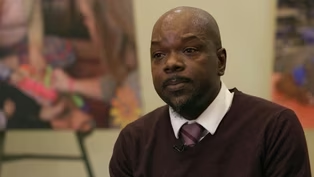
Vaughn Nebbitt (Full Interview)
Video has Closed Captions
Clip: Ep1 | 8m 27s | Full Interview with Vice President of Early Childhood Services Family & Children's Place. (8m 27s)
Providing Support for PBS.org
Learn Moreabout PBS online sponsorship

- Home and How To

Hit the road in a classic car for a tour through Great Britain with two antiques experts.












Support for PBS provided by:
Smart Start: A KET Special Report is a local public television program presented by KET