State of Affairs with Steve Adubato
Dr. Colum F. Amory; Sara Cureton; TJ Best
Season 10 Episode 7 | 26m 39sVideo has Closed Captions
Dr. Colum F. Amory; Sara Cureton; TJ Best
Dr. Colum F. Amory, MPH, Chief of Cerebrovascular Services at Hackensack University Medical Center, explains the signs and causes of stroke and its link to aphasia. Sara Cureton, Executive Director of the NJ Historical Commission, talks about the nation’s 250th anniversary. TJ Best, Senior Advisor for NJ Public Charter Schools Association, discusses new legislation for charter school oversight.
Problems playing video? | Closed Captioning Feedback
Problems playing video? | Closed Captioning Feedback
State of Affairs with Steve Adubato is a local public television program presented by NJ PBS
State of Affairs with Steve Adubato
Dr. Colum F. Amory; Sara Cureton; TJ Best
Season 10 Episode 7 | 26m 39sVideo has Closed Captions
Dr. Colum F. Amory, MPH, Chief of Cerebrovascular Services at Hackensack University Medical Center, explains the signs and causes of stroke and its link to aphasia. Sara Cureton, Executive Director of the NJ Historical Commission, talks about the nation’s 250th anniversary. TJ Best, Senior Advisor for NJ Public Charter Schools Association, discusses new legislation for charter school oversight.
Problems playing video? | Closed Captioning Feedback
How to Watch State of Affairs with Steve Adubato
State of Affairs with Steve Adubato is available to stream on pbs.org and the free PBS App, available on iPhone, Apple TV, Android TV, Android smartphones, Amazon Fire TV, Amazon Fire Tablet, Roku, Samsung Smart TV, LG TV, and Vizio.
Providing Support for PBS.org
Learn Moreabout PBS online sponsorship- [Narrator] Funding for this edition of State of Affairs with Steve Adubato has been provided by Myron and Elaine Adler private foundation, in support of the Adler Aphasia Center.
NJM Insurance Group.
Serving New Jersey’s drivers, homeowners and business owners for more than 100 years.
EJI, Excellence in Medicine Awards.
A New Jersey health foundation program.
Valley Bank.
Seton Hall University.
Inspiring great minds to greater purpose since 1856.
PSE&G.
Powering progress.
The Fund for New Jersey.
Delta Dental of New Jersey.
We love to see smiles.
And by New Jersey Sharing Network.
Promotional support provided by CIANJ, and Commerce Magazine.
And by NJBIZ.
Providing business news for New Jersey for more than 30 years, online, in print, and in person.
[INSPRATIONAL MUSIC] - Hi, everyone.
Steve Adubato.
We kick off the program with Dr.
Colum Amory, who's the chief of cerebrovascular services at Hackensack University Medical Center.
This is part of a series we're doing called "Voices of Aphasia".
And Dr.
Amory, first of all, thank you for joining us.
- Thank you so much for having me on the show, Steve.
- Now we know "Voices of Aphasia".
We know what aphasia is because we're partners with the Adler Aphasia Center.
I've been honored to be involved in their fundraising efforts over the years.
Mike and Elaine Adler established that center.
It's important, but people don't know what aphasia is, but it's also connected many times to stroke, which you know a lot about.
A, what's a stroke?
B, Doctor, what is the connection potentially between having a stroke and then aphasia and what it is?
- Sure.
- It's a lot, I know.
- Yeah, thanks.
So first of all, a stroke happens when blood flow to the brain gets blocked off, usually by a blood clot that comes from somewhere else in the body.
And when that happens, part of the brain gets injured because it doesn't have the blood it needs to survive well.
When this happens, the part of the brain that gets injured is the part that expresses itself in the stroke.
So if the part of the brain where language lives gets affected, then you will have aphasia, which is a difficulty with expressing yourself, understanding, or speaking.
- So here's the thing.
We've worked with the Adler Aphasia Center and met many people dealing with aphasia.
You should go on their website to take... And our website as well.
Take a look at some of those previous interviews.
But here's what I'm struck by.
The issue with a stroke is so... Issue with dealing with a stroke.
The issue's dealing with a stroke that the time that it hits one or it begins and the time one is treated is critical, as I understand it, and you'll explain it a lot better, Doctor, because that time is brain and what happens to the brain in that time before symptoms happen.
And then you're treated could have a very detrimental impact on certain brain functions, including the ability to communicate.
Do I have it right?
- Yeah, that's correct.
So when blood gets blocked from getting into the brain, immediately the brain cells start dying.
And the longer the brain is without blood, the more brain cells get permanently injured.
So it's critically important that if you have, or your loved one has symptoms of a stroke that you get to the hospital as soon as possible because we have treatments that we can give to patients in that early period of time to make a major difference in their outcome, including in their ability to speak, move, walk, and so on.
- Okay, so let's do this and team, if you're gonna... I'm not sure we're gonna do this in post-production, but I'd love to have these letters put up.
It's B-E-F-A-S-T, BEFAST, okay?
Let's do this.
B, balance.
Unable to balance.
These are symptom, signs, that you may be having a stroke.
Real quick on that doctor.
- Yeah.
So B stands for balance.
So if you have difficulty keeping your balance when you're walking all of a sudden, and all of these letters are meant to be taken as a sudden onset of these symptoms.
- So it happens quickly.
- Exactly, in a flash, which is why the name stroke came about 'cause it happens so quickly.
E stands for eyes or vision, so a sudden change in your ability to see.
F is for face, and so that's if this one side of the face becomes droopy.
A is for arm or strength in the arm or legs, so the weakness on one side of the body.
S is for speech, and that's that aphasia or ability to talk or ability to express yourself.
And then the T stands for time, as a reminder to all of us, how really important it's to get to the hospital quickly.
- You know, the other thing about working with the Adler Aphasia Center is on the issue of awareness.
We're involved in a public awareness effort.
I used to struggle with whether I would talk about this or not, but I learned from Mike and Elaine Adler who have passed, but their impact continues in the work of the Adler Aphasia Center.
And Mike had aphasia and Elaine was his caretaker and his advocate, and they advocated together for people dealing with aphasia.
Changed laws throughout the state of New Jersey and the nation and public awareness.
But people who deal with aphasia, it's important that we're aware of that.
So my dad dealt with aphasia.
I didn't talk about that at first, but I thought, this is a guy whose life was talking and when he got sick, we weren't sure what was happening, but he did have aphasia.
Bruce Willis has aphasia.
How important is that Bruce Willis and others who are recognizable, respected in their field, how important is it that they acknowledge that they're dealing with aphasia because they're one of many, many, many people who are?
- Yeah, I agree absolutely.
And it's always a wonderful thing when people are able to talk about what's going on with them.
You know, there is should be no shame associated with this.
This is an unfortunate outcome of various diseases.
Stroke being one of them.
Bruce Willis had a primary progressive aphasia, which is a kind of dementia.
and, you know, hearing these life stories of people who have dealt with this, I think makes it more accepted, more normal, and something that people can therefore be more comfortable working on, and people get better from aphasia.
You can get better from aphasia by working at it.
- We just did an interview interview with Mike Hornbostel.
Hornbostel.
who was a member at the Adler Aphasia Center.
We did an interview with Mike, who was an... Is, was and is an incredible guy who when he had the stroke and he dealt with aphasia, his ability to communicate was challenged on so many levels.
But here's what struck me about Mike.
He worked so hard at the Adler Aphasia Center.
He had so much help there.
What he was, his ability to communicate when he first was diagnosed with aphasia and then he joins us and he's an incredible dynamic guest.
Struggling at times to get the words out, but confident in doing it.
- Yes.
- Is that the norm, Dr.
Amory?
- So, you know, recovery from stroke is different for every individual, and it depends upon a lot of things.
It depends upon how big the stroke is, where the stroke is, how old you are to some degree.
And also, you know, how you were doing before you had the stroke, right?
So if you are a reasonably healthy person ahead of time, it certainly helps with recovery.
But recovery takes time and it takes hard work.
The brain doesn't bounce back in the same way that say, you know, if you cut your skin and it scabs over in a few days, it looks, you know, reasonably good.
The brain takes time.
We usually expect weeks to months of recovery after a stroke.
But everybody can improve to some degree.
- Dr.
Colum Amory, who's the chief of cerebrovascular services at Hackensack University Medical Center.
A part of the larger system, HMH, Hackensack Meridian Health, one of our longtime underwriters.
Dr.
Amory, thank you so much for joining us.
We appreciate it.
- It's my pleasure and thanks so much for having me.
- Yeah, there's more to understand around voices of aphasia.
Stay with us.
We'll be right back.
(grand music) - [Announcer] To see more State of Affairs with Steve Adubato programs, find us online and follow us on social media.
- We're now joined by Sara Cureton, who's Executive Director of the New Jersey Historical Commission.
Their website's up right now.
Sara, great to have you with us.
- My pleasure.
Thanks for the invitation.
- You got it.
We're big into history, which is why people should check out our series, "Remember Them," with my colleague, our executive producer, Jacqui Tricarico, and co-anchor.
The website will be up.
Check out "Remember Them," and thank you to the Historical Commission for helping us to produce that program with great content.
Let folks know what the Historical Commission is because it's really important, particularly in this 250th anniversary of these United States.
Please, Sara.
- That's correct, the Semiquincentennial.
Yes, the New Jersey Historical Commission is a state agency.
We're located in the New Jersey Department of State, and we are dedicated to the preservation, advancement, and enjoyment of state history, so that's what we do.
- And again, check out the interview we did with the Secretary of State, the Lieutenant Governor, Dr.
Dale Caldwell, because Sara and her team are part of the Historical Commission reporting up to the Secretary of State, so that's an important discussion.
Sara, let me ask you, what is RevolutionNJ?
- Well, RevolutionNJ is the state's official initiative for planning for this 250th anniversary of the nation.
We were created by law in 2018, and we are a public-private partnership.
So we are the state part of it, the public part of it, and we have a nonprofit partner, which is Crossroads of the American Revolution.
So we've been working over the last, oh, seven or eight years to get ready for this big anniversary, so we're pretty excited to finally, finally be here.
- The history teacher Nick Ferroni.
He produced the series all about the Revolutionary War and New Jersey connection as well.
He's fabulous.
Check out the interview we just did with him.
Why is Ferroni, Nick Ferroni, and others who are doing this kind of work, why is that work so important?
'Cause it falls under that umbrella of the grant that you you folks have, right?
- Well, it is important work for many, many reasons.
I mean, history, obviously, I've spent my life working with history, and it's a continuing joy to me.
We think it's absolutely critical that people understand the past.
It's that foundation that we can build on together when we understand the full story to build that better future together.
But the other part about history that I think sometimes people overlook is it's so much fun.
And I think Nick really highlights that in his videos that he's been producing.
It's fascinating.
There are no more fascinating stories out there than the stories from our past.
So this is a great year to really invite everyone to dig into that, not only for the way it can help us understand where we wanna go, but it's just a whole lot of fun too.
- Hey, speaking of fun and what's fascinating, I'm a student of history and realize how much I don't know, New Jersey played an absolutely critical role in the Revolution, the Revolutionary War, and George Washington spent 25% of his time in the Garden state, which was not called the Garden State then.
Sara, pick that up.
- Well, and I think we have been underappreciated for 250 years (laughs) in terms of the critical role that New Jersey played, and more military engagements unfolded here in New Jersey.
But when you just think about the geography and our placement between New York and Philadelphia, you know, the two armies were crisscrossing New Jersey throughout the war.
The war was a long one.
It it goes on about eight years.
So, so many stories unfolded here, so many critical moments.
So we, over the next, you know, eight years or so are gonna have so much to unpack and explore as New Jerseyans.
- Your funding comes exclusively from the state of New Jersey?
- It does at the moment, yes.
We are very grateful that we've had an appropriation that began with that legislation in 2018.
That has enabled us to do a lot of great work to get ready for this, so that has been a critical key in the progress we've made.
I also wanna point out that the state also allocated $25 million to capital preservation work at 10 state-owned Revolutionary War sites.
So that's another huge project that- - Hold on, sorry, for interrupting.
What does that mean, capital?
You're talking about restoring?
- Yes, I am.
- Like what?
Like what?
- Well, actually, these particular projects have been focused on making improvements at 10 of these sites to really make them more visitor-ready, because that's a huge goal of ours, and that is to get more people out to New Jersey to explore our historic sites.
So a lot of that money has gone into improvements that are gonna make these sites better, be able to serve visitors from both in-state and out of state, so new signage, new walkways, accessible bathrooms, new visitor welcoming areas, and one of the really big projects, probably the biggest, is a brand new visitor center for Washington Crossing State Park.
- I was just gonna ask you about the Washington.
- Yeah.
- Sorry for interrupting again.
It's Washington Crossing State Park?
- Correct, so there's a park on the Pennsylvania side, but there's also a park, a beautiful park, on the New Jersey side.
And maybe a little known fact is that the old visitor center over there was actually created for the Bicentennial and was intended to be temporary.
So just look at that, 50 years later, we are so excited that a brand new visitor center is gonna be finished this year at Washington Crossing State Park with new exhibits.
Beautiful new location, so you can really look over the Delaware and see from the center where Washington crossed on that fateful night in 1776.
- We'll continue to do our programming celebrating the 250th anniversary of our country.
- Great.
- Let folks know why it's important to do that, Sara, to celebrate.
- Well, I think, these anniversaries are, in a way, arbitrary, but they give us an opportunity to both reflect on the past and reconnect with those ideals of the Revolution, and then think about how we wanna take those ideals into our future.
So it's a great opportunity that we don't want to miss to do that exploration and thinking and reconnection to each other, into those principles that started this country.
But as I, as I mentioned before, I'm a child of the Bicentennial, it's also creating some wonderful memories for our children and for our visitors that they're gonna carry forward and know that New Jersey history is something to be cherished, preserved, and enjoyed for many, many more years to come.
- Sara, we look forward to working with you and your team at the New Jersey Historical Commission and celebrating our 250th anniversary and also continuing our work on "Remember Them."
Thank you so much, Sara.
All the best.
- My pleasure.
Thanks so much.
- You got it.
Stay with us, we'll be right back.
(grand music) - [Announcer] To see more State of Affairs with Steve Adubato programs, find us online and follow us on social media.
- We're now joined by TJ Best, Senior Advisor for the New Jersey Public Charter School Association, one of our partners in our series, "Urban Education That Works."
Good to see you, TJ.
- Good to see you too, Steve.
- You got it.
Question right outta the box.
There've been some changes, reforms, if you will, in the charter school system.
Lemme disclose that back in the day my dad, Steve Adubato Sr.
founded the first charter school in the state of New Jersey, the Robert Treat Academy.
I know a little bit about charter schools, but you live it every day.
They didn't have reforms then, they were just starting.
Now that there've been reforms, what are the reforms and why does it matter matter, TJ?
- Well, I wanna start by saying we fully supported the legislation that was just passed led by the Senate Education Chair, Vin Gopal.
The biggest change really was just to add more accountability and transparency.
It's been 30 years since the charter school legislation was first passed, and since that time, charter schools have evolved, they've grown, and there was time that we put legislation in place that accounted for all of those changes.
Some of the big things that it did was just to add more transparency in terms of the types of information that we need to put on our websites, making sure that the public is fully informed anytime we hire somebody, enter into contracts.
We are public schools, and we should be accountable to the public at large.
And that's what this legislation did.
- And what does it say about, or what does it do when it comes to so-called bad actors?
Because there was a tremendous amount of publicity around certain charter schools that were failing, that were structurally, financially, educationally, they were not sound.
What did the reforms do as it relates to dealing with those kinds of schools?
How would the Commissioner of Education identify them?
What happens when they do identify them, please?
- Yeah, so the commissioner has always had a lot of authority when it comes to charter schools.
And what this has done is it has even strengthened the commissioner's ability to place charter schools on probation.
As you know, charter schools enter into a five year performance contract with the state of New Jersey.
We like to consider ourselves the most accountable public school there are.
If our schools aren't performing, whether it be academically or financially or from a governance standpoint, the Department of Education has the ability to put us on probation or close us down.
And we've seen that happen with some of those bad actors.
One of which had some issues both academically and from a governance standpoint.
And the department closed them down after, when they were up for renewal.
- And you support closing those schools down when they are not performing?
- Totally, totally, I mean, we are here for the kids.
We wanna make sure that we are accountable to the families and to the taxpayers.
We receive our revenue from the state of New Jersey through the local municipalities, and we should be held accountable.
And when our schools aren't performing, we need to be held accountable to those standards.
- But, TJ, you mentioned a five year deal, a five year contract.
Did the reforms move from a five to a 10 year renewal period?
- Yeah, that was one of our big wins that we like to consider.
We've had some schools like.
- How's that a win?
Explain, how's that a win?
- So like the school that your father founded, for example.
- Yeah.
- They are a phenomenal school.
They've been outperforming both the local district average as well as the state and national average.
They're one of.
- At the Robert Treat, I'm just trying to give another plug for the Robert Treat Academy.
- At Robert Treat Academy, they've been outperforming national standards, and if they're doing everything right, they should be allowed a little bit more time to continue the work.
Our team's effort needs to be focused on the classroom and in instruction and not preparing massive amounts of reports.
The accountability that we have already with the renewal process is very, very cumbersome.
They ask for everything, not just academics, financials.
They interview the staff, they interview board members.
And to do that every five years means it takes almost a full year of just preparing for that review.
So giving great schools like Robert Treat Academy, the ability to have a 10-year was a big win for us.
It's not automatic for everyone.
- Yeah.
- It's only for proven providers that's been around for at least a decade.
- Yeah, by the way, we can't mention the Robert Treat Academy again 'cause that'll sound like a commercial.
- No problem.
- So we had your colleague Harry Lee on with us, right, and I asked him this question I wanna ask of you because I remember when my dad was starting the charter school, one of the questions that kept getting asked, still gets asked.
You're cherry picking, you're picking, you see you're shaking your head already 'cause I know 'cause I was witness to it.
There's a lottery to get into that charter school.
There are at many.
I don't know if it's all, but the argument that you're cherry-picking the kids, the public "public" schools, they have to take everybody.
Charter schools not so much.
You say what to that TJ Best?
- I say we are public schools, and just like all public schools, whoever applies has to have the same opportunity to get in.
So what we do is we have a lottery, and many times our lottery is weighted for students who come from low income backgrounds or special needs students to make sure that we have our fair share of those students.
- Explain what the lottery looks like.
I've seen it in person.
Explain to folks what it's like.
And by the way, parents, they're hoping and praying that their number gets picked, their name gets picked, but it's peer reviewed.
There's usually an accounting firm that comes in and does it.
Pick it up from there.
- So normally if there's let's say 100 seats available in kindergarten, we normally have about 1,000 families that will apply for those hundred seats.
And what we do is we don't look at anything other than just a number on a sheet of paper.
That goes most of the time into a computer generated lottery where it will randomly pull out those numbers.
Now there are some exceptions where we would have a special consideration for siblings.
So if you are a sibling, your number will be together with your brother or sister to really help families out to make sure that they get those kids into school.
But as the numbers come out, once we reach 100, those first 100 students get into the school, and then we continue the lottery process for the other 990 students or 900 students and make sure that as they come out of the lottery, they're number one on the wait list.
Number two on the wait list, number three.
So if a opening happens, we go based upon that wait list.
There is no cherry picking whatsoever.
- Lemme put this in context.
There are 84 public charter schools in the state of New Jersey in 18 counties serving 64,000 students.
As of June 2025, 23 charter schools were closed, and 30 were not granted renewal or voluntarily surrendered their charter.
Last question for you, TJ, to what degree do you and your colleagues at the Association regulate, monitor, and frankly put pressure on the schools that are not performing?
- Well, we are our biggest critics.
At the end of the day when we have our meetings with all of the charter schools statewide, the main thing that we tell 'em is that we're here to serve the families, and we're here to serve the students.
And that's gonna take precedence and paramount.
So anytime that one of our schools is a bad actor, we'll call 'em out on it.
And when we have our meetings with legislators or the Department of Education, we let them know what's going on because we don't want one school to infect the entire sector.
We're doing great work.
We have outstanding performance both academically as well as serving the families.
And we wanna make sure we continue that for more students - To TJ's point, we will have Senator Vin Gopal on again.
We had him on as this was being, as the legislation was moving forward, but it was not passed.
We'll have Vin Gopal, the Senator who chairs the Senate Education Committee on State of Affairs to talk more about his perspective on this.
TJ, best to you and your colleagues at the Charter School Association.
Thank you so much for joining us.
We appreciate it.
- Thanks for having us.
- I'm Steve Adubato.
This is "State of Affairs."
We thank you for watching.
We'll see you next time.
- [Narrator] State of Affairs with Steve Adubato is a production of the Caucus Educational Corporation.
Funding has been provided by in support of the Adler Aphasia Center.
NJM Insurance Group.
EJI, Excellence in Medicine Awards.
A New Jersey health foundation program.
Valley Bank.
Seton Hall University.
PSE&G.
The Fund for New Jersey.
Delta Dental of New Jersey.
And by New Jersey Sharing Network.
Promotional support provided by CIANJ, and Commerce Magazine.
And by NJBIZ.
Hi, I'm Naomi Gwartz from the Adler Aphasia Center.
Aphasia is a language disorder that usually results from a brain injury such as stroke or a brain tumor.
While aphasia can affect one's ability to speak, understand, read, and write, it does not affect intellect.
Programs offered at our center help improve communication skills as well as confidence and quality of life while surrounded by others who understand aphasia.
If you or a loved one is diagnosed with aphasia, there is hope and community.
 New
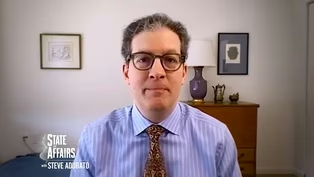
NewAnalyzing the signs & causes of stroke & its link to aphasia
Video has Closed Captions
Clip: S10 Ep7 | 8m 50s | Analyzing the signs & causes of stroke & its link to aphasia (8m 50s)
 New
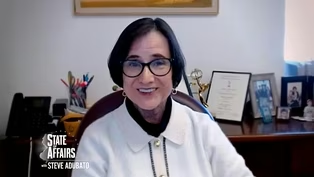
NewCelebrating NJ's contributions to America's independence
Video has Closed Captions
Clip: S10 Ep7 | 8m 47s | Celebrating NJ's contributions to America's independence (8m 47s)
 New
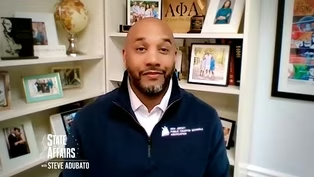
NewHow do charter school lottery systems work in New Jersey?
Video has Closed Captions
Clip: S10 Ep7 | 9m 40s | How do charter school lottery systems work in New Jersey? (9m 40s)
Providing Support for PBS.org
Learn Moreabout PBS online sponsorship New Episode
- News and Public Affairs

Top journalists deliver compelling original analysis of the hour's headlines.

- News and Public Affairs

FRONTLINE is investigative journalism that questions, explains and changes our world.

 New Episode
 New Episode
 New Episode

 New Episode
 New Episode
 New Episode
 New Episode
Support for PBS provided by:
State of Affairs with Steve Adubato is a local public television program presented by NJ PBS