
Dragon Fire I, A Frontier Champion, Art of the Press
Season 32 Episode 2 | 27m 35sVideo has Closed Captions
Potters revive a kiln, learn about Simon Kenton, and artists print Kentucky's literature by hand.
Dedicated potters breathe new life into a kiln that’s been dormant for decades. Learn about American explorer Simon Kenton, who became known for guiding pioneers through a port of Limestone on the Ohio River that is now known as Maysville, Kentucky. And passionate artisans are keeping a centuries-old tradition alive by printing the state’s greatest literature completely by hand.
Problems playing video? | Closed Captioning Feedback
Problems playing video? | Closed Captioning Feedback
Kentucky Life is a local public television program presented by KET
You give every Kentuckian the opportunity to explore new ideas and new worlds through KET. Visit the Kentucky Life website.
Dragon Fire I, A Frontier Champion, Art of the Press
Season 32 Episode 2 | 27m 35sVideo has Closed Captions
Dedicated potters breathe new life into a kiln that’s been dormant for decades. Learn about American explorer Simon Kenton, who became known for guiding pioneers through a port of Limestone on the Ohio River that is now known as Maysville, Kentucky. And passionate artisans are keeping a centuries-old tradition alive by printing the state’s greatest literature completely by hand.
Problems playing video? | Closed Captioning Feedback
Where to Watch Kentucky Life
Kentucky Life is available to stream on pbs.org and the PBS app.
Providing Support for PBS.org
Learn Moreabout PBS online sponsorshipProduction of Kentucky Life is made possible in part by the KET Millennium Fund.
Coming up on Kentucky Life, a kiln that lay dormant for decades has a new lease on life, and Central Kentucky artisans are firing amazing works of art as a result.
We'll tour the beautiful setting for this week's show, Yew Dell Botanical Gardens in Crestwood.
We'll introduce you to a key figure in Kentucky history, Simon Kenton, and we'll take a look at the art of letterpress printing in Kentucky using antique tools to bring vibrant prints to life.
All that's next on Kentucky Life.
[music playing] Hey, folks, and welcome to Kentucky Life.
I'm your host, Chip Polston.
It's good to see you again.
Our travels today have brought us to the Yew Dell Botanical Gardens in Crestwood.
Now, back in 1941, Theodore and Martha Lee Klein bought 34 acres of farmland here in Oldham County to build their home, start a farm and nursery, and raise their children.
Theodore was an avid plant collector who introduced more than 60 new varieties to cultivation while living here.
When he passed away in 1998, development pressures threatened the property.
Recognizing the unique attributes of Yew Dell, a board of community volunteers raised the funds to purchase and restore the property all while sharing its treasures with the public.
Since then, Yew Dell has been added to the National Register of Historic Places and was named by Horticulture Magazine as one of the nation's top destination gardens.
It is an absolutely beautiful site, and we can't wait to explore it with you.
But first, in Boyle County, a group of dedicated potters have embarked on a project to breathe new life into a kiln that had been dormant for decades.
In partnership with the Art Center of the Bluegrass, a new generation of artists is reigniting a traditional firing process and helping ensure this enduring craft continues to thrive.
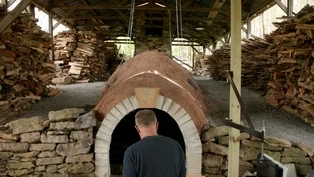
[music playing] An anagama kiln is one of the oldest methods used to fire pottery, dating back to the 5th century in East Asia.
Anagama is the Japanese word for cave kiln, a long, tunnel-shaped chamber carved into the side of a hill.
Fed continuously with wood, the fire burns for five to seven days without rest, with potters tending to it around the clock to reach its optimal temperature of 2,200 degrees.
And in Danville, that same fire brings this artist community together.
The whole reason a sane person would go to all this trouble to make pots is the mark of the fire on the clay.
You can almost visualize the path of the fire through the kiln.
The wood ash collects on the clay over the course of the firing, and then it melts as it gets to the temperature, and it forms these beautiful ash glazes.
and it forms these beautiful ash glazes.
This kiln was built by Steve Powell and his ceramic students at Centre in 1993.
I discovered it about 10 years ago.
It was kind of a collision of good timing, good luck, and goodwill that the project took off and happened so quickly this time around.
It's just super exciting to see something that was started 30 years ago come back to life through the work of Jonas Hurley and so many others.
We started work on it August 2025, reconstructing the kiln, insulating it, rebuilding the chimney, rebuilding the firebox.
I was thinking, “What have we gotten ourselves into?” We put the Kaowool around it with the chicken wire, then the high refractory, and then on top of that the cement to help seal in the kiln, to get it nice and insulated, to help hold all that heat so the pots can do what they need to inside the kiln.
The kiln had two long spines of bricks running along either side with a long tail that made it resemble a dragon.
It seemed an appropriate name for something that you used to get to 2,200 degrees.
Since it's not been fired for 20 years, it's almost a rebirth or development of a new community.
We have people that are gone now that played a huge part, and it's almost like part of their soul lives on through this kiln each time you fire it.
That legacy lives on to the next group that comes in.
That teapot, I can get in here.
We have a wide variety of potter that is participating in this firing, so we've got the full range of small and really large stuff.
I mean, it's a giant game of Tetris where you're trying to fit pieces and get levels to line up.
One bad stack, and all of a sudden you have 100 pots laying in rubble.
We're actually getting into the zone that's going to have a whole lot of heat coming to it.
And you really want to make it so that the flame kind of has to work to get through the kiln.
It kind of snakes through, and that also helps distribute the ash through the pottery.
Most of us that are here today are just starting to get a glimpse of the potential of what this process can do.
It's going to be a learning tool for all of us.
[clapping] I'm relieved that we are here, and nervous and excited and curious to see what pots are going to come out.
Curious to see if we get it up to temp that we want to get it up to.
[music playing] This is day five, and today we are trying to climb.
It's really fired well.
Now, anagamas are good designs.
That's why we're still using them after 1,500 years.
Watching the fire as we get further along in the stoking process, we'll rely less on the temperatures and more on what the kiln's doing.
The flame in the chimney tells you that the entire chamber is pressurized with fuel, with hydrocarbons in the wood.
When it dies out, that means it's time to stoke.
We had 600, 700-degree difference between the front of the kiln and back of the kiln.
Well, as we started to stoke it down the side port, as you load it, we started to make the temps be more congruent all through the kiln, and we've actually done that to where it's only 20-degree difference.
You can't fire an anagama kiln by yourself.
There's six-hour shifts that we're doing with three to four people per shift.
You initially want fairly dense, mixed hardwoods up to 2,200 degrees.
After that, you'll move primarily to pine, which burns very hot and very fast.
It takes a lot of fuel and a lot of people to keep the kiln that hot.
[music playing] There's nothing like opening day.
A lot of potters refer to opening a kiln as either Christmas or sometimes it's Halloween, sometimes it's April Fool's.
You're never going to open this kiln and see the same results.
Seeing the first section, I was like, “We're headed towards some really awesome pots.” I am surprised and delighted that this kiln fired so well, so efficiently, so fast.
For a kiln this size, we can do this in a five-day firing.
That's pretty fast.
[scraping] Oh, yeah.
This next guy got hot.
[laughs] You can see this is a gorgeous example of where the fire hits the pot and melts and creates this surface.
But then, as you rotate the pot, you can see where this area of the pot is dealing more with the flashing of the fire.
So, if this was fired in a different style of kiln, the colors would be more consistent, but that's the beauty of wood firing.
Just a lot of Bob Ross happy accidents that happen.
[music playing] [scraping] Oh, what do we got here?
We got an assemblage there.
Be careful.
As it fires, it fuses, so now the artist has a decision.
Do I break it and create two pots, or do we save it like this, and maybe it's a symbol of the firing and what happens?
You can see the ash collection just naturally from the kiln.
I have some Shino glaze on it as well.
And, yeah, I think the kiln did its thing and deposited a lot of ash on that.
That was towards the back of the kiln.
In my opinion, if this came out of an electric kiln, I'd be like, “Oh, okay, there's a little cut.” And now, instead, with the wood firing, it just has beautiful kisses of fire on it that excite me 50 times more.
There's different aesthetics in wood firing that different people prefer different things.
The wood firing process has so much to offer artists and potters that you can hope for certain things, but the kiln's going to give you what it wants to give you, and it's just nice to see such a variety.
I'm just super happy with the whole kiln.
Kind of amazed at the quality of results we got.
[music playing] Couldn't have expected such a community of folks to gather around and spend awful hours doing hot, awful labor.
But for the end result, I think it's worthwhile.
A lot of times, as a potter, you find yourself very isolated.
To finally be able to come together with a large group of people that share a similar interest and passion, that's by far one of the treats of firing an anagama kiln.
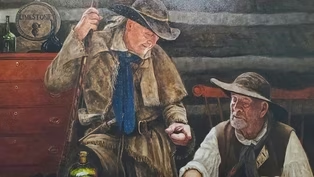
[music playing] Visitors traveling through Kentucky will often come across the name of Simon Kenton, the Simon Kenton Highway in Kenton County in northern Kentucky, for example.
He was an explorer in the Western Wilderness, a contemporary of Daniel Boone and George Rogers Clark.
Kenton guided settlers of the time to a place on the Ohio River called Limestone, what today is Maysville, Kentucky.
Indeed, some would say Simon Kenton is the founder of Maysville.
[music playing] Born in 1755 in Colonial Virginia, Simon Kenton grew up tall and strong.
At age 16, he would find himself fighting over a woman, beating his rival so severely he thought he had killed him, and therefore he would be punished.
Kenton ran away from home and, like others of his time, began to explore the wilderness to the west.
He learned to track game animals and built a reputation in fighting and learning the ways of American Indians.
He found himself attracted by the stories of the cane lands in an area called Kentucky.
Kentucky had that mythological cane land that everybody wanted to find.
It grows anywhere from 6 to 15 feet, and it's like a bamboo.
There was an abundance of deer and turkey and different kinds of wildlife that could hide in that cane.
In 1775, Simon Kenton traveled down the Ohio River, disembarking at a natural port where Limestone Creek emptied into the Ohio, Limestone Landing.
Limestone Landing was a river port at that time.
Limestone is the predominant rock here.
We're built on a rock, basically.
In 1773, there was a Colonel Hedges, a Colonel Young, Lawrence Darnell that came down, and Lawrence Darnell founded Lawrence Creek and named it after himself.
And Mr.
Hedges named us Limestone.
Most pioneers coming down the river traveled by flatboat, a boat that served two functions.
The reason they were flat was because at that time, Kentucky didn't have dams.
And so, at any point, the Ohio River could be shallow, or it could flood.
And then, when they reached Limestone, they would dismantle those boats, carry the wood in as far as they felt they were safe from the Indians, and they used that same wood to build their cabins.
These pioneers dragged their flatboats inland to build their homes in newly established Washington.
Several of these log cabins still stand, including one serving as the town's post office.
Simon Kenton chose not to settle in Washington, but continued south into central Kentucky on a buffalo trace.
His experience in fighting Native Americans led him to become a scout at the forts of Boonesborough and Fort Harrod.
Here, he met two other well-known explorers, Daniel Boone and George Rogers Clark.
During one attack on Boonesborough, he saved Daniel Boone's life.
[instrument playing] This was the time of the American Revolutionary War.
George Rogers Clark, now a general for the colonies, asked Simon to join him on a mission down the Ohio River to the Falls of the Ohio and then to go north to fight the British and the British-led Indians.
Kenton and Clark were followed by pioneers who chose to stay at the Falls, settling on Corn Island.
Eventually, these settlers founded the city of Louisville.
A short time after the battles, Simon Kenton was captured by a Shawnee tribe.
He would face excruciating torture and eventually was forced to run the gauntlet.
The Indians lined up on either side.
They've got tomahawks.
They've got clubs.
They've got switches, everything.
But he was a big man.
He was at least a little over six foot, and he was fast.
And he learned a lot of things, dodging people and everything.
And he survived eight gauntlets.
And they were so awed by his bravery, they gave him a membership to their tribe.
Kenton would return to Limestone in 1784 and build Kenton Station.
This station, like Tanner Station that still stands just south of Washington, was a small wooden fort designed to defend those living inside against attacks.
In 1787, Kenton married his first wife, Martha Dowden.
That same year, the name of Limestone would change.
John May came down the river on a flatboat, and he was bringing another group of people, and they heard children and women crying on shore, “Help me, help me.” And it was Indians, and they ambushed him, and he was pierced in the chest with an arrow.
And when he died, they renamed Limestone Maysville after John May.
[music playing] Kenton continued to help those coming through the area, and he carefully chose and encouraged certain pioneers to remain and help build Maysville into a town that earned a distinct title.
We were called the Gateway to the West at that time.
Had it not been for Simon Kenton, I don't believe that we would have been the mecca of the area that we became.
Our next story takes a look at the rhythmic ink-stained world of Kentucky letterpress printing.
Now, from its academic home at the King Library Press to influential modern studios like Larkspur and October Press, local craftsmen are using antique machinery to keep a centuries-old art form alive and transforming Kentucky literature into stunning tactile works of art.
[music playing] What we're doing is really, I think, necessary.
We are carrying on very good writing in Kentucky by both known writers and unknown writers.
And we're also carrying on a tradition that is more and more going away.
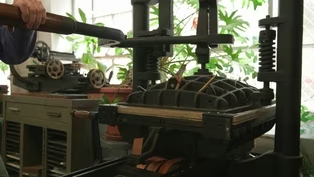
[music playing] Letterpress printing is when you take a piece of type or an engraving and actually print it directly into the page.
You have individual pieces of metal that have a letter on each piece.
This allows you to arrange a text, print it, and then redistribute it.
Some people think it's tedious.
But if you love to set type, it's very soothing.
It's totally a handcrafted product.
When folks get to the King Library Press, they first are like visually inundated with so much stuff.
A lot of printing presses, prints everywhere, books everywhere, very active.
You get the smells of ink and solvents.
I don't really notice a smell anymore, but people come in and go, “Boy, this really smells good because of the ink.” And ink is one of those resources that a little ink goes a long way.
[squeaking] [clanking] The Chandler & Price I've heard have this nice, soft clanking sound.
It's a clamshell-type press.
And when it's in the printing mode, there'll be a click in there.
And it's all mechanical, and it's just a dance that you have with the press.
[clanking] The process of typesetting, or what we call composition or composing the text, has been primarily taking an individual piece of type, or what's called a sort, and laying it in a composing stick.
It clicks into the composing stick, and you can hear that sound as it drops in.
[clicking] [clicking] Setting the type from this end of the composing stick to the other end, and so it appears that you're setting it backwards and upside down because the bottom of the letter is facing away from you.
So, when you take the type from the composing stick and put it on the bed, it actually is going from top to bottom.
You put it in the press and ink the press, and there's that kind of, some printers talk about, you know you've got enough ink on the disk.
When you hear that hiss of the rollers going over the ink, it's a special sound.
It's just very zen for me.
[clanking] Bite is a sort of impression that's left down into the paper, and you can feel it.
It has a texture to it.
And so, what you're doing is you're making a sculpture.
You're not printing.
You're making a sculpture.
I like the feel of that impression, and I think a lot of people like that feel.
In the old printing, though, they don't want an impression, especially if you're going to read on the verso of the page.
They wanted that perfect kiss of the ink.
They wanted it to be invisible.
This centuries-old craft began in the 1450s with Gutenberg's Bible.
300 years later, in 1787, letterpress printing arrived on the rugged Kentucky frontier.
In Lexington, John Bradford established the Kentucky Gazette, ink staining the very first pages of the Commonwealth's history.
Generations passed, and modern commercial printing pushed the old ways toward obsolescence.
But in 1956, a new chapter opened at the University of Kentucky.
There, Carolyn Reading Hammer established the King Library Press, transforming a rugged pioneer tool into a living academic tradition.
Carolyn Hammer was just an amazing lady.
She taught me how to set type.
And the press we used was one that's still at the King Library Press.
Carolyn would often set the type, and I would help with the printing and then distribute the type.
And Carolyn's goal was to have a space where students could come and learn this tradition in order to help them better understand the text that they are working with.
So, a lot of us are learning through books and through finding practitioners and craftspeople and saying, “Hey, can I work with you?
I really want to learn this craft.” And Carolyn understood that pretty deeply.
And that's part of how the tradition gets handed down.
We all found each other at King Library Press.
Even to this day, her work and her teaching is still in my head.
She was very important.
[music playing] We have such a rich literary scene in Kentucky.
I've been blessed to be able to publish some of Kentucky's finest writers, as well as new writers, some who have gone on to be Kentucky Poet Laureates.
Authors really love to see and feel their work in letterpress.
With fine press, I think that there is a sort of experience of feeling more connected to the artists who have made it.
by the time I have finished that piece and setting each letter backwards and upside down, letter by letter, I pretty much have sort of ingested the piece in some way.
It's just such a part of my life.
It's my happy place.
[clanking] Often with letterpress printing, especially using movable type, you get a sense of the artist's hand in it.
And that sort of trace gives the object a kind of liveliness and soul to it.
It's the human part of making things by hand.
The focus and the time and the expertise and the love that has been put into the object.
And I like to think transferred to the person who is the recipient.
I know that my work has a soul in it, as well as any craftsman in this state and puts all their energy into it.
They're putting part of their soul in their work.
[clanking] [squeaking] [music playing] We've had a great time here today at Yew Dell Botanical Gardens in Crestwood.
Theodore Klein's legacy as an innovative horticulturalist really does live on in what you've seen here.
And to walk these grounds truly is a stunning experience that we've really enjoyed.
Now, if you've enjoyed our show, be sure to like the Kentucky Life Facebook page and subscribe to the KET YouTube channel for more of what we like to call Kentucky Life Extras, where you'll have access to lots of other great videos.
Until next time, I'll leave you with this moment.
I'm Chip Polston, cherishing this Kentucky Life.
[birds chirping] [music playing]
 New
NewVideo has Closed Captions
Clip: S32 Ep2 | 8m 29s | Artisans keep letterpress alive, printing Kentucky’s greatest literature by hand. (8m 29s)
 New
NewVideo has Closed Captions
Clip: S32 Ep2 | 8m 38s | A group of potters embarked on a project to breathe new life into a kiln that had been dormant. (8m 38s)
 New
NewVideo has Closed Captions
Clip: S32 Ep2 | 6m 20s | Many credit frontier guide Simon Kenton with founding Maysville, Kentucky. (6m 20s)
Providing Support for PBS.org
Learn Moreabout PBS online sponsorship













Support for PBS provided by:
Kentucky Life is a local public television program presented by KET
You give every Kentuckian the opportunity to explore new ideas and new worlds through KET. Visit the Kentucky Life website.