Oregon Art Beat
Drawing From History
Season 22 Episode 5 | 26m 59sVideo has Closed Captions
Mark Hallett, Darrell Grant, Yer Za Vue.
Paleo artist Mark Hallett draws and paints dinosaurs and other prehistoric animals. He created original concept art for Jurassic Park! We catch up with composer, performer and PSU professor Darrell Grant as he performs his work “The Territory.” Before becoming an award-winning painter and respected teacher Yer Za Vue worked as an animator bringing some of Disney's most beloved characters to life.
Problems playing video? | Closed Captioning Feedback
Problems playing video? | Closed Captioning Feedback
Oregon Art Beat is a local public television program presented by OPB
Oregon Art Beat
Drawing From History
Season 22 Episode 5 | 26m 59sVideo has Closed Captions
Paleo artist Mark Hallett draws and paints dinosaurs and other prehistoric animals. He created original concept art for Jurassic Park! We catch up with composer, performer and PSU professor Darrell Grant as he performs his work “The Territory.” Before becoming an award-winning painter and respected teacher Yer Za Vue worked as an animator bringing some of Disney's most beloved characters to life.
Problems playing video? | Closed Captioning Feedback
How to Watch Oregon Art Beat
Oregon Art Beat is available to stream on pbs.org and the free PBS App, available on iPhone, Apple TV, Android TV, Android smartphones, Amazon Fire TV, Amazon Fire Tablet, Roku, Samsung Smart TV, and Vizio.
Providing Support for PBS.org
Learn Moreabout PBS online sponsorshipSupport for Oregon Art Beat is provided by... and the contributing members of OPB and viewers like you.
[ ?
?? ]
MAN: It was a great shock to me when my father told me that dinosaurs were extinct.
But that made me draw them so I could make them real.
WOMAN: The favorite character is Mulan.
I love that she understood the bigger picture beyond herself.
And she's always been a hero of mine.
[ horse galloping and huffing ] MAN: Well, even in telling the difficult stories, it's about what we can learn from the difficult stories, because those vibrations are still here.
[ birds chirping ] MAN: I think your fascination for dinosaurs certainly sets in as a child, and if you're lucky, it never goes away.
[ ?
?? ]
Dinosaurs are bigger than life.
They were creatures that were strange, that were fierce, that were scary -- scary in a delightful, exciting way.
ERIC SLADE: Mark Hallett has spent decades bringing dinosaurs to life.
We can't produce any photographs of T. rex.
We can certainly document the fossil finds with photography, but I think we need paleoart to be able to show what these things looked like when they were alive.
He's earned his reputation in the world of paleoart, a term he's credited with coining.
Paleontological art combines both science and art in a very felicitous way.
You're basically using observable things and combining with the intuition and the inspiration of an artist to create things that no one has ever seen before.
I love this idea very much.
I am creating life restoration.
It was a saber-toothed cat found several years ago in South Dakota.
The cranium, or the upper part of the skull, it's very badly crushed.
However, we have the lower jaw.
This gives me a pretty good idea about its size.
But also, each of these little bumps and grooves have meaning.
Scientific sleuthing in paleoart is a tremendously appealing thing for me, because I love deducing what something would look like based on known, observable facts.
This combined with the intuitive quality in being an artist is the best of both worlds.
It's a very grubby, beat-up book, but it's the original.
This book had a tremendous effect on my psyche as a child.
To me, they looked almost like photographs of actual existing animals.
And it was a great shock to me when my father told me that dinosaurs were extinct.
But that was one of the things that made me draw them so that I could in my mind make them real and make them understandable.
The work of an earlier generation of paleo artists taught Mark that the art improves alongside the science.
Our knowledge of prehistoric cannibals has changed quite a bit.
We know now that T. rex holds its body in a horizontal mode, rather than the more vertical one that we thought it was.
And it's quite possible that T. rex had some kind of feather-like body coverings that helped keep heat in.
So it's very important to keep up with this kind of new information.
With a career spanning nearly a half century, some of Mark's most beloved pieces have, well, gone the way of the dinosaur.
The depiction of Mamenchisaurus that I did for the Los Angeles County Museum of Art in 1986 -- at the time, it was thought that it was a close relative of the so-called Diplodocus.
Well, as it turns out, it was not a Diplodocus at all.
The head that I've done for that particular painting is entirely wrong.
At some point, I want to change it.
That's the way it is in scientific illustration.
Nothing will ever stay the same, which is a very good thing.
It's ironic, then, that the very painting Mark needs to fix is the one that caught Hollywood's eye.
[ dinosaur roaring ] Well, I was very happy when I got asked if I'd be interested in being a consulting artist.
The project was the first Jurassic Park.
I worked with the digital effects people on doing the very first concepts of dinosaurs, including T. rex, including the so-called raptors.
I wasn't the only person working there, but I filled in a necessary gap.
And it was a wonderful experience, because I got to learn from these people.
I think I was able to help them understand what dinosaurs may have really looked like and how they may have moved.
Spielberg wanted to create the entity of the so-called ''spitter'' dinosaurs.
I kept being asked to refine my drawings and refine my drawings and make them smaller but make them really scary.
And of course, making a dinosaur that could spit venom was considered a really cool idea.
And I think the results were pretty good, even though there was never any such dinosaur that existed.
[ dinosaur roaring ] Mark also worked on Disney's Dinosaur and several documentaries on paleo life.
But his success didn't come easy.
What I have is a congenital birth defect.
My lower left arm and right lower leg are missing.
It's the way I came into the world, so it really hasn't stopped me from doing what I want to do.
[ film reel whirring ] [ ?
?? ]
When I was probably about six years old, my mother took me to the Natural History Museum in Los Angeles.
I had a impossibly uncomfortable and heavy prosthetic right leg.
The museum's main entrance had a series of steps that seemed to go on forever.
And I just looked at it and didn't think I could make it.
I just decided that I would overcome the discomfort.
I saw halls of North American, African, Asian mounted animals and natural habitats.
And I was profoundly glad that I made the decision to overcome my discomfort in getting up there.
And it really awakened me very much.
Being a double amputee restricted my ability to do some things, but then made me go in the direction of others, very much like water when it's blocked in one direction seeks another.
[ ?
?? ]
My newest book will be called In Search of Big Cat Origins.
The book will take us from the earliest origins of cat-like animals, tracing their evolution and how they adapted as master predators to become lions, tigers, leopards, and jaguars that we know now.
Now in his 70s, Mark is showing no signs of slowing down.
He'll soon start a book about horse fossils, and he'll finish work on that newly-discovered saber-tooth cat.
And he spent the end of 2019 in India as a visiting lecturer at a school in the foothills of the Himalayas.
Clouds, because they're dimensional, you want to make sure that they have shadows.
Now I have a chance to show people how they can actually make careers out of science and art, which excites me very much.
I often liken myself to some kind of little fox or ferret snuffing around a series of doors.
And then I wait for one to open a crack and then I put my nose in and see what kind of opportunity I can come up with.
Being able to have a unique career in science and art has been an extraordinary adventure.
I feel very fortunate that I could really do these things.
[ clapping rhythmically ] [ playing slow jazz tune ] MAN: Oregon represents, I think, a lot of things in people's imaginations.
Oregon has been seen as a utopia.
It was the road to a brighter future, to individualism and possibility.
And I realized I would be really interested in seeing if I could tap into the ethos or the vibration that the land drew out of us and see what would happen if I tried to write music kind of based on that.
And so that whole sort of question and inquiry became the album that is ''The Territory.''
The idea of place is important to me because I've lived in a lot of different places.
[ ?
?? ]
I lived in Manhattan in the 1980s and '90s.
So I could walk down to the Village to jazz clubs, and so I was just in heaven.
Honestly, I felt like I was in the center of the universe.
Any night of the week, you would go hear the legends of the music.
Like, they're all there.
For me as a young professional, it was really fantastic.
ERIC SLADE: Darrell Grant became one of New York's most sought-after musicians, playing and touring with big names, including jazz legend Betty Carter.
[ singing indistinctly ] GRANT: Playing with Betty Carter provided me a number of great first opportunities.
It was my first tour to Europe with her.
And I think there's a clip of me playing in her band on David Sanborn's ''Night Music'' show.
My dream of being a jazz musician was certainly realized.
I had opportunities to play with people, do my own records, and develop a reputation.
So, yeah, I've had a great, great time.
But in 1997, Darrell left New York and moved to Oregon.
I feel like I'd made my mark, or some little mark in New York, and I was looking for a place to really feel like I could make a contribution to community in a broader way than I could have trying to make a living as a jazz musician in New York City.
[ playing soft, calm melody ] One of the things that I love about Oregon is the abundance, just the sheer abundance of beauty, of green, of water.
It seems to be a really community-driven place.
Like, decisions are made, big decisions are made, that foster and engender community.
[ playing soft jazz tune ] The song ''Rivers'' is about the way that the rivers in the state sort of carry commerce and carry the salmon... but also carry our dreams and beliefs.
And they sort of are this fertile channel for what becomes a state.
''Rivers'' sounds like water to me.
It's very flowing.
It has this kind of flow and surging to it that I really think expresses the river.
[ playing upbeat jazz tune ] One of the great ironies about Oregon is that it was this utopia, but it was seen as an exclusive utopia, originally intended to be a utopia for white citizens only.
And so for many, many years, they had these exclusion laws.
So I felt like I needed the piece to represent those realities, too.
?
Just up around the corner ?
?
One block from the Union Station sign ?
?
There's more than a hundred rooms to choose ?
?
And no colored lot to give you the blues... ?
GRANT: The Golden West Hotel was the first African-American-owned hotel west of the Mississippi River, and back during Portland's days of segregation, that was the only place in town where an African American could stay.
And the black churches were only blocks away down there, and so they'd all come to the Golden West, and they'd have lunch buffet there and do their social talking there.
I guess I tend to try and project hope just as my general perspective.
So even in telling the difficult stories, it's about what we can learn from the difficult stories, because those vibrations are still here.
?
'Round Mr. Moore's athletic club... ?
The opportunity for those bad decisions will present itself again.
And if we do not learn from what we did before, if we do not firmly have in mind the lessons that we learned from what we did before, we will repeat them.
[ ?
?? ]
For everybody having a place that they feel like they want to invest in making a difference, it seems like a good thing.
Because we can draw from that place and we can then give back and serve that place.
So I feel like that's part of what we're all meant to do.
I would hope that ''The Territory'' would allow people an opportunity to reflect in the same way that watching the sun rise over Mount Hood allows them the opportunity to reflect and the same way that sitting out and watching Haystack Rock at Cannon Beach allows them the opportunity to reflect on their lives and on what they care about.
Just an opportunity to reflect.
[ rhythmic clapping and drumming as song ends ] [ ?
?? ]
WOMAN: I'm going to cheat.
I'm going to throw some of this brilliant green in there.
Whenever I paint something, I have to think about, ''Oh, what am I trying to say from my heart and my core?''
And for me, that means, ''Well, does it move me?
Is it exciting?
Am I sad when I'm painting this?''
It could be just the lighting behind the mountain.
[ ?
?? ]
Or the way that tree, the gesture in that tree, it speaks to me.
Or the model in front of you.
It just evokes a certain genre or mood.
I get all jazzed up, and then I just react.
My name is Yer Za Vue, and I specialize in painting and animation.
[ Disney theme plays ] GENEVA CHIN: Za began her art career in 1993 at Disney Studios in Orlando, Florida.
My process now as far as creating my own art, it's still really relevant to Disney, as far as a story.
One of the first things that we always talked about at Disney is story, story, story.
[ ?
?? ]
MAN: She's an artist's artist, in that artists come into the gallery to see her work.
It feels like her brush almost dances around the canvas.
ZA: How much abstract do you want in there before it becomes too distracting?
Or is it not enough?
[ brush scraping canvas ] When you look at it from a distance, you are thinking of it like a realistic painting, because everything comes into focus.
[ brush scraping bucket and water sloshing ] That one there, there's this gray about it, and I like that.
So then I'm going to try to infuse a little bit of gray.
In this case, the painting says to me -- it's very loud.
I feel like there's something that needs to be here.
That's better.
Za got hooked on art shortly after emigrating from Laos at age seven.
When her third-grade teacher in Colorado showed her drawings of ballerinas... My eyes just went... and I would just go like this.
And I think that's what started the seed for me, because after that, I would go to the library, I would go through tons of books that I didn't know what they were called, but it's Sleeping Beauty, Snow White, and I loved it.
I thought the drawing was spectacular, the background.
I didn't know that someday I would work for the ''big cheese,'' Mickey Mouse.
But it was always a part of my life.
MAN (VOICEOVER): The Kansas City Art Institute, a four-year college of art and design.
This is where she applied and was accepted.
In our culture, growing up, all I remember was the chores and all I remember was the cooking and cleaning, so by the time I could get away, I was screaming.
But her parents were... Not so happy.
They wanted me to go to college.
But the idea of going out of state was just too much for them, as Asian parents.
So her parents convened a meeting of elders.
They were all Hmong and they were all men.
And they all sat me down in my parents' living room and they played good cop/bad cop.
The elders thought they had changed Za's mind.
But when it was time to go to art school, Za stood her ground.
Had I been raised in Laos, I think I would have not have rebelled.
If my parents said, ''You can't go to college,'' I would have just accepted it.
Because that's just what the Hmong culture does.
Her parents softened after Za landed a coveted internship at Disney.
Za was too young to apply for the internship, but a teacher snuck in her portfolio.
It was a dream come true for a college kid.
[ ''Suspicious Minds'' by Elvis Presley plays ] The internship led to a job.
Za helped animate Disney classics like Lilo and Stitch and Mulan.
The favorite character is Mulan, obviously, not just because I have some background with her, but because I love that she understood the bigger picture beyond herself.
And she's always been a hero of mine.
And the whole idea of cutting your hair and trying to play both men and women, there's something really appealing about both masculinity and femininity.
Mulan was my first promotion into the key position, so I got to take on more responsibility and got to see more behind-the-scenes, so Mulan was very special.
?
That's the way, uh-huh, I like it ?
That's Za, singing in a Disney employee band.
When I was in college, I was super super quiet.
And Mulan broke me out.
And for the first time, I felt like, ''Oh, these people are just like me.
And now they can't shut me up.''
[ laughs ] Sorry.
[ ?
?? ]
Za says she's the first Hmong animator at Disney.
I'm the first, to my knowledge, and according to the Hmong historian.
She worked at Disney more than 10 years.
Sometimes animators worked up to 80 hours a week.
That took a toll on their bodies.
They were having major surgery left and right, and not to mention your back, everything starts to ache.
Because I drew on this finger so much, it started to throb and my bones started to change.
She started mulling over an art teacher's advice, to go to Disney, get experience, bank your high pay, and then go on to create your own art.
He suggested that it's not a good idea to stay in one place for too long.
I knew I wanted to paint, but I didn't know that you could potentially do that and make a living from it.
So I decided to go to illustration as my degree, but I always loved it.
Even at Disney, when I was working 40, 60, 80 hours a week.
I was still going to the weekly painting courses that they offered.
In 2004, Disney closed its Orlando animation studio.
Za has a sister in Portland.
She'd borrowed her vehicle and hit the road for four days.
[ ?
?? ]
She even picked up two hitchhikers.
I did it that one time, and it was the first and the last.
Okay, just saying that.
[ laughs ] But it changed my life, so I'm thankful for them.
We'd just sit there and they'd talk about the pros and cons, what do I want to do, what were my hopes and dreams, what did I like.
I decided, okay, I don't know how, but I'm going to have a leap of faith.
And I came to here a year later, and, as they say, the rest is history.
Get ready to take notes.
Za's leap of faith?
To pursue her passion to paint and teach.
The actual definition is action within action.
Especially if you get a chance to go out there and work for a company like Disney, or just gain a lot of knowledge under your belt, it is an honor and a privilege to have gained that, And then you need to pass it on.
Perfect.
On, lens off.
It should loop.
I really love teaching, because there is something about the mind of somebody who is really hungry for knowledge.
Magic of animation.
It just took two frames out... STUDENT: I really enjoy animation, and whenever I listen to songs or something, I always picture an entire animation in my head.
So I just want to sort of make some of those visions true.
Some of Za's students have gone on to work at at prestigious companies, like Disney, DreamWorks, Laika, and Nickelodeon.
ZA: I'm so proud, and I couldn't be happier for them, because it gives them a chance to chase their dream.
They're geniuses.
[ ?
?? ]
My life is constantly turning, and it's a journey, and I think a lot of times, of self-discovery.
[ ?
?? ]
It always felt -- and it's weird to say this -- that there was something that was guiding me, and I never felt like I was gonna be lost.
and there was always something bigger.
Thanks so much for joining us.
There are hundreds of Oregon artists you can discover on our website, opb.org/artbeat.
[ instruments warming up ] Once again, Darrell Grant.
[ jazz music playing ] Support for Oregon Art Beat is provided by... And the contributing members of OPB and viewers like you.
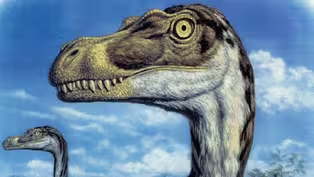
Mark Hallett, Dallas, Oregon Paleo Artist
Video has Closed Captions
Clip: S22 Ep5 | 7m 41s | Mark Hallett, paleo artist from Dallas, Oregon. (7m 41s)
Video has Closed Captions
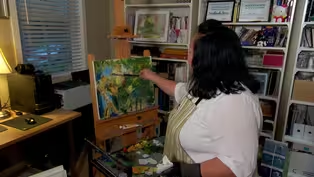
Clip: S22 Ep5 | 9m 51s | Originally from Laos, Yer Za Vue worked for a decade as a Disney animator. (9m 51s)
Providing Support for PBS.org
Learn Moreabout PBS online sponsorship















Support for PBS provided by:
Oregon Art Beat is a local public television program presented by OPB