
E17 | Lead Testing, Hillside Steps | Ask This Old House
Season 24 Episode 17 | 23m 42sVideo has Closed Captions
Sink drain maintenance; methods for testing lead-based paint; granite hillside steps.
Richard Trethewey breaks down why sink clogs happen, how to prevent them, and why chemical drain cleaners can do more harm than good-offering safer maintenance alternatives. Mauro Henrique demonstrates how to test for lead-based paint, comparing at-home rapid tests to a professional XRF analyzer. Then, Mark McCullough installs granite hillside steps, creating safer access to a backyard fire pit.
Problems playing video? | Closed Captioning Feedback
Problems playing video? | Closed Captioning Feedback
Funding for Ask This Old House is provided by The Home Depot, Renewal By Andersen, and ChipDrop.
Support provided by:


E17 | Lead Testing, Hillside Steps | Ask This Old House
Season 24 Episode 17 | 23m 42sVideo has Closed Captions
Richard Trethewey breaks down why sink clogs happen, how to prevent them, and why chemical drain cleaners can do more harm than good-offering safer maintenance alternatives. Mauro Henrique demonstrates how to test for lead-based paint, comparing at-home rapid tests to a professional XRF analyzer. Then, Mark McCullough installs granite hillside steps, creating safer access to a backyard fire pit.
Problems playing video? | Closed Captioning Feedback
How to Watch Ask This Old House
Ask This Old House is available to stream on pbs.org and the free PBS App, available on iPhone, Apple TV, Android TV, Android smartphones, Amazon Fire TV, Amazon Fire Tablet, Roku, Samsung Smart TV, and Vizio.
Keep Exploring
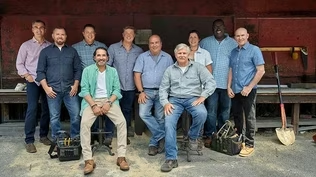
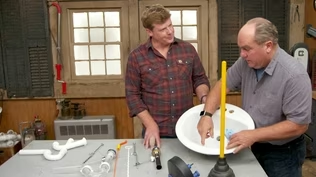
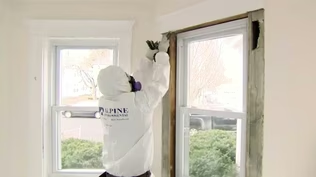
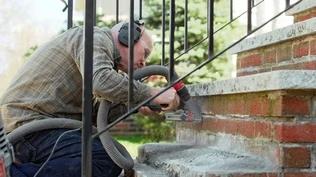

This Old House Insider Newsletter
Get This Old House exclusive stories, tips, and behind-the-scenes information delivered right to your inbox every month.♪♪ Kevin: On "Ask This Old House," our experts travel across the country to answer questions about your house.
♪♪ Today, Richard talks about sink-drain maintenance with tips and tricks to keep everything flowing.
Then, Mauro demonstrates both some low-tech and high-tech ways to test for lead paint.
And a steep hill has a homeowner stumbling.
Mark steps in to help install some hillside stairs.
Mark: I don't think that could've gone any better.
Kevin: All that on "Ask This Old House."
♪♪ Kevin: Hey, Richard.
Richard: How are you?
Kevin: All right.
What's going on here?
Richard: It's not a cooking show.
You know, everybody's got plumbing clogs, and they don't happen overnight.
So I want to review some of the things that cause sink clogs... Kevin: Okay.
Richard: ...and then what you can do to prevent them.
Kevin: Sounds good.
Richard: Okay.
First thing, we start at the kitchen sink.
Every single sink has a trap underneath it.
And so that trap has got a water seal... Kevin: Yeah.
Richard: ...that keeps sewer gas from coming up.
Kevin: Right.
Richard: By its very nature, it's designed where it can catch things.
Kevin: Oof.
Richard: So, this is a dramatic example.
You can see a bracelet and you can see flossers and even coffee stirrers can get stuck down there.
Kevin: So, good to hold water... Richard: Right.
Kevin: ...but also a natural place for everything else.
Richard: It's a tight bend, and so it can actually trap stuff in there.
Most traps can now come apart easily.
You can clean them and put it in.
So that's your first place where stuff can clog.
Kevin: What's going on in your household?
Look like you have Mardi Gras here in one trap.
Okay.
I get it.
Richard: But the other culprit really is not the solids like that.
It's grease.
Okay?
Kevin: Yeah.
Richard: So when you're working around the kitchen sink and you wash the dishes and you've got a fair amount of bacon grease or whatever, it's gonna want to work its way down, and it's going to try to re-coagulate in the long horizontal pipes that are often down in the basement.
Okay.
So I would recommend, if you have a lot of grease, You should try to save it and not put it down the drain and then throw it away properly, because it can change its state from a liquid to a solid.
So I thought we'd do a little demonstration right here.
This is grease.
Kevin: In its liquid form.
So it's a little warm, right?
Richard: Correct.
And this pipe is cold.
So now let's simulate... Here goes the grease going down.
Kevin: Starts hot, and it's moving.
But over, say, 10, 20, 50 feet of cold pipe... Richard: Absolutely.
Kevin: Oh, look at that.
Yep.
Richard: So, now... you see what happened?
So, now, just as you'd expect, it's gonna stick to the bottom side of it.
Now, that's a layer.
Now you do a little bit more, and it's another layer, another layer.
And sooner or later it will close its aperture down, and you'll end up with a stoppage where nothing comes out.
Kevin: This is your point about building up over time, which -- holy smokes.
Richard: That's an extreme example.
Kevin: Right.
Richard: You know, if you've got a modern system with PVC, it's not going to be that dramatic because there's not much surface tension, so it's going to run down there more readily.
But a lot of houses still have old galvanized or cast-iron, and that's a steel pipe with a galvanized coating, and that can just be a place where it's got a fair amount of friction inside of it, and now it'll just keep on layering and layering.
Kevin: And that's your point -- build up over time.
So a little bacon grease, you know, on a Sunday morning, no big deal.
But for five years you end up with... Richard: That's right.
Slowly builds it up.
Kevin: Okay.
Richard: The other thing is, not just grease, it's hair.
Kevin: Come on.
Not with you.
Richard: Not with me?
[ Laughs ] So, hair has got some natural places to clog.
One is in the regular -- Underneath the sink is this pop-up assembly.
We all know them.
They go up and down like this.
Kevin: Sure.
Richard: And a perfect place for hair to catch is right here.
Kevin: 'Cause there's an obstruction right in the middle of the drain.
Richard: It sticks right into the water stream.
Okay?
So it's a perfect place.
So, one brilliant invention is this.
So, this goes down and -- Throw that away.
Throw that away.
You don't need that anymore.
You put that down.
And here's your new stopper.
Okay?
So that's how the water stops.
But look what's below it.
Kevin: Ooh!
So you've got a strainer.
Richard: That's right.
Kevin: And is this designed to come out so that you can easily...?
Richard: Absolutely.
And when you live with a shedder, that's a really good invention.
Kevin: We won't tell her.
Richard: Okay?
Kevin: And what about the...?
Richard: The other thing is the shower.
This is a great little invention.
You know, it's not beautiful, but it does a great job to catch all the hair, and you can clean that and keep that shower drain from taking all that hair.
Kevin: Throw this over the fixed strainer and know that you can take this out and clean it.
Richard: Yeah.
And that hair is unbelievable.
It just stays attached to anything.
It's like -- it's like it gets caught on any snag, so it's difficult to clear it.
Kevin: Mm-hmm.
Richard: So, everybody wants to go after these things with a chemical because it's simple.
"Let's throw it in there..." And so I just want to talk about them a little bit.
This is a drain cleaner.
This is sodium hydroxide.
It could be a base or it could be an acid.
Okay?
There's different ways to do it.
But in all cases it's gonna try to go aggressively at the organic matter.
So what I've got here is some hair and this into some water.
Kevin: And you have a thermometer in there why?
Richard: Because I'm going to show you the chemical reaction when we put lye... Kevin: So we're at 80 some odd degrees now.
So, this is 100% sodium hydroxide, also known as lye.
Kevin: And that's doing what?
Richard: Well, it's gonna break down the organic matter.
You see it.
It's gonna raise the temperature dramatically.
Kevin: Holy smokes.
Richard: What is it?
Kevin: It's already over 150.
Richard: Right.
So, now, that might clear the hair, but if you got ancient old pipes or thin wall, old pipes, and now you're putting in all that temperature and aggressive behavior in it, you can rot the pipes away, and now you've caused another problem.
And then if somebody has to come along later and run a snake down there, now you've got the issue of this caustic chemical that will hurt people.
Kevin: So, clearly, it's doing something in there.
Does it also work on grease?
Richard: Yeah.
This is a similar example right here.
This was hair and grease in here, and it broke it down.
And it re-formed the grease to make it now be able to convey down to the main drain.
Kevin: Got it off of the pipe and gets it flowed out.
Okay.
Richard: Okay.
So this works, but it can be damaging to the pipes and to the people that come after it.
Kevin: So if you prefer not to grab things like this and pour them down the drain, is there anything you're comfortable pouring down the drain?
Richard: There's some organic solutions.
This is baking soda and vinegar.
You can use this as an organic way to keep those drains clear of grease.
And this is fantastic.
This is actually -- it's an enzyme.
There's no caustic chemicals.
And those enzymes will just eat anything organic.
Just keep on eating that grease and it'll actually -- you could put enough down there, and that pipe would just be as clean as a whistle over time.
Kevin: So, over time, literally just starts to eat away at something like.
Richard: Like a big buffet for that enzyme.
Kevin: All right.
Well, thank you, Richard.
Richard: All right.
Kevin: I mean, disgusting, but still, thank you.
Richard: Thanks for sharing it with me.
Kevin: [ Laughs ] ♪♪ Hey, Mauro.
Mauro: Kevin, how you doing?
Kevin: I'm doing all right.
Looks like we're talking lead paint, huh?
Mauro: Yes.
Kevin: All right.
So this is something you must come across a lot, given what you do.
Mauro: Almost every day.
Every time when I approach to do a project in a house that was built before 1978, as a professional painter, I have to test for lead paint.
Kevin: So, back in the day, most paint had lead.
They slowly phased it out.
And '78 is that sort of year when kind of before, let's assume it is.
Mauro: Yes.
Kevin: After, we know it was illegal.
We know that lead, when ingested, inhaled, or whatever, is really bad for us, terrible for young children because it affects the brain development.
Mauro: Exactly.
For young kids, you should be really careful with that, because brain damage and all the other stuff that might come with that.
Kevin: So, what's your preferred way to test?
Mauro: Well, okay.
We have this fast-result test.
There's a liquid and a powder tube inside.
Kevin: I'm just gonna pull this out so I can take a look at that.
Mauro: Yeah, pull that out.
Yeah.
Kevin: So, liquid.
Mauro: Liquid.
Powder.
Kevin: Powder.
And they're actually not touching because there's almost like glass and glass in there.
Mauro: Exactly.
You're gonna have to crush part A and part B, but, first, put the gloves on.
Kevin: You, me, rubber gloves.
It's gonna be a party.
[ Both laugh ] Mauro: All right.
Let's clean the blades first.
Kevin: So... Mauro: Little alcohol wipe that cleans out the blades.
Might be contaminated by something.
Kevin: Right there.
Mauro: Okay.
I'm gonna cut with the angle.
Kevin: You want me to get through the surface?
Mauro: You have to go through all the way down to the first coat of paint.
Kevin: Oh.
Let me see if I can come back and get you to bare wood.
You okay with that?
Mauro: That's good.
Kevin: Okay.
Mauro: Looks good.
Kevin: So, tell me about this test.
I've bought them before.
I can do this?
Mauro: You can do that.
Every homeowner that will perform some work on a house.
If the house was built before 1978, this is a good test to do it.
Kevin: Got it.
Mauro: Now you're going to press part A, part B. All right?
Crush it.
[ Glass cracks ] Kevin: There it goes.
Mauro: Part B. Kevin: Oh, yeah.
Mauro: Make sure.
Now you're gonna shake it.
Kevin: And I want to put this on my cut?
Mauro: You want to put this in your cut right in there.
Just rub it against it.
Comes out orange.
Kevin: Mine kind of stayed orange.
Mauro: That means no lead.
Kevin: How'd you do?
Mauro: I can see red, and I can see pink.
Kevin: You're positive.
Mauro: I'm positive, you're negative.
Kevin: Okay.
So, this means you're now going down a different route, in terms of the protocol that you have to think about... Mauro: Absolutely.
Kevin: For mitigation, encapsulation, and all that type of stuff.
I've seen these.
We've bought them before.
So, good for a homeowner?
Mauro: Good for a homeowner.
Kevin: But also good enough for you?
Mauro: It's good enough for me, but, nowadays, we have something even better than that.
Kevin: Oh, lay it on me.
What do you got?
Mauro: We got these machines that are called XRF, which is accurate to detect lead paint.
Kevin: And when I see XR, is it safe to assume it's got an X-ray feature?
Mauro: Exactly.
Kevin: Huh.
All right.
And so how does this thing...?
Mauro: Works?
You just go against the surface.
It goes right through the paint layers.
We don't have to do the cut.
[ XRF beeps ] Kevin: Ooh, that was fast.
Mauro: Red.
Kevin: Positive.
Mauro: Positive.
Kevin: Holy mackerel!
And mine?
Can you do mine?
Nathan: Do yours now.
[ XRF beeps ] Kevin: Negative.
Mauro: Green.
Negative.
Kevin: That fast.
Mauro: You don't have lead paint, I do.
Kevin: So, like you said, I don't have to cut my windowsill to expose it for this whole test.
That thing is not gonna damage anything.
Mauro: That thing doesn't damage anything because you don't have to cut the wood, and it can read the -- if you have lead paint, through the layers of paint down to the wood.
Kevin: May I?
Mauro: You could.
Yes.
Kevin: So if I go to yours... [ XRF beeps ] ...the numbers below, all this stuff here, does this matter to you at all, or do you just care about the positive?
Mauro: That means the amount of lead that you have in your house.
Kevin: Oh, so it's measuring the concentration.
Mauro: Measuring the concentration that you have.
Kevin: Do you care about that?
Mauro: You should.
Kevin: Because...?
Mauro: Because all the rules and regulations.
But that applies to different states and towns.
Kevin: So, are you suggesting that you could get a positive, a number, I guess, higher than zero might be the base?
It could be higher than zero, yeah.
Kevin: But it could be low enough... Mauro: It could low enough... Kevin: So you don't have to... Mauro: To follow up with all the protocols.
Kevin: So, this could save you a lot of headaches.
Mauro: Save a lot of -- yeah, a lot of money, too.
Kevin: This is kind of binary, positive or negative.
But this is super specific.
Mauro: This is precise.
Kevin: I have not seen this before.
I haven't seen you use it.
Is this a pro's tool?
Mauro: It's more for like a home inspection.
And sometimes a general contractor has one of those.
Kevin: Someone who's in the business of inspecting.
Mauro: In the business and inspect for lead or any other detection that they want to find out in the house, this is handy.
Kevin: Awesome.
All right.
Well, thank you, Mauro.
Mauro: All right.
Thank you.
♪♪ Mark: Today, I'm headed to the state of New Hampshire.
Fun fact about New Hampshire is its nickname.
It's called the Granite State, and that's due to the large boulders, the rock formations, and the quarries throughout.
I love working with granite for a number of reasons.
It's durable, it stands up to harsh weather, and it's been used in building and landscaping for years.
♪♪ Pete.
Pete: Mark.
Mark: How you doing?
Pete: Good.
How are you?
Mark: Great.
Great to see you.
Pete: Great to see you, too.
Thanks for coming over.
Mark: Yeah.
Well, thanks for writing us.
I already see the patient right here, right?
Pete: This hill here, yes.
Mark: Yes.
So, my wife and I, we built this house about a year ago.
And we have this beautiful side yard, as you can see.
And we built a beautiful fire pit that we've started to enjoy.
But, unfortunately, it's very difficult to get down to.
Mark: Right.
Pete: And that's something that we've had a lot of issues with, as I'll show you right here.
There's a couple videos of me actually falling down this hill.
Mark: Yeah, wow.
Pete: Yeah.
Very painful.
Mark: Are you all right?
Pete: Yeah, I'm -- I'm surviving right now.
So, that is something I'd like to avoid, going forward.
So what we're hoping to do here is find a safer way to get down.
Mark: All right.
Well, it's something we can fix, and I do have a couple ideas, so let me show you.
Pete: Let's do it.
Mark: All right.
♪♪ So, here's our step.
Pete: Okay.
Mark: Now, there are two different ways we can do this.
To my left, you can -- we already know how steep that is, right?
Pete: Yes, we do.
Mark: So if we cut into that hill right there, from the bottom to the top, we're probably gonna end up with 8 or 9 steps, which is quite a climb, especially if you have something in your hands like burgers and hot dogs.
Pete: Yes.
Mark: We would have to pour a footing, then build the step.
So, a lot of work.
And once we got done with the steps, we'd have to add a rail.
So another expense.
Pete: Okay.
Mark: Second way that we could do it is right here.
So, you can see this slope.
This slope actually coincides with your doorway up top, so it might be just an easier flow.
And this is gonna be a much easier build.
We can take this beautiful piece of granite right here.
You see that?
Pete: Yeah.
Mark: I mean, this is New Hampshire's finest.
We have a bunch of those, so we can kill this slope, just inserting these pieces of granite into that hill and get out that way.
What do you think of that?
Pete: I think that sounds great.
It's gonna look beautiful.
Mark: All right.
Okay.
So, first, we have to dig, then we have to do some gravel work, and then we put the tread on that.
But let's get started with the shovels.
Pete: Let's do it.
Mark: All right, Pete.
So, the first thing we're gonna do with the first step is locate it.
So, this stone wants to face that fire pit because we're going to twist around this little walk, and that's what we want to face 'cause that's where we're going.
So, if you hold the tape... That stone is 40 inches.
Pete: All right.
Mark: So, I'm just gonna do a rough little spray.
Pete: Okay.
Mark: This represents our dig area.
Pete: Okay.
Mark: Uh, again, facing that fireplace, so I like that.
Time for shovels right now, Pete.
Pete: All right.
Mark: You can have a long handle.
Pete: All right.
Mark: I'll take the short.
Take that.
See that right there, Pete?
Pete: I do.
Mark: That's clay.
Pete: Okay.
Mark: Okay.
So, we're down to clay, which is solid stuff.
Take this out.
We still want to go a little bit deeper.
Pete: How deep are we gonna dig here?
Mark: Som I normally like to go at least 12 inches.
Pete: Okay.
Mark: Just 'cause I want to get the gravel in for drainage.
So, Pete, that looks to be about 12 inches.
Do you mind getting that hand tamper?
Pete: Absolutely.
Mark: But you can see this clay is really flattening out very nicely.
We want to make sure we're working off a base that's as solid as possible.
And, again, lucky enough to have clay below, which packs very nicely.
So, let's dump this crushed stone.
Just gonna go right there and flip it up.
Spread that out with your flat shovel.
Pete: Got it.
Mark: Excellent.
What I'm gonna want to do next is compact.
Pete: And what are we putting this crushed stone down for, Mark?
Mark: So, the crushed stone is gonna be twofold for us.
Number one, and most importantly, it's gonna be drainage.
But number two, it's gonna act as our foundation.
That's why we want to compact it as much as possible.
Pete: Got it.
Mark: See how I threw that a little?
Pete: Yeah.
And just same thing?
Level it out?
Mark: Level it out.
And you should put us right where we want to be.
That simple, Pete.
Now we're ready for the stone.
Pete: All right.
Mark: Stone's gonna go in the hole, but we left this dirt here for a purpose.
We're gonna take this granite, we're gonna go on top of the dirt.
We're gonna re-evaluate.
But we also want to give our chance to catch our breath, get some leverage, bend our knees, which is super important.
Never hurt my back because I always bend my knees.
So, take the stone, flip it forward, get under it.
Go right to the dirt.
We're gonna roll this down.
Pete: Okay.
Mark: This is the bottom.
And then we're gonna flip it in.
Pete: You got it.
Mark: All right.
So, there we go.
Again, take another breather.
I'm gonna get down.
Pete: Okay.
Mark: Keeping my fingers under it.
And I'm gonna go right in and drop her down.
I don't think that could have gone any better, Pete.
So, Pete, I'll take the 2-footer.
Excellent.
All right, Pete.
So look at that bubble, and you can see that I'm pitching the stone frontwards.
That means the water's gonna drain that way.
Pete: Okay.
Mark: And when I go this way, I'm trying to do the same thing.
You can see the bubble leaning this way, which means I'm pitching that way.
Pete: And why are we pitching toward the hill this side?
Mark: So, it's a call that we're making right on the spot because I'm noticing our surroundings.
You can see the hill over here.
That's gonna want to take the water and bank it out.
If I go this way, it might get caught right here, build up, become ice.
So that's the reason we chose that.
Pete: Awesome.
And what's left for this stone?
Are we doing anything else here?
Mark: So, we're gonna do nothing here.
We're gonna do the rest of the stones that way.
We're gonna leave this as is.
And if we have to move it around to adjust, it'll be free and easy.
At the end, we'll come and backfill all the stones at once.
Pete: Sounds good.
Mark: All right.
Let's get going, Pete.
♪♪ All right, Pete, why don't you get in?
Pete: You got it.
♪♪ ♪♪ ♪♪ Mark: Couple taps just to lock her down.
Pete: Okay.
Mark: All right.
Next step.
♪♪ ♪♪ We're looking good.
Now we can backfill.
♪♪ Great.
And that's gonna help lock this stone in.
♪♪ ♪♪ Second to last step, we're gonna put down this fabric paper.
So, if you grab one end... Pete: You got it.
Mark: And kind of line me up.
Just throw a little rock on top of it for now.
Piece of steel.
Next one is behind you, Pete.
Pete: You got it.
So, Mark, what are we putting these down for?
Mark: Very typical.
When you're doing landscape, you put this down before you put the mulch down or, in our case, the gravel.
But this is gonna keep the weeds from coming up.
Pete: Okay.
Mark: So, Pete, we're just gonna nail in this stake.
Pretty heavy-duty stake.
That's just gonna keep our fabric paper in place.
All right, let's get some stone.
Pete: Let's get it.
Mark: So, right up to the edge of the driveway.
Pete: All right.
Mark: All right.
Pete: Just rake this out, Mark?
Mark: Yes, please.
Pete: All right.
Mark: So, I'm thinking this is gonna be gravel all the way down, and it's going to match the side door, and it's gonna match the front entry, so... Pete: That's perfect.
Mark: All right, Pete, what do you think?
Pete: I think this came out beautifully, Mark.
Mark: All right.
Great.
I'm real happy myself, but I am gonna leave you with a little bit of homework.
You can see that dirt patch?
Pete: Yes.
Mark: Throw a little seed, no problem over there.
But up here, you know, especially when you have company, higher hill to navigate.
So if you plant a row of bushes all the way across the driveway here and then maybe loop this corner, that's gonna direct the company into this walkway flows nicely down into the backyard, and right to the fire pit.
Pete: I like that idea.
Mark: All right.
Great.
Pete: Awesome.
Well, thank you so much for coming to New Hampshire and helping out with these stairs.
It looks awesome.
Mark: Well, thank you for having me, Pete.
I had a ball.
And I love New Hampshire, so... Pete: Absolutely.
You want to go sit by the fire?
Mark: Yeah, let's go over and check it out.
Pete: Let's do it.
Mark: All right.
If you have questions about your house, we'd love to hear from you, so keep them coming.
Until next time, I'm Mark McCullough for "Ask This Old House."
Ooh.
Nice.
Pete: This is warm.
Mark: Yeah.
I wish I had a marshmallow.
♪♪ Kevin: Next time on "Ask This Old House," Nathan heads to a historic neighborhood in New Orleans to help some homeowners install shutters.
Then, Jenn and Lee talk fertilizers, organic versus synthetic, when to use and how much.
And do you know how many smoke detectors you should have and where to put them?
Heath answers these questions for a homeowner.
Woman: Thank you so much.
I feel so much safer.
This is great.
Kevin: All that on "Ask This Old House."


- Home and How To

Hit the road in a classic car for a tour through Great Britain with two antiques experts.













Support for PBS provided by:
Funding for Ask This Old House is provided by The Home Depot, Renewal By Andersen, and ChipDrop.