Windows to the Wild
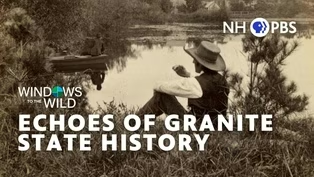
Echoes of Granite State History
Season 20 Episode 5 | 27m 29sVideo has Closed Captions
Host Willem Lange shares stories about Shaker history, and Appledore Island’s natural beauty.
Host Willem Lange explores the history, culture, and people of Canterbury's Shaker Village. While there, he hears the story of a Revolutionary War veteran who found refuge in the forest behind the Village. Then we travel with a docent to Appledore Island.
Problems playing video? | Closed Captioning Feedback
Problems playing video? | Closed Captioning Feedback
Windows to the Wild is a local public television program presented by NHPBS
Windows to the Wild
Echoes of Granite State History
Season 20 Episode 5 | 27m 29sVideo has Closed Captions
Host Willem Lange explores the history, culture, and people of Canterbury's Shaker Village. While there, he hears the story of a Revolutionary War veteran who found refuge in the forest behind the Village. Then we travel with a docent to Appledore Island.
Problems playing video? | Closed Captioning Feedback
How to Watch Windows to the Wild
Windows to the Wild is available to stream on pbs.org and the free PBS App, available on iPhone, Apple TV, Android TV, Android smartphones, Amazon Fire TV, Amazon Fire Tablet, Roku, Samsung Smart TV, and Vizio.
Providing Support for PBS.org
Learn Moreabout PBS online sponsorship♪♪ -Welcome to Windows to the Wild, I'm Willem Lange Today we take you from land to sea.
We start at Canterbury Shaker Village.
We will hear some stories about the people who lived there and the mystery that lies in the forest just behind the village.
From there, we'll meet a docent who leads trail trips to an island six miles out at sea.
But first, Marshall Hudson is a land surveyor who often stumbles upon interesting and forgotten places in New Hampshire.
He writes about them for New Hampshire magazine.
I met Marshall at Canterbury Shaker Village, where he shared some stories about history, culture and the people who lived there.
♪♪ We're in Canterbury, New Hampshire, at the Shaker Village.
Some of these buildings, which housed as many as 300 people in the 1850s, are more than 230 years old.
♪♪ The last Shaker sisters to live here died in 1992.
♪♪ It's been a museum ever since.
The Shakers are gone from Canterbury, but their history remains.
♪♪ -Let's go look at the sign.
-Marshall Hudson will share stories with us that paint a picture of who the people were who lived and worked here.
♪♪ -They had a guy here who was good with quarry, and so a lot of these stones were built by him.
His name was Micajah Tucker-- -Marshall’s a land surveyor.
His work takes him to places that most of us don't get to see.
That's where he discovers stories waiting to be told.
Once his surveying duties are over for the day, Marshall takes photographs of the site and later researches what he found there.
He then writes stories about them for New Hampshire Magazine.
I love what the Shakers did you know, they just they were so practical, you know, you know that everything they did was impossible but practical.
The Shakers were a Protestant sect founded in England in 1747.
They were pacifists who practiced communal living.
They didn't marry and were celibate, adopting children and recruiting converts into their community.
-Well, Shakers came here late 1700s and they built the meetinghouse.
♪♪ -Shaker architecture is recognized by its simplicity, craftsmanship, and ingenuity.
♪♪ It's one of the reasons Marshall brought us here.
Oh they paved this didn’t they?
-Yeah this was the access ramp up into the second story.
It was a three story-- well, it was it was built and added on to multiple times so depending on the decade we're talking about, it was a multiple story barn.
At one time, it was the biggest barn in New Hampshire.
They had dairy cows.
They had an impressive herd of dairy cows.
-Yeah?
♪♪ -And in 1973, it caught fire and burned to the ground.
-Oh, dear.
♪♪ [somber guitar] ♪♪ -Okay there was a Shaker brother named Henry Blinn, and he had a large appetite of interests.
He was always picking new hobbies and developing new hobbies and experimenting and he just had a lot of interests.
-Yeah.
-And one of his interest was call it gardening with trees.
-Yeah?
-And so this is his arboretum, and he's planted trees and if you look, there's a sugar maple, there's an ash, there's an oak, there's a pine, ♪♪ there's another sugar maple.
He, he cultivated and actually grew a garden of trees.
♪♪ [leaves rustling in wind] See a birch.
♪♪ I see a birch over there.
I see a hemlock in there.
-Yeah?
-I see a red oak over there and a white oak over there, So they were kind of-- He was kind of pick and choose and planting.
It's just kind of neat to have a little tree garden.
♪♪ So with this building we're going to go around to the front.
♪♪ But just kind of take a look at the proportions and see what you think.
♪♪ Well, it's a trick question, so-- -Oh yeah?
-Yeah.
♪♪ -What's the trick question?
-Well, ♪♪ The proportions always looked a little odd to me.
-Yeah?
-And there's a reason why they-- Why it looks like it does.
-Yeah?
-This was the school where the where the kids went to school, -Yeah?
-and it was a one story, smaller building built, 1823.
Well, they decided they needed a bigger school, more kids.
And part of the kids were were from the neighborhood, not just Shakers, in those days one room schoolhouses were scattered all over.
And so they had two schools here.
So they needed, to make the school bigger.
And rather than put an addition on it horizontally, they decided to go vertically.
-Yeah.
-But they had just put a new roof on it.
And they shingled the roof with wooden shingles and so they figured it had a 40 year life.
-Right.
-So rather than take all of all the shingles off and then put a second story on, they lifted the building 12ft in the air -And put a new first floor-- -And put a new first floor in.
And so they were limited by the footprint of what was there.
And putting it 12ft up, it kind of gives it a stretch.
-Yeah.
-An unusual stretched look.
[Willem chuckles] let's go look at this building.
-It’s okay.
♪♪ -Okay see this white one over here?
-Yeah?
-Now that's the Shaker meetinghouse.
-Ah, okay.
-And see, it's got two doors?
-Yep.
Men and women yeah.
-That’s so the men could go in one and women go in the other, and they wouldn’t accidentally bump into each other or anything.
♪♪ So that's the meetinghouse, which was kind of their church.
They did their services in there.
They sang, and part of their worship involved dancing, and so they did some dancing in there.
But what I wanted to tell you is because that was kind of their church when they built it, they felt they needed to build it with reverence.
And part of that reverence during construction meant no talking during construction.
-What a pain in the neck that is-- -So instead of hollering, hey, I need nails, or bring me a hammer, or hold that board or something like that-- -Or two and a half inches-- -Two and a-- knock it again hit it again.
[Willem chuckles] It was all done with whispered, whispered commands.
-Yes right, Reverend on your toes-- -Reverend on your toes and whispered to me-- ♪♪ So this intersection used to look a little different.
-Yeah?
♪♪ Well, that's pretty much north and that's pretty much south, ♪♪ east, east and west.
-Yeah, right.
-And so the Shakers built this granite watering trough.
It's one solid piece of rock and they carved, carved it for a watering trough and put it here and they positioned it so that the diagonals point north, south, east and west.
And travelers coming through could stop and water their horse, you know, and it would tell them, you know, when you come to the stone watering trough, no matter what direction you're coming from, go north and you'll come to Shaker Village.
That kind of.
Yeah.
Direction before cars had GPS units and stuff.
-Yeah.
-Well, the Shakers got old and cars came into being and the road got changed.
And years later, the town road agent came through and he decided this was in the way of snowplows.
And so he decided he didn't need to be here anymore and he picked it up and took it away.
-Yeah?
-Well, the shakers objected and said no, we want our watering trough, bring it back.
And there was a battle about who really owned it, because if it's within the road right of away, he felt he had the right to remove anything that's within it.
-Yeah, right-- -Well, come to find out, that doesn't hold up.
-Oh really?
-No.
-So they still owned it.
-So they still owned it.
So he had to bring it back.
And he brought it back and then positioned it.
-Yeah?
-But he didn't get it north south east west.
If you look at the compass he's-- -Yeah.
-tweaked a little bit.
-I think he did that on purpose -He probably did it on purpose just out of, out of a little bit of spite and grief.
-Yeah.
♪♪ -Here we are.
This is Turning Mill Pond.
-Turning Mill?
-Turning Mill.
There used to be a factory that sat right there.
-Yeah?
-And they used water power coming out of here.
-Yeah?
-To power the mill.
-Yeah.
-And they had lathes and stuff in there where they turned pegs and chair rails and then those kind of items that they made that the Shakers were known for, for making.
And there's also another one in there called Wood Mill where they sawed firewood.
-I can just hear the poor water sayin, c’mon, we-- [Willem chuckles] -We're just getting warmed up.
-We have to work all the way down-- -So working your way up, you got Carding Mill, you got Wood Mill, you got Sawmill, you got Turning Mill.
The next one up had a couple of different names.
It was known as Ice Pond, It was also known as Tannery Pond.
-Yeah.
-Or Factory Pond.
-Yeah.
-And then we keep going, then there's Fountain Pond, there's New Pond, Long Pond, Lyford Pond, Stump Pond, there’s a bunch of them.
-Wow!
-And depending on what century and what decade we're talking about there are many as 12 ponds all sequentially stepped up above each other-- -Yeah?
-and the joke was, by the time the water left the Shaker property, it was all worn out.
-Why not yeah?
-Because each one ran a mill [Willem chuckles] as they worked their way down.
-Yeah.
♪♪ It wasn't only the water that was worn out.
The dams holding it back got tired too.
-Now about 15 years ago, one winter, ♪♪ this dam breached and blew out.
-Oh-- -And big hole in the dam.
-Yeah?
-And they hired some surveyor to come survey the water level so that they could get-- -Oh yeah you were the guy.
-so that they could elevation-- -I seen a picture of you standing on top of that.
-That's what I was going to show you is a picture of me-- -I saw that yeah.
-standing on top of that ♪♪ -Guy would have to be nuts to go out there in the wintertime and stand on that.
-Well he had to be -Fall in the ice- -a paid surveyor.
-Or nuts.
-Or nuts.
-Or both.
-Or both!
[Willem chuckles] ♪♪ We'll return to Shaker Village to hear the story of an American Revolutionary War veteran who spent years piling rocks out behind the village.
But first, I want you to meet Karen Shields.
She's the UNH Marine Docent who leads trips out to Appledore Island, six miles off the coast of New Hampshire.
♪♪ [gulls cackle] Karen Shields arrives at the dock for her morning commute.
♪♪ ♪♪ [water spraying] ♪♪ She boards the Gulf Challenger, a University of New Hampshire research vessel.
It's about a six mile trip to Appledore Island, one of the Isles of Shoals.
♪♪ Karen brings along a group of eager explorers ♪♪ [indistinct chatter] -I am a UNH Marine Docent.
♪♪ What is a docent?
It is a trained, volunteer educator.
And we serve sort of, the interface, if you will, between research.
Researchers here and the public.
So we endeavor to teach both children and adults more about the marine environment.
-Several other docents make the trip to Appledore to help with the tour.
♪♪ [gulls cackle] Karen plans to show off the island’s natural history.
-So how do you think all these plants got here?
♪♪ [faintly] -Birds.
♪♪ -There's a good percentage that did come from birds.
Yeah, I've been a docent for about six years.
I actually grew up on the sea coast.
Always was interested in the marine environment, but back when I was a kid, fields, marine fields for women were not really prevalent.
[gulls cackle] I went to UNH.
I became an occupational therapist.
And so now in the waning parts of that career, I then discovered the marine docent program, which allowed me to kind of indulge myself in marine science yet again.
♪♪ -There are nine islands out here that make up the Isles of Shoals.
♪♪ [gulls calling] They played an important role in New Hampshire's fishing economy during the 17th century.
♪♪ [gulls calling] There are legends of pirate activity out here, but the real treasure is Appledore’s natural history.
-So I would like the folks today to feel a greater connection to the environment here and to be able to relish the fact that only a few miles offshore, they have an opportunity to experience something that many, many people never get.
I used to be an avid hiker.
I used to feel the same way about the mountains up in Franconia Notch.
I felt like I was very, much, [gulls cackle] fortunate to be able to see the world from that perspective as well.
So I’d really like them to take home just a greater appreciation of the natural world.
♪♪ [gulls calling] Anybody have any idea what this is?
-Is that St John’s?
-Yes!
St John's-wort.
What-- -Karen and the other marine docents are knowledgeable tour guides.
[faint chatter] They receive training, and spend a lot of time over the years immersing themselves in the history and science of the places they visit.
♪♪ -Just above, up on the path you see a black-backed gull.
that is a greater black-backed gull.
It is the largest, gull in the world.
[faintly] This little guy is doing.
♪♪ We are the interface between researching and or researchers and the public.
So every month we have a monthly meeting as part of a docent, the docent program, and we get to hear about the up and coming research.
So this orange flower is usually found [gulls cackle] on the opposite side, opposite side of a trail from either poison ivy or stinging nettles.
It is the anecdote and this is called touch me not.
[gulls calling] So I volunteer because I believe that it's a way to give back to older folks and to kids, growing up.
I think volunteerism and teaching about the marine environment is really, a gift.
We have this wonderful resource right off the coast, and I don't think we appreciate it nearly enough.
♪♪ So to protect them right?
Yeah, so let's talk about crabs.
-When folks can't get out in the field, Karen brings it to them.
♪♪ Karen and the other docents that visit schools, they bring along some critters.
-So versus taking the kids to the coast, we bring the coast to them, and we have a various, or various amounts of different teams here, estuary is here.
I think this is kind of cool because I think these are eggs under here.
So sometimes these kids have never seen the ocean and here in Rochester this most of these kids have been to the beach.
But it's really a great way to demonstrate the importance of the ocean, the importance of the critters in the ocean.
This one-- [indistinct chatter] So this is a great way to get kids really excited about the outdoors and something that's very accessible to them.
-Okay, I have some stickers for everybody.
[children chattering] ♪♪ -The tour ends with the relaxing ride back home and ♪♪ [indistinct announcement on boat speaker] Karen says that every day out here is another opportunity to learn something new about our world.
[gulls cackle] -Through this program, I've had to learn a lot about cultural history as well as natural history.
As I get older, I find myself more and more interested in history.
And so this Appledore experience, sorta wraps it all together.
♪♪ [gulls calling] If I think about Appledore, I think about science and art.
♪♪ So I'm very fortunate to be able to experience both.
♪♪ I know the trip was a success by the smiles on everyone's faces.
[motor whirring] People seem pretty happy.
♪♪ [gulls cackle] -The American Revolutionary War ended in September 1783.
When you visit Shaker Village in Canterbury, New Hampshire, take a walk in the forest behind the village.
You'll find a story there about a veteran and the legacy of the war.
Marshal Hudson shows you what he left behind.
♪♪ We're at the Shaker Village in Canterbury, New Hampshire.
It's a national Historic Landmark.
This is where members of the religious group lived beginning in 1792.
Its last resident died 200 years after it was founded.
♪♪ It's been a museum ever since.
♪♪ The Shakers were a Protestant sect founded in England in 1747.
They were pacifists who practiced celibacy and communal living.
♪♪ -They had a guy here who was good with quarry and so a lot of these stones were built by him-- -Marshall Hudson has a story to share about one man who lived on the property, but didn't spend much time with the other residents.
♪♪ -Let's go look at this-- -Marshall's a land surveyor who sometimes stumbles upon forgotten stories while he works in the woods.
♪♪ If something catches his eye that seems unusual or interesting, he researches it and writes about it for New Hampshire Magazine.
This is one of those stories.
♪♪ To tell it, Marshall leads us into a forest about a mile from the village.
♪♪ So there was a Shaker named Peter Ayers.
He was born about 1760.
So he’d have been about 15 when the American Revolutionary War broke out.
♪♪ [American Revolution music] He had served with George Washington during the Revolutionary War, and he was very young when the war started he was like 15.
-Yeah?
-So he'd have been in his early 20s when it ended.
And certainly he saw some things in all those battles and-- -Yeah.
-and when he got out, he went looking for, quiet life and the Shaker pacifism appealed to him and he joined the Shakers.
♪♪ -But communal living didn't work for the young war veteran so an exception was made.
Peter was given a spot in the woods where he lived on a small farm.
Boy, that's nice, you know?
That's nice of em.
-Yeah and they would come and get him once a week and bring him to church.
♪♪ And he worked out here the whole week all by himself, alone.
And one of the things he left behind are these piles of rocks.
♪♪ The question is why he did this?
Certainly there was an agricultural element to it.
He was clearing the fields for crops and apple orchards and plowing and planting, and so the rocks had to be moved.
But he did more than just pick up rocks and dump them in a, in an area.
He stacked them.
♪♪ And besides the agricultural element, my suspicion is he had some kind of post-traumatic stress disorder, and he needed to work out his demons.
And so stacking rocks is a very labor intensive thing and if you get into it and get into the groove, your mind is focused on the rocks and you're not thinking about the other things that bother you.
♪♪ -Ain’t that a mighty work?
[Willem chuckles] Are we gonna see others?
♪♪ -Yes, there’s, about a dozen, all totaled, that I've found and aware of.
♪♪ [footsteps] [crunching leaves] This is a bigger, taller one.
It's got a bit of a turret look to it.
Kind of turns, kind of turns an angle, it’s still sloped on the backside, but it's still very vertical, straight up and kind of turns and is kind of on this overlook.
♪♪ But he did more than just pile em if you look he's got base stones and he's got them linked in tightened up.
He worked awful hard out here all alone stacking rocks.
♪♪ We'll come to sites where the rocks are so big and heavy I don't know how he was able to lift them up and over his head.
♪♪ This pile lined up square and straight with a slope this way, and it levels out flat going this way.
It makes me wonder if he was anticipating perhaps some kind of barn or something?
Driving in on this level and the barn going that way with maybe a drive under?
♪♪ It's a mystery!
♪♪ -Peter Ayers, the teenager who fought alongside George Washington, lived in these woods and piled rocks into his 90s.
♪♪ -They brought him back to the village when he was an old man, 92 or something like that.
And they would bring him to church.
And church in those days was like an all day thing and the preachers would talk and you'd sing and you'd dance and you'd shake and do that kind of thing.
And he would argue with the minister in church and say, I'm 92, and I knew Mother Anne personally when she started this religion and I went to her services and I interacted with her and what you're preaching now is not what she said and believed and he was so disruptive and argumentative that they ordered him bound and gagged and in the record he's bound and gagged when he goes to church because he was a fighter right to the end.
♪♪ -The end for Peter came one day in a grass field near the village.
-In those days, when the hay was ready and you had to get the hay in for cows and horses, everybody participated, and they had Peter Ayers at 96-97 however old he was, he was the lead man, swinging the scythe going through the field and they said it was hard to keep up with him.
♪♪ -Peter eventually ordered everyone to lay down their tools, find shade, and take a break.
-And then a little while later, the call was announced to resume to work, stand up and go back to work, and he failed to answer the call.
♪♪ Dead.
♪♪ Now if you think about it, is there a better way to go?
You were a fighter right to the end and you're leading the pace and the other guys can't keep up with you and you sit down, enjoy a cup of Schwitzel and then, then you're gone.
♪♪ -Well, we've come once again to that part of the show that I've always liked least, the time we have to say goodbye.
So I shall.
Bye bye.
I’m Willem Lange, thank you for watching Windows to the Wild.
♪♪ Support for the production of Windows to the Wild is provided by the Alice J. Reen Charitable Trust.
The John D. McGonagle Foundation, the Bailey Charitable Foundation, Road Scholar and viewers like you.
Thank you.
-Make a gift to the wild and support the Willem Lange Endowment Fund, established by a friend of New Hampshire PBS, to learn how you can keep environmental, nature and outdoor programing possible for years to come, call our development team at (603) 868-4467.
Thank you.
♪♪ ♪♪ [chime]
Echoes of Granite State History (Preview)
Preview: S20 Ep5 | 30s | Host Willem Lange shares stories about Shaker history, and Appledore Island’s natural beauty. (30s)
Providing Support for PBS.org
Learn Moreabout PBS online sponsorship














Support for PBS provided by:
Windows to the Wild is a local public television program presented by NHPBS