
Education in the Time of COVID-19
Season 2 Episode 45 | 56m 45sVideo has Closed Captions
One Detroit and Education teams talk with superintendents, teachers, parents, and students
To help find answers on the future of education, the One Detroit and Education teams talk with superintendents, teachers, parents, and students about how the pandemic has impacted not only the big picture of education statewide, but also how teachers work with students, how parents support their kids and other parents, students’ social and emotional learning, and more.
Problems playing video? | Closed Captioning Feedback
Problems playing video? | Closed Captioning Feedback
One Detroit is a local public television program presented by Detroit PBS
Education in the Time of COVID-19
Season 2 Episode 45 | 56m 45sVideo has Closed Captions
To help find answers on the future of education, the One Detroit and Education teams talk with superintendents, teachers, parents, and students about how the pandemic has impacted not only the big picture of education statewide, but also how teachers work with students, how parents support their kids and other parents, students’ social and emotional learning, and more.
Problems playing video? | Closed Captioning Feedback
Where to Watch One Detroit
One Detroit is available to stream on pbs.org and the PBS app.
Providing Support for PBS.org
Learn Moreabout PBS online sponsorship- Coming up on One Detroit, what's next for our schools?
Districts across the area are working overtime to make big decisions for the fall, hear from superintendents, teachers, parents, and the kids on where we're headed.
From learning challenges to technology to more resources for student mental health.
It's a full hour dedicated to education.
I'm Christy McDonald.
Join me along with Stephen Henderson, Nolan Finley, and our One Detroit Public Television Education team.
One Detroit is coming up.
- [Narrator] Support for this program provided by W.K.
Kellogg Foundation, a partner with communities where children come first.
The Cynthia and Edsel Ford Fund for Journalism at Detroit Public TV.
- [Narrator] From Delta faucets to Behr paint, Masco Corporation is proud to deliver products that enhance the way consumers all over the world experience and enjoy their living spaces.
Masco, serving Michigan communities since 1929.
The DTE foundation is a proud sponsor of Detroit Public TV among the state's largest foundations committed to Michigan focused giving.
We support organizations that are doing exceptional work in our state.
Visit DTEFoundation.com to learn more.
- [Narrator] Business Leaders for Michigan, dedicated to making Michigan a top 10 state for jobs, personal income, and to help the economy, Nissan foundation, and viewers like you.
(upbeat music) Hi there and welcome to One Detroit, I'm Christy McDonald.
Thanks so much for joining me.
It's mid-June and school is out, the school year is over and it has been a challenging last three months.
If you're a parent or a grandparent, I have three kids, homeschooling during the pandemic has been overwhelming at times.
And now school districts across the area have to figure out what's going to happen in the fall.
And they have a lot of things to take into consideration, including the budget.
So this next hour of One Detroit is a special focus on K-12 education and the future in a COVID-19 world.
Coming up on One Detroit, we'll take a closer look and hear from superintendents from across Southeast Michigan.
Many have multiple plans ready to put in place, but timing is everything.
We'll hear what they're taking into consideration, the state's role, and how the budget deficit will be a big factor.
Plus Detroit Public School Superintendent, Nikolai Vitti with Stephen Henderson on investment in schools and technology.
We'll also hear from teachers who are trying to adjust to online learning and having connections with their students.
Nolan Finley will have their stories.
We'll also have help for parents, many of whom have struggled with helping out their kids at home while trying to work.
Our Detroit Public Television Education team will help us out there.
And then focusing on the wellbeing of kids.
The disruption of schedules and the pandemic's mental toll on kids is just being realized, what to look for, and how we as parents can help.
We'll also take a look at how special education plans are changing.
And then we'll hear from kids across the area, what their hopes are for the school year, and we'll get a good look at so many of the unique end of the year school celebrations happening across Southeast Michigan.
It's a pivotal time for K-12 education and it starts with the planning for the fall.
Each district has different needs, but many school leaders are trying to figure out the next steps with guidance from the state.
(upbeat music) - It's high time in Michigan that we stop looking at public education as an expenditure and start looking at it as an investment.
- Being able to be flexible, being able to pivot so that we're meeting the needs of our of our students is extremely important.
- We need to look at how effective this system we've had.
And I will tell you, it has performed better than we thought but not to the degree of what is acceptable.
- Our teachers have been forced to become facilitators, more facilitators of student learning, and how can they do that in such a way that their time with students, their time in-person with students is that much more valuable?
- They are the conversations being had by school administrators across Southeast Michigan right now as they put together multiple options for the fall.
I spoke with Dr.
Robert Shaner, Superintendent of Rochester Hills Community Schools in Oakland County.
He's also on Governor Whitmer's Return to School Advisory Council.
Mike DeVault, superintendent of Macomb Intermediate School District, along with Dr.
Alesia Flye, Macomb ISD's chief academic officer, and Mark Greathead, superintendent of Woodhaven-Brownstown School District in Wayne County.
What are some of the considerations that you're taking into account when you are starting to make these decisions about what fall will look like for your district?
- Really a couple of things, how to get kids back in school, in as a normal a fashion as we possibly can while keeping them safe, providing for virtual choice if parents choose that and also being able to pivot to a really probably a more sophisticated remote learning platform sometime in the fall, if that becomes necessary.
And that it's extremely, extremely complex.
If you think about, just for instance, let's talk about our transportation system.
If we have to socially distance transportation and put 15 kids on a bus, or 20 kids on a bus.
I put 115 school buses on the road every day and I know there are school districts in the tri-county area that even larger than us, that almost doubles the number of buses and runs that need to put on the road, not to mention the time that it takes and then do those health protocols that we're hearing we might have to execute.
- We're anticipating that some parents may not wanna send their kids back.
So not only do you have to have a regular school plan, but you have to give parents a choice to have something online or distance learning.
If in fact, we have to have, and by the way, we're assuming that thermometers, face masks, and all those things will be on a traditional school model.
And that's very different than any students has ever, ever participated, then you have to look at hybrid systems, two or three or four, we've looked at 14, there may be three or four that are actually doable, and somewhat more better at large districts than with small districts, so we've teased that all out.
We have plan to submit to the governor's office and also in the entire area.
And if in fact, worst case scenario, we could be back to remote where we are now, but we can no longer just have the technology shortfalls and the training that would be used to teachers if it's full remote, and online in the fall.
- What does the appropriate schedule look like?
It certainly can't be one size fits all.
So what works best for our youngest learners versus what works best?
And what can our older students handle and take on?
If we have a blend where we do have the students in-person for at least part of their learning, we need to be very cognizant about prioritizing which materials are best suited for in-person instruction?
Which curriculum is best suited for in-person instruction?
And then what can we do in advance virtually?
- Is it hard, Mark, to look across the board?
Because you already have some districts coming out saying, "Well, this is what we're doing already."
that is so individualized district by district.
And though you can talk, let's get together as Wayne County schools, as Oakland County schools, but really what would work for one district may not work for another?
- No, but I also think there's a lot of value and collective power in working collaboratively the way we have in Wayne County.
And we've taken the approach that we fully recognize, appreciate, and support that each local school district will have decisions to make that are best for their community.
- What are some of the concerns that teachers are having?
- Been serving the community on an ongoing basis throughout this time, and some of our students surveys that the students were out for a week and a recurring theme was how much they miss their friends, their staff.
But I think just in terms of the staff, we hear the wonderings about how their students are doing as they've kept in touch, they know that some of our families have been significantly impacted by this pandemic.
- I think, again, the expectations are gonna be higher.
I think the requirement for us to support our staff and be more focused about what we deliver is gonna be there.
So the things that we're working on, we're going to move to a one-to-one technology environment.
We're making sure that all of our students have connectivity, and we're working very diligently, become more focused on which platforms that our teachers are using and making sure that they have the professional development support that they need.
- There's research out there that indicates, even without a pandemic, you typically do have some summer loss in terms of instruction.
And there's already some documented research that indicates that there will be some instructional loss during this, throughout this global pandemic as well.
And so, part of our plan is assessing where students are, when they're back with us and we typically do that anyway, every district will be getting benchmark assessments, information about their students, and so that they can come up with a differentiated plan to help improve the achievement.
- What does this do to where you believe student achievement is?
And we had to put that on hold for a little bit?
- Absolutely, I believe we need to put it on hold for a little bit.
I don't say that in a cavalier way because it really makes me sad that we would have to put it on hold for a little bit, because what I feel we've been lacking is consistency in our benchmarking, in our measurements of the benchmarks.
We need consistency year over year data, data that's given to us in a timely manner, data that we can quickly act on to improve our instructional practices.
So to use the same benchmarks and the same testing methods in an entirely different learning and teaching environment would provide us with meaningless data.
- What are you hearing out of Lansing right now and the difficulties of trying to plan for a dozen different scenarios and knowing that you're going to need more resource and hearing that possibly you're going to get less?
- I cannot increase our costs and decrease our revenue.
And more importantly, for them to make a comparison to a private business, at this point, I can't even create a forecast.
But many of my colleagues in the private sector forecast almost on a monthly basis and I can't even create a forecast to have any indication of what my profit loss is gonna be, and our profit and loss in student achievement and outcomes for children.
So this is gonna be, it's gonna be a challenge and I hope folks understand it's high time in Michigan that we stop looking at public education as an expenditure and start looking at it as an investment.
- What is your concern about funding for schools?
- The first concern is that potentially could be going in the wrong direction.
Yes, through the School Finance Research Collaborative, we had already identified where school district funding needed to go to make it equitable and meaningful across the board.
Now with the potential of going in the wrong direction with so many increased demands on school districts, so with the type of cuts that have been thrown out there, even without those added expenses, I fear that a good number of school districts wouldn't even be able to open their doors in the fall.
- We have actually met with all of our United States senators and our congressional delegation and their support along with a governor that you can't separate school from opening a community of business.
Moms and dads depend upon us and we have to make up for that time loss, so it's an enormous lift.
- I wanna talk to you a little bit about, I guess, the mental health support for parents and for students and what we really need to take into account.
- we have 130,000 students that we serve in this county and we know that it will have impacted each of them potentially in a different way in terms of the student and the families.
And so yes, we have instructional goals, but our goals of making sure students feel safe and nurtured and supported as they reconnect in the school setting is a priority.
- There's a couple of things that the pandemic has taught us about public education.
First of all, it's taught us that it's a foundation of our communities.
It's someplace that really is the bedrock of the word community.
People go to their public education systems for so many different things outside of education.
Mental health services are gonna be critical.
I think we're way under estimating the trauma that this has had not only on children, but adults.
And the reentry part of it, the anxiety that people are gonna feel coming back into a social setting and thinking about all the different possibilities that might happen.
It is gonna be critically important.
And it's gonna be critically important to approach this holistically.
- The state is expected to come out with its recommendations soon and many districts expect to have more detailed plans early to mid-July.
While there are new plans coming up for the Detroit Public Schools community district, there are going to be shorter days smaller class sizes.
Stephen Henderson caught up with Dr.
Nikolai Vitti, the superintendent there for more on what students and parents can expect this fall.
- So you have a little bit of work to be doing as all school superintendents do, you make decisions, though, about what school will look like in the fall.
Tell us what you've decided.
- So this wasn't randomly done.
We looked at what the guidance that was issued by the CDC, OSHA, the Michigan's state opening plan, look closely at the American Federation of Teachers' document, AFT, and try to put all of that together based on the reality that COVID has disproportionately impacted Detroit in the black community.
So we knew that our plan had to be deeper, had to have more protections in it, more safety features than, let's say, districts up north, or even to the west of Detroit.
And so this is a collection of our best thinking based on the research that's out there, the medical best practice, and now it's about engaging stakeholders internally and externally about how they feel about it.
Where are we right?
Where are we missing the mark?
What needs to be adjusted?
What needs to be added?
And so far the conversations have been positive.
I think people recognize that this plan does look different from what they've seen from other districts, but that doesn't mitigate the fact that folks are full of anxiety, especially our most veteran teachers.
They're worried about coming back and they have legitimate reasons to worry because they're in a health category that's more at risk.
But I think what I've been saying is we can't start the conversation with no, and we can't end the conversation with no.
So what do we do differently?
What do we do better to make you feel more at ease?
Because our children have to have face-to-face instruction.
- So let's talk about the nuts and bolts of how that will work in the fall and how it's maybe a little different as you point out from some other districts?
- Yeah, so I think some distinguishing differences will be one, our employees will have to be tested.
So everyone will be COVID tested before they return to the building.
That instructional staff, administrators, support staff.
Secondly, we'll we're planning on taking temperature checks as folks come into the workplace, including schools, children included.
That will be different.
We're going to have students and employees take a self health check linked to the symptoms of COVID that will be done through an app that would be submitted daily.
That probably will feel different.
I think those are the distinguishing points.
Beyond that, I think that's when we get in territory where things will be similar.
So smaller class sizes, not eating in the cafeteria, not exchanging classes.
Setting up cleaning stations or sanitation stations where students and employees will have ready access to sanitizer, making sure that our bathrooms are fully supplied.
We're gonna establish a hotline and an email address so that employees, students, parents can submit complaints or concerns in anonymous way so there's no fear of retribution, we can address those issues.
We're gonna deeply clean every night, we're gonna leave a note of a checklist of everything that was done to assure folks that it was clean.
So those are some features that I think other districts will have.
But as I said, there are some things that we're gonna do differently.
- Yeah, one of the things that I worry about and this is not just in Detroit, I think lots of communities deal with the same dynamic, although, of course, we have more of it in Detroit, is the ability of parents to be able to adapt to a school week, for instance, that's not five days, right?
A lot of people count on school for among other things, taking care of their kids while they're at work.
Do you worry that this will play out really differently for families in Detroit?
- Yeah, that's, we were sensitive about that in creating the reopening plan.
That's one reason why we don't intend to go to a hybrid schedule for K-5s and K-8s.
So we are expecting school every day, Monday through Friday.
We typically go seven to 7 1/2 hour, so we may shorten a day to six hours, but we are going to school every day, and we thought about that because of the siblings reality.
A lot of our parents have multiple children at different grade levels.
And so it would be maddening to think about, well, the kindergartner has to go to school on Monday, but the fourth grader doesn't go until Tuesday.
That would be too much of a hardship on our parents as they're trying to get to work every day, sometimes working two, even three jobs, so we don't want to burden them in that area.
But some of our large high schools may have to rely on a hybrid schedule on a Monday, Wednesday, Friday basis, still be day-to-day teaching, but not all students in the building at once.
Just schools like Cass, Western, Renaissance are too big to have that many students in the building, at least preliminarily in the fall.
That might change if if things continue to improve from a COVID perspective, but right now, we're just not comfortable with that in the fall.
So we're also better positioned as a district because of the Connected Futures investment, the $20 million, and every student having a device and internet access does level the playing field for us, so that if we have a second wave, we can go to online learning and continue the regular curriculum.
(upbeat music) - We've all had to deal with a lot during the pandemic.
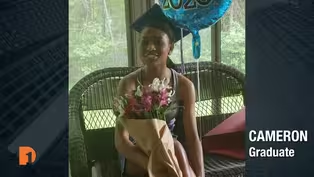
So we asked the community to ask their kids about the challenges they faced and how they hope things will change.
- Throughout digital learning, we found out that homework became harder and that we weren't learning enough as we should have been.
- At school, the directions are a lot more clear than at home because in Zooms, you don't always have it every minute, but when you're inside the class, and you need to know it, you get to just like have the directories right there 'cause my teacher usually writes it up.
- I hope that the school district structures are online learning in a way that I'm actually able to comprehend the information that I'm learning because I feel like in these past few months, I haven't been able to learn the way that I usually would have been in seat.
- Going into next year, I would hope that some schools take time to reteach us the topics that we were taught during online school.
- I wanna go back to school because I miss seeing my friends, and it's hard to only stay here at home with only my family.
- Even Zoom's assignments, online school is showing me to appreciate my teachers and having face-to-face discussions with them, and being able to interact with others and socially learn.
- I hope that we go back to the physical school building and that everything returns the way it was.
And I also hope that I maintain a 3.5 grade point average or higher.
- Even though it's unclear where we'll be in the fall, they still look forward to the future.
- I want to keep learning new things and finding new ways to learn and resume working with the people that love me and support me most.
- I'm excited graduate because I'm ready for this year to kind of be over, they have a fresh start for next year to figure out what I kind of wanna do with my career.
- This is the perfect time to apply for scholarships and also get myself colleges ready.
- My hope for going into high school is that I have a good art class and I'm able to take all the classes that I need and get all the stuff done that I can get to college.
- When I grew up, I wanna be a judge.
- I really wanna become a teacher so that I could help kids and help educate people to become better people.
- A lot of kids missed that in-person connection with their teachers and teachers really felt the same way.
Not only did they have to quickly adapt to online learning, but like some of the students, they struggled with technology.
It's going to be very interesting to see what the teaching ranks will even look like this fall.
There's a lot of uncertainty there.
The Michigan Education Association just came out with a survey of 15,000 teachers and support staff.
7% are leaving because of Coronavirus concerns, either retiring or retiring early and another 23% are considering it.
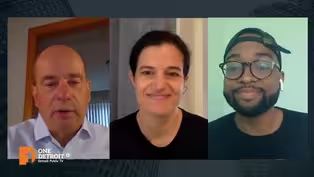
Nolan Finley talked with two middle school teachers about the future of in-classroom teaching and concerns about health.
- Thank you and welcome to One Detroit.
We have with us now Jean Wilson, a science teacher at Ann Arbor STEAM, a K-8 school, and Patrick Harris, an English teacher at Detroit Achievement Academy, also a K-8 school.
Now, two or three months ago, you've been teaching quite a while.
You're used to teaching in a certain format.
Three months ago, four months ago, if someone told you you were gonna be holding classes over a computer, virtual classes.
You probably wouldn't have believed it was possible, would you?
- I would have been shocked.
(laughs) - Patrick, I mean, how's it going?
I mean, tell us About how this is working, trying to do your classroom instruction remotely.
- I think for me, I'm mostly concerned about access.
I know that my students want to learn, I know that they're motivated, and they want to be engaged, but it's not so much as we weren't prepared for distance learning.
I think that we weren't prepared for equity issues.
We weren't prepared for access issues.
Not that these issues are new, because we know that these issues has existed for forever, right?
But we weren't prepared for it to smack us in the face the way that it did when Governor Whitmer said, "Hey, we gotta shut it down."
- And so by access issue, you mean access to computers, access to the internet?
How have you dealt with that?
Have you overcome it?
- I think it's a battle.
I think It's not something that you can do in an emergency.
It's something that takes deliberate time and intention.
And so as a school, we have given out as many laptops as humanly possible, and we have personally went to family's houses and helped them get connected to internet for those who needed help, and then we've connected them to community resources.
So we've helped them to get acclimated to those free internet, free laptop resources.
But at the end of the day, it's a long battle.
It's not something that you can solve in a couple of months or a couple of weeks.
It's something that truly is a systematic issue.
And so even though students had access to devices or access to the internet, there's still a discrepancy with speed, there's still a discrepancy with how loud your house is, right?
And how many siblings are sharing that device that you have, right?
So like when I say access, I mean every student getting the true opportunity to really show their best work.
And I don't think that we have achieved that as a society.
- Jean Wilson, my daughter is also an eighth grade science teacher, and it seems like that's a very hands-on course, particularly for middle schoolers.
How do you transfer that hands-on education to a computer screen when you're not anywhere near the students?
- Well, I'm really fortunate that our school is a project-based learning school.
So what I was able to do was create projects that like had many options, like a menu of projects, so that there were lots of different ways to dive in.
No matter where you live, no matter, like all the issues Patrick just mentioned, there's a lot of issues with access.
In my school being very diverse, there's a lot of discrepancy between what people have access to.
And so those menus of options, I also tried to have lots of menus of options of ways to to actually like do the research part of our work, so that if there were issues with downloading videos or things or streaming anything, there were articles to read, or just shorter bits of information.
I also worked really hard to make sure I was reading everything out loud so that there was an audio component.
But as Patrick is saying, we have no control over the volume in the house, the time they get that device.
There's so many things that like in the classroom, we can provide that we could not ensure access to at home.
- Are all the students participating?
Are you getting 100% of your students online?
- It fluctuates, we've had at most maybe 80% of students who were turning in assignments and logging on to the office hours that we were holding every single day but it was not consistent.
So sometimes that number drops, sometimes students catch up on assignments, and that simply be because we're living in a global pandemic, right?
And so there are some times where you're abling, you're upping, and you're motivated, and then someone in your household gets sick, or someone in your immediate family dies, right?
And so, I let my students know it's not about the work at this point.
And so my job was just to make sure that they knew that I was flexible, I was available, and I was helping them to be, you know, make this work as accessible as possible.
- School is also very, is very much a social experience.
What are they missing?
How are they coping?
What do you worry about?
- We set up our Google Meets every day.
We have a daily Google Meets starting the very first Monday we were home at 11 o'clock.
It sounds like you do a lot of the things the same, right?
At 11 o'clock every single day and it's very social.
I go over their schedule and their checklist of what they need to get done that day.
And then we do what's called a morning meeting.
It's part of a program called developmental designs where we greet, we share something, we do some sort of activity.
We've been doing a lot of fitness challenges, like, the plank.
(laughs) And the kids, they just think it's a lot of fun.
We'll do a Kahoot, but recently, it's been a really good space for talking about, like what happened in Georgia and talking about what's happening around the country and what happened in Minneapolis, kids really wanna talk.
I found that to be incredibly an important and sacred time and I actually have had kids say they don't want it to end, they don't want-- - So how comfortable are you both that your students are where they need to be at the end of the school year?
- I think that's arbitrary and I think it is subjective at the end of the day.
I think no matter what, students, well, teachers would do what they do best, they will meet students where they are come to fall.
- I really couldn't agree more.
I think these arbitrary measures your speaking of, like, that's not the goal right now, and maybe it's time to question some of those goals.
The question is like, how are the children?
Not where they are, it's how are they?
And I have heard kids for like maybe the first time in my career saying they miss school so much.
They can't wait.
And it melts my heart because usually, I'm hearing, "Ugh, how many more days?"
- I hate this school.
(speaking over each other) - Jean, what are you worried about come fall?
- I don't know that I'm, I mean, I guess, I should be worried, but I'm more, I'm not that worried.
Like the kids, I wanna be back with the kids.
I'm hopeful that we're gonna see a shift in equity.
And we're gonna see a shift in that mindset of what a teacher's job is.
We serve, we serve kids, we make sure they're safe, we make sure their needs are met, we make sure that our lessons are for them.
They give them a place in the world.
Our lessons are written and designed with the standards and the needs of kids.
And I think if that's what we're doing, we're gonna be wildly successful.
- I was gonna touch on that and say, I'm a bit worried about the second wave.
I know that the second wave is gonna come.
We're naive to think that it won't.
- We just, we have to be mindful of all of these things and we have to follow the guidelines and we have to wear masks.
I noticed that, I don't know if masks are a bad idea.
But I think we're gonna have to.
The health and wellness of our children and their families has to come first.
- We've heard it over and over again from educators and kids.
The mental health toll that this school change and really life change has taken on so many people.
It's staggering, school psychologists, counselors, social workers are going to be in need more than ever before.
And with every age of a student, there's a new challenge.
Joining me now is Karen Anthony, she is a counselor and she's the early childhood mental health consultant for Oakland Schools.
Hi, Karen, it's good to see you.
- Hi, nice to see you.
- And also with us is Sirrita Darby.
She's an educator and she created Detroit Heals Detroit to address trauma in students.
Sirrita, it's good to have you too.
- Likewise, glad to be here.
- All right, so Karen, why don't you go ahead and just give us a sense of how you're working with students in your role with Oakland schools?
- So I work in our early childhood unit.
So I primarily work with our Great Start Readiness Program, which is our preschoolers.
So with whatever challenges that they may have when it comes to mental health, oftentimes, it's connecting them with resources and making sure that they feel, like feel like their supported so that they can be in school to learn.
- Sirrita, what about you and working with teens and trauma?
- So I've been an educator in Detroit for the past five years.
With Detroit Heals Detroit, we try to combat the negative mental health impacts of COVID-19, so we've been doing that with our Youth Task Force and really letting youth lead that movement, but also realizing that the root causes of trauma needs to be addressed too.
So we consider ourself a social justice organization that aims to do that as well.
- All right, Sirrita, why don't you start, go ahead by describing what are some of the signs of stress that students are showing at this time with schedules disrupted also, maybe some at home, difficulties at home if they're stressed there.
- Absolutely, yeah, so the anxiety, the depression was already present before COVID-19, right?
So now we're just amplifying that anxiety and that depression that already existed, especially in marginalized communities.
I mean, again, the inequalities within the communities are being amplified and the students are really feeling it.
If they didn't feel it before, they're feeling it now, right?
I know a lot of people see our elderly population as the most vulnerable during this time, and that is true, but I also want us to recognize that our youth are some of the most vulnerable too, because when we think about this pandemic 10 years, 20 years from now, our youth are gonna be feeling that burden.
They're gonna cure it a trauma on our backs from this pandemic for generations to come.
And then, they're gonna carry it out to their children.
So we have to think about that as educators and people in this work, how do we combat that for them?
- Karen, let give us a sense of what are the signs that even the littles are showing that they're stressed by this?
- You might see kids that start to almost amplify a lot of, I don't wanna say aggression, but maybe just you see them moving a little bit more, like there's this piece of isolation that we have right now, that's really hard.
Kids need to be out, they need to be playing, they need to be moving.
And oftentimes, they're just not able to have that opportunity now, so you're gonna probably see more outward signs of kids behaving and different ways, but then you can also see the opposite, so sometimes you see kids moving in the other direction where they might withdraw, they might kind of move into themselves.
And so I think for parents, it's really just watching to see how different is my child acting?
Is this kind of their normal way of being?
Or have they really, really changed?
And if they have, then that's a time to reach out for some support.
- Sirrita, what about some of the older kids?
What are some of the signs and maybe even the differences between gender?
Sometimes girls express themselves in a totally different way than boys do?
- Yeah, yeah, definitely.
So with our women population and our young women population, we can see it show up as anger in the classroom, right?
She's reacting to what's going on in her life.
That's a natural reaction.
And then I see that our boys sometimes they get withdrawn.
They're not present within the classroom, even though they're physically present, mentally and emotionally, they're not there, and they're not connected to the learning and they can't be because of what's going on at home, because they have to think about when back home and what home may look like.
- So Karen, how difficult is for a child who's trying to do the schoolwork?
Who's trying to keep up with everything?
How much does this play into what they actually can do?
- Partly what's happening is that, parents are trying to stay on top of their own work and the things that they're doing.
And then they're also trying to support their children and doing what they need to do.
So it's really, there's a lot going on in families' homes.
So in thinking about these little ones, especially the little ones, learning online is not really something that the preschoolers especially do.
It's just not, it's not in them.
But I think it really is hard because we learn through being together and so these little ones aren't really getting that opportunity anymore.
A lot of what I've been telling parents is kind of like, take a step back.
If you feel like it's too much, communicate with your child's teacher and just let them know.
This is too much right now and we can't do this.
And most teachers have been really, really supportive in that.
- You know Karen, you bring this great point.
And Sirrita, let me ask you about how can parents help when parents are feeling trauma themselves, that they are just trying to get through the day themselves, let alone trying to now troubleshoot what's happening with their kids or trying to figure out, is this normal behavior?
Is this not normal behavior?
How do parents help when they're feeling that trauma?
- Yes, this is a traumatic event for everyone involved, even if it's little.
I know some people have the luxury of working from home and don't have to go to work and put yourself at risk.
But for those families that do, that's traumatic to go to work and put yourself at risk and then come home and think about how your child may be feeling that trauma too from being at school or not being at school, or not feeling safe?
So thinking about that for parents where they have the extra stress in thinking about their selves and then thinking about their children, their physical and mental wellbeing is a lot.
- What about mental health services, Karen?
Are we going to be seeing more of that coming from the school or at least more resources from schools across the area, knowing that this is just a key component to learning is making a child feel like their whole to begin with?
- That is one of the priorities that we have right now at Oakland schools is we are putting together plans and we are seeking out more and more resources.
I think K-12 will likely get some dollars that will help support those pieces.
There's never any guarantee with younger kids because it's not part of the K-12 system.
But I would like to say, there's gonna be more support in K-12 but I do know that like right now, our state budget is kind of up in the air.
So I really would hope that would be a priority, but I really don't have that answer.
- You know, and I think Sirrita, that's one of the things that we're gonna see are more nonprofits gonna be stepping in?
Are more organizations, Detroit Heals Detroit, being able to to kind of fill that gap that maybe our schools need might not be able to help so much with?
- Trauma is not dealt within isolation.
So it shouldn't be combated in isolation.
So that's what organizations like Detroit comes in and tries to help.
It's a collective effort of community, combating trauma and making sure our students heal and get through this tough time.
So what I hope is that those budgets for those things that destress the students don't get impacted, like sports, or arts.
- So last words from both of you.
Karen, let me start with you.
The things that we need to take into account now moving forward with our kids?
- I guess my biggest thing is always for people not to be afraid to reach out for help.
And that's the piece that I think sometimes, there is still a stigma about mental health in our communities.
And so if we really think about what can families do, they can reach out for help when they need it, - Just as practitioners in this work, remembering that our students are going to be mentally affected from this pandemic, so really realizing that as we start school in the fall, and doing everything we do to alleviate that stress for them, whether that be having less homework or having less working class and really making sure we're committed to the mental health as well as the academics 'cause they're both important for our students.
- Well, here at Detroit Public Television, we have an education team.
They work with teachers and parents and early childhood educators on curriculum and support from our PBS Kids platform.
Tara Hardy is our Detroit Public Television education leader and she talked about parenting and what we can all do to help our kids during this time.
- With me today is Kathleen Alessandro from Great Start Detroit/Wayne.
I would love to start out with just giving a summary of what it is you do?
What is the Great Start Detroit/Wayne?
And how do you how do you help parents?
- Well, there's a great start in every county in Michigan.
We serve the City of Detroit in Wayne County.
What do we do?
We try to connect the dots for families with children ages zero to eight.
We consider ourselves connectors, providers of accurate information so that parents can do their thing, but with current correct information.
There's a lot of, my technical term for it is, there's a lot of knucklehead information out there.
And it's a time and a place and a space where people just need good solid information, good connections to resources, good understanding of the best things they can do with their children in their home setting and supportive of schools.
- Can you describe what you've noticed during this time with families, with having to do school at home, and having to work and what what are some of the challenges that you saw for families during the last three months?
- Never before in my history, and you can tell I've been around a while.
Never before have I seen parents with so many challenges on a daily basis.
They are uncertain about their jobs, they're uncertain about a child care center being available when their job does come back, they're uncertain about health.
How do they protect their child's health, their own health?
Where do they engage in the community?
Where do they need to back off and remains still socially distanced?
Where do they get resources?
Where's the next meal coming from?
How do I assist and work with my special needs child?
How do I keep my child busy all day?
Am I supposed to engage with three different teachers if I have children in different grades?
And I think it has absolutely immobilized parents and panicked them to the point that we almost need a reset, and maybe summer is the time for a reset.
- This was something that just came.
No one really had time to prepare for this.
And the fall we have some time before fall.
We don't know what's gonna happen, but we do have some time before fall to, can you give us a little idea of what you think.
Do you think school districts will have a better handle on this in the fall as they have time to prepare?
- I think school districts are working nonstop to try to figure out the best answer for this.
And as we know, information changes.
So they're having to keep up with every potential option that there might be to keep children safe and provide an educational opportunity.
I would hope that parents would stay connected with their district or their school.
Information will continually be shared.
They will be advised of changes.
They'll have an opportunity for some feedback, but you have to be in the loop.
And the way you can be in the loop is either connecting with your district's current communication system.
A lot of districts, nearly all, have some type of messaging system to parents.
Make sure you're connected to that and make sure that's the one email you get to every day.
And also try to use this opportunity to support your child in simple daily ways that help them have some continuity between sort of a broken off year and hopefully a new year.
But the first way to do that is to make sure you're connected with your child's school so you can stay aware and apprised of any changes or plans that they have.
- So that connection would happen through enrolling your child in the fall, even though we don't know what it's gonna look like?
- Exactly, whether you're in preschool, if you're looking for preschool, make sure you are enrolled.
They might say that we're not sure if we're opening yet, that's correct, but if you're not in the queue, if you're not on the list, you're not going to be made aware of any changes or plans that they have to reopen.
You wanna make sure you're connected.
Register, enroll, connect with the communication systems.
That's the best thing you can do to make sure at any time you're getting the correct current and accurate information.
- Going into summer, summer might look different, again, for families with children.
What should we be thinking about for summer?
Is social emotional something we need to focus at development?
Is that something we need to focus on this summer?
Should we try to catch kids up so they're not behind?
What should families do?
- The most important thing you can do this summer is support your children, your family, keep it together in a comfortable way.
You're not expected to be teachers.
You're not expected to be psychologists.
You're expected to bet engage as best you can with your children on a daily basis.
So here are a couple of things that I think have sort of evolved out of this crisis that could be helpful this summer.
First and foremost, nearly every museum, zoo, aquarium, both locally and nationally is offering Facebook Live.
They're offering recorded segments.
They're introducing you and taking you to places and spaces you might not have had time to take your children before.
They're all available, use them, tap into them, depending on your child's interest.
You can find, it's miraculous, you can find every amazing piece of culture, history, science is being made available right now to help families get through this.
Take advantage of that.
In addition, the end of the day, particularly if you have young children, if you're just talking, reading, and singing to your child, you're doing it, you're doing it, you're building the social emotional, you're making them feel comfortable.
Go for walks, play in the backyard.
Sing a song together, make it the summer of simple things so that people with all, that the news gives us on a daily basis, have your home be a place in a space of some degree of comfort and we recognize, it's tough being in a house all day with the people you love.
There are moments, we need to get a little distance even without COVID, but we need a little distance.
So work that into it, but recognize it's a challenge, but do the simple things better.
- There's a lot of stress on parents trying to help out our kids at this time.
But there is even more stress on families who have students with special needs, like kids with IEPs, Individualized Education Plans, and those are plans that a school district has to come up with by law to help out special needs students.
I spoke with Dr.
Lanissa Freeman.
She's the head of special education for Southfield Schools.
And how do you sit and say, "This is what we need to do for each one of these students."
And it's federally mandated that they are afforded education and there are certain benchmarks and parameters that a district has to meet.
- Well, it's a collaborative effort.
The good thing about being in special education is that we're never alone, we work as a team and the parents are very much a part of that team.
So just finding out exactly what they needed, making sure that if they needed equipment that we were responsive to that.
So we issued over 900 Chromebooks in our districts so that parents could have access, but also making sure that they had a balanced approach, meaning that we were going to connect with those families via phone call, just having a schedule created for each of our families was very different for each unique family.
So getting some consistency, developing a routine with them was very critical.
- And as you navigate going through forward and taking a look at some of the achievement marks that the students will be reaching or that they have to, that they have to be reaching, how do you deal with that?
How do you deal with IEPs?
Do the schedules get changed?
I'm sure you're navigating all of that.
- Yes, well, we're continuing with our IEP meetings.
So we've held a lot of those IEP meetings virtually and they've gone quite well.
I mean, parents are very grateful for that opportunity to connect with the staff, to talk about the educational planning for their students, but also to develop just basically a distance learning plan.
Let's find out what is working well, find out what other supports you might need, so we still sent home individual packets to students, making sure that parents had access to materials.
We also have our therapists that are connecting with our families to use regular household items, creating a maze with laundry baskets and building forts to make sure that kids have that physical therapy that they needed and getting the entire families involved, so each family is different, each student is different.
And our approach really is about meeting not only the student's needs, but the needs of that family.
So that has been very, very critical.
- How would you characterize in all the work in the years that you've been working with students the time that we're in right now and the importance of education and connection, especially when it comes to our special education students?
- Yes, well, it's so critical that we get it right.
We're literally writing the blueprint for pandemics or any national disaster.
So it is so important that we take this opportunity to understand the unique needs of our families and get it right, we don't have anything to go on.
We haven't had a pandemic in our country for over 100 years and that time, they didn't even have special ed laws on the books.
So now that we have this unique time, it's so important that we develop a blueprint for others to follow if it should ever happen again.
But that individual support is what we're really holding on to in the collaborative spirit of our team.
We have had paraprofessionals, psychologists, social workers, teachers, principals, all hands are on deck.
And they know my model is boots on the ground, find out what parents need, so that we can help them, but also being sensitive to the needs that some of our parents are sick.
Some of our students have been hospitalized.
We've lost staff members.
So it's very important that we remember that compassion over compliance.
We're really taking a look, a hard look at what families need and knowing that they can change every day.
We're hearing about losses, we're also hearing about recoveries, but that also changes our work because some of our families are just trying to make it, just trying to get through.
And as we continue this work, we're finding that every day is different, every week has been different.
But being responsive to their needs is what we're finding is the most important.
And that's why we're consistently communicating with our families to find out what's happening.
We're having virtual parent trainings, we're having virtual parent meetings, just trying to make sure that they see our faces so they hear a familiar voice our students, our teachers are reading stories, our paraprofessionals are following up with phone calls, just so that they know that we're here and we're in this together.
(upbeat music) (calming music) (cheering) - [Woman] Congratulations.
(siren wailing) (cheering) (cheering) - Life is like a pandemic because it's memorable.
Coronavirus is going to go down in history, and so will your life.
Life is like a pandemic because your perspective determines your joy through it.
No prom, typical graduation, or planned last day of school.
You can focus on the negatives, or you can shift your perspective, so there you have it.
The things Trenton Public Schools taught me about life, symbolized by a pandemic.
(uplifting orchestral music) - A fitting end to the school year, I love seeing all those smiling faces and celebrations.
Congratulations to everyone.
Well, now we know the work is really beginning at the district level.
We should know more in early July, mid-July, and also the input from the state.
We will follow all the latest news.
And we know that there are more stories out there on early childhood education and higher ed, make sure you go to our website at OneDetroitPBS.org.
We're working on those stories there.
Plus, you can get connected to our education team and see what they are doing each and every day.
We'll keep you informed.
For all of us at One Detroit and Detroit Public Television, I'm Christy McDonald, thanks so much for joining us.
We'll see you next time and take care.
- [Narrator] You can find more at OneDetroitPBS.org or subscribe to our social media channels and sign up for our One Detroit newsletter.
(upbeat music) - [Narrator] Support for this program provided by W.K.
Kellogg Foundation, a partner with communities where children come first.
The Cynthia and Edsel Ford Fund for Journalism at Detroit Public TV.
- [Narrator] from Delta faucets Behr paint, Masco Corporation is proud to deliver products that enhance the way consumers all over the world experience and enjoy their living spaces.
Masco, serving Michigan communities since 1929.
The DTE foundation is a proud sponsor of Detroit Public TV, among the state's largest foundations committed to Michigan focused giving.
We support organizations that are doing exceptional work in our state.
Visit DTEFoundation.com to learn more.
- [Narrator] Business Leaders for Michigan, dedicated to making Michigan a top 10 state for jobs, personal income, and a healthy economy, Nissan foundation, and viewers like you.
(piano music)

Celebrating Student Milestones
Video has Closed Captions
Clip: S2 Ep45 | 2m 9s | How Metro Detroit communities are celebrating their graduating seniors during the pandemic (2m 9s)
Video has Closed Captions
Clip: S2 Ep45 | 10m 13s | Dr. Robert Shaner, Michael DeVault, Dr. Alesia Flye, & Mark Greathead are interviewed. (10m 13s)
The Need of Psychologists and Counselors in Schools
Video has Closed Captions
Clip: S2 Ep45 | 7m 55s | Karen Anthony, Mental Health Consultant & Sirrita Darby, Detroit Heals Detroit (7m 55s)
New Plans for the Detroit Public Schools Community District
Video has Closed Captions
Clip: S2 Ep45 | 6m 9s | Dr. Nikolai Vitti, Superintendent, Detroit Public Schools Community District (6m 9s)

Parenting During the Time of COVID-19
Video has Closed Captions
Clip: S2 Ep45 | 7m 4s | Tara Hardy interviews Kathleen Alessandro, Executive Director, Great Start – Detroit Wayne (7m 4s)
Special Needs Education in the Time of COVID-19
Video has Closed Captions
Clip: S2 Ep45 | 4m 38s | Dr. Lanissa Freeman, Special Education Director, Southfield Public Schools is interviewed. (4m 38s)
Video has Closed Captions
Clip: S2 Ep45 | 2m 7s | Students share the challenges they've faced and how they hope things will change. (2m 7s)
The Uncertainty of Teachers in the Fall
Video has Closed Captions
Clip: S2 Ep45 | 8m 34s | Two teachers give insight on the future of in-classroom teaching and concerns about health (8m 34s)
Providing Support for PBS.org
Learn Moreabout PBS online sponsorship New Episode
- News and Public Affairs

Top journalists deliver compelling original analysis of the hour's headlines.
 New Episode
- News and Public Affairs

FRONTLINE is investigative journalism that questions, explains and changes our world.
 New Episode
 New Episode
 New Episode
 New Episode
 New Episode
 New Episode
 New Episode
 New Episode

Support for PBS provided by:
One Detroit is a local public television program presented by Detroit PBS