
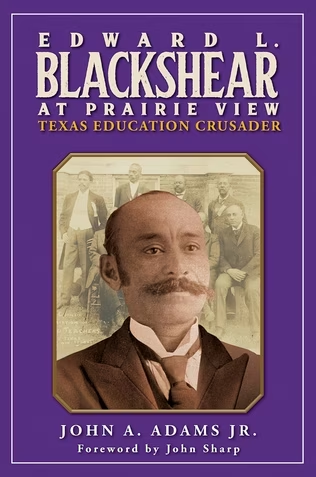
“Edward L. Blackshear at Prairie View: Texas Education Crusader” by John A. Adams Jr.
Season 2026 Episode 11 | 27m 14sVideo has Closed Captions
John A. Adams Jr. joins to discuss his book, "Edward L. Blackshear at Prairie View".
John A. Adams Jr., author of "Edward L. Blackshear at Prairie View: Texas Education Crusader", joins to discuss his biography of a foundational leader in Black education whose name many Texans may recognize from schools and buildings but may not know the story of the man behind the name.
Problems playing video? | Closed Captioning Feedback
Problems playing video? | Closed Captioning Feedback
The Bookmark is a local public television program presented by KAMU
“Edward L. Blackshear at Prairie View: Texas Education Crusader” by John A. Adams Jr.
Season 2026 Episode 11 | 27m 14sVideo has Closed Captions
John A. Adams Jr., author of "Edward L. Blackshear at Prairie View: Texas Education Crusader", joins to discuss his biography of a foundational leader in Black education whose name many Texans may recognize from schools and buildings but may not know the story of the man behind the name.
Problems playing video? | Closed Captioning Feedback
Where to Watch The Bookmark
The Bookmark is available to stream on pbs.org and the PBS app.
Related to This Episode
Providing Support for PBS.org
Learn Moreabout PBS online sponsorshipHello, and welcome to The Bookmark.
I'm Christine Brown, your host.
Today my guest is John Adams, author of Edward L Blackshear at Prairie View, Texas: Education Crusader.
John.
Welcome back.
Good to be here.
Thank you.
Always a pleasure to have you.
Because I know we're going to talk about some interesting history, usually some interesting Texas history.
And today is no exception.
Yep.
This I think this is I found a very interesting topic that turned into an exceptional book that the press did.
So I'm really happy of that.
Well let's start.
I mean, the book is well named, but people may even have heard the name or seen it on a building or a school, but maybe they don't know who who he is.
Who is?
And I think you're exactly right.
Blackshear was an educator in the late 1890s up to the turn of the century.
There are about half a dozen schools around the state of Texas named for Blackshear.
The football stadium at Prairie View is named for Blackshear.
But after the turn of the century, a lot of people he has been lost.
And that's part of the story, is here is a major education leader in the African-American community that is just kind of lost to tie.
And and this is a topic you came.
I feel like a lot of authors say this.
They're working on one book and they keep they keep seeing the name over and over again.
And this one kind of came to you the same way, Renee.
Exactly.
The connection here is with so Ross.
He is a very close friend and confidant of all things called Ross.
He is born in Alabama, goes to school, all places.
Iowa, where the church school named Tabor Tabor College, which is closed now, called up and talked to him up there.
But he comes back to teach school in Austin in the late in the eight, not late 1880s.
And at the time when Ross is a senator, then he becomes governor, while he becomes a teacher, then a principal, and becomes the head of this is Blackshear, now of the Austin School District.
And so one of the interesting stories is Ross periodically would go out in front of the Capitol and sit on a bench, and if anybody in town got a question or a complaint, they could just walk up there while he's smoking his pipe and ask him.
Well, Blackshear would walk from school district, walk up Congress and go there and met Mitt Ross and talk and said, we've got a school problem and we need assistance with this.
And Ross, let's figure out how to do it.
Well, over the years, they began to be really good friends.
So in my work on so Ross that the press did so Ross today and him I kept coming up with this guy Blackshear you know, and and of course Blackshear will be recommended after Ross is president of A&M.
He's still at the school in Austin.
They only the president and purview.
And Ross says, go to Austin and get this guy named Blackshear.
And he will be the principal at that time.
The president of Prairie View is called the principal until 1947.
And get him and put him there.
And they were close friends.
Blacks are visited often in College Station.
Ross.
Every fourth board meeting he held a preview.
And so the connection there comes out of this box full of information that I kept saving on Blackshear, that I figured, well, it might make a good article, but as I begin to check, there was a lot more to the man than just running the school.
So when you start to after you finish that book and decide, I want to, I want to develop a little more time to him.
I mean, this is a figure who, you know, as we say, his name is everywhere.
But how do you find more of his writings, his papers?
There's no official one archive dedicated to the man.
Well, the hunt is better than the kill.
And I'm very good at the hunt.
And I love the archives.
And I love to do research.
Quick example.
He goes to Tabor College and he, with one other friend of his named Keating Hightower from Waco, and I check on Tabor and it's close to the 1950s.
So I picked the phone up my call up the Tabor, which must have 25 people living there in the town.
And I get what they call the Chamber of Commerce.
And this lady answers the phone and she goes, well, I'm also the historian.
And I said, I'm asking about this.
Well, in the basement we have all the records from the school.
We have those and we keep them here.
And I said, you've got to be kidding me.
So I don't think much about it.
So she says, well, send me an email.
So I send an email about this and about two weeks she calls back and said, would you like to have his report cards and his grades and some papers?
He did.
I said, he got to be kidding me.
And so she says, I can't believe you're even asking for this.
But he will graduate the top of his class.
He makes all A's and B's.
He is.
His curriculum is.
I mean, I didn't take physics, and chemistry was a very high powered curriculum.
He was apparently very well and he could write very well and gradually, like I said, at the top of his class.
But here, here we go.
We find these documents.
And so I begin to check.
I found documents in Washington, found him at Tuskegee, found him at Austin, of course, in the Barker Center and the history and the Texas Archives.
And so then tried to put those together.
And that's when I realized there's more, more here.
And then, of course, church documents.
That's another very big thing.
He was very big with the Aim church.
And when he gets to Austin, I finishing school, the local minister grabbed him and said, oh, you're going to get to help me.
Well, what he wanted to do is help him raise money because they were trying to pay for the sanctuary that finished the building.
And so he learns the church and of course, the politics and how to run meetings.
So it's a very from a democratic standpoint and an education standpoint, he gets a real lesson in dealing with people raising money.
And then, of course, here he is walking up to the capital to talk to the governor.
So it's he's a very fascinating individual.
One other very important thing, and I didn't realize that one of the greatest things that had been done is a portal in Texas history up at North Texas.
Oh my gosh, it's fabulous.
Well, I go to the portal of Texas History and I start key wording him, and all of a sudden articles just keep popping out.
And there are literally we put together over 350 articles and letters and they are exquisite.
His writing is excellent.
He addresses a lot of sensitive issues of the of the time, whether it's Jim Crow, whether it's education or whether it's funding a black schools.
He's very engaged and he is very straightforward documents what he does.
But the trove of information that sitting out there was just unbelievable.
What a gold mine.
What a yeah, what a wonderful thing to especially I feel like now you hear so many stories of, oh, the records are lost and there was a fire or there was a flood.
Meanwhile, you're finding his full report cards.
I mean, you had you had good luck with this one.
Right.
And of course, you know, we put together the next volume is going to come is his letters and they are over 350 and they are just they're fabulous.
And their letters, the letters and editorials, not just on some general thing there.
There's letters he's exchanging with the president of the states he will bring.
He has got a brother going to Howard School, Howard University in Washington, D.C., and I can't figure out whether he was going to be a doctor or whatever, but he's up there.
Well, he either goes to see him or gets on the phone or sends him a letter and they hear McKinley.
He's going to be making a trip to the country.
So he has his brother go over to the white House, to the to the West Wing and meet with the scheduler and say, you know, if you come through there, would you stop and pray view?
I mean, how in the world would think of something like this?
Well, you're not going to believe it.
We found the letters that they found the telegrams.
I've got the letters to where they cut the deal, to the point that his he had his wife put together all the ladies in the community there to write a letter to Mrs.
McKinley saying that we hope you, if you're a company, the president, you come see us.
And that letter is in the National Archives.
Amazing.
And but the National Archives is kind of funny.
They they're in archives, you know, they are going to tell you what they have or don't have.
They had no idea what the connection was.
It was in the McKinley papers.
And so sure enough, he comes.
He didn't stop at Texas A&M.
He stopped for five minutes in Houston, and they built a special platform.
And he pulled up.
The president did at Prairie View College and stopped and gave a speech from the back of the train.
And we found a picture of it for the book of him standing on the platform talking to the students.
And then he left from there and went to Dallas.
And the rest is history.
But it is fascinating that.
And it's it's worked in combination of work, luck and whatever.
It's fascinating.
The record is out there.
How much Texas history still needs to be told.
The countless individuals who made and will hopefully get in to talk about more of the specific things he did, but the impact he had on making Prairie View.
Potentially into prayer, I mean, at the time was we talked about it wasn't a college, yet he was advocating to have a full university for a full four year university for for African American students in Texas, at a time when getting education at all was still difficult for them.
School was struggling and it was struggling big time.
And I mentioned his connection with the church and all that.
That became very important because he went out to went to the preacher's AME convention, said, we need your support.
You need to get your local high school going so we can have students that can come to our school.
That's the first part of funding.
Thank goodness he had Ross there.
And the there was a land grant of act of 1890, and that was a no more money.
And Ross specifically earmarked money there.
But one of the most interesting connections he makes at your survey, in all the the models, is he meets Booker T, Washington and Tuskegee and he is Booker T has already started, but he realizes that model of developing the school, getting getting all the academic courses in there, but also having programs to teach, first of all, teachers.
That was one of the biggest changes.
We want to develop teachers for the high schools and then also the industrial arts and do that.
And so he went to Tuskegee a couple of times and visited.
More importantly, he twice had Booker T Washington come to Texas and come to the school and speak.
But before he did that, he would have him speak to fundraisers in Houston.
And he learned the secret behind Dubois, W.E.B.
Du Bois and Washington is how they knew how to raise money to support their operations.
Nothing wrong with that.
It worked very well.
People wanted to support education.
People would come in and Texas was slow in coming up on this.
And Berkshire.
Blackshear was somewhat successful, but not as successful as they were.
But he learned what you needed to do and how to develop the programs.
Well, all of a sudden the Roman takes off.
And that's part of the story, is no one even knew this African-American school was west of Mississippi, that it is the biggest school, but it becomes the largest school in the United States.
But by 1910 and enrollment programs, activities, the physical plant, it really, really grows quite well.
And it's and it's supported by N.M.. Now remember it is a part of the the before there's an A&M system.
It's one of the first components of the school.
And so it was in the Constitution to to have the school and of course to to maintain it.
But blacks are very quickly understood how to connect the dots with the social and the political and to bring people together to be to do that.
You get the sense throughout.
I mean, as you read the book from he had thought maybe it was an eight, maybe it was learned, I don't know.
But this ability to kind of understand the moment, understand the person he was talking to and how to to maybe tailor his speech, tailor his request.
Taylor.
Well, he he wasn't a politician, but he almost was.
He's right on the edge of he, he, he was just very adept.
And he, he, he learned this from Booker T Washington on how to push that envelope of the politics as much as you could.
You know, politics is in Texas education forever.
So you can't get out of it.
But you've got to be careful on how you how you manage that.
So that's very true.
He he did want to go.
The boys wanted to go radical.
Let's just demand everything and do all this.
Well we weren't ready to do that.
None of the schools were ready to do that.
We want to get there.
But he realized to cooperate and work on this, that you're going to.
And he's got opposition, let me tell you, both black and white.
I mean, he has got major upcoming and go ahead.
But he he makes sure he's keeps the the ministers association, the teachers association.
He visits the legislature.
Ross actually allows him to go over and testify for their own budget.
And he's a and he goes over with a man named Cabot.
We have a street in Brian he called Cabot.
William R Cabot was with the longest serving board members.
And he tells the story.
Ross says, Cavett, you go over it.
I won't.
Blackshear to go with you to talk about their budget.
Kathy comes back is my gosh, brought your stole.
The day he was articulate, he entered the questions.
He had the vision of education.
He could relate to everybody in the room and stole the day.
And both A&M and purview got their full funding that year.
At the time, he testified.
So you are right.
He had he had that innate ability to be able to to navigate in this very not totally tumultuous time.
But things are changing.
I mean, this is you've got the little Jim Crow overhang.
I mean, you have these things that are happening.
But he also knew we had to push this forward.
And one of the big measures were putting more teachers in schools.
More teachers have become principals, producing more students to come back, graduates that would come back to to attend A&M, Prairie View A&M.
He and he advocated for, as you say, the teachers, but also understanding that maybe not everybody wants to be a teacher.
The the extension agency, the farmers, he he he had kind of a broad approach to education in a way that I was was very forward thinking.
I think.
Yeah, you mentioned very important item extension.
This is the Agriculture Extension Service.
People like Du Bois is off.
You don't need to deal with that.
We want to be high level.
Oh, wait a minute.
90% of the Texas economy is agriculture.
And he realized as a development land, more African Americans are owning farms and land.
And it's expanding the numbers.
I checked the numbers.
They're all up.
Well, they also need to know the best methods and whatever.
So Ross, when the Smith Leader Act comes out, ends up putting the first extension service station at Prairie View and said, you better recruit some people.
Let's figure out how to do this because we've got to build it.
Well, he could have said no.
Our other schools, we we don't deal with it.
He said, no, we'll embrace this.
Well, not only did he make a big difference there, he received more money.
They hired more faculty.
And the concentration of African-Americans at that time were in about 80 counties in East Texas.
So he was able to really zoom in on where his customer was.
He got them bought in to to contribute and to support local schools.
And then he piggyback this was having an annual farmers conference on campus.
And of course, most of these farmers had never been to a college campus.
And he'd bring them in for 3 or 4 days, and they'd wine him and dine him and have barbecue and speakers and everything, and they invite the families to come with them to see what the product was.
And of course, they extension presentations really took off at that time.
It was really a key component to his strategy of making more awareness of the importance of education.
And that's, I think, one of the keys that, you know, it's more than it's it has more of an impact down the road.
We've mentioned the names Du Bois and, and, and Booker T Washington, and these are the you know, when you think of forward thinking black leaders of the time, those are the names people probably could pull from.
But I think maybe the if I can be so bold as to guess the goal of this book and the and the and the companion volume to come is to elevate Blackshear because he was contemporaries of them.
I mean, he was in the conversation with them, but unfortunately, we've forgotten our own history.
We don't realize we had our own version of them here in Texas.
And he was lost.
This book and the letters are going to go between Blackshear, I mean, between Washington and Du Bois, on the on the library bookshelf.
And there are probably others there might have been a leader in Arkansas, are one in Alabama, but the one that really stands out and and he becomes not just known in Texas, but in the southeast, he's well known.
If you if you're dealing with a Tuskegee and he's visiting all these schools, he's known, but quite definitely this fills in a major gap on major contribution on education thinking and how to push it forward and how to develop it higher education in Texas.
But it everyone across the South.
And, you know, surely there had to be others.
And but there's been a really and they're fabulous individuals.
Du Bois in Washington, absolutely no question.
But there had to be other people to, to step forward.
And and I believe this there's no question, especially when you see look at his writings.
They're just eloquent.
I mean, it's it just really surprises you when you look at it.
And his argument on how to develop something and get support, I also think he he speaks to there's always that question about is Texas the South?
Is it the West?
And the answer is both.
But here's a person who is again aware of where he is, the culture that he's in, and he's able to again, thread that he understands where both we need to speak to being both right.
The age old question, are you part of the South or a part of the West?
We have clearly the influence that overhang of the South, but the West is the frontier and moving forward.
So it's a combination of that southwest to to bring that together and that that's lost to people on the other side of the Mississippi River and of course, Texas.
What did Texas what did it belong to?
It was totally independent.
So you could see how black shirt could kind of get left out or missed because Texas is south in terms of cotton and agriculture.
But from, you know, west to here, it's the frontier changes it and brings in a whole new entrepreneurship.
He's a he's an entrepreneur and things that weren't taking place.
That's another thing.
He was able to take leadership positions or I believe other African Americans and other states were not able to do that at the time because he stepped forward.
He, you know, he he made himself politically known.
And so it is politics with Governor Hogg that comes on.
And so Ross and all these people and very important part of all these people knew each other.
Texas was not that big.
And he was good at work in a room and inviting people.
He would invite the entire legislature for graduation to campus.
Maybe half of them would come and they'd fix all the barbecue and stuff that they could, but they got to come see the campus.
A&M was doing that.
Ross was doing that to make sure people understood what this education knows.
There was pushback.
People want to say, hey, we're going to keep those boys on the farm, keep them working.
You know, what good is there to have an educator?
We don't we don't need book learning.
We need people out there, you know, plowing.
We book learning can hopefully help you how to plow better and mark it better and be a better leader in your community.
Which leads up to interesting also offshoot.
This is where the county agents become to come out of this and is doing the county agents and for the white County agents, will Blackshear very quickly begins to recruit key farmers who who are graduates of Prairie View, who they retrain and become county agents, and many of the East Texas communities.
Well, the county agent is a big person.
I mean, you got the sheriff and the judge, but the county agent, even today is still very part of the community.
And so he plugs that in, which is a major promotion, not just for the agent back to Prairie View and to Blackshear.
I want to make sure we you've talked about his writing a lot.
And of course, when we when we get the companion volume, we'll probably talk about it again.
But, you know, he's not just right.
He's the writing is is as you say very he also he wrote he wrote all kinds of things is what I want to say.
He wrote there's poems, there's songs.
I mean, he, he was writing he, he, he, he was trained in the classics too.
I mean, his writing is not only effective, it can also be quite beautiful.
It is the poems I even mentioned that like, kind of like he said, every 2 or 3 months I'm going to write a poem.
And these are and these are period poems and poems, you know, at the turn of the previous century was a big thing.
Newspapers printed on everybody loved them.
They read them in church, it read them to schools and everything.
So he fell into that, and he could turn a phrase and so he could write very impactful finds.
The most impactful poem, I think, is he wrote the poem for Saul Ross's eulogy, if people want to know.
Oh, wait a minute.
How could that happen?
Well, the poem that's printed all the newspapers is by Blackshear.
But then all of a sudden you find articles about the situation in Japan with agriculture and what's going on in Japan.
You're going, how in the world could he be right about Japan?
And it's not just some little knock over piece.
It's got details.
He's studied the topic.
He's interested in how that that classic or that old Asian system works and what he's looking for.
Other parts that I can use, I think, I really think he's fishing to find stuff.
So the variety is just really incredibly, very interesting.
Absolutely.
I look forward to the next volume.
And we, of course get pieces of his writing here in this book, but it's just a taste.
It makes you want more.
So I'm very excited for that.
Well, unfortunately we're running low on time.
I want to talk about his legacy.
We've talked about how a lot of it's lost, but but what do you think the legacy of the impact of.
Well, I think he really opened a lot of people's eyes to the portraits of all higher education.
But clearly black in education for African Americans would need to be done.
You know, the education would struggle.
Up until World War two.
Prairie view will become Purview University in 1947.
But he left a mantra and a charge to those who followed him W.R.
banks, who becomes president after and purview and others about what can be done.
And let's look at how do we develop this and make make this school really what it is.
The campus today is just a knock out.
If you haven't been there lately, it's it's just unbelievable.
The growth of the school.
It's it is has a major impact.
Well that's not by accident.
It had to be developed and that, that that support and that that vision of what needs to be done.
There was a scenario that this might have just died on the blind.
They could have said, oh, well, let's let the public schools do it.
No, this is I mean, the private schools do it.
No public higher education in the Constitution to be done.
And he took it on as a charge.
And I think that is one of his biggest legacies is to make people aware that the importance of education and what it can do for community families around the state of Texas.
Well, I can't say it better than that.
This is a fascinating portrait of a name I hope we'll all better know going forward.
And I. I'm just grateful that you were you wrote the book that you came here to talk to me today about it.
This is a name we we should be, as you said, mentioning next to other Texas leaders of the time period that have been lost.
And there's others out there that that really need to be research that stood with him to make a Abraham Grant as a man.
There was a bishop.
I mean, no one knows about him.
There's just okay, kidding.
Hightower, his buddy from Waco who goes on to be president of two universities and major publisher, and everything all out of Texas.
But they've been lost to time.
Well, it looks to come.
More stories to be told.
We we have a rich history that we just.
We need to do more digging.
Continue the hunt as you as you say.
Well, thank you so much for being here.
The book, again is Edward Blackshear at Prairie View.
I appreciate you joining us and we will see you again soon.
 New Episode
- News and Public Affairs

Top journalists deliver compelling original analysis of the hour's headlines.







 New Episode


Support for PBS provided by:
The Bookmark is a local public television program presented by KAMU