
Entertainment
Season 2 Episode 4 | 57m 15sVideo has Closed Captions
Modern energy enabled mass entertainment like popular music, movies, TV shows, and video g
Entertainment both shapes and reflects our attitudes about energy. Modern energy enabled mass entertainment like popular music, movies, TV shows and video games, which impacted our society. Energy changed sports with climate control and modern lighting, and amusement parks help familiarize customers with energy breakthroughs.
Problems playing video? | Closed Captioning Feedback
Problems playing video? | Closed Captioning Feedback
Entertainment
Season 2 Episode 4 | 57m 15sVideo has Closed Captions
Entertainment both shapes and reflects our attitudes about energy. Modern energy enabled mass entertainment like popular music, movies, TV shows and video games, which impacted our society. Energy changed sports with climate control and modern lighting, and amusement parks help familiarize customers with energy breakthroughs.
Problems playing video? | Closed Captioning Feedback
How to Watch Power Trip: The Story of Energy
Power Trip: The Story of Energy is available to stream on pbs.org and the free PBS App, available on iPhone, Apple TV, Android TV, Android smartphones, Amazon Fire TV, Amazon Fire Tablet, Roku, Samsung Smart TV, and Vizio.
Buy Now
Providing Support for PBS.org
Learn Moreabout PBS online sponsorship- The imagination of people anywhere, creating the next thing is what brings progress about.
I see technology as a beautiful equalizer.
- Without energy, there would be no music as we came to know it in the 20th century, and, now, well into the 21st century.
- Energy goes into every part of the process from making the records when a band is in the studio to actually pressing them here on the factory floor all the way to the shrink wrap tunnel that we use.
[upbeat music] - Movies are a photochemical process, whether it's natural lighting or artificial lighting within the studio, power is used, energy is consumed.
[Narrator] Energy bought us spare time.
Time that could be spent on amusing ourselves with entertainment, listening to music or watching movies or TV shows instead of toiling on a farm or in a mine.
The world is entertained today on a scale that previous generations couldn't imagine.
Entertainment is a tr illion-dollar global industry.
Energy makes our entertainment possible.
Our movies, sports, music and podcasts are built on energy for their production.
And behind our electrical outlets, wires, power lines, power plants and electrical grids are constantly turned on while entertainment is consumed.
Modern forms of energy increase the demand for entertainment and bring us our entertainment faster than ever.
That's why "The Story of En ergy" includes entertainment.
[upbeat theme music] [Narrator] To understand ourselves and each other, we must understand the force behind the global events that shaped the world.
[helicopter blades whirring] [ship horn blasts] [thunder rumbles] This is "Power Trip: The Story of Energy."
[audience applauds and cheers] [upbeat music] [Sportscaster] Firing it up, touchdown Cowboys.
[audience cheering] - My name is Scott Woodrow.
I'm the director of engineering here at AT&T Stadium.
This is more than just a stadium.
This is more like an industrial compound.
We are a closed stadium.
We do have a roof that can open up but it's basically a closed stadium.
[dramatic music] - When you're conditioning three million square feet of space, energy's gonna get consumed.
- Think about 70,000 humans in a stadium, each human gives off about a hundred watts of heat, but if you're cheering and clapping and stomping your feet and yelling, it might be a little bit more, maybe 125 to 150 watts.
That's like a really hot light bulb.
[audience cheering] - In the summertimes here in Texas, we can get above a hundred degrees Fahrenheit very easily, high humidity.
Game day, we won't let it get above 75 degrees in here.
The stadium is actually designed for a peak load of maybe 26 megawatts, which is really high.
The energy use in the building, number one is HVAC, number two is lighting.
I would probably throw number three as LED boards, which are TVs, mainly 'cause the big one.
Just imagine putting several thousand TVs together, but then we also have over 3,500 other TVs around the building.
[audience cheering] Seventeen megawatt is a summertime Texas preseason game normally.
- If you have 70,000 people each giving off a hundred watts of heat, you get to seven megawatts of heat pretty quickly, which means you need seven megawatts of cooling, which is a big part of that 17 megawatts of demand in a stadium.
An individual home might use one to five kilowatts, so we're talking about 10,000 homes-worth of energy just for this one stadium during one game.
- Sports in a city, no matter what the sport is, football in America, soccer over in Europe, any of the big events, it brings people together.
They have a common goal.
It's an important thing, even though we use a lot of energy for that one day, we make sure it's for a good cause, for a good reason.
Giving people something to cheer about, it keeps a little joy in the world.
[chuckling] [audience cheering] - The big sporting events in America we think about are like, the Super Bowl or the World Series, but even bigger than that is the Olympics international competition that we can all watch around the world at the same time and even bigger than that is the World Cup or maybe, like, a billion people watch these soccer matches around the world.
[upbeat music] What happens in the United States with the Super Bowl is tens of millions of people are watching the same football game at the exact same moment.
And when it goes to commercial break, people often run to the bathroom, and we flush the toilets at the same moment and that's called the "Superbowl flush."
In England, there's a show called "EastEnders" that was very popular, and it turns out that whenever that show would end, there'd be a spike in electricity demand as a bunch of people would turn on electric tea kettles and make their tea.
So for about two minutes there's a spike in demand of a couple gigawatts of power, which means there have to be a couple nuclear power plants on standby just to satisfy the demand for the electric tea kettles right as that show ends every day at the same time.
[clock ticking] [upbeat music] [Narrator] Some would argue that all this energy for entertainment amounts to wasting resources on trivial delights.
What value does entertainment have for our society?
Storytelling and entertainment has always been with us, bringing us together and unifying our culture.
At the same time, entertainment can help us understand ourselves and each other.
- Entertainment is a part of the human experience and part of the human desire for being together and to be transported.
Plays, live music, dances, expositions, sporting events that people would watch or participate in, all of these forms of entertainment have been changed by modern energy.
Before the days of modern energy, it would take place in person, live, it could be something as simple as a drum circle or a collective event or in the ancient Greek times, watching a play in an amphitheater.
This is done without modern amplification of sound, without modern lighting, without modern electrical tools for special effects.
Modern energy changed entertainment in a variety of ways.
One is, it gave the ability to move indoors and have lighting.
So even if it was dark outside, 'cause it's nighttime or there's a storm, with indoor lighting, you could still have your entertainment.
Some of the performance venues in Europe in the 1700s, 1800s, they would use candles or torch light and eventually, gas flames in the Paris Opera House to light up the stage.
Today, theatre and movies bring together people who are rich and poor, but there used to be different opera houses for the rich versus the common person.
So this shows up in the movie "Amadeus," sort of the aristocratic opera house and then the more common or middle class opera house.
For older entertainment, you would have props and you'd have costumes, but all handmade, there were no factories to do mass production of either the makeup or the paints or the props or the materials.
So it took a lot of effort to put on the production but then also just to get all the equipment you needed for it.
If you go back in time, entertainment venues, things like, circuses and fairs and expositions were a way a lot of people had their first exposure to modern energy or modern energy appliances.
In 1893 was a Columbian Exposition, "The White City" in Chicago, where Westinghouse and other organizers installed hundreds of thousands of electric lights.
For many people, that was the first time they'd ever seen electric lights.
We have so many entertainment options today.
It's hard to imagine what a world's fair is.
People didn't get to travel to Japan or Europe very easily, so these exhibits for some is the only exposure people would have to different traditions and histories.
The "Columbia Exposition" in 1893 in Chicago had 25 million visitors.
One in four Americans visited it over a year.
These circuses and fairs and expositions were a way to introduce people to these new energy devices.
And that set us up eventually for amusement parks like Coney Island where they had electric displays that people could go through ride and look at light bulbs.
[upbeat music] [gentle music] How people listen to music today has changed because of modern energy.
If you go back to, like, Victorian England and read the literature, they'll talk about the family withdrawing to the parlor and people taking turns playing the piano to entertain each other.
So music was always live.
- A lot of homes, even sort of modest homes had pianos and that's how popular music circulated through sheet music sales.
You had a piano at home, you could tap into the sort of currents that were happening around you.
[Radio Announcer] You have been listening to a concert by the Ambassador Orchestra in the studios of WEAF New York.
- This program was broadcast simultaneously over the facilities of WEAN in Providence and WNAC in Boston.
- Then with the rise of radio in records, in record players, you could have a recording where you listen to the same exact version of music over and over again and many people would've access to the same thing.
[upbeat music] - If you're a young boy in a family that isn't earning an awful lot of money, you consume music through the radio and, of course, through the TV as well.
♪ Two, one ♪ [upbeat music] ♪ Five, four, three, two, one ♪ TV was vital.
By 1964, I think I'm right in saying, a program called "Ready, Steady, Go" came on.
It was originally based only in the London area, but it was then rebroadcast at different times of the evening in different areas.
Wow, that was unbelievable because that wasn't just the Beatles, but it was the Stones and The Who, and Dusty Springfield, and Lulu and the American bands.
Radio stations were able to transmit to a little transistor radio that you walk through the park and listen to the Small Faces or The Who, or if you were lucky, you know, the Mamas and Papas.
It's revolutionary.
The plastic revolution was so important.
And I'm always surprised how much PVC is missed out of things, because it actually, transistor radios are made outta PVC.
All sorts of things are made outta PVC.
- Today, records are made from polyvinyl chloride, PVC.
That's where it gets its name "vinyl" is from the material that's used.
- Polyvinyl chloride, it's a very interesting plastic.
Through various chemical processes, it's able to become elastic and that meant that you could get a master of a record that would make an impression into it and then repeat that impression all the way through the process.
So you'd have identical records.
♪ Tutti frutti ♪ ♪ Oh rootie ♪ ♪ Tutti frutti ♪ I mean, if you'd have heard, I dunno, "Tutti Frutti," on the radio on a Tuesday night, the next thing to do would, you'd have to go out on the Thursday or maybe the Friday and buy one of these British Inkie.
They were the weekly press and we called them "Inkies" because the ink could rub off on your fingers, but we're talking about papers, like, the New Musical Express, the Melody Maker, et cetera.
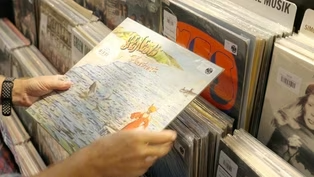
[upbeat music] - Back in the day, you'd have to go to a record shop and flick through the vinyls and see what artwork stands out to you.
- You might go in and I'd go, "Oh, have you got a record by Joni Mitchell?"
They'd go, "No."
But if so, you go out again and then you'd wait for their daughter to be serving on the show.
Diane, and she was gorgeous as well, and then you'd go in and I'd be very embarrassed, but I'd say to Diane, "Do you happen to have a Joni Mitchell album?"
And she'd say, "Yes."
And I'd play it on my father's gramophone player, which was an old radiogram he'd got secondhand from somewhere.
Eventually, I persuaded him to buy me a portable dance set record player, a small one, and I'd take it upstairs, and I'd carefully place it on and wipe it clean, just in case there might be any factory dust on it.
And move over and drop onto the record and away we went.
It was very sensory experiences, it's so exciting, and you got the feeling that somebody somewhere knew what you liked.
So it was like a communication device as well.
You were communicating to the record and to the people that presented this record and say I want more of this.
♪ Love, love me do ♪ ♪ You know I love you ♪ - The Beatles were highly influential in how albums were made back in the '60s.
They wanted to write every single song on that album and it to be one big piece of art that people would buy and listen to from start to finish.
They didn't want someone just to buy an album for one song.
[Narrator] Magnetic tape, using chemicals derived from fossil fuels became the standard for recording music around the world.
These tape machines revolutionized the way artists could write songs with multi-track tape recording.
The Beatles used tape machines in a way that changed music forever.
- There would be a mono tape, maybe with just a single tape on it.
I think The Beatles recorded their backing track to "Love Me Do" on the mono tape, then they played along to that tape on the first track, then they sang along to it when it was dubbed onto the second track.
So there were two tracks there and then it was dropped onto the final tape machine.
By the time we're looking at Sgt.
Pepper, let's say, it's a multi-track, which means you can allocate certain tapes and certain track.
So the studio becomes a creative environment, whereas, previously, it was a recording environment.
- George Martin was a genius and he revolutionized the way that recording studios were used.
He saw them as an instrument in their own right.
[upbeat music] [Mike] The sounds that producer George Martin gets out of the Beatles are phenomenon.
[upbeat music] - The recording studio could be used to add more to music, chop in and cutting and layering music to create much more depth within the songs.
Sgt.
Pepper album tells a story throughout.
It's considered one of the earliest concept albums.
- ♪ Sergeant Pepper's lonely hearts club band ♪ ♪ We hope you will enjoy the show ♪ [Mason] The Sgt.
Pepper album was one of the first to have a gatefold album sleeve.
So that's the type of album sleeve which can be opened up like a book and it pretty much doubles the canvas size for artists to work with.
You can feature more visuals, so now, instead of just listening to the music, fans could listen, cut out paper cutouts and learn the lyrics and sing along as well.
And I think it led to a new attitude where music can be more than the music, it can be an experience.
- Now on streaming services, it's not as easy to have that experience.
You don't have the record where it plays exactly how they wanted you to listen to it.
- The upsides are that more people can discover new types of music.
You can discover it on your phone with the press of a button, and I think artists are probably getting more devout fans that way.
[Narrator] Which is a better choice for our long-term energy consumption, streaming or physical media?
The electricity needed to support streaming services has risen higher than ever because far more people listen to music repeatedly or binge watch shows.
Streaming is everywhere and almost everyone is streaming.
Unlike vinyl and radio, which were once enjoyed by a smaller number on discreet occasions.
In this way, streaming's long-term effect on climate change is too big to ignore.
[slow upbeat music] - For most people in the younger generation, music has always been free and it means something special when you support the band by buying vinyl at their merch table, that says something about where you're putting your dollars and your time in a very special way.
And I'm excited to see physical products like vinyl, books, board games, even, bring more people together.
I started Gold Rush Vinyl because while I was working in Silicon Valley, my sister and I were also managing some Indie bands on the side and we started to see the realities of digital music.
I tell people all the time, a statistic that blows my mind, "Most independent artists here in America that make music will make the same money selling 100 vinyl records that they will off two million YouTube views."
Here at our pressing plant, we physically press the records.
This is our factory floor space where we manufacture all the vinyl.
This is how our vinyl actually arrives to us.
Each bag's about a hundred records.
These pellets are made of polyvinyl chloride, that's why it's called vinyl.
We go through so much black vinyl that it actually comes in these huge ton barrels to us.
Each one of these is about 5,000 records, so about half of what we press here is black vinyl and half is color.
Interestingly, the process hasn't changed all that much from the early 1900s when these cylindrical records were made.
We're gonna cut two lacquers, a side A and a side B, and then we're gonna spray it with silver.
The nickel gravitates to the silver in the machine and starts to form a shell.
When we rip that off, we have what's called a stamper.
We put these plates into our machine, almost like a waffle maker and press copies of the record over and over and over, and then we melt down the raw vinyl beads in our extruder barrel, which squeezes it out, kinda like this squeezy cheese combination.
[machine whirring] So this here's our hopper, that's where the vinyl beads get poured, and this is the extruder barrel that's starting to melt it into that squeezy cheese kinda format I talked about.
That thing gets captured in a mold to make what we call a puck or a biscuit, depending on what country you're in, and one of these would be pressed in our machine to become a record.
At most old vinyl record pressing plants, you'd have a humongous fire tube boiler.
It's constantly heating, it's got fire running to keep steam and water really hot.
Instead, we've found units that when they have enough steam, they shut down, and it means that we're using a lot less energy.
After a few seconds, it starts to cool down and moves to the trimming station, where a hot trim knife will cut that off, and then voila, you've got a record in about 30 seconds.
[machine whirring] Most of the records we send out are shrink-wrapped.
We press mostly for independent artists.
Those are artists that are not signed to major record labels, but more and more artists are coming off their labels and so we press from everyone from Dolly Parton, on down to the band that might be playing at the local coffee shop.
- Without modern energy, there would be no popular music as we came to know it.
[audience cheering] [slow upbeat music] [Narrator] Just like music, sports can entertain us.
For over a century, games have been played under lights at night inside climate-controlled stadiums, and broadcast into our homes.
There is energy embedded in the uniforms, the equipment, the grass, the seats, and the scoreboard.
Artificial turf or fake grass, found in most stadiums, is a petroleum product.
In the 1960s, AstroTurf, made with fossil fuels, famously launched inside Houston's Astrodome stadium in 1966.
AstroTurf was promoted for being a water and fertilizer-free alternative to real grass and soon was adopted by many other stadiums.
In the 21st century, competitors appeared on the market and AstroTurf wasn't the only alternative to grass.
Ice hockey can be played in the summertime in Florida.
With the introduction of energy, sports was changed forever.
[Commentator] Dunk!
[audience cheering] - Really, human experience, to my observation, seems like there's a lot of rivalry and conflict.
A lot of it is violent and horrible.
[dramatic music] And sports is a way to have that conflict in a peaceful way.
No one dies, but it's like a microcosm of war.
It replaces that, and that's especially the spirit of say, the Olympic Games.
[upbeat music] We had chariot races thousands of years ago with the decathlon, but they had to be competed during the day, because there weren't indoor venues with indoor lighting that could be used for them.
Sporting events became more popular and accessible as modern energy came along.
You could have boxing matches that were indoors with lights and these were big events, and people went to watch the event, but also to be seen.
[audience cheering and applauding] - Sports in America became part of the fabric of our national culture during the 19th century with the advent of leisure time.
Baseball came known as the national pastime, Walt Whitman wrote beautifully about it.
It's no surprise that it's the sport of poets and writers.
It was our return to the country for several hours.
In the course of a day, you could sort of go back to the farm almost.
Professional baseball was a very urban experience and our great grandparents' day, spectators at a major league stadium were about 90% male.
They would come from their offices because games traditionally started at 3:00 PM, they were dressed up.
No matter what job you had, you were wearing a jacket and a tie.
It's a "Where's Waldo?"
thing, finding a person not wearing a hat.
So it was a more formal social gathering.
This was in an age, of course, where you could not access the game by either radio or television.
You had to be there, and people, I think, felt a certain obligation to be at their best.
[upbeat music] Energy developments have had everything to do with changes in sports.
The ballparks were located adjacent to railroad stations and eventually, subway stops.
[upbeat playful music] [Narrator] The first major league baseball game at night took place on May 24th, 1935 in Cincinatti.
The Cincinnati Reds versus the Philadelphia Phillies.
[crowd noise] [Commentator] Reggie Jackson.
Long drive, right field!
[Narrator] Games played at night meant cooler weather.
Today, every major league baseball stadium has electric lights, and many have air conditioning and retractable roofs.
But on hot summer days, most fans dress for the heat, shorts and T-shirts.
That wasn't always the case.
[upbeat playful music] - It was a different experience than it is now.
Now, unfortunately, the experience of going to a major league sporting event, you barely have time or quiet to talk with a friend to contemplate things and not be assaulted with advertising noise, music, what have you.
Not only did the spectators have to endure wearing wool clothing, but the ballplayers themselves.
My Lord, they're like a tweed jacket that a Scottish shepherd would wear.
I mean, they're brutal.
So if you were playing a double header on a July afternoon in say, St. Louis, where the temperature on the field was over 100, it was quite an experience.
Players complained about it.
Casey Stengel put lettuce leaves in his hat to cool his head.
Players would cut holes in their hat.
Starting in the '60s, teams finally go to cotton blend uniforms for hot weather, and then you get into the later 60s where nylon and polyester and artificial fabric was introduced.
Than we started getting real interesting things like tear-away jerseys in football.
Players would come off the field looking as though they'd been in a riot or something.
That was a brief period where things went a little off the rails, but certainly, the equipment related to protection has been a major challenge and a major development.
When Tony Conigliaro got beamed in 1967, that did a lot to open the hearts and minds of the public to the universal acceptance of batting helmets.
These artificial materials are easy to produce and they're cheap to produce.
Slowly but surely, the teams found a marketplace with selling reproduction jerseys.
It has become a marketing bonanza.
Everyone's a walking, talking advertisement.
- Sports was always local or regional because people couldn't travel so easily before modern energy, but as you have modern energy, first, the teams could travel more easily.
So a baseball team from Boston could more readily play a baseball team a couple states away.
It also made it easier for the fans to attend sports from all over.
[band music] [Announcer] Let's get those Narragansett Television cameras focused on some of the highlight plays we saw last year.
Gary Coleman covering more ground than a circus tent.
- Sports went from being regional to national due to two things, radio and television.
[Sportscaster] Boy, look at this lucky guy.
He's got the best seat in the house, and he is also got that cooling, thirst-quenching Narragansett Lager beer.
To bring the on the spot, play by play report of Graham McNamee, describing the doings in Pasadena's Sunny Rose Bowl to winter bound listeners in New York.
- The team I always point to is the St. Louis Cardinals.
They developed a loyal following from Georgia to Arizona.
Why, because you could pick the signal up.
There are many people who followed the Cardinals their entire lives and never once saw a game.
In Canada, the one television program that united the country was "Hockey Night in Canada."
We have a similar phenomena here on Sunday afternoons when probably a majority of male America is tuned in either to an NFL game or the red zone.
Stadiums that were built post-World War II tended to gravitate towards the suburbs.
Why, because highway development.
The advent of the interstate system.
You were driving places instead of either taking public transit or walking.
Climate contributes to the fact that we have four separate seasons for sports.
The Astrodome opened 56 years ago and started the whole movement towards indoor stadia.
[Interviewer] What do you think of the inside of the Dome stadium?
- I think it's beautiful.
It's so big.
- Temperature down to 69 degrees.
- You can play a World Series game in an indoor stadium when it's snowing outside.
When the Astrodome opened, they tried growing grass in there, it didn't really work.
It probably looked like my back lawn, of course, brown and tattered and they finally had to come up with a better idea so they put the rug down and there you had it.
[upbeat music] Sports really has changed dramatically ever since that time.
[Narrator] The demand for air conditioning is on the rise globally as our temperatures rise.
The air conditioner has evolved from a desirable luxury item to practically a necessity.
Air conditioning is now so common, it is the single biggest driver of peak electricity demand in hot climates.
The inventor of the modern air conditioner is a man named Willis Carrier.
He invented the modern electric air conditioner in 1902.
Air conditioning saves lives, increases the livability of hot regions, and enables better functioning schools and hospitals.
The entertainment industry, specifically movies, helped spur this innovation.
- I think to talk about the early days of the film industry, we maybe need to make a distinction between the film industry and the move to Hollywood.
[dramatic music] There is commercial film production starting in the 1890s, most of it's East Coast or Chicago.
There's a great popularity of outdoor westerns, but many outdoor westerns are not filmed in the West.
New Jersey often functions as a kind of stand-in for the movies.
It does not completely look like the west, so a number of film companies start moving west.
- It took a lot of light to record on movie film and you have 350 sunny days a year in Southern California, so you have all that free energy.
[Prof. Dana] California has a kind of dryness that's inducive to movie-making.
L.A. has a variety of environments, within a couple hours, you can be at a big lake, you can be in the mountains, you can be near snow, you can be in canyons, you can be on the beach.
- There's a famous energy movie called "How Green Was My Valley" about a Welsh coal mining town that was filmed in Malibu.
Essentially, it's filmed in Southern California.
These mountains show up in TV shows like "M#*A#*S#*H" and everything else.
So it could be Korea, it could be Wales, whatever, it's still Southern California.
That's part of the magic.
[Narrator] By 1916, the city of Los Angeles had electricity in most of its industrial areas, which allowed film production to be plugged into power.
As movie production grew because of available electricity, movie production also increased the demand for electricity.
Movies became both a power consumer and a driver of more power consumption.
[upbeat dramatic music] - The irony is very quickly, by the teens, even as you're shooting on location, you're also moving a lot of production indoors.
So you've moved west to a place that has sunshine much of the year, but then you sort of turn your back on natural lighting and go indoors.
One of the ironies is, in the studio, you're trying to recreate the nature you've actually shut the doors on.
The commercial film industry is labor intensive, it's cost-intensive, it uses lots of resources.
[Film Announcer] Film is silver-coated cellulose.
[film reel rattling] Cellulose is a byproduct of cotton and there wouldn't be any movies if millions of bales of cotton weren't grown each and every year in our southern states.
That cotton is shipped all over the country in order to go through a process like this.
From cotton... to cellulose, to a thin sheet of celluloid, then silver is used to sensitize the film.
[dramatic music] The film industry uses more silver from our western states each year than is needed to plate all of the knives and forks and spoons that are used in this country.
- One of the attractions to bring people into the movies is Technicolor, which actually uses three strips of film.
So it's three times as costly.
It uses up three times the resources.
You need brighter lights on sets and Technicolor sets are evidently extremely hot.
- You control the light in there, but you also control your sets, and if you have to leave them up day after day, you can keep them there in a stable situation.
- If you had to be in a studio, or even if you're outdoors and you wanted to set the stage, you maybe can't get there with the outdoor backdrop.
So you'd have painted backdrop.
Energy was used to manufacture these backdrops so you could create the "Emerald City" and "The Wizard of Oz."
- Beautiful, isn't it?
[Michael] Create a scene in Egypt for "Cleopatra," could film in Southern California, but make it look like you're somewhere else.
- There's a lot of control that happens in a stage and you can build a lot of things in a stage.
"Sin City" was entirely on a sound stage in the green screen.
Pluses, easy scheduling.
[laughing] You're basically in one room.
You can control the weather.
You know, that's a beautiful thing when you're making a movie.
You always have to have a cover set 'cause if it's gonna rain, if it's gonna be lightning, thunder, hurricanes, whatever, you have somewhere to run and actually keep working.
[guns firing] [theatrical music] - In the '20s and '30s, there's an interest in compositing effects, rear projection, all of that's handled better within the studios.
[classical music] [Announcer] The Casting Office, where many are called, but few are chosen.
- Things are tough, I haven't worked in three days.
[tsk-tsks] [airplane whirring] [Narrator] As more studios were built, new power stations were added to the electric plants around Los Angeles.
These newly built movie studios continually increased demand for electric power.
[Prof. Dana] It's not just the individual sound stages that are self-imposed, it's the entire production company.
Many studios, especially by the teens, are veritable cities.
- It was not unusual for some of the bigger studios to have their own generating plants, [dramatic music] at least for emergency purposes, where they could create their own electricity if the grid was not reliable.
[dramatic music] - Universal has its own post office, it has its own hospital, its own nursery, its own prop department.
[classical music] One of the things we forget is how delightful new media technologies are when they begin.
When I grew up, a TV set warmed up for a while and you see the signal gradually appear.
Now your computer boots up instantly and I don't think it has the same sense of transition from non-being into being, and that was part of the wonder of the movies.
In a world, where for many people, especially, if you're outside the big city, there's the change of seasons, but there's also a kind of day-to-day regularity of life.
Movies bring in a dynamism.
- A hundred years ago, the original animated classics were hand drawn frame-by-frame.
So these epic movies that are an hour-and-a-half long would take a long time to produce with so many artists having to fill in the different frames.
Think of, like, "Snow White and the Seven Dwarfs" of these other classics.
[upbeat music] - MoMI has a collection of roughly 130,000 or so objects.
We call it a "material culture collection."
So we don't collect film and television per se, but rather, the objects that go into producing them and promoting them.
[upbeat music] Everything from historic cameras and projectors and editing equipment to fan magazines and costumes and licensed merchandise and photographs.
It's a very broad, very eclectic collection.
Miniatures are used to create special effects.
You might have a giant building, but you're not gonna build a giant, enormous building, so you build a miniature of it.
- Special effects has been part of the history of movies, because the movie makers always want to catch the audience by surprise.
"King Kong" had incredible special effects.
With new tools, you could do computer animation and do much more sophisticated things instead of 2D sort of add depth.
You could add waves and color and speckle light, things that look more realistic.
And then movies like "Star Wars" came along, one of the most successful movie franchises of all time, built on its special effects.
[Narrator] Film production is a small part of the energy needed for entertainment.
After movies are filmed and edited, energy is needed to connect films to audiences and this is called "marketing" and "distribution."
The distribution chain uses energy at every stage.
[lively music] [film reel rattling] - I think there's no accident that it's Thomas Edison who is credited with inventing the incandescent light bulb and also the Father of Motion Pictures.
You can't have a projected image without a light source.
So in that sense, energy and the movies are inseparable.
Movies were really an outgrowth of other forms of visual entertainment.
It's kind of no accident that the first motion pictures were just promoted as novelties that were part of larger stage shows.
People had been gathering in the dark and looking at the images projected by magic lanterns.
They were static images that were kind of manipulated to give the slight illusion of movement.
- The very term "cinema" comes from etymologically, the same origin as kinesis, the kinetic, that which is dynamic, that which is in motion.
There are itinerant traveling projectionists who will go from town to town.
Through the beginning of the 20th century, there's a kind of unpredictability to that.
A city may be wired DC, a city may be wired AC, there may be cities that are not wired at all.
You need machinery that can work on all standards or doesn't need electricity.
The first film projections are actually hand cranked.
Audience is getting restless, you wanna turn a drama into a comedy, you turn the crank faster.
Many projectionists would start with the image just being projected static and then they turn the crank and that was part of the wonder that you see stasis converted immediately into motion.
Film, metaphorically, is about energy.
It is about movement, even though it emerges from photography as one of the technologies that influences it, it is about dynamism.
- Really these things were happening around the world in various ways.
As inventions happened in one place and became possible, different people adapted them for use in different parts of the world, often, simultaneously.
- In the early days, while there are some story films and narrative films, much of the delight of the first movies is simply seeing the world change through time.
Most people do not travel a lot before the 19th century.
Trains are in a way a kind of visual spectacle.
You look out the window, you see space fleeing in front of you.
Interestingly, one very early genre of film is what's called "cow catcher films" where they put the camera on a front of a train.
[gentle dramatic music] And they just filmed the train moving through space.
- Some of the earliest pioneers of movie making here in the U.S. was Edison, of course, and Dickson.
The Lumières in France were really key.
[gentle music] But it really wasn't until movies were used to tell narratives, that stories came into the picture, that they became the kind of cultural force that we know them of today.
[gentle music] [Narrator] Lighting and shaping the light to create a mood became a key element of storytelling.
Private companies like Century Lighting and the Mole-Richardson pioneered early studio lights powered by electricity.
[gentle music] - By the 1920s, you can say that the cinematographers in Hollywood were painting with light.
There was a strong influence from Germany in this period because German films really paid attention to cinematography already by the 1920s, and many German cinematographers as well as other filmmakers ended up in Hollywood by the 1930s.
Of course, a key event in Hollywood history comes in the late 1920s when the cameras themselves are electrified, when they go from being hand cranked cameras to cameras running off an electric battery pack and, therefore, running at a steadier rate.
For sound cinema, synchronization had to be perfect.
- Before air conditioning, movie theatres are packed with people who are sweating.
[gentle music] The movie theatre experience is not necessarily a pleasant experience.
People are expectorating on the floor.
The first major modern air conditioners are around 1905.
Movies, starting in the teens and '20s when moving towards feature films, the experience of sitting in the theatre is extended.
The discomfort becomes more obvious.
Middle classes start mingling with lower classes at the movies, and all of this encourages the thought that maybe movies should include air conditioning.
- It really is said to begun with the Balaban and Katz theatre chain in Chicago in the late 19-teens.
They had terrible business during those hot, sticky, humid summer months.
And so to entice people to come in, they began to introduce air conditioning.
Movie houses were probably the first public spaces in the world that offered air conditioning to the public.
- There's a famous phrase in the '20s, "The show starts on the sidewalk."
So outside, there'll be marquees, there'll be posters.
- For movie premieres, arc lights were employed certainly, in Los Angeles and New York.
There would be a red carpet sometimes laid out for dignitaries to arrive on.
You can even see this in the old 20th Century Fox logo.
It shows the top of a theatre with search lights spearing upward into the heavens.
- By the '30s, many, many, many movie theatres have air conditioning.
And in the moment of the depression where people can't afford personal air conditioning, movies become a place to go to not just to see movies, but to get out of the heat.
For one ticket price, you can see several movies, you can see cartoons, you can see featurettes, short news reels.
You can get away and into a cooled environment for two to three to four hours.
Many movie theatres on the sidewalk are not only advertising individual movie titles.
The minute summer starts to roll around, a number of movie theatres will put up imagery outside of the North Pole, of polar bears.
A number of movie theatres will actually have thermometers.
[Narrator] Energy provided more than just air conditioning in a movie palace.
Once people were comfortable inside in a climate controlled environment, lights dimmed and audiences were transported to other worlds.
Beams of light projected moving images which when watched over an hour and a half would allow a story to unfold.
Energy made all of this possible.
Film critic Roger Ebert once wrote, "The movies are like a machine that generates empathy.
It lets you understand a little bit more about different hopes, as pirations, dreams, and fears.
It helps us to identify with the people who are sharing this journey with us."
[dramatic music] - My name's Nicole Perlman, and I am a screenwriter.
I'm co-writer of "Guardians of the Galaxy," "Captain Marvel" and "Detective Pikachu."
I think Hollywood is always going to be a useful way for people to envision themselves in a different world, and whether that means an actual different world or in a field that's just beginning, seeing representation of yourself reflected on screen, it's been proven to be a massively positive recruiting tool, whether it's "Top Gun" recruiting pilots or "Jurassic Park" making people go into genetics.
- I think that movies have the power to bring people together in conversation about big issues.
They can be a catalyst to a public conversation around issues that are really important for their time.
- Movies are often topical, so in moments where, for example, there's an abundance of energy, you might have celebrations of the energetic.
- The idea of class struggle is really sort of endemic to how coal mining has been portrayed both in documentaries and in fiction film.
There are tropes, of course, if you look at the grand sweep of the history of film.
- "How Green Was My Valley," it's a beautiful book and motion picture about a Welsh coal mining town.
It deals also with the unionization that comes in the early 20th century to those coal mines.
[dramatic music] "How Green Was My Valley" clearly refers to the idea that we once had a verdant landscape in that part of Wales and now it's covered with slag.
- For a long time, from the 1930s to 1970s, oil was good and portrayed well in the movies.
That's 'cause we liked oil and it was good.
It made us rich and gave us freedom.
- The trajectory of "Beverly Hillbillies" up from the ground comes a bubbling crude, and what that enables him to do is leave behind the grubby world of oil.
Now his oil wells are producing not only oil but wealth, and the trajectory then is to go to Beverly Hills and to be a Beverly hillbilly.
- There is a connection between oil millionaires and movies.
Howard Hughes had a lot of oil interests and was a major player in Hollywood in his own wacky way as a producer and eventually as head of RKO Studios.
- As an art made by moguls for everyday citizens, movies are caught up in a complicated class structure.
[Barbara] "Giant" is about the corrupting force of greed.
- It's the very idea of the gusher and James Dean covered with the oil is about this figure who's letting things go to his head and he's juxtaposed against the Spartan proper use of wealth that we see in the Rock Hudson figure.
- All of these depictions of energy on screen have this inherent conflict around the necessity for energy production, but there's always this backstory about how that is a sort of corrupting influence.
[dramatic music] [Announcer] Here are some scenes from the first half of tonight's story.
[dramatic music] - The show "Dallas" was a worldwide phenomenon.
In the opening credit, show the transition of Texas from agricultural economy towards an oil economy.
It shows all the trappings of that wealth with houses and ranches and even buying entire football teams like the Dallas Cowboys.
So energy shows up as an enabler, a funder, and a topic.
[dramatic music] - By the time you reach the 21st century in a film like "Syriana," the oil industry is this dark, sinister worldwide corporation, oftentimes, that is engaged in its own kind of geopolitical maneuvering.
- "Syriana" is interesting as a film that's about global interconnection.
You know, what happens here has implications there.
- There are worldwide conspiracies and there are really no more good guys.
All the governments, the religions, the corporations, each are pursuing their own agendas, each are working in secret, and, we, individual, humans, are kind of just helpless pawns in this vast global game.
[theatrical music] - In the post-war period, especially in the 50s, there's both fear and awe at the atomic.
I remember growing up with these, there were a whole series of non-fiction films for school about "Our Friend the Atom."
On the other hand, in the film, "The Incredible Shrinking Man," a guy accidentally goes through a radioactive cloud and then starts to become diminutive.
[Barbara] Films like "The China Syndrome" were indicative of this moment of reckoning with nuclear energy by showing how corrupt big business weather, even government was.
Those are records of different cultural moments.
- Science fiction films can sometimes be predictive, but more often, particularly recently, their cautionary tales.
"Blade Runner" being a great example of that.
[Prof. Dana] It's about what happens when earth becomes unlivable.
[Announcer] A new life awaits you in the Off-world colony.
- An extreme example would be the film "Soylent Green."
- You gotta tell 'em.
Soylent Green is people.
[Prof. Dana] What happens when there's no longer protein on Earth?
So government is actually killing off humans and turning them into food.
- Energy is very cinematic in movies.
So often, energy is not something you can see itself in the real world, whereas, in blockbuster movies you often get to see all sorts of different colors or effects.
I think, over time, my work has found different ways to utilize science.
When I first started out, I was writing science-based stories, stories about NASA, astronauts, real-life physicists, and while I still do some of that, I think a lot of the work that I've been doing lately has been in more of the blockbuster, less hard science fiction, and more in the world of Marvel and things like that.
Energy is something that allows a different world to exist.
It tends to be the thing that the whole movie hinges upon.
So if you have unending sources of clean energy, you can have a much more advanced society and whether that goes into a dystopian society or a utopian society, something more like, "Star Trek" where you can be sort of post scarcity.
I think a lot of that comes down to what energy source you have.
I think we've already grappled a lot with the idea of energy that can destroy us.
What's interesting is trying to find ways to have it save us or have it change our society in a way that allows us to have a more sustainable future and what does that future look like?
- I think we like to see energy in movies portrayed as simple solutions to big problems because we want to see what that kind of power would look like in the real world.
The funny thing is, there are real world technologies that may get us there.
What's amazing about the Arc Reactor, it's stable and tiny, apparently, is cool enough that he can wear it on his chest.
Can't it pretty much power a city?
- Oh, wow, yeah.
- People, if they don't envision something like that, then they won't start wondering why they don't have it.
There are numerous examples you could point to of somebody getting their inspiration for a piece of tech from something they saw in a movie or read in a book.
- Movies reflect and shape our world.
[Prof. Dana] Movies are a form of modernity.
They come in to celebrate the dynamism of life.
So whether a movie is for or against energy in any specific way in its narrative, I think movies celebrate movement.
They are a medium of energy.
- The technologies behind the moving image have changed wildly over time.
- Around 2000, the pending millennium, was a lot of discussion was there the end of cinema.
We will always be consuming moving image culture.
I think movies have been absorbed into something larger.
- Communication has gotten so much more rapid.
It used to be where ideas used to take some time to cross an ocean.
People needed to move around to share ideas.
It really is different forms of energy that have enabled the rise in the speed of those forms of communication that have so completely transformed our world.
I think it's really hard to tell what the future of film-going is going to look like.
It's very, very clear that the lines between film and television and all of these different forms are getting much blurrier.
Funny enough, we had an exhibit about TikTok, like a couple months ago, that looked at several influential TikTok's that had come out and the array of duets that they had inspired and how TikTok influencers were becoming legitimate artists in their own right.
Everybody now has the power to make a moving image and share it.
Is it more democratized?
Perhaps.
Also, there's so much more out there and the audiences are so fractured.
So with that democratization has come a polarization as well.
The entire frame has shifted.
It's more important than ever to understand how things are made, who gets to make them, what the dangers are, what the promises are.
What we try and do here is equip people with the knowledge to kind of understand where things come from and help them envision where things could go.
- Desire for entertainment, in the ancient world, is the same as today, to distract us from reality and to give us some joy that we might not get otherwise.
As energy continues to evolve and innovate, the entertainment complex will also innovate.
But I also hope that it will teach us something about energy and give us more of a conservation mindset.
[upbeat music] [Narrator] Energy and en tertainment are interrelated.
Amusement parks helped familiarize customers with electric lighting and new energy forms.
Energy sparked the invention of motion pictures, gave rise to music recording, made sporting events and equipment possible, and powered lighting, temperature and humidity of the indoor spaces like stadiums and theatres, making them comfortable.
Energy is necessary to create our entertainment and distributed to our theatres, televisions or smartphones.
And all of this entertainment has driven the demand for more energy.
But can entertainment actually show us the answers to our biggest energy- related questions?
[dramatic music] We don't know how this will play out, but entertainment's a part of that equation and it can help shape our view to chase a more optimistic path.
[dramatic music] [synthesizer music] [dramatic music] ♪ ♪ ♪ ♪ ♪ ♪
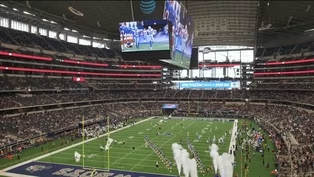
Energy for Sports and Entertainment
Video has Closed Captions
Clip: S2 Ep4 | 2m 14s | As fans flock to football stadiums, energy is consumed. How much? (2m 14s)
Video has Closed Captions
Preview: S2 Ep4 | 30s | Modern energy enabled mass entertainment like popular music, movies, TV shows, and video g (30s)
Providing Support for PBS.org
Learn Moreabout PBS online sponsorship
- Science and Nature

Explore scientific discoveries on television's most acclaimed science documentary series.

- Science and Nature

Capturing the splendor of the natural world, from the African plains to the Antarctic ice.










Support for PBS provided by: