Destination Michigan
Episode 1502
Season 15 Episode 2 | 26m 46sVideo has Closed Captions
Mt. Pleasant, Detroit, Marquette & Saginaw
In Mt. Pleasant, we'll follow one local chef as he discovers his indigenous culinary identity. Henry the Hatter has had your head covered for over 100 years; we'll stop in Detroit to visit. In Marquette, we'll take a picturesque bike trip while absorbing the history on the Iron Ore Heritage Trail. Then, in Saginaw, we'll prepare for one of the universe’s biggest celestial events with Troop 366G.
Problems playing video? | Closed Captioning Feedback
Problems playing video? | Closed Captioning Feedback
Destination Michigan is a local public television program presented by WCMU
Destination Michigan
Episode 1502
Season 15 Episode 2 | 26m 46sVideo has Closed Captions
In Mt. Pleasant, we'll follow one local chef as he discovers his indigenous culinary identity. Henry the Hatter has had your head covered for over 100 years; we'll stop in Detroit to visit. In Marquette, we'll take a picturesque bike trip while absorbing the history on the Iron Ore Heritage Trail. Then, in Saginaw, we'll prepare for one of the universe’s biggest celestial events with Troop 366G.
Problems playing video? | Closed Captioning Feedback
How to Watch Destination Michigan
Destination Michigan is available to stream on pbs.org and the free PBS App, available on iPhone, Apple TV, Android TV, Android smartphones, Amazon Fire TV, Amazon Fire Tablet, Roku, Samsung Smart TV, and Vizio.
Providing Support for PBS.org
Learn Moreabout PBS online sponsorship(ambient music) - Hi everyone, and welcome to another edition of "Destination Michigan."
We're cooking up a great show for you.
Here's what's coming up.
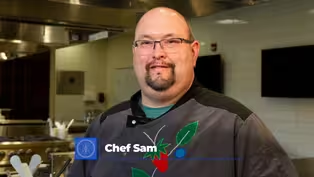
We'll introduce you to Chef Sam Anglin from the Saginaw Chippewa Indian Tribe, and follow his journey to discover his indigenous culinary identity.
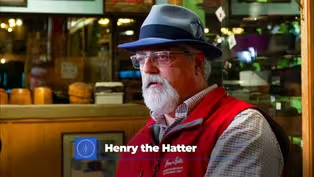
And whether it's celebrities or politicians and everyone in between, the list of customers of the famous Henry the Hatter store in Detroit is endless.
From practical to fashionable, how they've stayed strong for more than a century in business.
Then we trek to the upper peninsula and bike through history along the Iron Ore Heritage Trail, learn more about the vital resource and how it helped transform the country.
Plus, we set our sights on a local troop of scouts and find out how they prepared for the solar eclipse.
Those stories next on "Destination Michigan".
- [Announcer] Support for "Destination Michigan" is provided by the CMU Bookstore.
(ambient music) T-shirts, sweatshirts, hats, maroon and gold memories, and an official outfitter of Adidas apparel at the Central Michigan University owned and operated CMU bookstore.
(ambient music) Online shopping seven days a week at cmubookstore.com, on campus at the University Center, and game day locations at Kelly/Shorts Stadium and the John G. Kulhavi Events Center.
(ambient music) (upbeat music) - We get things started this time from the Allen Foundation Culinary Nutrition Center on the campus of Central Michigan University.
And our first story is sure to delight your taste buds.
A member of the Saginaw Chippewa Indian Tribe, Sam Anglin knows his way around the kitchen, but he hasn't always been comfortable with his indigenous ingredients and dishes, something he was determined to change.
With knives sharpened, we learn about Chef Sam's culinary journey.
(chopping) - Well, my journey on food first started when I was young with my father.
I was probably about between maybe seven and eight.
On the PBS station there used to be a couple cooking shows.
One was "Martin Yan Can Cook," an Asian chef, Very funny, very personable.
So I used to love to watch that show with my dad and my dad would even recreate some of his dishes.
So that kind of really inspired me because unfortunately, my dad passed away when I was young.
So I really held onto those shows, those memories.
And that's really driven me.
After high school, I didn't really know what direction I wanted to go, so I was able to work in a few restaurants around town here.
And a couple of the chefs really inspired me to pursue my education with cooking.
They taught me how to scratch cook.
They taught me the importance of not wasting food.
Every penny counts.
So that was really crucial to my development of becoming where I'm at today.
That did inspire me to further my passion into cooking by attending culinary school at the Grand Rapids Community College.
- [Reporter] With childhood inspiration developed from PBS cooking shows and formal educational training added to his knowledge base, Sam's cooking foundation was taking shape, but there was still a piece missing.
- During my culinary program, I was able to work with one of the chefs there, Angus Campbell.
He is a European master chef, and I told Chef Angus that I was a Native American.
He said, oh man, I'd love to learn some food.
Tell me all about it.
And I was super embarrassed because I didn't know anything.
But that's always stuck with me, that I always wanted to pursue that.
So I worked a lot in classic French kitchens, classic French cuisine, learned all that, the classic brigade system, all the mother sauces.
But I never really felt like I fit in in any of those kitchens.
I always just felt like this wasn't for me, I didn't belong, and that sunk in.
After a few years of my culinary career, I was able to meet the Sioux chef, Sean Sherman.
And that's when really the indigenous foods really started to go off for me.
He came to the tribe, did one of his book signings, and that really lit the fire in me because at that moment, I felt I knew where I belonged because at that time I was really starting to get back to my culture for about three or four years.
And I always thought for us truly to be a sovereign nation, we have our language, we have our culture, but no one ever talks about food.
So I was like, that's my calling.
That's how I can help spread the knowledge of food sovereignty, native American foods that's always been here.
So that's where my fire kind of first started.
It really got exciting for me when I was able to help organize the Saginaw Chippewa Tribal Farmers Market.
I was able to work with some of the farmers that had these traditional seeds, traditional products, and that I was able to incorporate them into tasting samples at the farmer's market.
That really helped me be creative, helped reignite the fire within me.
By going in full speed to the food sovereignty movement, I was able to learn from other Native American chefs the importance of acquiring these foods.
- [Reporter] Chef Sam is enthusiastic to use the same ingredients his ancestors showcased and reintroduce those flavor profiles to waiting pallets.
- The squash, the beans, and the corn.
And they all complete a circle for one another.
The beans, when they are done for the year, those nutrients help the corn come back next year and vice versa.
Each of those are important for the balance of those.
So it's of course the three sisters, but then you have all the wild game that's available, the elk, the venison, and the fish that's always been here.
Some of the game birds.
There's a whole bunch of stuff out there.
Then when you go into the springtime, the forest comes back alive with all the fresh greens and the spring mushrooms and all the abundance of what Mother Earth brings to us.
What I've really found intriguing is some of the spices.
Us indigenous people were creative people.
And I know my ancestors were creative people too.
And no one likes to eat bland food.
We all think of adding stuff to it.
So around here there's sumac, there's cedar, using pine needles, creating different kinds of smokes and curing methods with utilizing maple sugar, the salt.
It's really remarkable if you start delving into all the stuff that's still here and that's always been here, that we can reawaken to the public with.
And some of these flavors that are not out here are pretty unique.
And when I cook, I like to keep my recipes simple so I can highlight those ingredients so everybody can have that distinct flavor.
- [Reporter] Food and culture often walk hand in hand, creating cultural and family traditions.
However, there were times when traditional foods were taken away from the Native American population.
- I guess with the inflammation of the boarding school system, not only did it displace the children from their families, really the whole concept was to civilize the Native Americans.
But while in the course of doing that they really really affected the health of the Native Americans too, because they took 'em away from their traditional foods, a lot of the foods they had to really work hard for and exert that energy to keep 'em healthy, to sustain those foods.
But when they were taken to the boarding school, they weren't given very good foods.
They were having oatmeal, porridge, heavy carbs, heavy sugar laced foods, and nothing that really had any heart to it.
They would get disciplined for going out to the orchard and picking an apple on their own.
They weren't allowed to do that.
So it really inflicted a culinary trauma on the Native American people who attended the boarding schools because there's no passion in that food, and it's just another way to bring people down was having them eat that kind of food.
And then that also created all the health disparities of diabetes, overweight.
Well, for me, that was another passion for me to learn how to cook is because we did get our monthly supplies of our commodity foods.
And some of that foods wasn't very healthy either.
So that helped me be creative.
Oh, I have tuna fish in a can, so I can doctor that up a little bit.
Or the beef in the can, the pork in the can, how I doctor that up?
So that kind of helped me be creative too and learn how to utilize some of those foods that weren't very tasty.
- [Reporter] Chef Sam is looking forward to introducing more folks to indigenous flavors and experiences.
- Well, I'm hoping that they take away something that they will remember and then maybe take it back home and cook it with their families and have that same story that I gave them passed on too.
Because that's what it's about.
It's about spreading that knowledge, 'cause if we don't spread that knowledge, it's useless.
And that's my mentality, we gotta spread it.
People coming in, watching me cook and explaining those dishes, it really, really humbled me and showed me that people do take an interest in Native American food, and not a lot of people do know about it.
And I was really impressed with the students coming in and, hey, I'll try everything, or, hey, tell me a little bit about this.
And everybody was so eager to listen and I'm so willing to share.
So it was a perfect combo right there.
And I was just so impressed with everybody coming in and taking part in this and really, truly honoring these foods and tr honoring the people who were here before me and my ancestors.
- Sam warmly welcomed guests to the Dining Commons on CMU's campus for a special event, presenting a taste of traditional offerings that included dishes featuring buffalo and wild rice.
Well, our next story is a special one.
Adam and Chris traveled to Detroit to visit the nation's oldest hatter, Henry the Hatter.
Chris's grandfather was once a customer at the store.
And, well, Adam, he was just excited to learn about the history of the store that's been selling hats for more than a century, and maybe find one that fits his own head.
(smooth ambient music) - My name is Joe Renkiewicz, current caretaker at Henry the Hatter.
Through high school, I always collected hats.
I got my grandpa's old hat.
Never knew I was gonna get into the business.
I was actually working in a bakery, a local bakery in the city of Hamtramck where I was born and raised.
My high school principal came in and asked me what I was doing at the time, working in the bakery.
He says, I've got a job interview set up for you.
Hooked me up with Henry the Hatter, who was taking over an established hat store in Hamtramck.
I interviewed a week after my wedding.
I was hired beginning January 3rd, 1985.
- [Reporter 2] The original Henry was a skilled hat cleaner and figured if he could clean them, he could sell them.
In 1893, Henry the Hatter opened their doors for business.
Business boomed.
They quickly became the exclusive hatter of Detroit and gained national attention.
(smooth ambient music) In 1941, Henry passed, and the business changed hands.
- Seymour Wasserman, a hatter from New York, had his own business, wanted to expand, came to Detroit, asked the cab driver, take me to Henry the Hatter.
The cab driver said, which one?
So he knew that there were more than one location.
He came to the main store in the Detroit area and almost bought that place on the spot.
Very happy with the clientele, the merchandise he carried.
And it's been in the Wasserman family since 1948.
I was able to purchase it when we lost the lease on our store in Broadway in 2017.
(smooth ambient music) When we lost our lease back in 2017, after being in that building for 65 years, customers came to us.
"My dad, my grandpa, my great grandpapa used to shop with you guys.
I want to come in here and see what they were buying."
"I remember coming here with my grandpa.
I wanna have that same feeling that when he bought a hat, he felt good walking out of the store 'cause he knew he looked good in that hat.
I want that same feeling now."
So the love that the city of Detroit showed us when we lost that lease helped us to move into this building here.
- [Reporter 2] The main store is located in Eastern Market with a second in Southfield.
We visited the main location and quickly learned that hats are cool.
They come in so many styles and colors.
Taking a moment to pause and take it all in, it was evident that hats are important and significant, not only today, but also throughout history.
- We were asked to provide a hat for Dwight Eisenhower for his second inauguration.
They wanted to show austerity in government and not going full fledged formality with a top hat.
So he had somebody partner with Henry the Hatter to do a homburg style.
So it's just, again, not quite as formal as a dress hat, but still formal enough to wear for inauguration.
- [Reporter 2] The president's hat at an inauguration is a big deal.
Some blame John F. Kennedy and his choice not to wear a hat when he was sworn in as a starting point of the decline of men not wearing hats.
Joe offers another reason.
- At that time, automobiles were becoming prevalent.
Gentlemen weren't standing out in the street corner waiting for street cars or buses or cabs.
So the part of the hat being a part of your uniform, especially coming outta the service, gentlemen didn't wanna wear uniforms anymore, got away from the hat and didn't need it as a form to protect them from the weather.
So they just started going without a hat.
A hat is very personal.
One of those things when you put it on and you look in the mirror, you can tell, or we can tell as a salesperson, when they look in the mirror, if they don't like the hat, they're gonna tell you straight off, I don't like this.
Or if they like it, you'll see a smile, you'll see them stand a little bit different in that mirror.
And that's what we're looking for, as people come in and say "I've never worn a hat before, please help me."
That's what we're here for.
That's one of our main objectives.
- [Reporter 2] I've worn many hats in my lifetime.
To have the opportunity to have a professional fit me was a chance I couldn't pass up.
Joe helped fit me in the right size hat and assisted in finding the perfect hat to match my personal style.
- First time hat buyers, we have them come in and try something on that's a little bit softer in texture.
It just fits better.
Some of the other dress hats that we carry have a little bit more structure to them so you have to break 'em in.
You have to wear it a few times to let the the body heat shape the hat itself.
So we start in the first cabinet there where the hats are soft, rims can be worn up or down.
We can change the styles, but basically it's what the customer sees in the mirror that's gonna affect whether they purchase that hat or not.
- [Reporter 2] I found the perfect hat and it had to be stretched just a tiny bit to fit my head, but the customer service and attention to detail was topnotch.
Looking at myself in my new hat, I did feel like a real somebody.
- Pretty much any customer that makes that cash register ring, we consider a celebrity.
- [Reporter 2] To be completely transparent, I was excited and a little giddy knowing I was leaving the store with a hat box with that iconic Henry the Hatter logo on it, just like so many have done over the last 130 years.
- Henry the Hatter has been recognized by the Historical Society of Michigan as a Michigan centennial business for more than 130 years in the hat business.
They have no signs of slowing down anytime soon.
Michigan, as we all know, is home to an abundance of unique museums that showcase the rich history of our state.
Now in Marquette, there's an outdoor museum that explores the iron ore trade.
The Iron Ore Heritage Trail, it not only exercises your body, but your mind at the same time.
(ambient guitar music) On the banks of Lake Superior just outside of downtown Marquette is a stone structure which stands as a welcoming landmark to the historic mining city.
The Carp River kiln is just one of the many historical stops to visit as part of the Iron Ore Heritage Trail.
- Back in the 1800s they would make charcoal to put in these big iron furnaces, and charcoal heated faster and hotter.
So they would put wood in these kilns and burn the wood to make charcoal.
So on this property, there used to be a big furnace with 19 kilns dotted along the way that somebody would keep that fire running and make the charcoal to put into the furnace to make the pig iron.
And the reason it's pig iron is because it would melt down into these structures that look like mini pigs.
- [Stefanie] The Iron Ore Heritage Recreation Authority has developed an interesting way to celebrate the iron mining legacy, a 47 mile interpretive rail trail that tells their story while traversing the same land that the iron ore once did.
- [Carol] We do wanna celebrate our past and a lot of what Marquette looks like is because of that past.
I mean, the people that made money that built these beautiful buildings, the ore dock that you'll see, and everybody goes, what is that?
'Cause not many places have an ore dock, when we have two.
So we wanna celebrate what our unique past is.
- [Stefanie] Since 1845 iron ore has been mined in the Marquette iron ore range.
The iron helped drive the industrial revolution and played a pivotal role in the Allied war efforts, feeding raw materials to the factories that produce planes, tanks, ships and ammunition.
- We have 81 interpretive signs like right here that we tell people what happened.
And we don't give you the whole story 'cause we get about 100 or 150 words, but we wanna give you an inkling.
And then also you go past a lot of the museums that we have here, the cliff shaft, the Michigan Iron Industry Museum, where a linear history that you'll see what's happened, we'll tell you what's happened, and then you can go and find more in the museums.
But you'll see the progression of mining when we'll talk about it, where it was like an open pit where people just hit the rock and broke it apart and got the ore, to the days where they went underground because you couldn't see the good ore anymore.
Like 70% iron is good ore, but then it starts getting less and less.
So they would follow that vein down underground.
We also have some artwork that tells you about the different transportation, and it's underneath a trestle, a train trestle that's actually live still.
So you could go underneath it while a train's going above you.
And we talk about the different transportation, 'cause first of all, they started with ox and carrying carts down, and then you had locomotives, and then steam locomotives, and now the diesel locomotives.
So just the differing ways that transportation carried it.
- [Stefanie] The Iron Ore Heritage Trail runs from Ishpeming through Negaunee to Marquette and out along the shores of Lake Superior.
Repurposing the abandoned railroad quarters, the trail takes visitors on a one of a kind experience only found in the upper peninsula.
- [Cindy] We're blessed with a natural and beautiful geography.
So we have these big rock outcroppings, we have a big forest, and we have Lake Superior shoreline, which is probably the most popular part of the trail with people here.
So you'll go by rivers, you'll go over rivers, you'll see lakes, go to parks.
It's not just the history, but it's also the natural beauty.
- [Stefanie] The natural beauty of the area has attracted outdoor enthusiasts from across the state and beyond.
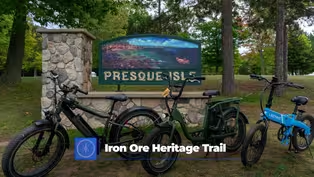
A must stop destination is Presque Isle.
Adam, of course, found the best way to explore it.
(ambient music) - Start peddilng.
We're going to be looking at some e-bikes here at Bates Bikes.
Electric bikes are gonna bridge the gap of the accessibility that people need to get back on a bike or extend it.
They're gonna help you gain a little bit of assistance going up a hill or through tough terrain.
As you pedal, it's gonna multiply your input, and the harder you pedal, the more assist you get.
You also have an optional throttle that you can use if you have any hip, knee, or ankle issues.
Now Presque Isle is special to Marquette because we a one-way loop that goes around an isle.
It's the closest thing we have to an island here that you can get on easily.
And so what's nice about it, bikers, hikers, and even cars can go on this accessibility trail, up around different rock formations that are special to the history of Black Rocks.
There's some indigenous history, there's some zoo history.
Now Black Rocks is my favorite part of Presque Isle.
It's a formation of rocks that you can jump 15 feet into about 30 feet of water.
And so a lot of families go there.
An electric bike is the best way to see Marquette because we kind of have a far range of a lot of things to do, from Presque Isle to the shoreline trail, all the way out to Harvey and up towards Negaunee.
So in order to see everything, you are gaining a lot of distance.
And for the novice rider, for the person that hasn't been on a bike a lot, the electric bike bridges the gap of skill and allows them to go further, faster, and frequent.
(ambient music) - Now, for those looking to visit the Iron Ore Heritage Trail, there are numerous trailheads that will allow visitors to experience it in sections if 47 miles is too far to travel in one day.
Well, the recent solar eclipse bedazzled stargazers across the country, and of course here in Michigan.
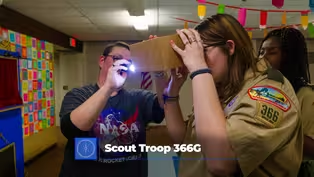
In Saginaw, troop 366G is made up of a group of enthusiastic scouts who are especially fascinated with space exploration.
They recently accepted the challenge of safely viewing the eclipse.
Take a look at their designs.
- So today I'm going to be teaching Troop 366 about the history of eclipses and I'm also going to be teaching safety for viewing the eclipse.
And we're going to be building an eclipse viewer so that they can take it home and possibly view the eclipse themselves.
They are a girls' troop.
They joined the first day that girls could actually join the BSA.
- [Reporter] With a passion for science, technology, engineering, arts, and mathematics, Angie is ready to guide Troop 366G through their eclipse preparations.
- I have been teaching STEM to this troop since their inception.
So they're gonna take a box and you cut a hole in the box and you put aluminum foil over the end and you poke a hole in it, and then you cut another hole in the side of the box and you put white paper inside the box.
So the sun comes, you stand with your back to the sun, and you put the viewer kind of over your shoulder and the sun comes through the hole, the pinhole, and you look through the viewing hole on the side and it actually shows just a picture of the sun through the pinhole for you to see the eclipse.
Okay, now, look in there.
I'm hoping that they use the boxes at least for a little while and then view it with the eclipse viewers.
I hope that they use both ways to see which one works better.
Scouting is an amazing program.
I am a boy mom, I don't have any girls, so I was super excited when the girls were allowed to join because if it would've been something that was offered when I was a kid, I would've joined in a heartbeat.
That is probably what I'm most passionate about, is teaching science and technology, engineering and math to girls, because when I was younger, it wasn't encouraged, right?
You went to school and you were going to become a teacher or you were going to become, and those, I would love to be a teacher.
I'm not a teacher by profession, I am a data analyst, so not the same.
But girls weren't really encouraged to be scientists or astronauts.
I was in an engineering program and I was one of the only girls in an engineering program.
So I think that it's important that they get the exposure to do those things, that it's okay, girls can do it too.
Just like the boys can.
I hope that it gives them a little bit of excitement for this.
I hope that it encourages them to look into it a little bit more, delve into it a little bit deeper.
Some of the history that I'm going to tell them about, I didn't even know.
In preparing for this, I learned something.
So I'm hoping that they learn something and it ignites a spark in them to want to learn more.
- [Reporter] Eagle Scout Michaela is eager to absorb all the eclipse knowledge she can.
- The fact that it's such an uncommon thing to see, from what I've heard, at the level it'll be this year, I wanna understand how that works and why it is so rare and what makes it special.
Our troop has actually worked a lot with the people who are here today doing STEM related things.
So I feel like we've kind of fostered that environment in our troop.
And I feel like with the science merit badges that I've taught, I've tried to bring some of that into our troop as well.
We do a lot of things in the outdoors, a lot of service for the outdoors.
And so I'd really hope that their love for STEM is thriving right now.
- I love everything that there has to do about space.
When I was a kid, I wanted to be an astronaut.
I mean, I'm the girl that on a clear night is looking in the sky, right?
I wanna see the stars.
I wanna teach the kids how to pick out constellations in the night sky.
And so I'm hoping that maybe this is something that they will want to do.
Goodnight scouts.
Dismissed.
- Good night.
- Now to commemorate the eclipse, Scouts earned a special glow in the dark patch for their detailed preparation.
That'll do it for this edition of "Destination Michigan."
Thanks again for joining us and we'll see you again next time.
(cheerful upbeat music)
Video has Closed Captions
Clip: S15 Ep2 | 7m 56s | In Mt. Pleasant, we'll follow one local chef as he discovers his indigenous culinary identity. (7m 56s)
Video has Closed Captions
Clip: S15 Ep2 | 5m 13s | In Detroit, we'll visit the oldest hat retail store in the United States. (5m 13s)
Video has Closed Captions
Clip: S15 Ep2 | 5m 27s | Combining history and bike riding on the Iron Ore Heritage Trail. (5m 27s)
Video has Closed Captions
Clip: S15 Ep2 | 3m 58s | In Saginaw, Scout Troop 366G prepares for the eclipse. (3m 58s)
Providing Support for PBS.org
Learn Moreabout PBS online sponsorship















Support for PBS provided by:
Destination Michigan is a local public television program presented by WCMU