Destination Michigan
Episode 1504
Season 15 Episode 1504 | 24m 30sVideo has Closed Captions
New Era, Constantine, Glen Arbor and Otsego County
It’s fun for everyone when we visit the Lewis Adventure Farm in New Era where we’ll pet animals, cruise down a slide, and sample tasty treats. Then, we speed for the checkered flag at the boat racing school in Constantine. Next, we’ll paddle our way down the scenic Crystal River in Glen Arbor. Plus, we’ll get our thumbs green in Otsego County and discover the importance of native plants.
Problems playing video? | Closed Captioning Feedback
Problems playing video? | Closed Captioning Feedback
Destination Michigan is a local public television program presented by WCMU
Destination Michigan
Episode 1504
Season 15 Episode 1504 | 24m 30sVideo has Closed Captions
It’s fun for everyone when we visit the Lewis Adventure Farm in New Era where we’ll pet animals, cruise down a slide, and sample tasty treats. Then, we speed for the checkered flag at the boat racing school in Constantine. Next, we’ll paddle our way down the scenic Crystal River in Glen Arbor. Plus, we’ll get our thumbs green in Otsego County and discover the importance of native plants.
Problems playing video? | Closed Captioning Feedback
How to Watch Destination Michigan
Destination Michigan is available to stream on pbs.org and the free PBS App, available on iPhone, Apple TV, Android TV, Android smartphones, Amazon Fire TV, Amazon Fire Tablet, Roku, Samsung Smart TV, and Vizio.
Providing Support for PBS.org
Learn Moreabout PBS online sponsorship(upbeat music) - Hi everyone and welcome to this edition of "Destination Michigan."
Get ready for the sweetest and cutest half hour on television as we journey across our Great Lake state.
Animals, check.
Food, check.
Apple cannons, check that too.
Come with us and have a blast at the Lewis Adventure Farm and Zoo in New Era.
Next, we dive into the very fast-paced world of racing boats on water.
You will not believe how fast they can go.
And then, while some have a need for speed on the water, others enjoy a slower pace in our states, rivers, and streams.
Coming up, taking in the sights and sounds of Northern Michigan one paddle at a time.
Plus preserving and conserving, why native plants have a far greater purpose than just keeping our state beautiful.
(bird twittering) - [Announcer] Support for "Destination Michigan" is provided by the CMU Bookstore.
(bright upbeat music) T-shirts, sweatshirts, hats, maroon and gold memories, and an official outfitter of Adidas apparel at the Central Michigan University owned and operated CMU bookstore.
(upbeat music continues) Online shopping seven days a week at cmubookstore.com, on campus at the University Center, and game day locations at Kelly/Shorts Stadium and the John G. Kulhavi Event Center.
(upbeat music continues) (lively upbeat music) (upbeat music continues) - Welcome back, I'm Stefanie Mills, coming at you today from Lewis Adventure Farm and Zoo near New Era.
Now, it's owned by the Lewis family and it is an idyllic place to spend time with your family.
And that's exactly what we did during our visit and we had an absolute blast.
(upbeat music) Whether it's interacting with animals or firing off the apple cannons, (cannon clanking) at Lewis Adventure Farm and Zoo, you can practically do it all.
This beautiful property boasts everything from sweet treats and food, to calming strolls through their flower fields and orchards.
- I was driving by, we actually were headed to a cabin to do some camping and some outdoor nature stuff with the family, and about 16, 17 years ago drove by, had my kids in the car and went, "What is that place?
"That looks pretty cool."
Piqued my curiosity, stopped.
They had goats, they had some produce and things like that.
And checked it out and then every few years would stop back, when we got along this way, watched it grow, and it's exploded.
- [Stefanie] Rob Recknagel went from visitor to employee here at the farm.
He started off bringing his own kids, now he helps create memories for the next generation as the farm continues to grow and expand.
- Literally started as a produce stand in front of the original farmhouse, which is still on site.
Basically started selling cherries, peaches, apples, kind of the main staples of the farm, asparagus.
And then they went, "Yeah, people seem to be buying this," and sold a lot of it, built a market, and then 20 years ago, got things going and said, "Let's do some agritourism, "let's get some goats in here, "start the petting zoo."
And then with some creativity and ingenuity by the Lewis family.
(machine whirring) A little secret, they're really good with air compression, they make apple cannons.
So you started with, you know, the agritourism piece, but then the bee popper, apple cannons, jumping pillows, giant slides, had the ability to build and be creative and use their land in a different way than farming.
- [Stefanie] The farm is such a fun mix of different types of experiences.
The friendly goats greet you the second you arrive, and there are multiple animal encounters that you can take part in, giving you the chance to learn more about them.
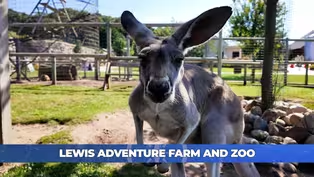
And if you're lucky, you get to pet them too, like we did with this kangaroo.
And I'm not sure if we have seen anything ever cuter than this kangaroo with a case of the zoomies.
Well, Rob says the farm has zookeepers on staff and work year round taking good care of them and their unique habitats.
Now, one of my favorite highlights was watching the prairie dogs chase each other around the hill.
Now heading further along the path, the noise level begins to change from loud tings and taps of paintballs splattering on targets and trees to the booms and explosions from the apple cannons.
- I love the apple cannons.
(cannon popping) It's a really smart, you know, business model where you're going like, "Hey, these apples "were on the ground, "now they're gonna be shot out of a cannon."
So it's not wasteful in that respect.
It's a pretty smart business model.
You're loading them and firing them out at an incredible rapid rate of speed and hitting targets.
I mean, you're shooting windshields and windows out of cars and battering these vehicles and they're really powerful.
So you have the compressed air generator pushing apples, you know, thousands of feet per second.
And it's really fun.
People like to ruin stuff, smash stuff, break stuff, it's fun.
- [Stefanie] I promise you a visit here will not ruin your day unless you don't plan accordingly.
(visitor screaming) (water sloshes) - The number one thing that I would say to people who are coming is be prepared for a four to five hour day.
It's not a quick stop in.
The biggest mistake that anyone could make is going, "We're just gonna stop by, "it's a farm, it's a petting zoo.
"What could they possibly have?"
And when you walk in and you see 45 plus attractions, at least 40 species of animals, and then things, the additions like splash pads and then unique things like the apple cannons, our giant corny barn, you're gonna have something literally for all ages.
(visitor groaning) - Check this out.
I am with McKayla, one of the zookeepers here at Lewis Adventure Farm and Zoo.
McKayla, what do we have going on here?
This is a capy encounter.
So we've got a little plate of food here.
- Uh huh.
Hey, capy.
(bright upbeat music) And what's his name?
- This is Scooby Doo.
- Okay.
And he's one of two?
- Yes, Velma is having a hideout right now.
- Okay, that's all right.
Then you're the winner over here today.
So explain what an animal encounter is like here.
- So basically you just get to come in, hang out with the animals, learn how to safely pet and feed and interact with them.
We let you know animal facts, answer your questions.
- [Stefanie] Now tell us some facts about our capybara here.
- [McKayla] So Scooby-Doo is the world's largest rodent.
They are semi-aquatic animals, so they do have webbed feet.
- [Stefanie] Okay, all right.
(upbeat music continues) And they have a nice pond of swim in and he's about to get all the food and Velma's not gonna get anything.
- Yeah, she's missing out.
- All right, well this is just one of the many encounters that you can have here at the farm along with many of their attractions.
So like we mentioned earlier, this place is fun for people of all ages.
Come and check it out.
(upbeat music continues) Well, switching gears now, we have all heard that iconic line from "Top Gun", "I feel the need, the need for speed."
Adam knows it too.
In fact, he spent some time with a group who fulfills their need for speed racing on the water.
Check them out.
(powerboats revving) - There's a very long history of boat racing in Michigan.
Boat racing is also just part of Michigan's history as well as being something that's part of its present.
(powerboats revving) - [Adam] A real quick history of power boat racing in Michigan.
You guessed it, it involves Detroit.
The motor city was the epicenter for the sport in the early 1900s.
Detroit businessmen, Garfield Wood, became racing's first superstar, winning five straight powerboat Gold Cups and the first man to hit 100 miles per hour on water.
(upbeat music) World War II paused much of the powerboat racing in the 1940s.
But when servicemen returned home, boat building and racing again dominated the waterways in Michigan, making way for new designs and methods to power boats across the top of the water.
Many best described as backyard jobs.
(upbeat music continues) The popularity of power boat racing led to an increasing cost to stay competitive on the main circuit.
But the desire to compete didn't stop hobbyists from finding a race and forming clubs.
Today, the Michigan Hydroplane Racing Association is home to dedicated power boat enthusiasts who gather and race in communities across the state.
(upbeat music continues) - We have everyone from nine year olds, to people in their seventies who will be racing this weekend.
People come from all different kinds of backgrounds.
Some people are third and fourth generation boat racers and some people have just gone through our racer school and decided they liked it and started racing.
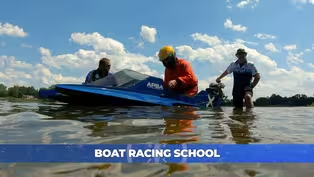
- Racer School is a safe controlled environment for us to put someone who has never been in an outboard hydroplane before on the water to learn how to navigate it and ultimately how to be able to compete and race in one of the events that we host.
(powerboat revving) A race for us consists of two three-lap heats.
- [Adam] Racer School is designed to get more people interested and involved in the sport.
- Unique thing about racing boats is our track is changing all the time and you got to be aware of that.
What we like you to do is get on plane as near parallel to the race course as you can.
Of course so without hitting anything.
- [Adam] The idea is to teach newcomers the fundamentals of outboard racing.
And after about an hour of classroom instruction, they head to the water in a safe and controlled environment.
- Here we're simulating kind of race conditions, but we also have people on the water in boats in case something did happen.
- [Adam] Instructors help get the students in the proper safety gear and acclimated to the boat's controls.
And once that motor starts, they're off.
The goal is to get the boat on plane, which is where the boat is traveling just above the water.
(powerboat revving) After a few solo laps on the water, students have the chance to go head to head with one of the top racers of the club.
(powerboats revving) (upbeat music continues) At the completion of the afternoon, students walk away with a knowledge and skill to compete in a formal race.
- To me, it's much more exciting to do than watch.
Unless you get in one of the boats, you won't realize it.
It's like driving a car on ice.
You don't have to be going a hundred miles an hour if you're driving a car on ice for it to be exciting.
And when you're on water and the whole boat is out of the water and just moving and dancing everywhere, 70 feels fast enough when it feels like it could go in any direction at any second.
- [Adam] Spending an afternoon on the shores during a race weekend, one does get a bit curious about what it's like to race.
Racer School provides that introduction with only a small investment and an afternoon of your time.
(powerboats revving) - It's a way to experience racing and competition on a budget that anybody can afford.
And this is the first step.
(upbeat music continues) - So fun fact, while their boats can reach speeds up to 70 miles an hour, the professional boats can hit speeds of up to 200 miles an hour.
The Michigan Hydroplane Racing Association Racer School takes place on the Friday of their race weekend in June.
Visit their website for more information on the school and when and where you can see their boats in action.
Now a place that's near and dear to my heart is Glen Arbor.
As many of us know, this place is an outdoor recreation haven.
There are opportunities to bike, hike, climb, and swim.
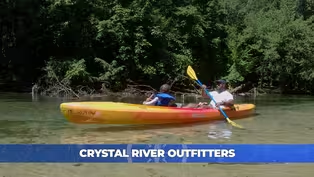
And this time we're taking you on a scenic and serene kayak trip on the Crystal River.
Nestled within the Sleeping Bear Dunes National Lakeshore, a paddle with Crystal River Outfitters offers a wonderful blend of adventure and relaxation.
- All right, you guys are all set.
Crystal River Outfitters has been in operation since 1994.
My husband, Matt, actually started working here when he was 14.
And then in college he decided to buy the business.
He graduated from college, returned here, opened up the shop for another season, and now 20 years later we're still doing it.
- [Matt] Got two adults to sit inside kayaks.
- [Presenter] Whether you're a first time paddler or making your return trip to Leelanau County, the calm beauty of the Crystal River is absolutely enticing.
(bright upbeat music) - [Katy] The water, it's always the water, people come to the area and they're just astonished.
Especially this time of year, you can see it more.
I was out on the lake yesterday on Glen Lake and the water is Caribbean blue, it really is, so I think that's the biggest draw.
When people come, they're just awe inspired by it.
- [Presenter] Michigan is filled with sensational recreation locations that showcase exquisite vistas, and Glen Arbor is certainly no exception.
(upbeat music continues) (bird twittering) - In 2011, "Good morning America" had a poll and they ranked Sleeping Bear Dunes National Lakeshore as the most beautiful place in America.
Well, Glen Arbor is very lucky in that it's basically surrounded by Sleeping Bear Dunes National Lakeshore, so people wanting to visit the Lakeshore, obviously Glen Arbor saw a huge spike in traffic from that.
The biggest thing that it did for the area is it really expanded the season.
Before, I would say Glen Arbor was kind of Memorial Day to Labor Day.
It was always busy in those months.
So people, if they wanted to come up, they had to think about maybe early May, they had to think about September and October.
And that's been really, really great for business.
And from that, all the businesses in the area have kind of learned how to, like, "What are other things "we can provide to keep people coming back year after year."
- [Presenter] One trip on the Crystal River and you might be hooked, it captivates newcomers and welcomes returnees back with its gentle flow.
(gentle music) - The Crystal River, from the head of the river down to our shop, four and a half miles.
It is a very naturally shallow river, super clear.
This is a great river that's super engaging for all kinds of different paddlers, beginners, families, even people that have paddled a lot.
I feel this is like the tale of two different rivers.
The first half goes strictly through the National Lakeshore.
There's no private properties or anything up there.
So we work with the National Lakeshore to trim stuff back, but still they come at it with habitat in mind, rightfully so.
So with that being said, you're still navigating around some trees and things like that.
The river twists and turns itself.
On average, this river, 18 inches deep.
But you could find some holes that are like a good three or four, and the water level does fluctuate, we just had rain a couple days ago, so right now the water levels are rising on the Crystal River because of that rain.
I find that people come out here and they're just amazed at the clarity, the amount of wildlife that they're able to see.
Again, an engaging river, not necessarily your lazy river, and I don't say that to scare anybody off.
I say that just because unlike some other paddles, during this whole thing, you're seeing nature, you're paddling around it, you're managing your boat.
There are three different portages to be able to manage on this river currently.
(gentle music continues) - [Presenter] Part of the fun of paddling on the Crystal River is appreciating your surroundings, taking in what's above, on, and below the water.
(water gurgling) - So when it comes to fish, small mouth bass, rock bass, the head of the river, because it's close to the Fisher Lakes leading into Big Glens, there will be trout that hold up there, steelhead.
We've had pike cruise through, and that's actually part of that whole culvert program, is to be able to help establish better fish habitat back and forth through this river.
At the same time, once the fall gets here, salmon will run this river.
And that's a super unique time to be able to come out and paddle on the Crystal River 'cause you're out there with the school of salmon.
And when they're hitting your boat, it kind of feels like a torpedo and they're right there next to you in that shallow water, it's pretty unique.
Then when it comes to birds, I mean you're gonna see kingfishers and all kinds of different heron, bald eagle are spotted on the river.
When it comes to mammals, there's deer, there's raccoons, possum.
I saw with my own eyes, even though there's sign of it all over the place, I saw my first beaver out on the river.
It was very cool to be able to see all the different wildlife that's available.
(gentle music continues) We get a lot of persons that have paddled a lot of different rivers, and they come here and they speak so highly of how we help manage this river, how the National Lakeshore manages the river, but how, again, I'm gonna use that word, engaging.
They've paddled a ton, they come here and they're like, "That was super fun."
It might not be super challenging for them, but they've enjoyed the entire experience because of how much you're paying attention to the wildlife and to the river itself.
For first time paddlers, I think that it lends itself very well due to the clarity, due to the depth, due to the speed.
Sure, there'll be a person or two that dumps, but that's the nature of kayaking, being on the water anyways.
The nice thing about this being a naturally shallow river is it's typically very warm.
It's very easy to just stand up.
We'll encourage everybody to wear PFDs, to be nice and safe, you know, and we help try to educate people when it comes to paddling as well.
Trying to give people lasting memories with these simple little adventures that we've got.
That's another big reason that we've got a lot of people coming to this area.
(gentle music continues) - Now if Winter sports are more up your alley, you can also rent snowshoes, cross country skis, or fat tire bikes.
Talk about fun throughout all of our four seasons.
Now when it's time to plant a garden or update landscaping, inspiration comes to us in many forms.
A dedicated group in Otsego County encourages green thumbs to get back to their roots of Michigan and consider using native plants.
(gentle music continues) - The garden started just as a demonstration place to show people the trees and shrubs we sell during our tree sale and how to implement into your yards.
And I'm pretty good at selling a stick with no leaves on it, but having them planted and growing out here and showing how you could incorporate it into your landscape was a huge plus.
(gentle music continues) Well the garden was an empty field and I started it in 1997.
They showed me this piece of property, asked what I could do with it.
So it was just a dumping ground for the county, cement, huge pile, a half acre of garbage.
And we just started, a lot of help from the master gardeners at that time, and we just started making different garden beds and it just expanded.
- [Adam] To say Patricia and her team are passionate about their work is an understatement.
Their mission is to assist the people of Otsego County in the wise use and management of their natural resources for a healthy environment.
They are dedicated to raising awareness of the benefits of using plants that are native to Michigan, meaning plants that predate the European settlers of the 1700s.
- They're from here, they're adapted to our climate, they're adapted to our weather, and they're adapted to our wildlife.
So the deer, the rabbits, everything here that's native, they live in kind of a symbiotic relationship.
(gentle music continues) - [Patricia] The root structure on native plants, like a grass, may have a root structure of maybe two, three inches, where native plants could be three to eight feet.
If you put, like a buffer along a lake or stream with native plants, even if it's only 10 feet wide or something, you'll be able to capture any nitrate, anything from septic systems, anything coming downhill.
Everything flows downhill around these lakes and streams.
It'll capture all those nutrients that will go to the plants and stay out of your lakes.
- [Adam] The county that charged Patricia with creating a demonstration garden had another request.
"Instead of just preaching about using native plants, "let's consider growing them."
- [Patricia] And they're pretty tired of hearing me talk about it 'cause there was no place to buy them.
And so the community also got together with me, a lot of grant writing to build this small greenhouse, so that we could offer a source for the native plants that I've been, you know, preaching about for, it must have been 10 years.
- [Adam] With the help of the community and key stakeholders, the native plant nursery was born.
Every spring for the last dozen or so years, the greenhouse opens its doors to sell over 50 species of native plants.
And people come from all over the state for the sale.
But before the sale can happen, volunteers are hard at work making sure there's a product to sell.
- We are blessed with an amazing community that feels very strongly about the greenhouse, native species, and conservation in general.
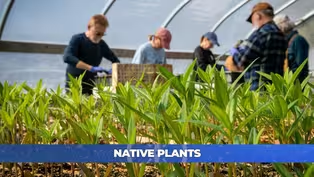
- [Patricia] We have volunteers that come to plant, so we have trays that hold 200 plants each.
And they take one or two little seedlings and put in each one of these.
It's all hand done, the trays are hand packed with soil.
- [Kelly] And in six weeks we have plants that are ready to go into a plug-sized container, which is what we sell.
(gentle music continues) - [Adam] It's hard to believe that this land was once a dumping ground for the county.
The Otsego Conservation District is a one of a kind green space, a three-acre garden home to native flowers and trees and a variety of gardens to explore.
(gentle music continues) - This place is so full of life and it is really a testament to community.
This place was built by groups of children who are now grown with their own children and bring them back here.
It was built with hard work, dedication, and passion.
It wouldn't be what it is without the community that comes and maintains it.
We have volunteers who maintain our flower beds.
We have volunteers who come out and help us weed and rake and keep it beautiful.
And it's a space open to the public.
And I think that that is absolutely incredible, that you can come and you can learn for free, and come and bring your kids to a safe space where you know that they're gonna experience something unique.
(gentle music continues) - The district has bought in, you know, to all my dreams, you know, they just believe in it and believe in how much it is useful for educating the people.
Whether it's forest management or wildlife habitat or just water quality or what it is, it's a good place to bring people and show them what we're talking about, 'cause we do preach a lot as you could see, but it is good to show people and not just talk about it all the time.
- I get to spend my days sharing what I'm passionate about.
I'm from Michigan, I grew up here, lived in the same place my whole life.
And I think that this is one of the greatest states in the country and probably one of the greatest places in the world.
We have incredible natural resources, from our waters to our plant life, our forest, fields, wildlife.
And I just feel very passionate about it and I get to share that excitement with people of all ages.
And I get to learn something new every day.
'Cause I don't know everything, I don't think I'll ever know everything, but I get to learn constantly.
- And just the other day there was three different groups from different places here and kids laughing and running and playing and it was like, just brought it all home that this was the reason for all of it, you know, is just to get kids outside and enjoying nature.
(gentle music continues) - And if you're interested in Michigan native plants, check out the Conservation District's website.
They have a catalog of all their plants they offer in their annual sales as well as a guide to you can start a Michigan native plant garden of your own.
Well that wraps up our show for today.
Thanks so much for watching and supporting our travels across our great state.
We'll be back soon with another episode of "Destination Michigan."
(bright upbeat music) (upbeat music continues) (upbeat music continues)
Video has Closed Captions
Clip: S15 Ep1504 | 5m 36s | We paddle our way down the scenic Crystal River in Glen Arbor and marvel at the phenomenal views. (5m 36s)
Video has Closed Captions
Clip: S15 Ep1504 | 5m 10s | Lewis Adventure Farm and Zoo (5m 10s)
Providing Support for PBS.org
Learn Moreabout PBS online sponsorship

- News and Public Affairs

Top journalists deliver compelling original analysis of the hour's headlines.













Support for PBS provided by:
Destination Michigan is a local public television program presented by WCMU