Oregon Art Beat
Sign of the Times
Season 22 Episode 7 | 26m 59sVideo has Closed Captions
Sharita Towne, Nick Lee, Claire Duncan
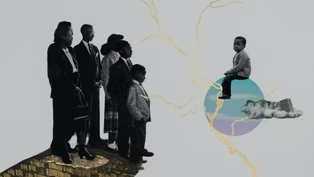
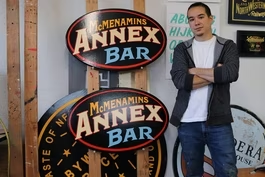
Portland-based artist Sharita Towne makes collaborative art works that honor and spatialize Black life. Nick Lee is the owner of Studio Signs Co. which has been responsible for creating some of Oregon's most popular and iconic billboards and signs. We visit painter Claire Duncan's gallery show "Dialogs with the Anthropocene" to see her thought-provoking work.
Problems playing video? | Closed Captioning Feedback
Problems playing video? | Closed Captioning Feedback
Oregon Art Beat is a local public television program presented by OPB
Oregon Art Beat
Sign of the Times
Season 22 Episode 7 | 26m 59sVideo has Closed Captions
Portland-based artist Sharita Towne makes collaborative art works that honor and spatialize Black life. Nick Lee is the owner of Studio Signs Co. which has been responsible for creating some of Oregon's most popular and iconic billboards and signs. We visit painter Claire Duncan's gallery show "Dialogs with the Anthropocene" to see her thought-provoking work.
Problems playing video? | Closed Captioning Feedback
How to Watch Oregon Art Beat
Oregon Art Beat is available to stream on pbs.org and the free PBS App, available on iPhone, Apple TV, Android TV, Android smartphones, Amazon Fire TV, Amazon Fire Tablet, Roku, Samsung Smart TV, and Vizio.
Providing Support for PBS.org
Learn Moreabout PBS online sponsorshipSupport for Oregon Art Beat is provided by... and the contributing members of OPB and viewers like you.
They said that it was for a traffic stop.
I live in a certain place and time, and all the work I do is essentially turning Black collectivity, Black celebration, Black presence into form.
MAN: There's so many different aspects of sign painting that you could spend your whole lifetime seeking more knowledge, and there'd always be more to learn.
WOMAN: There's a very big thing that's happening in people's minds right now.
I sort of view myself as part of the stream of history.
I've got chills.
It's wonderful.
[ ?
?? ]
[ ?
?? ]
WOMAN: All right, cool.
Great.
There's a lot of ways to describe what I do.
Some people call it community-based art, some people just throw it in some kind of contemporary-art category.
I like to think of what I do as a Black geographic praxis.
Like, it's Black geography as a verb.
You know, I live in a certain place and time, and all the work I do is essentially turning Black collectivity, Black celebration, Black presence into form.
It rises from a community need and desire and a community voice.
We heard all the gunfire, and I just grabbed my chest.
In my particular practice, I really like to wed community organizing and civic happenings with art practice.
I was born in Oregon.
I grew up and down the West Coast between Washington, Oregon and California.
And so a lot of the need I see is coming from my own position as a great grandchild of the Great Migration, right?
So Black people arriving to the West Coast and essentially making place here.
We have so many needs.
The need to celebrate ourselves, the need to hone and keep our histories, our family histories, our neighborhood histories.
There's a need to spatialize community memory in this place, in a place that is built on constantly pushing out Black people.
So this is a print that I've been working on for two years now.
The title, ''Black Life and Black Spatial Imaginaries: Glimpses Across Time and Space,'' each of these have, like, an element that's from the present and from the past.
So this is the lower Mississippi River, going all the way up to St. Louis.
And then this is L.A., Portland and Seattle.
So this is about the migration from the alluvial plains of the Mississippi River westward, following I-5, that's connecting these three cities.
[ ?
?? ]
Looks like Superman ice cream.
I loved growing up on the West Coast.
We have such wide slices of sky.
And so I've always really taken to dusk and dawn in a particular way.
And so I've kind of been geeking out on making these, like, circle gradients, and I think of them as kind of this snapshot of Black imagination under a particular sky.
Oh, yes!
I like making things that can have a life away from me with people in their everyday.
I like that they would carry their groceries or their books in a tote bag.
I like that they would pass along a zine that I made that somebody that doesn't even live in my city can read.
So I've done screen-printing since I was like 15 in my neighborhood, screen-printing shirts.
And printmaking is just totally accessible, and it's like such a democratic, wonderful form.
Right now, I'm working on a project that's called ''A Black Art Ecology Takes Place.''
And that we actually had a portrait of Keaton in the middle.
And it's really the culmination of years of research and community organizing and relationships.
It's the original animation.
So it'll be low-tech in that way.
It's a project that conceptually takes the mid-century logic of blight, that Black people are a detriment to an urban ecology and need to be excised from the map, like some kind of disease.
WOMAN: Hello and welcome to the closed-captioned podcast exhibition ''Black Life On Air''... TOWNE: Which we have seen time and time again here in Portland, be it the Memorial Coliseum or Emanuel Hospital or now with the gentrification that in some ways would like to make a plaque or a mural rather than having a Black family next door.
It takes that logic of blight and counters it and says it's false, and acknowledges that Black people have always been a thriving contribution to place.
And so to put resources in the hands of artists and communities to continue breathing life into a place.
It's not only making art, making videos, making projections.
It's simultaneously building the infrastructure that you want that art to exist in.
In terms of actual physical things that happen, it's a range.
I'm working with PCRI to do some public art on their new King + Parks Building.
It's at the corner of Rosa Parks Boulevard and Martin Luther King Boulevard.
[ ?
?? ]
Also working with the Portland Institute of Contemporary Art to give space and resources to Black artists in their space, which is on Vancouver and Williams, very gentrified streets.
In some metrics, we could even say Williams is the most gentrified street in the most gentrified city of the century.
So what does it mean to hand over resources to Black artists, curators and creatives in a space that has, like, free rent for 20 years?
It's actually looking at not only community fabric as form but looking at institutional infrastructure as form, what it means for an institution to lend their resources so that Black people can make their own self-determined infrastructure?
I think of the projects and the relationships that I have within this piece, it's not attempting to say that it's the entire Black art ecology of Portland.
It's a Black art ecology.
It's really just acknowledging the networks and underground root system that forms a community and that it is the life force in this place.
[ ?
?? ]
I think Sharita really gives you a platform for what to do now and moving forward.
The way she's able to, like, not just do it, but do it on this type of scale, I think, is very impressive and very necessary.
Sharita's tremendously important to the Portland art scene, because she's an artist who's really focused on process and bringing her community along with her.
SANDERS: I hope the exhibit inspires people to act.
TOWNE: There's a certain amount of catharsis and healing that comes through collaborating.
There's just this exponential force that bubbles up when we put our heads and minds and hearts together that is the form.
If a sculptor makes a sculpture and then there's dust scattered across the studio, to me it's like, if I put up an exhibition, it's like the relationships and the laughter of the people is the dust that's scattered around the artwork.
I hope that this work endures.
I hope to see more spaces designated for Black creatives and community.
I hope that the future of this work is more and more spatialized transformation of the place that we live in and it honors and centers Black life.
My name is Nick Lee, and I'm a sign painter.
[ ?
?? ]
I'm the owner of Studio Signs and Pictorial Displays, Inc.
I'm a second-generation sign painter.
My father ran the business before I bought it.
So I was pretty much born into the world of sign painting.
The fun thing about making signs is that it's very diverse.
One day I could be doing a wood sign, next day I could be doing a carved sign, next day I could be doing gold leaf on glass, the next day I could be doing screen-printing on metal.
So it varies.
There's so many different aspects of sign painting that you can spend your whole lifetime seeking more knowledge, and there'd always be more to learn.
Whatever the project may be, I just do my best to make it a top-quality product and make sure that the customer's happy with it.
So on this one, we're using 23-karat gold to gild these giant Nebuchadnezzar bottles that hold 20 standard bottles of wine.
Gold-leaf gilding is applying metal leaf, usually is gold.
Applying leaf to something is called gilding.
Gold leaf is so fine and thin that touching it with your fingers will just make it disappear from the oils on your skin.
Over the years, I've made countless signs -- thousands and thousands.
Some of them are quick, economical signs.
Maybe they're still up, maybe they're not.
But then the hand-painted stuff we do and the gold-leaf work, that's the type of work that is mean to last.
And it's meant to give a sense of permanency.
I think the resurgence in hand-crafted signs is just kind of a reaction to the design world went very clean and everything was glass and white and minimalistic, and that's nice, but I think that kind of lacks that human element to it... you know, the perfect imperfections that make it attractive.
I do all of the hand-painted signs for McMenamins hotels and restaurants.
Those designs are great.
They're colorful, and the lettering's really interesting.
So pretty much any McMenamins that you go to and you look at their big main sign, and that's something that myself or my father has painted.
Studio Signs was founded in 1963 by artist Dean G. Stanley, and they focused on the big pictorial displays.
Nowadays, this would be a printed photo, but back then it was all hand-painted.
In 1985, when Dean Stanley was getting ready to retire, he chose my dad as his successor.
I started in the sign-painting business in 1970 in Vancouver, B.C., and started my work with Studio Signs in '76.
We did truck lettering to window lettering, outside of buildings.
Lots of the signs that we'd do are out there, fairly permanent, some lasting 10 to 15 years.
We put a lot of time and effort into our work, so it's nice to have our stuff viewed for a long period of time.
Over the years, I took over more of the production and learning about how to run the business, and eventually my dad was ready to retire, and he said, ''Hey, you want to buy the business and take over?''
So in 2018, I bought Studio Signs.
He learned the craft early on, and I'm proud of him.
[ ?
?? ]
NICK: We're part of Portland Lee's Association, which is a family association for people with the surname Lee.
My grandfather was in it and my dad and my uncles.
We do lion dance, dragon dance and kung fu and get the youth interested.
So right now during COVID, we're not performing.
You know, everything is kind of shut down, so it was a good time to repaint the drum and get some new lettering on here.
I would consider my father a true sign painter, a true sign writer.
He can walk up, grab the brush and go.
He's been doing it for 50 years, and so he's built the muscle memory.
He understands the alphabets, the way they're supposed to look.
And it's beautiful.
Myself, I don't feel as confident doing something like that.
But I'm really into the technical aspect and the design aspects.
I also love the artistic side of it.
[ ?
?? ]
I've actually used some of these techniques to create some art pieces that I sent down to an art show that was in San Francisco called ''But Where Are You Really From?''
And it was a showcase on minority sign painters.
So a couple of the pieces that I made for the show was this Bruce Lee piece here, where I used liquid silver.
And then this one here was another mirrored piece, and 1882 refers to the year that the United States outlawed Chinese people from coming to the United States.
I was born in 1982, 100 years later, so this is kind of my tribute, saying, ''Look at this dark history that we had.
But 100 years later, and I'm a Chinese American artist,'' and so this is kind of my commentary on the Exclusion Act.
And they asked my dad to letter a poster to promote the show, so that was pretty cool.
For me, it was more satisfying for my dad to get the recognition.
We need to get our brush ready.
In the past, a sign painter was just a sign painter.
He was just some guy who did a job.
Now, with younger people who are wanting to learn, they're actually looking up to these old sign painters kind of like not rock stars, but they're idolized a little bit because of the skill that they have.
But to have these younger people say, ''Hey, we appreciate your work and what you've done and we want you to actually make a poster so we can memorialize it,'' I think that was really cool for my dad.
[ ?
?? ]
It's very important to me to continue the legacy of Studio Signs.
It was started in 1963, so there's not many businesses that last for that long.
And now, being the third owner, I feel like there's a big responsibility for me to continue to be successful, not only for myself, but also to continue providing quality signage and informing the visual landscape with good design.
My father and I are both life-long martial artists, and in the same way that there's a lineage from teacher to student in the martial arts world, I feel there's a similar lineage with the sign shop, and so, you know, for me to continue it on and continue the legacy, it's really important to me.
[ birds chirping ] [ ?
?? ]
WOMAN: Egrets can stand there motionless for a really, really long time.
And that waiting, that expectation, there's a little bit of healing that goes on when you see animals in that quiet, waiting kind of state.
And when I'm painting the flying egrets, there's a sense of awe about the power and the grace of their flight.
I majored in art in college with a design emphasis and never thought I was going to be a painter.
I was a graphic designer.
And it was only when I came to Ashland and decided to take up painting, I thought, as just a Sunday afternoon activity, but it grabbed hold of me, and there wasn't any looking back after that.
[ ?
?? ]
I started doing birds of prey really right out of college.
It sprang from driving down the highway where I grew up in Oklahoma and seeing those birds of prey sitting in the trees, standing on the telephone poles, and just being fascinated with that.
I design these pieces and compose all my work in Photoshop before I paint them.
I'm just going to show you this.
Now, those bird weren't there.
I put those in.
There's a different one.
And I use all my own photographs to work from.
For this bird, I just took the background and reconfigured it to go with this bird, and I've been adding these dark squares to make it have a slightly more design feel.
And then once they're composed, I start painting from there.
It's a lot about the paint for me and what it's doing and what it's making, and I paint in thin layers.
And you just keep working it, and eventually magic takes over.
The magic of the paint takes over.
As a graphic designer, I worked with photographers a lot.
And they really gave me an understanding of the meaning of light.
But just doing beautiful paintings, I was always looking for a little bit more.
I'm trying to elicit a response, but I don't consider myself a message or statement painter, either.
Now, that isn't true with the body of work that I've just finished that's in the gallery.
The name of the show is ''Dialogs with the Anthropocene.''
And I was curious about whether you could look at something beautiful and still find it beautiful after you thought about its possible demise.
MAN: I saw this show when it opened and was really struck by, first of all, just the craft.
I just found the way that these things were lit and rendered was really lovely.
And then I started seeing these second canvases, and it became clear to me that they were making a statement as well.
The way that top piece is painted, it's just very muted and sort of pale orange sun getting filtered through all the smog, really sends that message home really well.
This is a stressed situation.
These animals are stressed by what we're doing.
And I think the term ''anthropocene'' is wonderful, because it acknowledges the fact that the changes in our world are caused by humans.
Anthropocene is a word that describes a geologic epic in which humans have overwhelmingly impacted the Earth.
[ ?
?? ]
As humans, everything that we do leaves a carbon footprint, it leaves all kinds of footprints.
And a lot of those are unseen, and we're not aware of them until it's almost too late.
And that whole concept of humans changing our earth with our impact in a fairly short period of time was something that just hit me, and I felt compelled to respond to it.
Hi.
How are you?
WOMAN: Good.
DUNCAN: The gallerists let me sort of sit in the gallery during open times so I can hear what people say and see what their reactions are.
I love the idea of this being a bird that's startled by a shot with the bullets and one empty casing.
[ ?
?? ]
And just the layering of the pollution of the city with the clarity of light that's backlighting that egret.
They're so lifelike, and they just make you feel so much compassion.
I mean, it's breathtaking.
It just is an amazing statement of what's going on in the world in such a beautiful way that it just... takes my heart and just puts me right there.
[ ?
?? ]
This piece is titled ''Trampled Dignity, Fragile Dignity.''
It's representing the dignity lost from not only the people that are being shut out but also the dignity people are losing for our own country and our own government.
WOMAN: My!
Oh, the light!
You captured the light and feathers is just... thrilling.
Thrilling.
Oh!
All the barbed wire up above.
I've got chills.
It's wonderful.
DUNCAN: It's bittersweet to see it come down, because the responses have been very heartfelt.
And it's just been gratifying, humbling really, to see it.
This is what went with this.
That's interesting.
Wow.
You're the artist?
Yes.
Oh, my gosh!
They're wonderful.
Thank you.
DUNCAN: There's a very big thing that's happening in people's minds right now, and I sort of view myself as part of the stream of history.
I'm not coming up with any original ideas.
It's just happening because it's happening all around us.
I'm part of the stew.
There's a few more pieces in this body of work that I haven't completed yet, and I want to continue on and finish those, and we'll see where it goes.
[ ?
?? ]
To see more stories about the arts in Oregon, visit our website... [ ?
?? ]
Support for Oregon Art Beat is provided by... and the contributing members of OPB and viewers like you.
Video has Closed Captions
Clip: S22 Ep7 | 8m 29s | Portland-based artist Sharita Towne. (8m 29s)
Video has Closed Captions
Clip: S22 Ep7 | 8m 15s | Studio Sign Co. has created some of Oregon's most popular and iconic billboards and signs. (8m 15s)
Providing Support for PBS.org
Learn Moreabout PBS online sponsorship















Support for PBS provided by:
Oregon Art Beat is a local public television program presented by OPB