Oregon Art Beat
Uncovering Our Stories
Season 22 Episode 8 | 27m 38sVideo has Closed Captions
Willie Little, Betty LaDuke, James Allen
Portland assemblage artist and painter Willie Little creates work that tells stories of his family history in rural North Carolina. Betty LaDuke is a Southern Oregon painter well known for her vibrant work celebrating women and agricultural workers. Portland book excavator James Allen carves books until they look like word and image-rich pieces of sculpture.
Problems playing video? | Closed Captioning Feedback
Problems playing video? | Closed Captioning Feedback
Oregon Art Beat is a local public television program presented by OPB
Oregon Art Beat
Uncovering Our Stories
Season 22 Episode 8 | 27m 38sVideo has Closed Captions
Portland assemblage artist and painter Willie Little creates work that tells stories of his family history in rural North Carolina. Betty LaDuke is a Southern Oregon painter well known for her vibrant work celebrating women and agricultural workers. Portland book excavator James Allen carves books until they look like word and image-rich pieces of sculpture.
Problems playing video? | Closed Captioning Feedback
How to Watch Oregon Art Beat
Oregon Art Beat is available to stream on pbs.org and the free PBS App, available on iPhone, Apple TV, Android TV, Android smartphones, Amazon Fire TV, Amazon Fire Tablet, Roku, Samsung Smart TV, and Vizio.
Providing Support for PBS.org
Learn Moreabout PBS online sponsorshipSupport for Oregon Art Beat is provided by... and the contributing members of OPB and viewers like you.
MAN: When people see my work, I hope they are curious.
And then if they choose to investigate more, they can peel through the layers.
WOMAN: A lot of my inspiration has come from travels or that is symbolic and connected to birthing, to death, honoring other women's art.
MAN: It's about time, because you're digging into the past.
As I'm excavating the book, I'm discovering things.
[ ?
?? ]
Installation artist Willie Little moved to Portland in 2016 from Oakland, California.
His work has received international attention, including a piece that's now part of the permanent collection of the Smithsonian's National Museum of African American History and Culture.
These days, he makes his new work at his studio in Northeast Portland.
[ ?
?? ]
When I'm working on one of my pieces, I feel powerful.
I feel...joy.
Because I'm saying something that speaks volumes, more volumes than I could ever say in person.
And that's why I believe I was put on this earth, to say... Say words that many people can't say.
My name is Willie Little, and I'm a multimedia installation artist, storyteller and author.
[ ?
?? ]
The work I do is exploring and examining decay.
Social decay, physical decay, cultural decay.
I love getting in, you know, and feeling and seeing and touching, because it represents the passing of time, history.
It's almost orgasmic, actually.
Being around a lot of old things, I just -- I love it.
I love aging the pieces, because I want it all to look as if it was in an archaeological dig.
The torch is actually more of a tool than the paintbrush.
It looks really cool on this side.
Yes!
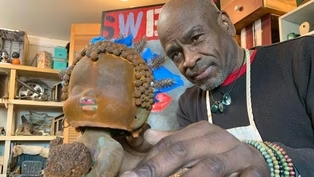
''The Weight of Resilience'' represents where we are now.
I have three books on one side that represents institutional oppression, and we have this doll on the other side.
Although these books should weigh more, because of her strength and resilience, she actually is equal.
Cockleburs are prickly seed pods.
They were used as racial epithets to describe African hair in its natural state.
In much of my work, I reclaim things that are insulting and re-present them.
We had them in the fields on my family's farm and they stuck to our clothes.
And I remembered how cool they were but how painful they were.
[ ?
?? ]
I was born in the Pactolus Township near Little Washington, North Carolina.
My first few years growing up in eastern North Carolina was exhilarating.
It was fun, it was joyous, it was rich.
My father owned a grocery store called Little's Grocery.
People could come in and buy penny candy, butter cookies and groceries, but at night, it became a juke joint.
People would come in, buy a 50-cent gin shot in a Dixie paper cup, and the blues filled the store with that jukebox.
It was something else.
The people who came through, I loved them, they loved me.
My sisters and I would laugh and talk about all the crazy things that went on.
If you ever saw the film The Color Purple, Harpo's juke joint, it was kind of jumping like that.
It was a place of solace, a place to let their hair down.
A little dancing, a little romancing a little gin... and sin.
The moment I realized that I had a story to tell, I was with an artist named Juan Logan, and I started telling him the story about my father's illegal liquor house, about some of the people.
He said, ''Willie, there's your story.
You need to -- you need to do something with that.''
In 1994, I received a project grant to create a juke joint.
[ ?
?? ]
I wanted to make something that really honored the richness of my family, where I came from, and I wanted people to see what I saw.
I knew I had something when it traveled around the country for several years.
It culminated at the Smithsonian in 2003, and that's where it is now, in the permanent collection.
I was in love with that shape.
[ ?
?? ]
I mean, everything about the store looked thrown together with, you know, spit and a prayer, but it withstood the test of time because it was so strong.
When people see my work, I hope they are curious, I hope they are educated and I hope they are inspired.
But I hope that they are seduced by what they see first.
And then if they choose to investigate more, they can peel through the layers, because all of my work is layered with so many symbols.
I want people to think.
WOMAN: Congratulations.
Thank you.
Thank you so much.
Thank you for coming.
Welcome.
I wanted to write a book because I knew I had a story to tell.
My work started out with writing narratives and putting them on the artwork.
So that was the beginning of me telling the stories.
When I was a child, my family lived in a narrow lime asbestos-shingled shotgun shack.
We had running water but no inside toilet.
I shared a bedroom with Earnestine, my older sister, seven years my senior.
It is a coming-of-age story about me growing up a little gay Black boy from the rural South.
And that girl goaded us every day, and I won't say any more.
You need to read what happens.
[ audience laughing ] Okay?
Okay?
I love sharing part of my life with an audience.
I love their response to me telling a story.
I was so excited when I saw this.
The work that I create about growing up from the rural South comes from a sense of joy, because I know I was loved.
And the work is a love letter to my past.
I was ashamed of it when I was college age, and when I grew beyond that shame, I just wanted to scream it from the rooftops.
I am proud of where I come from, I love where I come from.
And that's why it is so important for me to tell the story with that same amount of love.
[ birds chirping ] I enjoy the process of painting because it's part of me in the sense that it's both mental and physical.
I like the sense of thinking about what I'm doing but also sometimes just reacting angrily, happily, all kinds of moods.
It catches it all.
[ ?
?? ]
Paintings evolve.
They're like children.
They sort of need to grow up.
And very seldom do you get something that is mature right away.
It takes growing and living with it and thinking about it.
It allows me room to breathe with it and to evolve.
[ ?
?? ]
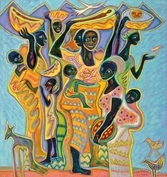
A lot of my professional work has been going to villages and focusing on women's art around the world.
Art that tells stories, it tells you a sense of the land... art that is symbolic and connected to birthing, to death.
A lot of my inspiration has come from those travels, learning and then honoring other women's art.
It can be symbolic and it can be personal, so it breaks every rule I ever learned in school.
In 2010, I began a series of paintings reflecting the farmworkers right here in the Rogue Valley.
And I was always in awe of the harvest season, just the joy that it brought to me to see life evolving and growing from the earth.
In creating my work, I don't have a dogma that I follow, but I follow issues of the here and now.
Because I've traveled so much, I'm aware of a great deal of suffering and a great deal of joy.
I tend to care about people who are linked to communities, to land... and want to offer a voice of saying, ''I see you and I hear you and I want to present what I can about what I feel about you.''
Paintings gradually began to be parts of larger exhibits that I had, including celebrating life at the Schneider Art Museum, but soon they became part of the Medford International Airport.
And that made me ever so proud that 26 farmworkers could be on the walls there for thousands of people to see year after year.
And that's my biggest joy, to see the people that my work represent getting excited by seeing themselves represented with dignity.
[ ?
?? ]
In April last year, I traveled to the Arizona-Mexico border.
I met with the Samaritans in Arizona, and they did things like go to the desert region on both sides of the border with water and leaving it in the desert where they felt were migrant pathways.
I was also aware of the organization called No More Deaths and how they had documented up to 7,000 migrants that had died just trying to cross the desert over a 20-year period.
So in Douglas, Arizona, the remains of a person had been found.
And now they were ready to plant a cross to honor that person.
And we came there with the cross to actually do a ceremony.
So this is where I was sketching, just trying to catch just the essence of it.
The faces in the cross are really symbolic.
They're a sense of the many, many people who have passed away and been found gradually through time.
And then many of them honored and many of them just lost forever.
My sense of birds became almost the arms of a cross, sort of bearing witness also to the experience and to the tragedy.
And then they became integrated into the wholeness of the cross.
Oh, jeez.
I grew up with parents that were immigrants.
Working class, lived in a Bronx tenement.
[ ?
?? ]
The sketchbook became a habit and went with me everywhere in the city.
Sketching market scenes, sketching street scenes, sketching people, faces, workers.
I then took that habit around the world.
I got to Mexico on a scholarship when I was 20 years old and stayed until I was 23.
I worked ferociously on campus and then in a little studio apartment that I had and created a whole body of work.
And then, Mexico City, there was a gallery called New Generations, and I had my first exhibit there.
In 1958, two years after I returned from Mexico, I met SunBear, or Vincent LaDuke, and together we moved to Los Angeles.
And lo and behold, we had a daughter, Winona, Winona LaDuke.
[ crowd chanting indistinctly ] We were dealing with the Vietnam War.
We were dealing with protests here.
We were part of the protests against the war.
So, yes, Winona grew up political.
She was exposed to a lot.
You don't even know who we are, but you're trying to throw a pipeline across the best wildlife territory in the world.
BETTY: I'm very proud of my daughter, and what she does is for a bigger sense of family and community, and the politics follow.
I don't like being confined to rectangles, to squares.
So what I like about the panels is I can re-create the form so it holds an energy of the image I want to portray.
It is the image.
And when I go to the lumberyard to buy my wood, I always buy the least expensive, and the guys kind of look at me, ''Hey!''
you know?
And I tell them, ''No, no, no, this is what I want.''
Basically I really only want the crummy old stuff that they can't believe I would want, but it has character.
[ ?
?? ]
I hope people find joy and hope in my work, but also I hope that they find questions.
Questions that need to be resolved, that there are no simple answers for, that makes them think.
This is my daughter, Winona.
Winona and Don.
WOMAN: Please welcome Betty LaDuke.
[ audience applauding ] Hi, everyone.
I'm really, really happy to be here... You know, when you're in your eighth decade, one of the great pleasures is I'm beginning to take the time to look and I'm beginning to feel honored that people are beginning to say, ''Hey, there is a good legacy here that's with us, and it will be with us.''
That makes me feel good.
[ ?
?? ]
MAN: University of Oregon from 1948.
Books with interesting illustrations are always fun, like that one.
I find old books, sometimes new books, and I alter them.
I leave all the pages bound, but I cut through the pages to reveal the content.
So I just make sculptures out of books.
With this photograph, I think that border would actually be easier to incorporate than the face.
Ugh, I have so many books in line.
I wish I could cut faster.
In the way Michelangelo is able to carve a sculpture from a piece of marble, James is able to carve a sculpture from a book.
[ ?
?? ]
JAMES: I'm just trying to set the stage where the different elements of the book seem to be interacting, almost like you could see them moving or communicating with each other.
LAURA: James does book excavations, and they fall in the category of book and paper art.
He's basically dissecting books and making them into a completely different graphical sculpture.
JAMES: First, the Battle of Ecnomus in Roman history.
It's sort of about time, because you're digging into the past.
You know, I'm digging -- as I'm excavating the book, I'm discovering things.
It's always intriguing to see how the past mirrors the present.
I've always been fascinated with altering existing objects, and it started out as a way to take media that was already out there and making it more interesting to look at.
I always am surprised by the things that emerge out of the books, something that I hadn't even thought would be included will all of a sudden line up in a really nice way.
LAURA: [ gasps ] Wow!
Oh, you don't do very many with color illustrations.
He can look at a book, find that central illustration, create a narrative around it and make this beautiful sculptural object.
And how he does that one page at a time really is amazing.
KATRINA SARSON: Laura Russell owns 23 Sandy, a Portland gallery dedicated to book arts.
James is one of the artists she represents to libraries and other clients.
Wow, well, you have amazing timing, because I just had a library yesterday call me and ask for books with botanical illustrations.
A lot of these books, if he wasn't rescuing them and making art of them, they would be lost.
Books are being discarded by libraries on a regular basis these days.
They're really literally recycling boxloads and boxloads of books.
Yeah, people do ask me that, like, do I feel bad about cutting the books up, and I guess I do sometimes think about, especially with the older books, just wondering how many of them are left.
But a lot of times, like the encyclopedias I just found, they were just sitting on the curb.
You know, if it rained, they would be all ruined, so I feel like I'm kind of rescuing them in some ways and giving them new life and then bringing attention to their beauty.
So just in the center of that.
Just take these two down?
No, I think take all three down.
Take all three down?
And just have this up in the center of that.
Okay.
When he's not carving, James works for Jane Beebe at PDX Contemporary Gallery.
It's, I think, interesting for a working artist to see the nuts and bolts of how a gallery works.
JAMES: I've been doing preparer work and art handling for over ten years, so it's nice to have a steady income to be able to know, well, if my art's not selling, I can still pay my rent and pay for my studio space and, you know, eat.
[ laughs ] [ ?
?? ]
I just want every little section of it to be interesting to look at so that the longer you look at it, the more you're noticing some little word or maybe there's, like, a little eyeball looking out at you that you didn't notice... as many little hidden details as I can get.
They generally tell me when they're done.
So then I just move on to the next one.
Nice.
Can I take a picture of you with it?
Sure.
Okay.
To see more stories about Oregon artists, just go to our website... Or check out OPB's YouTube page.
And be sure to follow us on Facebook and Instagram so you can see what we're working on right now.
Thanks for watching.
[ ?
?? ]
Support for Oregon Art Beat is provided by... and the contributing members of OPB and viewers like you.
Video has Closed Captions
Clip: S22 Ep8 | 9m 51s | Southern Oregon painter Betty LaDuke. (9m 51s)
Video has Closed Captions
Clip: S22 Ep8 | 8m 22s | Portland assemblage artist and painter Willie Little. (8m 22s)
Providing Support for PBS.org
Learn Moreabout PBS online sponsorship















Support for PBS provided by:
Oregon Art Beat is a local public television program presented by OPB