NatureScene
Everglades National Park (1985)
Season 1 Episode 2 | 27m 50sVideo has Closed Captions
Jim and Rudy take us to Everglades National Park.
In this episode of NatureScene, SCETV host Jim Welch along with naturalist Rudy Mancke take us to Everglades National Park located near Homestead, Florida.
Problems playing video? | Closed Captioning Feedback
Problems playing video? | Closed Captioning Feedback
NatureScene is a local public television program presented by SCETV
Support for this program is provided by The ETV Endowment of South Carolina.
NatureScene
Everglades National Park (1985)
Season 1 Episode 2 | 27m 50sVideo has Closed Captions
In this episode of NatureScene, SCETV host Jim Welch along with naturalist Rudy Mancke take us to Everglades National Park located near Homestead, Florida.
Problems playing video? | Closed Captioning Feedback
How to Watch NatureScene
NatureScene is available to stream on pbs.org and the free PBS App, available on iPhone, Apple TV, Android TV, Android smartphones, Amazon Fire TV, Amazon Fire Tablet, Roku, Samsung Smart TV, and Vizio.
Providing Support for PBS.org
Learn Moreabout PBS online sponsorship♪ [♪ calming guitar music ♪] Jim: This is part of the Everglades National Park the nation's third largest, 1.4 million acres.
Thousands of acres of saw grass just minutes from the busy city of Miami, Florida.
I'm Jim Welch here with Rudy Mancke, naturalist.
Rudy, this place is going to be tremendous I know, from what you've said.
Well, we're starting out in what I guess most people would consider the everglades you know, with the saw grass, as you've mentioned.
We need to look at that first.
But there's so much diversity here, Jim that I think we're going to be surprised by the amount of diversity.
And the key in this place is water.
That's true everywhere really.
This is the dry season, and so there's not a lot of water here.
Normally, there would be water where we're standing.
And so to see the greatest variety of animals, for instance you generally go to watery places.
The everglades used to be a lot wetter than it is today, though.
The water comes, you know, from lake Okeechobee sort of piles up there and then heads south from there flooding the glades.
And now a lot of that water's been diverted and that's changed the situation here just a little bit.
But even without the change this would be the dry season of the year.
It's the diversity, too.
From just a few minutes from a busy city like Miami we can see white-tailed deer and alligators and many, many kinds of birds.
The difference is that Miami and the other eastern cities are on a high ridge of limestone.
This is a lower area, you see.
Limestone is being dissolved away and we can see little pits in the limestone here, as... You know, right in front of us as we're talking.
And this limestone has been dissolved away.
It's lower, and that's where the water goes and that's where you have the greatest diversity of plant and animal life in the state.
The grass that you talked about saw grass we need to say up front is really not a grass.
It's a sedge.
When I was going to school we used to say "sedges have edges" three sides usually to sedges-- and that's what separates them from the grasses or from the rushes out here.
If you look carefully at the edge, it is a saw edge.
It's very, very sharp and can cut you, and so the common name "saw grass".
And it's interesting... Today is so windy.
A lot of times, you think of the everglades as a river of grass.
Well, the wind blowing this grass really gives you the feeling of water flowing by.
We're just inside the park entrance.
There's so many places to see in the Everglades park.
Shall we get started?
I think we should.
Let's go to a place where there's more water and I promise you a greater diversity of animals to take a look at.
a place called Anhinga Trail.
[♪ gentle guitar ♪] Jim, Anhinga Trail really attracts a lot of people as we've already been able to see because there's so much here and you can get so close to it.
And just with a pair of binoculars, you know like we've got you can even come closer to something that really is probably as close to you as you've ever seen it in your life.
A lot of birds.
And I think that one of the things that really gets people, though, quickly are those things right there right along the trail.
See the brown water snake coiled up there on the limestoney material?
Sunning a little bit.
Again, those reptiles need to come out of the water and warm up a little.
And the day's getting warm.
This wind, though, is kind of rough, though, isn't it?
It is, but such a welcome relief from the hot sun right now.
this dry season here in the Everglades Park.
These reptiles come out again like the alligators do and I can see further along a nice alligator sitting up on the bank.
You see that guy?
We've seen many sizes.
That's one of the biggest.
That's a good-size one and, of course, one of the reptiles, again.
The scales are very obvious.
And these animals need to warm up a little.
Now, it never really gets cold here but these animals need to warm up a little bit to really get started and he's sitting up there, warming up.
Eyes closed for a little while and then opening up.
You can really see the eyelids one that comes up and down and then also sort of a transparent one that covers the eye when the alligator's swimming.
Look at that mouth on that thing.
He opened it up there.
Kind of a yawn, I guess, and then closing back down.
You can see the teeth in there.
Again, those animals are no great problem to people unless you bother them.
And, of course, we're not going to do any of that today.
Rudy, you mentioned once the alligator's the keeper of the glades and that in the dry season it will build a hole for other creatures.
It's extremely important to have standing water in the everglades because water levels do fluctuate.
Anhinga Trailis a long Taylor Slough which is an area with water standing basically year-round, okay and so that really attracts a lot of animals more during the dry season than during the wetter season.
There's one other thing just a little ways.
Look at the... Look at the other snake over there by the grass, Jim.
You see that?
Another water snake?
Yeah, this is one that's called a Florida water snake because it's found basically in Florida and nowhere else on the peninsula.
And again, a pretty good size and a lot of people would think that was poisonous but a nonpoisonous animal that does quite well.
That brown water snake a minute ago was nonpoisonous, too.
There's the 26 species of snake in the park and only four poisonous but still, leave them alone.
Yeah, and most of the ones you see really are going to be nonpoisonous.
This is really kind of a reptile day because I see again turtles.
See those little turtles over there?
Mm-hmm, babies.
Yeah, just coming out to sun.
One of them's covered with algae on the shell.
The other one looks pretty clean.
But, again, those are probably one of the turtles that usually get called cooters down here.
There's a peninsula cooter that does well and there's also a red-bellied turtle down here that is a pond turtle standing water turtle that does quite well.
What about that large turtle over there the extremely big one?
Uh, Florida soft-shell would be probably what it is.
Very pliable shell.
You're going to see...
Probably not get a very good look at him but he's also active in the water around us here.
A couple of plants, too that are worth mentioning.
The yellow flowers down there are flowers on one of the carnivorous plants called bladderwort.
Doesn't look like much but that's kind of an interesting thing that's obvious.
And then the other yellow flower that really is much larger and is also attached to the plant with those large green leaves is called spatterdock.
A lot of insects live around it and there are quite a few animals that come to the spatterdock to really get insect life off of it.
And I see one, a rarer bird the purple gallinule.
See him moving along?
Beautiful coloration.
Beautiful purple on the front and the beak is interesting.
It's kind of yellow at the tip and orange and then sort of bluish on the top.
And that's an animal you don't see very commonly.
Look at the long toes on those feet.
Extremely long toes and because of the coloration attracts attention from many of the tourists passing down the boardwalk.
Yeah, absolutely, and look at he's... Again, he's letting us get very, very close and that's not something you normally get a chance to do with that animal.
The long toes allow him to walk on the spatterdock leaves and water lily leaves and other, you know, floating vegetation looking for invertebrates .
Is it safe to say, Rudy that the Anhinga trail, or the boardwalk is one of the places where you can on occasion, get this close and maybe one of the few places?
Oh, yeah, sure, sure.
And this is a special place for bird watchers but, again, we've seen things other than birds, too that make it very interesting for just about anybody.
One of my favorite little birds, diving birds-- high-billed grebe out there.
Look at that thing.
Many would say that is cute.
Oh, that is cute.
No other word.
It really is a fantastic animal.
And, again, a great diver often diving fairly deep in the water to gets its... Its food.
But look at that little beak and the feathers all ruffled up there... Can you tell, male or female?
No, not really.
Coloration?
No, not really.
Some birds very obviously different.
Others really aren't so clearly different.
But that is an interesting animal.
And that's one of the birds, again that does quite well here.
Just a little beyond him look at that great blue heron.
Now, there's a bird that I really like.
One of the largest you can see... One of the largest wading birds.
It's very, very common.
The sort of blue-gray coloration on it long neck, stiletto-like beak, little beady eyes and, again, very, very observant.
Looks like he really sees something moving in the water.
I think it's really that turtle that you were talking about a minute ago that Florida soft-shell easing by.
And you see the way he moves very carefully always with his eyes riveted on whatever causes the curiosity.
That is the turtle look at that.
That is the turtle moving.
He wouldn't be interested in anything that big.
He would probably be interested in the fish that the turtle is scaring up, you know, by its movement.
The great blue is so stationary at times, it doesn't seem real.
Blends in so well, too.
It's kind of hard to see unless it's standing out very obviously like that.
Now, this section of the trail is probably the best part to really see a bird that gives the trail its name the Anhinga.
And there is one right there wings spread out.
Look at that-- gorgeous.
Gorgeous sight.
Fantastic bird.
Course, another name is the water turkey.
Water turkey-- and you see the tail feathers there you know, sort of spread like a turkey's tail would look.
And when it flies, it looks a little like a turkey except for that long snake-like neck which gives it another name... A snake bird.
The snake bird.
And, again, a stiletto-like beak.
It feeds on a variety of animals in the water especially fish and spears them with that sharp beak.
And that's kind of nice.
That is a beauty.
See the sort of turquoise around the eye on that one?
That lets us know it's in breeding condition.
And that is a beautiful animal, fantastic bird.
And that one is the female.
The male is all black.
The female has that sort of brownish throat and neck on it, okay?
Mm-hmm.
So you can tell sexual differences in that bird very, very easily.
The Anhinga is one of the most popular attractions here on the Anhinga trail.
The tourists seem to love it.
They laugh at some of its antics, though.
It's clumsy at times.
Well, take a look over here.
See the nest up there with the female sitting on it and the male right beside her?
And most probably he's going to be working down to get some more material for that nest as time goes on.
And so we'll have to kind of keep looking at that.
But that's the male and female together.
You can see the differences very obviously.
I see something else though now, here... See the bird-- looks like he's getting ready to grab for some food over there that's almost all light blue?
Little blue heron-- remember the great blue?
You can tell by the coloration on this one, too.
Coloration and size.
This one is much smaller has a little dark on the end of the beak there but looks like it's looking for food around those spatterdock leaves.
Little blue heron-- fantastic animal.
Gosh there are a lot of wading birds here.
And there's another one over there that's even harder to see.
Louisiana heron is one of the names for it.
See, it looks bluish and yet it's got all that white on the neck and on the front of the body that makes that identification easy.
Look at him go out and grab something there in the water.
That has been called Audubon's favorite... Really?
Here in the everglades.
Yeah, well, that's interesting.
But anyway, he came out and grabbed something right there.
Probably getting little fish.
Now look at that Anhinga over there again.
People watch them for really hours.
I've seen them stand on the boardwalk and just watch the antics of the anhinga.
The male goes in the water and grabs this... Looks like a willow branch, okay?
And it comes up with it and it's trying to get all the way up to the nest.
It's so wet that it can't fly well.
That other one back there was spreading its wings to dry out.
And so it's got to leap from branch to branch to get up to the top.
Of course, the female's up there.
Look at her looking over toward him and then... Boom!
Look at that-- right in the nest with her almost knocks her out.
Gives her the little willow branch and she weaves it into the nest again.
They're fascinating animals.
This is a fascinating place to come and look at birds.
Of course, you'll see the anhinga as you mentioned earlier drying out a good bit.
There's reason for that.
Just doesn't have enough oil to keep his feathers dry when he dives.
He's under water so much he has to come out and really dry off before he can fly well again.
I guess the water adds a lot of weight.
Two other birds real quickly here.
The bird that looks a little like a purple gallinule and yet has a lot more white on it and a totally orange... Mostly orange beak is the common gallinule-- or the moor hen now is another name for it.
And then a very close relative over there with the white beak the American coot.
Gosh, we could stay here forever.
And look down right below us, Jim, the alligators.
( chuckles ) views all over the place and a little green heron even further on.
We could keep going forever at this one spot.
Look at him.
He looks like he's fishing.
One other thing that's really striking here, I think are the air plants.
Look at them all over the tree here, Jim right by the trail.
Several different kinds, all sizes.
Oh, man.
Many look like pineapple tops.
Yeah, and they're in the pineapple family, see.
These are bromeliads.
They're not parasitic on the tree at all.
They're epiphytes.
They live on top of the plant but they get moisture from the air and minerals from the air and, of course, they're green plants.
They make their own food although they don't look all that green at this moment.
See the red stuff coming up looking almost like candles?
A blossom or fruit.
That is the early flowering stalk, yeah coming up on it.
Fascinating plant.
And I thought I saw...
Yes, I do see some movement.
Look down now.
This is very hard to see.
This animal really camouflages.
Camouflaged.
American bittern easing along there again, stiletto-like beak lots of brown on this animal.
Blends in very well to reeds and other things.
Now, that is a special thing to see here perhaps that's one, Rudy that the average visitor here on the average day isn't going to see.
Yeah, because it's not obvious like many of the other things.
It's usually hidden.
It may be here but it's not always going to be seen.
It's fantastic.
Water really does attract a lot of interesting life-forms, doesn't it?
You have to take your time and appreciate it.
You can't rush through it.
Well, there's another place totally different.
The pinelands, it's very dry.
Let's see what kind of life's attracted there.
All right.
[♪ gentle melody ♪] this pinelands area, now, is another one of those dry parts of the everglades.
It's a little higher, too.
Not only does water make a difference here but elevation really does make a difference.
And these Florida slash pines which are all over the place and the palmettos underneath make this of course, another very unique habitat.
You would expect different plants and animals to be here.
Got sable palmetto and the saw palmetto out there.
Some of these pines... Well, the pines look burned over, Rudy.
Well, fire is one thing in the glades that has always been a normal thing.
And it does control things.
Now, if you did not have a fire going through here every now and then these pines, especially would be shaded out by hardwoods.
And the next thing we want to see is this hardwood hammock just beyond.
See, now we've come into a totally different world.
It's a little darker in here.
The diversity of the everglades, again.
Yeah, and again, fire keeps pines and saw palmettos.
Boy, when fire can't get to an area these hardwood hammocks form.
And, you know, it's kind of like going to the West Indies when you start looking at plants here because of tremendous diversity of plants that really you'd find in Central America or South America or near the West Indies and such.
There are also some interesting animals here and I was hoping we'd at least see one.
And I see one sitting over there one of the tree snails.
Banded Florida Tree Snail is the name.
See it over there, Jim?
Right.
Found mostly right here in the subtropics?
Yeah, and it likes these hardwood hammocks and feeds on, well, a lot of fungi.
It's a rather useful snail because it feeds on some of the fungi that would kill the trees.
How did they get here?
How did the vegetation, how did the snails come?
Well, that's a real good question.
How would you get from the West Indies here easily--without man?
And man didn't really have anything to do with most of the introductions of these animals.
Jump up in a hurricane, I guess.
Hurricanes are the way to get here.
If you want to go from south to here you just ride a storm.
Now, they didn't plan on that but seed got blown in from a hurricane.
Those snails over there, gorgeous snails probably washed in, you see, hanging to some vegetation and began to form colonies in hammocks in Florida.
And you'll have a nice little hardwood hammock here and then a saw grass area, you know and another hardwood hammock.
And so you get one population of those snails in one hammock that's really very differently marked from population in another hammock.
But hurricanes really have had an effect on the southern part of Florida and elsewhere.
What kind of snail?
It's one of the banded tree snails-- Banded Florida Tree Snail is the common name for it.
And they're rare animals and certainly not to be tampered with.
Beautiful.
And it's just sleeping during the dry season?
Not terribly active during the dry season.
Let's take a look at one other area that kind of gives us an overview of this place, okay?
This is another view now of that typical saw grass everglades and I kind of like it even though it's going off in the distance.
A lot of it, huh?
Rudy, it's beautiful.
And much of the everglades is the saw grass and, of course, the Indians called it pa-hay-okee which means "grassy waters."
mm-hmm, and you can see why and, again, the water now is down.
We said it's the dry season.
Look at the limestoney material out there and see the skim, the dried skim of algae that used to be living down there, now dead.
And a few cypresses coming out.
They're dwarfs-- probably a bald cypress variety.
They don't do well.
Again, it's dry this season and they can't get their roots down very deep.
And then almost like ships on the sea of grass you see these little hammocks, they're called hardwood hammocks, for the most part dotting the landscape out there.
And that's quite a haven, you see for lots of large animals especially the cougar, or mountain lion white-tailed deer, raccoon that kind of thing.
You're going to see a white-tailed deer looks like a doe, perhaps coming out through the grasses now.
On the side over there looks like it's been burned a little bit coming out to get a little nibble of something.
Doesn't seem to be very frightened of us.
And, again, that's one of the neathings about Everglades National Park.
The animals are used to the people and so it gives us an opportunity to get extremely close to them.
And, of course, with binoculars you can get even closer.
Rudy, is it true that the animals...
The closer you get to the equator they are smaller than those up north?
Yeah, white-tailed deer are all over the eastern united states and the further south you go in the united states the smaller average weight and size.
And then there is the key deer even below here that's the smallest of the white-tailed deer varieties.
It's beautiful here, very serene.
A lot of things to see.
We need to head from here now and see what salt water influences have done to certain sections of the Everglades, okay?
All right.
♪ [gentle music] ♪ one plant that really tells you the world is changing and getting salty is this thing we just walked between, Jim.
With the spidery looking legs.
Red mangrove extremely common now where you've got saltwater influences.
Look at the aerial roots on that thing... Mm-hmm.
Standing way above the ground and creating a unique habitat.
And lots and lots of animals really find this to be a very good place to live.
And I see a couple of snail shells... Oh, yes.
...we might want to take a look at because these are two animals, now, that do very well in situations just like this.
Mm-hmm, this is something that we've seen before.
This is one of the apple snails, yeah.
This one is a large snail.
Let's just turn it over here and look at the opening in there where the body of the snail is.
And since we're in the everglades we'll have to mention one bird that really feeds on this a lot is the everglades kite which is also known as the snail kite because it feeds almost exclusively on large snails like this.
And, again, you can see as I turn the shell around the spiral that's typical of the gastropods the snails.
Now, that's a big one.
It does well out here.
Here's the shell of another one, much smaller that I think is just perfectly named.
Mm-hmm, looks like a ram's horn.
And it's called common name a ram's horn snail.
Again, one of the snails that does well in freshwater situations.
We don't have a lot of water here today but, again, it's a little wetter around these mangroves.
Ram's horn snail.
There are all sorts of interesting things going on in a place like this.
I think one of the neatest, though is the way these plants get distributed in an area.
I see some fruit down here.
Let me go ahead and just get two things and I think I can point out how this thing works.
This is the mangrove fruit as it grows on the tree, okay?
Looks like a cigar shape.
It breaks off and hits the water which is usually below it.
And it floats somewhere and finally is deposited.
When it is deposited, look what happens.
Roots begin to grow on the thing.
I see.
And now what you've got, you see is a potential mangrove plant getting started.
And mangroves reproduce very rapidly and do very well in saltwater situations in tropical areas of the world.
And, of course, as we've said we're in the tropics today.
And they grow to a massive height.
They get very, very large and they dominate.
You know, there are very few places where you can go where one tree species, one woody species like this dominates everything else.
But when you think of the coastline of North America this is the only tree that really has tackled saltwater situations and done it well.
Of course, we're near Florida Bay and in the freshwater and brackish water, they thrive.
Sure, they do very well and are taking over, you see, this area.
You look out here and they're just scattered all over the place-- small now, but making a beginning.
And look again, now.
Remember the grassy prairies that we saw earlier, saw grass?
No saw grass here.
No.
What's going on?
Brackish water, you see really limits the range of the saw grass but it lets this little rush come in and do quite well so habitats are changing.
Let's go take a look at Florida Bay.
I think that'll be an interesting thing to see and we'll look for some mangroves down there and see if they're there.
Too.
Okay.
♪ [gentle melody] ♪ You know, a lot of times you find it hard to realize that there's so much life right around us.
But you come to a place like everglades and look at this.
( chuckles ): how many?
Isn't that unbelievable?
A lot of laughing gulls and some black skimmers and... Oh, they're phenomenal flyers.
Taking advantage of the breeze off the bay.
And that's kind of where we're headed, Jim.
This is a great place to end up.
Beautiful area.
Florida Bay is really spectacular and it's just spread out right in front of us.
(breeze blowing) This is a really rather shallow bay.
It sure does attract a lot of things, doesn't it?
It does-- great marine life and bird life.
Oh, boy, brown pelicans diving down there getting food as we stand here.
The tide's beginning to ease out and they can catch fish pretty easy as the tide's going away.
You can see little areas of turtle grass-- that brown stuff out there floating in the water really attached to the bottom but being pushed around by the water.
It's turtle grass.
Great place for sea turtles of great diversity.
And then, of course, those islands out there which down here are called keys all the time.
About 100 of those... 100 of those keys in the Florida Bay.
This is a spectacular place.
I've used the word "beautiful" so many times today.
It applies; windy also applies.
Yeah, it's been a strange day I think for a number of reasons.
The first thing that comes to my mind whenever I think of the Everglades is the diversity as you said, though.
I mean, we've really gone from high, dry ground to wet sloughs all the way down along the bay here and that's kind of exciting.
That's something that takes a lot of time, though, to see, you know?
It does.
We have had a long day here tried to see as much as we could but it's so important that when you visit Everglades National Park to slow down and get off the main highway and visit some of the beautiful places.
It's the only way you'll enjoy what's here.
And there are a lot of people here but you got to try to get away from them and make it a very personal experience because there is so much diversity here.
I was reminded...
Remember, we started off saying that the Everglades to most people is saw grass stretching forever and the name Everglades comes from the fact that the early Europeans coming here saw an open area that reminded them of the glades you know, open areas in their woods in Europe and it looked like it went on forever and the Everglades name came into being.
Of course, we know the Everglades don't go on forever.
They've been changed a lot.
They have.
But thank goodness the national parks service has protected a large amount of it for us.
It's a part of a natural heritage.
They were very threatened and perhaps generations to come wouldn't have had the opportunity to see the Everglades except for 1947 when President Truman declared it a national park.
It's a special place.
We encourage you not only to watch us here now but come and stand by this bay for yourself and have these experiences for yourself.
Let's finish nature sc ene this time by watching the sunset over the Florida Bay.
Oh, yeah, what a beautiful view.
♪ [gentle music] ♪ ♪ [gentle music] ♪

- Science and Nature

Explore scientific discoveries on television's most acclaimed science documentary series.
- Science and Nature

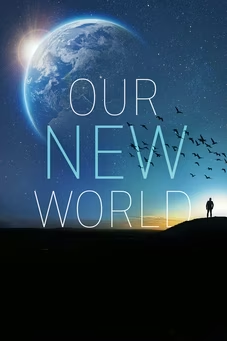
"Our New World" reveals Nature's astonishing adaptation abilities and how humans can help it thrive.











Support for PBS provided by:
NatureScene is a local public television program presented by SCETV
Support for this program is provided by The ETV Endowment of South Carolina.