
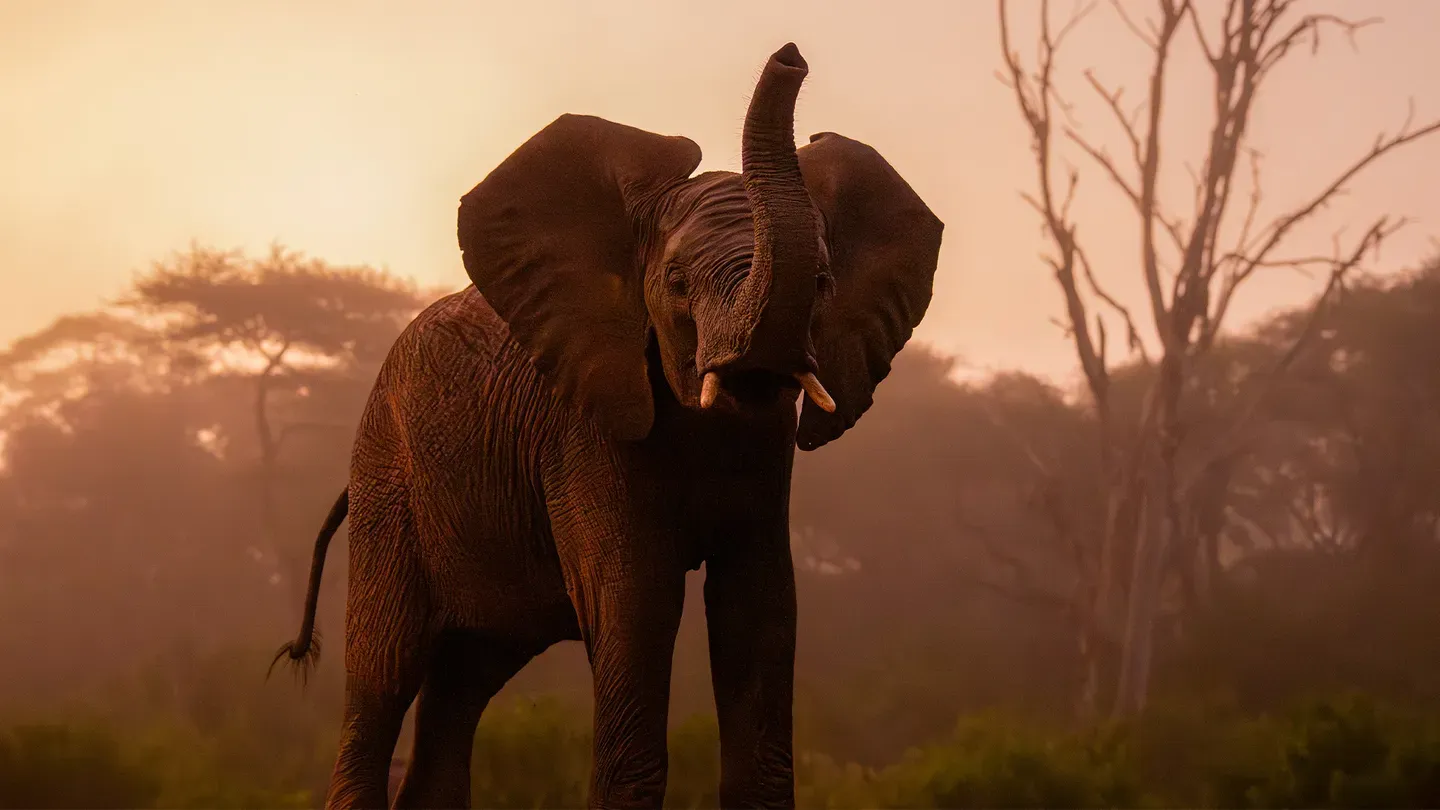
Evolution: Body Builders
Season 53 Episode 15 | 53m 45sVideo has Audio Description
Follow the surprising evolutionary journey that led to the majestic elephant.
From the first time two cells stuck together, evolution has been crafting new bodies—biological machines then put to the test by Earth's ever-changing environments. Discover the process behind the incredible variety of animal shapes and sizes.
See all videos with Audio DescriptionADProblems playing video? | Closed Captioning Feedback
Problems playing video? | Closed Captioning Feedback
National Corporate funding for NOVA is provided by Carlisle Companies. Major funding for NOVA is provided by the NOVA Science Trust and PBS viewers.
Support provided by:


Evolution: Body Builders
Season 53 Episode 15 | 53m 45sVideo has Audio Description
From the first time two cells stuck together, evolution has been crafting new bodies—biological machines then put to the test by Earth's ever-changing environments. Discover the process behind the incredible variety of animal shapes and sizes.
See all videos with Audio DescriptionADProblems playing video? | Closed Captioning Feedback
Where to Watch NOVA
NOVA is available to stream on pbs.org and the PBS app.
Buy Now
NOVA Labs
NOVA Labs is a free digital platform that engages teens and lifelong learners in games and interactives that foster authentic scientific exploration. Participants take part in real-world investigations by visualizing, analyzing, and playing with the same data that scientists use.Providing Support for PBS.org
Learn Moreabout PBS online sponsorship♪ ♪ NARRATOR: The world is teeming with life in all shapes and sizes.
ANDREW GILLIS: We see bodies that can fly, burrow, swim.
Some have bones, some don't.
Just about any form you can imagine you'll find if you look.
♪ ♪ NARRATOR: And this great variety of body shapes can be traced back to a single origin.
JEFFREY MARLOW: The earliest forms of life had no arms, heads, ears, noses, or mouths.
They were single cells.
NARRATOR: So how did life get from the microscopic to a world of giants?
RIKA ANDERSON: When the first cells found a way to stick together, it paved the way for bodies to form.
PETER GIRGUIS: And at that point, the whole diversity of animals just goes through the roof.
NARRATOR: But to get bigger and more complex, bodies needed to harness more power... MARY DROSER: Oxygen was a game changer in terms of body plans, in terms of complexity.
NARRATOR: ...team up with other organisms... My body is actually home to trillions of little microbes.
NARRATOR: ...and evolve new tools.
VICTORIA HERRIDGE: It's when you see something like this on your lap that you can really appreciate just how enormous they are.
♪ ♪ NARRATOR: How did life evolve from a single cell to the spectacular array of shapes we see today?
"Evolution: Body Builders."
Right now, on "NOVA."
♪ ♪ ♪ ♪ (elephant trumpets) ♪ ♪ (rumbling) NARRATOR: The elephant has to be one of evolution's strangest creatures... ...with an extraordinary nose that's as dexterous as a hand.
GILLIS: The trunk is really remarkable.
It has the strength to move a tree, but it can also function in such a fine way that it can pick up a single blade of grass.
NARRATOR: Enormous tusks that never stop growing.
STEVE BRUSATTE: The tusks can grow up to ten-and-a-half feet long, and together, they can weigh more than 440 pounds.
♪ ♪ NARRATOR: And a gigantic appetite.
SURESH SINGH: A huge amount of energy is needed to fuel an elephant.
We're talking feeding for 18 hours a day and eating four percent of their body weight in plants.
NARRATOR: But perhaps their most striking trait of all is their size.
HERRIDGE: Elephants define what we understand about being big.
♪ ♪ Their feet are like tree trunks.
HERRIDGE: Some of them weigh up to maybe 11 tons-- that's as much as a school bus.
NARRATOR: So how did this creature's enormous body come to be?
(rumbles) Elephants are the largest living animals that we have on the land today, but they are all just built of many, many, many cells.
BRUSATTE: Cells are ultimately the fundamental building blocks of bodies.
GILLIS: The elephant is really a marvel of evolution, because it reflects a quadrillion cells all working together.
NARRATOR: But where did those cells come from and how did they come together to form bodies?
♪ ♪ To answer that, we have to reach back into the distant past... ♪ ♪ ...to a time long before the first elephants, before the first mammals, before there were any animals at all... ...four billion years back, to some of the earliest life on Earth.
♪ ♪ This is the extraordinary story of how evolution transformed a single cell into the largest land animal alive today.
♪ ♪ ♪ ♪ Violent and unpredictable, the young Earth is hostile to life.
But beneath the waves, simple cells cling on... ...locked in a relentless struggle for survival.
Most are doomed, becoming evolutionary dead ends.
But some scientists think one cell is different.
This is LUCA, the elephant's ancient ancestor and, in fact, the ancestor of all life on Earth.
GIRGUIS: The Last Universal Common Ancestor, or LUCA for short, is the organism that gave rise, quite literally, to all life we see today.
MARLOW: It wasn't necessarily the first form of life.
It almost certainly wasn't.
But it's the one that got by.
LUCA, that great single common ancestor of all life today, that was the starting point for bodies.
NARRATOR: Scientists don't know for sure how LUCA's lineage survives.
Perhaps it's just lucky.
But what we do know is that LUCA can copy itself.
Each new generation inherits the traits that helped LUCA persist, but the process is not perfect.
Small mutations cause some copies to turn out differently.
These tiny glitches in the genetic code may be mistakes, but sometimes, mistakes can be useful.
DROSER: Maybe it's a mutation that makes an organism a little bit bigger than it might've been, or a little bit faster than it might've been.
A little mutation here, a little mutation there, that's how evolution works.
Evolution isn't goal-directed.
It doesn't have a purpose.
It's built entirely on these tiny little mistakes that allow life to take a new pathway.
NARRATOR: The journey to more complex bodies has begun.
Generation after generation, small mutations accumulate, becoming big differences.
LUCA is the seed from which the tree of life as we know it begins to grow.
♪ ♪ As time passes... ...LUCA's descendants flourish and spread.
Some adapt to capture sunlight, the ancestors of plants.
Others evolve to become fungi.
♪ ♪ Many stay small and simple, giving rise to the hidden microbial world.
But all of them descendants of that sole ancestor.
Although complex bodies still lie far in the future, life on Earth is already thriving.
♪ ♪ Until disaster strikes.
♪ ♪ Natural variations in the Earth's climate plunge the planet into a deep freeze.
♪ ♪ This period of global cooling is so extreme, it's called Snowball Earth.
ANDERSON: Snowball Earth was a time when ice sheets swept all the way to almost the Equator and our seas were almost entirely frozen over.
It was an extremely cold time and it was an extremely harsh environment for life to survive.
♪ ♪ GIRGUIS: It's not the cold of Snowball Earth that was the problem per se, but it was the fact that the amount of food available really tanked.
FRANKIE DUNN: Living during Snowball Earth was the ultimate survival test.
It would've been really hard to find enough food to make a living.
NARRATOR: Floating in these ice-bound oceans, one of LUCA's descendants is desperately searching for a meal.
Scientists call this hypothetical tiny organism Urchoanozoan.
GILLIS: Urchoanozoa can be thought of as the last single-celled ancestor of animals.
This is still a relatively simple organism, but it had a few features that set it apart from other single-celled organisms.
DUNN: So it would've had a flagellum, which is like a whip-like tail sticking out of one end, and this would have powered it through the water.
NARRATOR: Over billions of years, life evolved these new traits.
But one thing hasn't changed.
Urchoanozoan is still tiny, just a single cell, and there are only so many ways a single cell can find food.
♪ ♪ But in its battle for survival, Urchoanozoan will change the shape of life on Earth forever.
♪ ♪ (birds chirping) To illustrate the innovation that transformed life all those millions of years ago, evolutionary biologist Will Ratcliff doesn't need a time machine, just a remarkable creature alive today.
(laughs): Wow.
Look at this.
There are thousands of ants here.
Look at this little ant.
Alone, doesn't stand much of a chance, does it?
It's currently biting into my finger.
I won't lie, it's somewhat painful, but let's face it, it's not much of a match.
I could squish it right now if I wanted to.
This is a fact of life: when you're on your own, you have to make it all work.
You have to find food, reproduce, survive much larger opponents.
The superpower of these ants, however, is that they're not alone.
NARRATOR: Driver ants join forces in colonies up to 20 million strong.
RATCLIFF: And as they move through the forest, even prey that is thousands of times larger than the ants are is quickly overwhelmed if it cannot run, hop, or fly away.
In fact, right here, there seems to be an insect that has been balled over by about 500 ants.
They overcome the limitations of size through sheer strength in numbers.
And collectively, they're able to move through this forest finding prey, dismembering it joint by joint, bringing it back to the nest, feeding it to their offspring.
And together, they are able to accomplish what any one individual ant could not.
And in fact, they've hit upon a common motif in evolutionary biology, which is that with numbers, organisms gain new abilities.
NARRATOR: When you're tiny, cooperation can bring big rewards.
Over 600 million years ago, beneath the ice of Snowball Earth, it's thought Urchoanozoan is different.
The sticky molecules that cover its surface allow it to do something its ancestors haven't done before.
For a single cell, this trait barely matters.
But when it's time to divide, instead of drifting apart, the two cells remain stuck together.
♪ ♪ And they multiply... ...passing this ability on to their descendants until a vast alliance of cells forms.
♪ ♪ Some scientists call this hypothetical colony the Death Star.
Much larger than a single cell, it can do something extraordinary.
♪ ♪ By beating their flagella in tandem, the cells create water currents that suck in food, like smaller microbes, more efficiently.
A collection of cells all working together, this is the first multicellular organism and a major evolutionary step toward animal bodies as we know them.
Like every other revolution in evolution, multicellularity was an accident.
It was a mutation that allowed cells to stick together.
DROSER: Multicellularity happened many times across all different groups of organisms, so multicellularity in general originated probably 25 or more times, but in animals, there was only one moment of multicellularity.
ANDERSON: For animals, it turned out to be a winning strategy, because once they became multicellular, they never went back.
NARRATOR: The so-called Death Star can gather food more effectively than its single-celled cousins, thriving in even the harshest conditions.
But this is just the start of what a multicellular organism can do.
(birds twittering) The advantages of working together are evident in nature today.
(rustling) These ants are not a simple collection of cells.
Instead, they are an organized, integrated society, where every ant has its role to play.
Look at the size of these soldiers.
They are at least ten times larger than their worker sisters.
These soldiers, with their massive mandibles, defend the colony.
The much smaller workers find food and raise the offspring.
They dedicate their energy and their lives to the colony's success.
Specialization is a crucial evolutionary milestone.
And much like these ants, in early multicellular organisms, cells began to take on specialized roles and get new functions that their single-celled ancestors couldn't have done.
NARRATOR: When groups of cells began taking on different roles, they unleashed the full power of multicellularity.
If you are a single cell, you have to do everything all the time.
If you are a collection of multiple different cells, then you can develop organs and tissues which can specialize to do different things and give you an advantage in the world that you live in.
GILLIS: So you can have some cells that become very specialist at gathering food, other cells that are involved in motion, other cells that are involved in reproduction.
And this specialization really leads to more efficiency and more possibility.
This was a turning point in the evolution of life, because it allowed for the explosion of shapes that we see on Earth today.
♪ ♪ NARRATOR: Over millions of years, the descendants of the Death Star's cells continue to specialize.
♪ ♪ Sex cells, nerve cells, and muscle cells evolve, until what began as a chance mutation has become something revolutionary.
The age of bodies has arrived.
Just 100 million years after those cells first joined forces... ...the oceans are filled with many different body shapes and forms.
♪ ♪ Among them, an ancient ancestor of the elephant.
No tusks... (booming echo) no trunk.
Just a tiny worm, a fraction of an inch long, wriggling across the sea floor.
Compared to what came before it, it's incredibly complex, but it's still tiny.
Bigger, stronger, more powerful bodies require something that ancient creatures lacked... oxygen.
DROSER: Oxygen allows animals to survive.
Animals need oxygen in order to eat, in order to move.
BRUSATTE: Oxygen is like rocket fuel for living things.
It's highly reactive, it's highly energetic, and it was a game changer for the evolution of bodies.
NARRATOR: Animals use oxygen to convert food into energy.
But in these ancient oceans, oxygen is scarce, and early animals have limited ways to harness it.
GILLIS: Simpler animals would get oxygen primarily by absorbing it through their skin.
DUNN: In fact, there are lots of animals today which still breathe through their skin.
So, earthworms breathe through their skin, but there are limitations.
SAM GILES: You need to stay moist, so you have to stay either in the water or near a water environment to stay damp.
There's also constraints on how big you can get if you're only absorbing oxygen through your skin.
NARRATOR: Unable to absorb much oxygen, some early animals are small and slow.
But this little worm has something special.
Not all structures, when they appear, are brand new.
Evolution will often act on previous structures, which might be used for a different purpose.
NARRATOR: The worm's sides are lined with tiny pores that it uses to filter food.
But this worm has a special advantage, making it stronger and more likely to survive.
Its pores are slightly wrinkled on the inside, meaning more surface area to filter food, and also oxygen from the water.
♪ ♪ It passes these wrinkles on to its offspring.
Over generations, they deepen into folds, greatly increasing their surface area.
Until pores that were once used for feeding are repurposed for breathing.
It's the beginning of gills.
Gills were one of the major evolutionary novelties in the history of animal evolution on Earth, because it allowed animals to get more oxygen, and anything that allows an animal to get more oxygen is a win.
GILLIS: I can illustrate the power of gills using the art of origami.
So, if you imagine this is a surface that's being used to take up oxygen from the water, we have this surface area that's available for oxygen uptake, and that's kind of limiting.
But if instead we have a folded shape of the same size, you can actually increase that surface area massively in the same space, and enhance the ability to take up oxygen from the water.
So, simply folding tissue to increase the surface area is such a beautiful solution to a complex problem.
NARRATOR: Gills supercharge the uptake of oxygen, and more oxygen means more energy harnessed from food.
DUNN: Gills were an absolute gamechanger.
They allowed for much, much more easy energy capture, which fueled faster, bigger, stronger bodies.
And you can see the success of gills because they're present in so many different animal groups today.
NARRATOR: Gills come in many shapes and sizes... from the tiny clown fish to the giant whale shark.
Some have buried them deep inside their bodies.
Others carry them on the outside.
Gills allowed animals to grow bigger, more complex bodies than ever before.
♪ ♪ And in fact every amphibian, reptile, bird, and mammal alive today, including the elephant, and us, descended from ancestors with gills.
So, if gills were such a good idea, why did so many animals lose them?
In the waterways of Kenya lies something that may hold the answer.
WANJA DOROTHY NYINGI: In Kenya, fish have to be adapted to flooding and dry seasons.
Some droughts can last months and even years.
NARRATOR: Biologist Wanja Dorothy Nyingi is an expert on Kenya's freshwater fish species.
NYINGI: When the water begins to recede, then a fish species has a choice.
It can either recede with the water to a bigger stream of water or a lake, or adapt to that drop of water levels.
NARRATOR: This fish has a remarkable adaptation that allows it to survive in the shallowest of pools.
Meet Protopterus Aethiopicus, locally known as Kamongo.
NARRATOR: Like all fishes, the Kamongo has gills, but it also has something else.
NYINGI: Oh, my gosh, look at that.
That's a gulp, that's how it breathes.
That was amazing.
NARRATOR: It gulps air through its mouth, drawing it into a special sack, deep inside its body.
NYINGI: Normally, fish would breathe through their gills.
But this fish is very suited to these extremes because it has lungs.
It is a lungfish.
The lung breathing takes up over 90% of its oxygen requirements.
And the gills, though functional, are mostly for excreting carbon dioxide.
NARRATOR: This remarkable air-gulping ability first appeared around 400 million years ago, as a backup system, helping fish to survive in low-oxygen waters or brief droughts.
But when combined with another key adaptation, lungs unlocked an entirely new world.
You can see how it uses its limbs.
Unlike normal fish fins, they are muscular and very fleshy.
They have the capacity to crawl onto land.
This fish is very important when we speak about evolution, because it is our link to the transition that we made from life in water to life on land.
♪ ♪ NARRATOR: The descendants of that tiny worm gave rise to fishes with gills.
And eventually lungs, that not only helped them survive, but allowed them to do something extraordinary-- leave the water and live on land.
So, the first animals that came out onto the land were probably bugs, and then not long after that, vertebrates, backboned animals.
And they looked a lot like fishes with limbs.
PROSANTA CHAKRABARTY: I love the vertebrate transition to land because it's really fishes coming onto land, a fish out of water.
And one of my favorite fossils is this Elpistostegalian.
This was a big animal, something like this, a head this large, had a five-foot body.
We know that they had these pre-adaptations to live on land.
They have upward-facing eyes.
It breathed through its nostrils into these big lungs that it had.
And some of them start having limbs that really start resembling our hands and our feet.
NARRATOR: Scientists don't know exactly why those first fishes came onto land.
But they do know that they had four fleshy fins.
And these would lay the foundations, not just for the elephant, but for every land vertebrate that's ever lived.
This is known as the tetrapod body plan.
BRUSATTE: Once the tetrapod blueprint was in place, then that blueprint was free to be modified, to adapt, to change in so many different ways.
And that's produced things as varied as birds, which use their arms to fly.
It's produced whales, which have gone back into the water, that use those limbs to swim.
And even some tetrapods, like snakes, have lost their limbs entirely.
NARRATOR: Every paw, hoof, hand and foot on the planet today, including the elephant's and ours, all descended from those pioneering fishes that left the water and walked on land.
♪ ♪ SUMIDA: In today's world, we see an incredible diversity of body plans that are derived from the original tetrapod plan.
KORY EVANS: Every habitat you go to almost has a tetrapod living in it and has a tetrapod that's adapted to live in these really interesting habitats.
NARRATOR: But having four limbs isn't the only successful body plan out there.
SUMIDA: There are hexapods, like six-limbed insects, decapods, lobsters and crabs and shrimp.
There are animals with dozens of limbs on either side, like centipedes, for example.
NARRATOR: From no limbs to hundreds of limbs, evolution has shaped animal bodies into a myriad of different forms.
♪ ♪ But tetrapods have one major advantage.
They're really good at getting big.
♪ ♪ In the generations that pass after those first fishes left the water, they evolve stronger skeletons to support their bodies on land.
The most efficient lungs on the planet.
And robust joints to carry more weight.
And these traits allow some of them to evolve... ...into giants.
(wind whistling) Beings so large few predators dare challenge them.
A huge body can store more fat and water.
♪ ♪ And tall animals can access food that smaller animals can't reach.
Thanks in part to their enormous size, giant dinosaurs dominate the planet.
SUMIDA: Dinosaurs persisted for 180 million years, and they became the largest animals to have ever lived on the land.
So, in terms of size and diversification, dinosaurs may well be the pinnacle of tetrapod evolution.
NARRATOR: While the dinosaurs dominate... ...the ancestors of the elephant are still tiny.
They share the same four-limbed body plan, inherited from those pioneering fish.
But on a much smaller scale than the dinosaurs.
They're called Afrotherians, because they evolved in Africa.
♪ ♪ In this land of giants, their small size may seem like a disadvantage.
But that's about to change.
DROSER: Whether it's volcanism or an asteroid impact or climate change, the environment can absolutely be ruthless.
SINGH: Sudden environmental changes can completely change the challenges that animals have to overcome.
CHAKRABARTY: One adaptation might be good right now, but the environment might change, and it might change drastically.
GILES: What was previously a really useful adaptation, like being really big, can suddenly become a really big hindrance.
So, when it came to making it through mass extinctions, size really mattered.
NARRATOR: An asteroid devastates the planet.
Few survive.
The giant dinosaurs are finished.
In the end, their size is part of their downfall.
♪ ♪ GILES: In the aftermath of the extinction, anything that was above the size of, like, a big raccoon would have gone extinct.
SUMIDA: When you're really, really big, that means you're sort of specialized.
And when the environment changes, specialized animals are often, uh, subjected to a greater deal of pressure than those that are small and generalist.
GILES: In the post-meteor world, vegetation would have disappeared, entire food sources would have collapsed.
It was much better to be small, to be flexible, to be agile, being small is a really successful, uh, survival strategy.
DROSER: And it's those animals living in the shadows sometimes that come on to dominate Earth, and we see that time and time again when we look at the history of life on planet Earth.
The survivors sometimes come from very unexpected places.
♪ ♪ NARRATOR: In this new age, the small furry mammals find a world of opportunity.
And in Africa, the elephant's ancestors are among those that make it through.
Agile and adaptable, their small body size and sheer number are key to their success.
And so is their flexible diet.
These Afrotherians will eat almost anything.
Including plants.
Plants seem like easy prey.
They don't run, they don't hide.
But that doesn't mean they're defenseless.
MARLOW: Plants have evolved all kinds of ways to protect themselves.
GIRGUIS: Thorns, bark, even chemicals.
All of this is warfare.
It's to keep from being eaten.
NARRATOR: But even if you can get past their defenses, there's another problem with eating plants.
They contain a lot of cellulose.
GIRGUIS: Cellulose is this fantastic building block of a molecule that's made by a bunch of plants.
Think of it as like the structural part of a plant, the scaffolding-- it helps give plants their strength.
It helps them stay upright, and it's really, really, really hard to break down.
NARRATOR: Even today's plant eaters can't fully digest it.
After a full trip through the gut, nearly half the meal emerges intact.
SINGH: What we have here is a bit of horse dung.
If we take a closer look, you can clearly see the problem; there's actually a lot of fibrous material still in here.
There are little strands of grass here and there.
The grass has been chewed, it's been digested and yet it's still incredibly intact.
So, just goes to show it's tough being a plant eater.
♪ ♪ NARRATOR: So how did early Afrotherians manage it?
Throughout evolutionary history, plenty of animals have fed on plants, but few have been able to break them down unaided.
They have relied on an unseen partnership with something that they swallow along with their food.
SINGH: Most animals lack the enzyme cellulase, which allows them to break down cellulose.
But they have a secret weapon inside their guts.
Microbes.
And some are actually specialists in breaking down cellulose.
NARRATOR: Today, almost every plant-eating animal has outsourced digestion of plant matter to microbes.
It's what's known as a "symbiotic relationship."
These relationships are so important that, over time, evolution drives both species to become more and more interlocked.
They effectively can't live without each other.
NARRATOR: Without the communities of microbes living in their guts, most animals wouldn't be able to survive.
Including us.
SINGH: My body is actually home to trillions of little microbes.
And that's the microbiome.
In fact there are trillions of these cells in my gut alone, four-and-a-half pounds in fact.
Microbes love to live in the guts of organisms because it's kind of like an all-you-can-eat buffet.
The microbes don't have to move in any way shape or form.
The animals do the job of eating, the microbes do the job of breaking it down.
NARRATOR: Thanks to their gut microbes, the early Afrotherians thrive.
Spreading out across Africa, moving into many of the habitats left open by the giant dinosaurs.
BRUSATTE: When a lot of animals disappear, when there is a mass extinction, let's say, that means a lot of niches, a lot of jobs open up.
GILES: An animal's niche is what it eats, it's where it lives, it's what it does, it's how it behaves.
And animals can be really specialized for particular niches, to eat a particular kind of leaf.
Or hummingbirds can be specialized to have long beaks that allow them to extract nectar in a way that no other animal does.
EVANS: So, after a large mass extinction event, the surviving animals will then evolve often times to fill these jobs and fill these roles, um, and that can result in some really impressive adaptations and innovations.
NARRATOR: Some of the descendants of those Afrotherian survivors still live in Africa today, their bodies sculpted by the niches they inhabit.
WINNIE KIIRU: Growing up in Kenya, there was wildlife all around us.
I got so curious about how they live, how they survive, and that sparked my interest in becoming a biologist.
NARRATOR: Biologist Winnie Kiiru has dedicated her life to understanding and protecting some of the Afrotherians that survive to this day.
KIIRU: The Afrotherians are very unique and interesting.
Look at this animal, this is the hyrax.
Looks very much like a rodent, so furry.
NARRATOR: A small, nimble plant eater, the hyrax has retained many of the characteristics that helped its ancestors survive.
KIIRU: They climb very well.
They have these amazing soft pads on the bottom of their feet that are kept lubricated by their sweat glands, that allow them to move very well in the trees, and they can reach the top canopy, where they're able to find all these different leaves.
And because of being high up, they can also look out for predators.
NARRATOR: The tree hyrax body is shaped for life in the canopies.
KIIRU: They are very well adapted to the niche that they have found.
And their success is obvious, because they are very prolific around Nairobi.
You find a lot of them in the gardens here.
NARRATOR: While these hyraxes adapted to live in the trees, other Afrotherians moved into entirely different habitats.
KIIRU: Even if they look like rodents, some of their closest relatives are actually elephants.
Very unlikely relatives.
NARRATOR: Although closely related, hyraxes and elephants seem to have completely different bodies, because they evolved to live in different niches.
The Afrotherians had an excellent advantage because they were isolated on the African continent and had very little competition, and so they could actually populate a whole lot of different niches.
NARRATOR: Over countless generations, the Afrotherians adapted to a wide variety of different environments and lifestyles, making them one of Earth's most eclectic groups of animals.
KIIRU: The manatees went into the water.
The elephants went off into the savannahs.
The hyraxes eat all these leaves, high up in the trees.
And then you have the elephant shrews that went out and ate insects.
And the aardvarks with their long snouts that are able to go and find food in the termite mounds.
So, with all these different niches, it meant they were not competing against each other.
NARRATOR: Over time, the early Afrotherians spread across Africa, adapting to different niches that shape their bodies in different ways.
♪ ♪ (thunder rumbling) Some evolve bigger guts to process more plant material.
And a bigger gut... ...means a bigger body size.
This stocky creature is around three feet tall, much larger than its furry ancestors.
It spends most of its time browsing on plants.
It's an early Proboscidean, a relative of the elephant.
It's evolved elongated incisors for tearing through dense vegetation.
But big teeth can have their drawbacks.
Okay, right, so I'll put that on there.
Okay, I got it-- watch your fingers.
Like that?
You got it?
Okay?
Yeah, I got it.
There we go.
CHAKRABARTY: Evolution doesn't have a goal.
It's not working in a straight line towards some end.
All right, yep-- wait, oh!
Evolution finds solutions to problems.
And I got it, yes, comfortable.
This is the skull of a walrus.
These tusks can be really long.
They can be up to three feet from the very top all the way to the bottom.
These are used for mating and for courtship.
It's hard for these to eat with these big tusks in the way.
So, what they have to do is they stick their snouts into the mud and then find the little crabs and clams and mollusks, tucking their tusks behind them.
DROSER: Sometimes with evolution you end up with really strange body plans that you couldn't predict, that don't seem the obvious body plan to evolve on Earth.
GIRGUIS: So, evolution is always a compromise.
Sometimes you solve one problem, you create another.
NARRATOR: Like the walrus, these Proboscideans have muscular noses that they use to push food towards their mouths.
But this individual was born with a slightly longer one, giving it a tiny advantage.
It may not look like much, but it's the start of something entirely new.
Over countless generations, the muscular nose gives better access to food... ...fueling an even bigger body, which in turn, drives a longer nose, capable of reaching all the way to the ground.
Until, after millions of years, one of the most unusual bodies in the animal kingdom arrives.
This is Palaeomastodon.
It roamed the Earth around 30 million years ago.
It has the trunk and the tusks.
Big ears are still a work in progress, but it's a body shape that looks a lot like an elephant's.
Palaeomastodon is one of the many extinct ancient relatives of the elephant.
Originating in Africa, these relatives soon spread across the globe, adapting to new niches, which continue to shape their bodies.
Some have bizarre jaw extensions.
Others evolve downward-curving tusks.
And of course, the mammoths, those hairy icons of the ice age.
With huge guts for digesting masses of plants, the Proboscideans become some of the largest mammals to have ever walked the Earth.
Um... (chuckles) Does that work?
Like that?
WOMAN: That's amazing.
(chuckles) HERRIDGE: This is a replica mammoth tusk.
Uh, it's made of polystyrene, but even made of polystyrene, it is pretty heavy.
A tusk is really just an overgrown incisor.
So, that's your front teeth here.
Tusks come in all shapes and sizes, but it's when you see something like this on your lap that you can really appreciate just how enormous they are.
♪ ♪ NARRATOR: But of this once-diverse group, some 180 species strong, only three remain.
The Asian elephant.
The African forest elephant.
And the largest land animal on the planet today.
The African savannah elephant.
HERRIDGE: If you look at an elephant, I think you will see three things immediately that stand out.
Their enormous size, their incredible tusks, and their amazing, unusual, and unique trunk.
DROSER: It is the ultimate evolutionary multi-tool-- so, you're using your trunk to breathe, you're using it to pick up things from the ground and bring it to your mouth-- it's amazing.
And it is this extraordinary example of how evolution works.
NARRATOR: With a body that's made of a million billion cells, and powered by some of the largest lungs of any land animal... ...a gut up to 120 feet long, packed full of microbes for digesting plants... ...tusks that never stop growing... ...and a nose like nothing else on the planet... ...the elephant is one of evolution's most extraordinary creations.
There's something about elephants that speaks to humans.
Maybe it's because they have been our constant companions on our own evolutionary journey.
CHAKRABARTY: They share a close relationship with us and an environment with us.
They've been worshipped, and that's clear from a long history of, of human interactions with these beautiful creatures.
NARRATOR: Four billion years of evolution shaped the elephant we see today.
But its story is far from over.
Today, humans have become a driving force.
By poaching elephants in huge numbers for their ivory tusks, we are changing the course of their evolution.
GIRGUIS: We're starting to see that humans poaching elephants for their tusks is favoring those few elephants that are naturally tuskless.
HERRIDGE: There is such strong selection pressure on some populations that it looks like there is now an advantage to those elephants to not have the tusks that have been part of their evolutionary history for millions and millions of years, and the best explanation for that is us and poaching.
NARRATOR: But evolution never stands still.
GIRGUIS: If we get to a place where we're not hunting tusked elephants, and having tusks is advantageous, they'll come back-- that's how evolution works.
♪ ♪ NARRATOR: The elephant is not the end of the journey, just the latest chapter in a four-billion-year story that began with a single cell.
CHAKRABARTY: For me, it's so humbling to know that we're just part of this puzzle of evolution, this tree of life.
All life on Earth is related, and evolution helps us not just to understand who's related to whom, but how we got to where we are, and why we are the way we are.
♪ ♪ ♪ ♪ ♪ ♪ ♪ ♪ ♪ ♪
 New Episode
- Science and Nature

Capturing the splendor of the natural world, from the African plains to the Antarctic ice.

 New Episode





Support for PBS provided by:
National Corporate funding for NOVA is provided by Carlisle Companies. Major funding for NOVA is provided by the NOVA Science Trust and PBS viewers.