
Exeter Cathedral
5/1/2026 | 43m 36sVideo has Closed Captions
Dating back to 1114, this magnificent cathedral is crumbling away.
Exeter Cathedral is an awe-inspiring example of Gothic architecture. A team of experts tries to rescue this building's medieval glass and remarkable stonework.
Problems playing video? | Closed Captioning Feedback
Problems playing video? | Closed Captioning Feedback
Nick Knowles: Heritage Rescue is presented by your local public television station.
Distributed nationally by American Public Television
Exeter Cathedral
5/1/2026 | 43m 36sVideo has Closed Captions
Exeter Cathedral is an awe-inspiring example of Gothic architecture. A team of experts tries to rescue this building's medieval glass and remarkable stonework.
Problems playing video? | Closed Captioning Feedback
Where to Watch Nick Knowles: Heritage Rescue
Nick Knowles: Heritage Rescue is available to stream on pbs.org and the PBS app.
-Today, one of Britain's most stunning cathedrals is under attack.
-The biggest threat to medieval stonework is just time.
-It's amazing to think that this building has stood resolute over Exeter for over a thousand years.
But now it's disintegrating.
-Decay kind of accelerates more decay.
-I'll follow the team saving medieval glass from wrack and ruin... -This particular example is 700 years old and it's gone completely opaque.
-...discovering decoration hidden for 500 years... -I think this is early 14th century.
It's really beautiful.
-...and putting the smile back on the face of some incredible stonework.
-The face is inside the stone.
We've just got to find it and get it out.
-[ Laughs ] From castles to stately homes, Britain boasts some of the world's most glorious buildings.
But I think it's magnificent.
Nuts but magnificent.
With hundreds of years of history.
-Why was it hidden under a floorboard?
How did it get there?
-But our heritage is under threat.
-Something like 300-plus rooms are completely derelict.
-Come with me to see some extraordinary buildings being saved.
Look at the scale of it.
It's vast.
Meeting the craftspeople dedicated to their rescue.
-59 1/2 minutes of preparation.
30 seconds of glory.
-And witnessing the skills and passion needed to keep these incredible places alive.
-I'm leaving something behind that's going to last longer than I am.
It's a good way to make a mark on the world.
-For us all to visit and enjoy.
♪♪ Right in the middle of Exeter is one of Britain's oldest and most magnificent cathedrals.
It began life in 1114, started by Norman conquerors to show off their power, and it took the next 350 years to build.
It's been at the center of life in Exeter now for the best part of a millennium.
Henry VII's reformation couldn't finish it off.
The Puritans of the Civil War under Cromwell couldn't finish it off.
And finally, Hitler's bombs couldn't flatten it either.
Had a go, but couldn't finish it off.
But it has had a constant enemy.
The weather.
Centuries of wind and rain have wreaked havoc on the place.
But you still can't help being knocked sideways by its beauty and scale.
Especially arriving at its west front.
Reverend Greener, how are you?
-Well, thank you.
Welcome to Exeter.
-The very Reverend Jonathan Greener is Exeter's dean.
It is -- well, it's just a spectacular frontage on the place, isn't it?
-It's amazing really.
700 years old.
Apostles at the top and kings.
Of course, it was painted originally.
It's only when they took the paint off that it started deteriorating.
-Is that right?
-Yes.
-Can we have a look inside?
-We can.
-Incredible though the entrance is, it's just the warm-up act... ...for what awaits within.
Wow.
Well, I'm not a religious man, but I -- I felt I had to take my hat off to this.
This is extraordinary, isn't it?
-I think that's why it was built, to give a sense of awe and wonder.
-At over 380 feet, it's longer than an entire football pitch.
Generations of craftsmen spent their entire lives working on it.
-They started building at the far end.
And because there's no central tower, they continued the construction.
60 years later, they finished at this end.
This is the longest vault in medieval Britain.
Such attention to detail everywhere.
Everything's done to lift your hearts to heaven, really.
-It is stunning.
I can't help thinking that, 800 years ago, the people coming in from the countryside, or even the people in the village would look up at this and say, "It's so impressive.
This is where God lives."
-I think that's exactly what it's designed to do, and I think it still has something of that effect for people coming in.
-Presumably all the workmen that are working on this, because they're working on the cathedral, all of their sins to date would have been forgiven, wouldn't they?
-That's what we like to -- We offer them a fast passage to Heaven if they do a good job and cut the bill.
-[ Laughs ] That's definitely worth it.
You probably get a good price then, as well.
It wouldn't hurt to save a buck or two, as there's a massive amount of work to do over the next six months to stop the cathedral crumbling away.
There are nearly 100 panels of medieval stained glass to save.
There's exploration to find lost medieval paintings in the cathedral's chapter house.
And high up on the southeast of the cathedral, there's stonework in desperate need of repair.
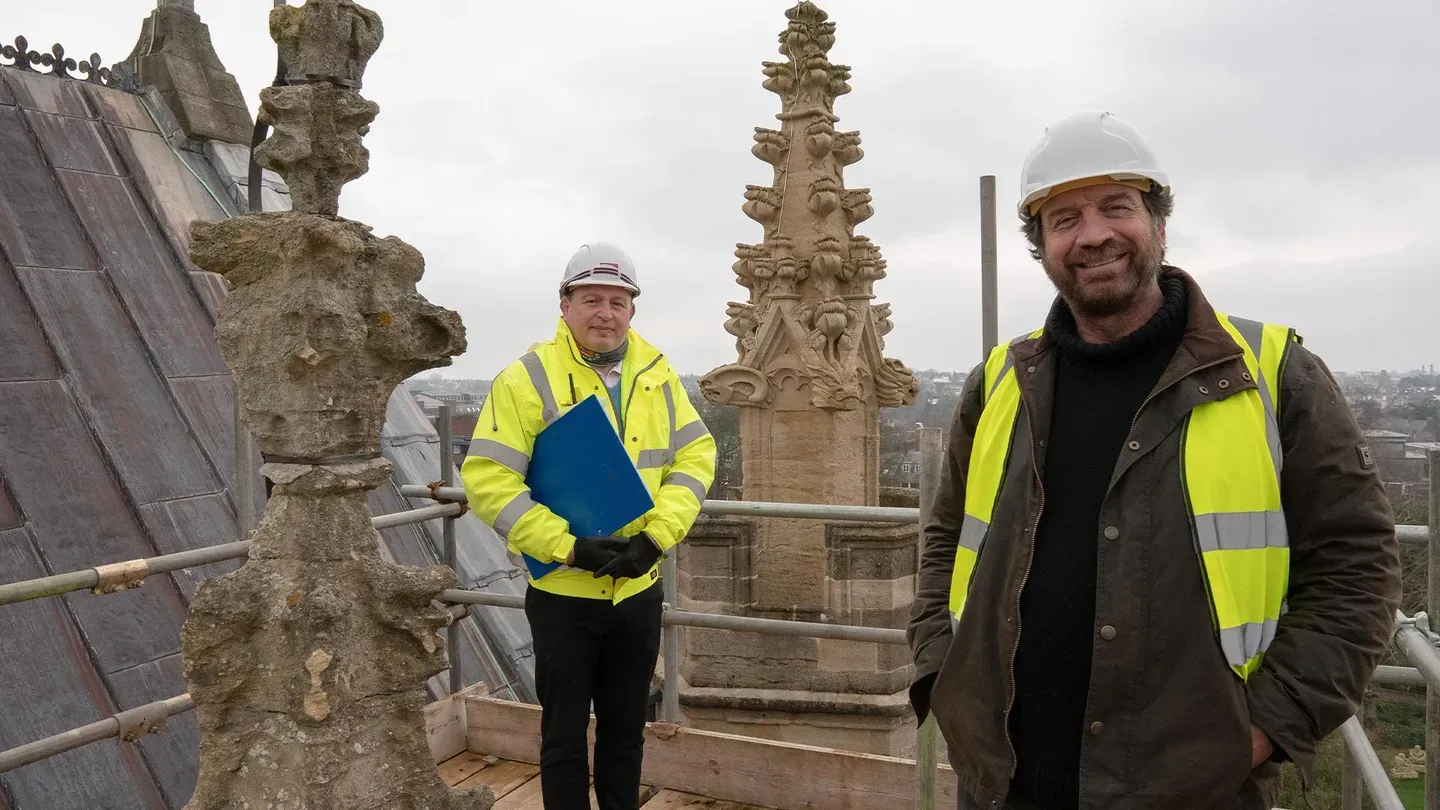
Chris Sampson, clerk of works, runs the six-strong team of stonemasons.
Not a job for someone with a fear of heights.
How high up are we here?
-We're about 9,500 feet up.
Or roughly that sort of -- -Yeah, which is making my knees go slightly watery looking over the side here.
What's fascinating is you can see everything from up here.
-Yeah.
You get a good panoramic view of the whole of the city.
-But more importantly, everyone around could see this.
-Yes.
That was the whole point, that this became the focal point of medieval Exeter.
-What are your big challenges up here?
-Prevailing winds and weather come from the southwest.
Where we are here, we're taking the full force of obviously anything which comes up.
But the biggest challenge and the biggest threat to medieval stonework is just time.
-Do you call this a finial?
-Well, this is -- The whole entity of this is actually a pinnacle, which is like a little spire, shall we say.
-And it's obviously dramatically worn away.
So how long, in terms of work, to change that and get it clean and renewed?
-The full process from beginning to end, for four of our masons, is nearly a year.
There's no point thinking that we'd ever complete all of this work at a cathedral, because it's a falsehood.
We never will.
-The next pinnacle in the frame is this one.
And those pieces deemed to have less than 80 years left in them have already been removed.
It might be 100 feet up, but to stonemason Owen Whitfield, making a perfect replacement is as important as if it were at ground level.
To get it right, he's copying details from a neighboring pinnacle in better condition.
-It's in pretty good shape.
You know, it survived, you know, 150 years of weather and, uh, a bomb.
So it's done quite well.
-Owen has to take measurements that he can follow back in the design studio.
-I've got a bit of template plastic here, and I've got a line on it, which is now the center line, and now I can mark the angle of the gablet.
And you get this right and make the drawings right, and then the rest of the stone is much easier to work.
-Straight lines are straightforward, but for curves, there's this natty little gadget.
-Okay, this is a profile gauge.
I'm using this to take a profile of this molding that we call a cavetto, and I'll trace around this and transfer that information onto a drawing so we can accurately replicate this molding.
-Back in the warm, Owen has to draw up all his measurements.
-We use these drawings to make the templates that we'll use to make the stone.
We use a piece of acetate like this.
We lay that over the top, and then we can draw on that in pen.
And then... this is the finished template.
-Finally, in the workshop, Owen can prepare the stone.
-Right.
I'm just applying the templates to the stone.
And then, I'll mark these on by drawing round them in pencil.
And that'll show us where the stone is inside the block to give me the sort of outline of all the bits that I need to take off.
Here we go.
-As Owen prepares the first stone for carving, I can see how they will need a year to build a single pinnacle.
You know, there is no doubt that the people who imagined, designed, and built this did it for the glory of God.
But I've been struck today by how the people who work on it now see it not just as a building, but as a living, breathing thing that they need to keep in good order for future generations.
And the joy for me is that the artisans who do that work are still around to be able to do it, and we get to see them do it, too.
And with huge stained glass windows to conserve, too, there's so much more than stonework.
♪♪ Exeter Cathedral has stood for the best part of a thousand years, often in the face of adversity.
If I'd have been unlucky enough to have been stood here at midnight on May 4th, 1942, I would have been blown to bits.
A German bomber overhead dropped a bomb which came crashing through the ceiling and exploded right here.
It was in a series of raids that Hitler orchestrated using a tourist guidebook to earmark the UK's most historic cities.
Exeter and its cathedral were at the top of the list.
Now, it can't have been easy for the guys tasked with putting this building back together again.
When King George VI visited to see how they were getting on with the renovations and the restoration, he described this as the largest jigsaw puzzle in the world, but the Exeter stonemasons stepped up to the plate and did a magnificent job.
And I can introduce you to the man who was in charge of the masons, up there in the corner.
A little tribute to him.
His name's George Down.
There he is with his flat cap.
Well done, sir, well done.
It's a fitting tribute for George to be immortalized in stone, alongside the hundreds of grotesques that cover the cathedral.
Supposedly to ward off evil, stonemasons have relished carving grotesques for centuries, and today Joe Milne has the honor of replacing one on the pinnacles.
-Hi, Nick.
-Hi.
I'm really excited.
I've got to tell you.
It's one of those magical things that's just so amazing to watch.
To make a face come out of a lump of stone.
-Yeah.
The face is inside the stone.
That's what we like to say.
It's always in there to start with, and we've just got to find it and get it out.
-Are these gargoyles or grotesques?
Because I'm never sure of the difference.
-These are actually grotesques.
A gargoyle usually has a water spout coming out of its mouth.
-Talk me through the process.
So this is the clay version that you've made.
-That's right.
I can then use this clay model to kind of take some measurements across from -- to the stone to help me carve it.
So I use some calipers to sort of measure things like the width of the nose or the distance between the eyes.
I then carry that over.
-What tools are you using at the moment?
-Right now I'm just using a selection of smaller chisels to work out some of the rough details.
I'm not really looking to carve anything too fine yet.
I'm just trying to find all the high points and get a general shape so you can start seeing the face coming out the front here.
-So how do you get the finish?
Because obviously the end finish is very polished.
Do you sand it or what do you do with it?
-Well, I'll use something like one of these tools, which is called a riffler.
And that's just used like -- like a rasp would be on wood.
And you can use that to take out some of the tool marks and leave it with a bit of a smoother, finer finish.
-It's an amazing thing that you're making something that's going to go up on this cathedral.
You know, the ones that have been up there since 1340, and there's no reason why yours shouldn't be up there for another 400 or 500, 600 years.
-I hope so.
That's what we aim for, you know, like it to be there long enough so that, when I'm old, I can point up there and say, "That's one that I made."
-Nothing's quick in masonry.
It will take two weeks to make a grotesque from start to finish.
Just on the next bench, Owen's at least made some progress on his gablets for the pinnacle.
-This is the one that we removed.
And you can see a lot of the details missing on that.
There are some up there which I'm taking photos of.
So, working between that and this, I try to recreate what was up there.
It's got a couple of crockets on it.
I've already carved this one.
And now I have to try and carve one that looks pretty similar to this, which is the tricky bit.
-One of the oldest parts of the cathedral is also one of the most beautiful.
Overseeing its restoration is architect Camilla Finlay.
Camilla, what is this place?
-So, this is the chapter house of Exeter Cathedral.
-The chapter was a group of the bishop's closest advisors, and this room was their private headquarters.
Its incredible ceiling shows that they had some fancy tastes, but it's believed that once upon a time the walls would have also been brightly painted.
So, what's under all these wrappings all the way around?
-So, hidden under these wrappings are a whole series of sculptures from the 1960s.
What we would like to do is see what's behind it, because we've got a hunch, or we've got a fairly good idea, that there might be some medieval wall paintings still behind these.
-Okay.
So you know that there were medieval wall paintings in here.
Why would they be still behind the sculptures?
-Part of the thing that they did in the 19th century was to scrub the walls.
But we know that because they've put boarding up in these niches, they may have left the wall paintings behind.
-Oh, this sounds exciting.
Can we have a look?
Camilla's been granted special permission to remove one sculpture.
This one here?
-Yep.
First thing we need to do is get that fleece off the sculpture.
-If they find anything, they can make a case to remove the others.
-There we are.
-Oh, oh, oh.
-Ooh!
Now, as you can see, it's a little bit lighter than you might think.
-When I tried to grab it, I thought it was going to be bronze and it was going to be really heavy.
And it wasn't.
-No.
It's fiberglass.
-Right.
-I mean, it's been made to look like bronze.
-I don't want to upset the artist or anybody, but that, it does look more like something from a horror film.
It's actually the Virgin Mary hearing from the angel Gabriel that she would give birth to the Son of God.
Which, to be fair, might have been a bit of a shock.
But she was made in the 1960s.
What she hides could be more than 500 years old.
-You see, it's so light.
-Yeah.
-I mean, it's totally deceptive.
You think it's going to weigh a ton.
-Down.
Leave her on the scaffold boards.
-Let's have a look, shall we?
-Yeah.
-Should we take the boards off?
-Medieval stone and glasswork often survives the ages, but decoration is incredibly rare.
You'll be very upset if they've scrubbed under here, as well, won't you?
-Oh, big disappointment.
-There we go.
-Ooh, careful.
Gently does it.
-Move them out.
And there we go.
All right there.
-Are we seeing anything?
-Yep.
Yeah, we've got them.
-Yeah, absolutely.
-No, we've definitely got them.
-Have you?
-Yep.
-Where?
-There, up there.
Look, the whole painted niche.
Do you see?
-Oh, I see.
-It's absolutely -- It's absolutely brilliant.
So look up there.
There.
Can you see?
All painted?
-Yeah.
-Absolutely perfect.
Exquisite.
That is spot on.
-What age are we talking about there, do you think, looking at it?
-I think this is early 14th century.
So this is really quite special.
Very early and actually really complete.
-How special is that?
-I mean, it's really special.
It's really beautiful.
-Camilla, you have tears in your eyes.
You're actually genuinely emotional about this.
-Really excited, genuinely excited, genuinely excited.
We've got something here that is part of that original scheme.
If it's here, we might have it in all these niches.
And if we're going to get this building to be back to its medieval glory, then this sort of fragment is really essential to that.
-I think it's astounding and a real honor and joy for me to be able to see something like that uncovered, and discovery of this sort, as I say, it's like, you know, you're lucky if you see something like this once in a lifetime.
This is just the start of the exploration.
There could be even more to uncover.
♪♪ This is the west front of Exeter Cathedral.
Experts say it's one of the greatest architectural achievements of medieval England.
It's covered in 87 intricately carved characters.
Which, let's face it, look to have seen better days.
Ready when you are, Matt.
-Okeydoke.
Up we go.
-Every five years, archaeologist John Allen inspects the stonework so essential conservation can be done.
The figures feature apostles, angels, and saints alongside Christ.
-This is the court of Heaven.
There is Christ at the center of Heaven, seated.
And in the original medieval design, a second figure sat there, which was the Virgin Mary.
But at the Reformation, the images of the Virgin were condemned, and so they were torn out all over the country.
-Of course, so she was very tied up with the whole Roman Catholic thing.
-Exactly.
For centuries, that niche was vacant.
And when, in late Georgian times, in 1817, they chose to restore the front, they saw this shield, which is Richard II.
So we put in Richard II.
-Put the wrong person in.
-But it's a complete blunder.
We've now got Heaven itself with Christ surrounded by angels and saints, crowning, not the Virgin Mary, but Richard II.
-Originally, the whole screen would have been painted to add to the impact.
The court of Heaven must have been a very colorful place, yet there's no desire to return it to that.
-It's all highly painted.
-But in modern tastes that couldn't be done again to protect it because it would just look too gaudy.
-That's part of the problem.
We just don't know enough about the color to be confident in replacing it all.
-If it were painted, it would protect it better.
-It would, and obviously it would be an amazing sight, but we really couldn't carry it off in an authentic way.
-Without a protective paint layer, these west-facing sculptures bear the brunt of the weather.
On the top row, stone conservator Matt Hoskins has spotted some new cracks and holes.
-We're just going to catch these little water traps and little weather pockets.
-So, where there's a crack appears in the statue, rainwater can get in and then freeze, and that busts it off, doesn't it?
-Yes.
Decay kind of accelerates more decay.
-To fill the cracks, Matt uses a very traditional filler that allows moisture to evaporate.
-It is a lime putty mortar.
It's lovely to use.
Right.
So the first thing is we just spray it up a little bit, because if it's too dry, it just won't stick.
And then... -Do you try and follow the form of it, or do you put some in and then shave it away?
How do you go about it?
-So you have to overfill it, and then you come back when it's kind of gone leather hard and scrape it back.
-Until the mortar sets, it has to be protected from drying out too quickly.
-For that purpose, we use cotton wool.
All we do is we just literally spray up cotton wool, make it nice and wet, and then just press it onto the repair, and we can leave that now until tomorrow.
-So that's why, when I arrived today, there's these little pieces -- It looked like, from a distance, like a seagull that had a very bad incident all over it.
But in actual fact, it's cotton wool.
And it's doing the job that you would do, like, on your bedding plants in the spring when you want to keep the frost off them.
You put like hessian or something over the top just to keep it protected from that frost.
-Yeah, yeah, it's exactly the same thing.
-It's not just the stone that bears the brunt of the weather.
Much of the cathedral's incredible stained glass dates back as far as the 14th century.
After Hitler bombed the cathedral, much of it was removed for the rest of the war to protect it.
However, time and the weather have still done their worst.
And over the next five months, there's a huge project to conserve 96 glass panels led by specialist conservator Jack Clare.
Jack, this cathedral has some of the finest examples of medieval stained glassware anywhere in the country.
-Yes, absolutely.
-And you've got to repair it.
-We do, yeah.
-No pressure then.
-It's some responsibility, yeah.
-What sort of problems do you come up against in these old windows that, you know -- I mean, how knackered are they?
-Well, they've survived remarkably well.
-Oh.
-But there are some problems with the structural makeup.
So, this particular example is 700 years old.
And you can see, in this central part and some of these outer bits, it's turned brown.
It's gone completely opaque.
So that is corrosion where the glass is chemically breaking down.
-How much of that is just plain dirt that you can get off to make it brighter?
-A bit.
Certainly the cleaning takes off surface dirt.
So you've got years of soot from burning of candles and incense.
But the corrosion is irreversible and, in my eyes and many others, add to the beauty of it.
-You think?
You don't think you should flip it out and maybe get a new bit in that's going to look a little bit better?
-No.
Absolutely not.
[ Laughter ] -While Jack and the team get the panels ready to go to the restoration workshop... Where are we going?
-We're going up all the way to the top.
-Wow.
-So we can get right up into the ceiling.
-...next door in the chapter house, architect Camilla has been investigating what else the place might be hiding.
That ceiling, as well.
The roof's beautiful.
-Yeah, it's amazing, but it has had a lot of change.
It's been through various phases of repainting and repair.
And actually, when you get up there, you're going to probably see quite a bit of work that you're not going to like as much as the old.
-The long-term plan is to return it to its original medieval state.
Over the next few months, they're investigating whether any of the dodgy Victorian repair work might be reversible.
Interestingly, what looked great from below, when you get up close, there's lots of things going on.
It's sagging in various places and weirdly, on the back there, I was like, they've replaced woodwork with steelwork, which is incredible.
-Yeah.
Cast iron.
When I was down at the ground level, having never been up here before, I'd assumed all this was timber.
And then, as we got closer, we realized that it is actually that they very, very carefully mimicked the timber in cast iron.
-Amidst their clever paint job, one of the 15th century carvings has suffered a bit of an indignity.
It's a bearded angel.
-I mean, it's so crude.
It really does sort of change the quality of the carving.
-I can't remember what it reminds me of.
-It's kind of got that fairground carousel look about it.
-That's what it is.
Yeah.
Or it puts on its rouge the way my nan used to.
-Yeah.
-Six centuries of repairs and remodeling aren't easy to unpick.
So, Camilla and her team are doing some exploration, starting with the paintwork.
Specialist conservator Ruth McNeilage is testing to see if they can remove the modern paint using an alcohol rub, revealing much brighter layers of medieval paint below the surface.
-You have to work through the dirt to get to the varnish, and then under the varnish, in some areas, is a later paint layer.
So, in this area, I've had to take off a varnish layer and a red oxide layer, because the original red is a vermilion.
This red color, which you can see is much brighter.
-So, how many layers of paint are we talking about?
Because some of this building was Norman.
So are we going back that far with the paint?
-No, no, because there was a fire.
So the roof was rebuilt in the 15th century.
So the earliest paint on the ceiling is from the mid-15th century.
-So what's the most recent painting that's gone on up here?
-We can tell it's 20th century from the pigments in the analysis.
So they use titanium dioxide, which you only get in the 20th century.
So that's why analysis is very useful, because you can actually date the paint layers from it, as well.
-Is that angel supposed to look like that?
-No, I don't think so.
I don't know if that was someone just having fun with a brush.
[ Laughing ] Not quite sure.
-70 miles north at the Holy Well Glass Studio, the 96 panels of medieval stained glass have arrived, and Jack's team of specialists form a sort of medieval conveyor belt.
It starts with Clare, expert window cleaner.
-This medieval glass, the paint is very fragile, so the skill is to clean the glass, remove the dirt without removing any of the paint.
So I'll start using a 50/50 solution of acetone and deionized water.
And with a cotton swab, I'll just roll across the surface of the glass.
This allows me to remove surface dirt without damaging any of the paint layers.
-Clare also removes the excess putty that would have held each piece in their lead frames, which, though they've been repaired several times in the past, now need to be remade by Sarah, sort of chief jigsaw maker.
-They were leaded before late 19th, early 20th century, probably.
In the middle, the lead is still in quite good condition, so it doesn't need replacing.
But the outside, the bigger sections had started to distort.
That involves a bit more work to get the pieces to line up properly when you've got old lead and new lead coming together.
-Stained glass is traditionally held together with lead, as it's soft enough to bend around intricate glass shapes.
-This is what we use, an H section lead, and as you can see, it's very malleable.
You can bend it with your fingers so that bends the shapes in.
Then we use a knife to cut through the lead.
Sharp knife.
And I just make lots of intricate cuts... ...until the piece fits back.
So, then, we use the horseshoe nails to pin the piece of glass and lead in place.
-The next job is to solder it all together, which falls to Connor here and Gemma.
-To solder the old lead to the new can be a little bit time consuming.
The older lead in this panel is oxidized and dark, so to prep it ready for soldering again, we need bright new metal.
So you take the top layer off.
We can do that with a wire brush or the aid of a blade to bring it back bright.
-The solder rod melts onto the hot iron and is spread onto the joints, holding everything together.
-We use a gas iron with a copper piece for the soldering tip.
It's got to be a good solder joint, otherwise everyone will know.
[ Laughs ] Many an eyebrow has been lost doing this job.
And my fringe.
That's why I don't have a fringe anymore.
Just get closer and closer to the panel as I'm working along.
-The team will have spent four months in the workshop cleaning, pinning, and soldering the 96 panels before taking photos to record their work for future conservators.
-This is one of the final stages of our work.
We'd hope to set these panels up for decades, if not a century or more to come.
These panels are basically ready to go back into their rightful home.
-And soon I'll get to see them in place as no one in generations has ever seen them before.
At Exeter Cathedral, the past six months has seen a surge of activity to save its unique medieval windows and much of its stonework.
Right.
Where's Owen?
-Hello?
-Hello.
-You all right?
-Yeah.
Good.
Thanks very much.
Looking forward to this.
As this phase reaches an end after 140 hours of work on one piece of stone... What we got going on here?
...Owen finally gets to fit his new gablet.
-I'm going to let you put it on yourself.
-Let me put the stone on.
-Yeah, yeah.
-Really?
-[ Laughing ] Yeah.
-Are you sure?
-It's not too hard.
-Clearly deluded, but at least he has a plan to help me not screw it up.
-So this is for you to have a practice on.
-It's very nice of you to bring up a practice piece for me.
-That's all right.
-Is that for your benefit rather than mine?
Because you're a bit nervous?
-I'm slightly nervous because, once it's in, it's going to be there for 200 years, hopefully.
-Yeah, okay.
The method to hold the stone in place with a metal pin has been in use for centuries, but today we use stainless steel instead of iron.
-We have to do what's called a drop pin.
Some people call it a mouse.
-Right.
-We'll slide it in.
Then we'll pull the string out and the pin will come out and lock it into place.
-That kind of makes sense.
-So, okay.
You'll be all right?
-Yeah.
And then what am I looking to do?
Line up pencil marks?
-Yeah.
There's three lines, so, see, that one needs to come forwards, and that needs to go that way a little bit.
-So now we undo -- -Undo the string there.
And then, if you pull sideways.
You feel it going in?
-Ah, yes.
-You feel it?
-It's dropped, I think.
-Yeah.
If you lift the stone up, then it should be in the hole.
There we go.
It was in the hole.
-It was in the hole.
Have I done well enough to be able to do it.
-Yeah, I think we should get it fixed.
First, Owen sprays the gablet with water to stop the lime mortar drying too quickly.
Then he spreads a little as a bed on the gap.
-So you only want a tiny amount, really.
-He then squirts some epoxy resin into the hole where the metal pin will go.
-Get the resin in now and then the clock is running.
-The resin, which sets really fast, will hold the pin in place.
We now officially have ten minutes to get the stone in the right place.
-Yeah.
-I mean, on the practice, there wasn't the pressure of time like this.
I'm actually really nervous.
So here we go.
-You ready?
-Yeah.
One hand on the side.
One hand on there.
Okay.
-Oh.
-Oh.
-Oh.
-The mouse come out?
-The mouse came out.
There we go.
-Don't want a mouse out that early.
Is it holding?
-There we go.
Go for it.
Let's see.
You can almost put it into place and then sort of just slide it across.
-Now where's that... -There we go.
-I'm a little bit forward this side.
What about your side?
-I think -- -Have a look.
-That's good there.
It's good there.
-What about the middle?
-Um, yes.
Yeah.
Let's try, uh... Drop the mouse in now.
So, there you go.
If I hold this down and you take both strings... -Take the both strings?
-You all right with that?
-Yeah.
I'm good.
-And go sideways.
-Yeah.
-All right.
-Oh, I think that worked.
-That's it.
-That's gone.
-It's in.
[ Laughs ] -It actually went.
-Brilliant.
-[ Laughs ] Well, what do you know?
Look at that.
Actually worked.
But you were hiding the fact you were literally terrified.
Because the thing was, if I'd have got that wrong and we dropped the mouse in on the resin and I hadn't got it right, essentially, there was no way of getting that out other than breaking it and making another one.
Was there?
-That's right.
Yeah.
-Because it's pinned and held and there's no way of getting the pin back out now.
-That's right.
Yeah.
Yeah.
-So that really was, get this wrong, and all of that 140 hours was... -Yeah.
-...up the Swanee.
-Yeah.
Wow.
Thanks for not getting it wrong.
-You know, I'm... Six months of conservation concentration is nearing an end.
Up in the vaults of the chapter house, Ruth and her team have been revealing the ceiling's paint layers.
-I'm quite pleased with the results.
-Below the surface, a whole different paint scheme is emerging.
-There you can see the green.
-And even the unfortunate angel gets a much-needed makeover.
-So, on this side, you can see we've taken it off.
But I'm going to stop there because I just think, um, you know, we've uncovered enough and it could be a bit damaging if we go any further.
-After five months in the workshop, the last glass panels have been cleaned, releaded, and restored.
♪♪ ♪♪ Now they are being returned to be put back in place.
Is this a nervous moment?
-Yes.
-Does it help me talking to you?
-Yes.
[ Laughter ] ♪♪ -Fitting stained glass is a tricky business.
There's no straight lines in this building.
-Yeah, about -- about there.
-Got it.
-Yeah, that looks good.
-And outside on the scaf, a familiar face is being given pride of place on the pinnacle.
-Obviously going to be difficult to see it unless you've got a good pair of binoculars handy.
But the thing is, I know it's up here, and I'm pretty pleased with how it looks.
That is conservation.
-This final piece marks the end of a busy six months.
♪♪ The thing I like about coming down to Exeter in Devon is that life moves a little bit more slowly here.
Things don't just change overnight.
Take this building, for example.
Been the same since the '40s.
The 1340s.
Quiet once again, you'd hardly know so much work had taken place.
And though work will never really end, it's occasionally nice to bask in the reflective glory of a job well done, something Jack and Gemma rarely get to do.
And seeing it complete for the first time myself... Well, if you're going to look at a stained glass window, you want to do it on a day like today, don't you?
Let's just say it certainly doesn't disappoint.
It's beautiful.
-This is it.
It's the light that gives stained glass its beauty.
-The sun is streaming in and you're getting all these beautiful colors through your work.
-We now live in an age with screens everywhere and vibrant colors.
-This still holds up, doesn't it?
You know.
Yeah, this would have been unlike anything, I imagine, that people would have seen day to day.
-Essentially like going to the movies.
-Really slow film, but a really nice one.
-It's like a giant jigsaw, isn't it?
How many thousand pieces of glass were there?
-Roughly 12,000.
-You mean roughly?
You, like, lost the odd one?
-No, we don't -- We don't count each bit.
But I think we've releaded around 70% of what was there, and we've managed to preserve the other 30%.
-I think it's a beautiful, beautiful thing.
-It is.
And because so much of it has been lost, it makes what survives that little bit more special, as well.
There's not much, so it's really worth preserving.
-All the glass now shines.
My goodness, doesn't it shine?
But what of the 700-year-old piece that looked like it was beyond repair?
So, where's this bit of glass that you were handling before?
It's that one, isn't it?
-Up on the right?
Yeah, yeah.
If you remember, that central piece was completely opaque.
-Yeah.
-We've brought some of the light back through it, which is a real treat.
-Well, you couldn't see any of that, could you?
It was like it was black.
-Exactly.
Yeah.
There was a really heavy layer of soot and grime on the surface.
So these were really rewarding to get the grime off and clean up nicely, far more vibrant.
And, yeah, a real treat.
-Let me ask you, are you religious?
-I'm not, no.
It doesn't take away anything from what we work on.
I feel a great sense of peace when I come into buildings like this, and I can only imagine, when they were built, how wonderful it must have been to come inside and see how glorious it was.
I know how I feel about it now in the modern world we live in, but it's definitely still magical, isn't it?
-The windows will gleam for several centuries yet.
If future generations treat them with the same respect.
The chapter house I've never seen without its scaffold.
But after months of rediscovering medieval paintwork, I finally get to see what an incredible place it is.
Oh, Camilla, this has changed a bit, hasn't it?
-It's coming along.
-Wow.
There were scaffolds -- gone.
You can see the size of the place.
Got lovely acoustics.
[ Vocalizes ] I know my singing's not very good, but what a great space to do stuff in.
-It is, it's a fantastic space.
-I noticed that the 70 sculptures are still up.
-Yes, they are.
We still haven't had the opportunity to expose what's behind them and find out if we've got more medieval paintings behind each one.
And that's the next thing I really want to do.
-Tell me about the roof, because I can see them patches where the test cleaning actually happened, can't you?
-Yeah.
Sometimes, when you do test cleaning, you spend weeks and weeks of time doing all this cleaning and the result is minute.
But, actually, here we've got a real difference.
You can see where Ruth and her team revealed quite a lot of the original paint scheme, and it's much more vibrant, it's much brighter.
You can see a lot more gold and you can see a lot more detail.
And the ceiling is amazing.
-How much is it going to cost to clean it?
-I think it's going to be a lot, about a quarter of a million.
-Quarter?
Wow!
-Yeah.
It's a big project.
It's a really big project.
-Whether you're visiting or just a passerby, you can't help but admire the outside of this place.
I've always been so impressed by how much attention to detail there is everywhere... ...whether at ground level or 100 feet up.
Owen.
-Hi, Nick.
You all right there?
-Yeah.
Good.
I wanted to come back and see your finished pinnacle.
-Yeah.
-It's amazing.
Wow, look at the grotesque here.
-It's fantastic, isn't it?
-Joe's grotesque.
-Yeah.
Joe's grotesque.
-Real character in that face, isn't it?
-That's it, yeah.
-You might want to get into a staring competition with it.
[ Laughs ] The same nose.
[ Laughter ] Beautiful in a grotesque way.
And this is obviously, you know, this is good work.
Don't get me wrong.
This is good work.
But there is a piece that I did.
This is it.
I remember this bit.
-That's it.
So that's the gable that you helped fix.
-A bit more on top now?
-Yeah.
There is, so, yeah, we've put the finials on top now.
-How much more work you've got to do along this run?
-Well, I mean, all of this side of scaffolding is probably gonna be up for next three or four years.
-Is it?
-Yeah, yeah.
-And then feet up after that, is it?
-No.
Then we go around to the north side and do exactly the same.
-Again?
So it's kind of a never-ending story really up here, isn't it?
-Yeah.
Yeah.
There's always going to be work to do.
-Basically, this is the artisan equivalent of the Forth Bridge.
Most people won't ever get to appreciate this hard work because it's too far off the ground.
But that's not what matters.
They do it for the pride to keep the cathedral in good condition, and in the hope that, in 150 years' time, the next set of stonemasons will look at their work and go, "Those lads did a good job."
Because of craftspeople like Owen and the other masons, the team of dedicated glass conservators, architects, and archaeologists, Exeter Cathedral has not only survived the millennia but looks forward to another.
Make no mistake, if you don't look after these places, they can be a pile of rubble in no time at all.
So why do they do it?
Do they do it for the money?
For the job satisfaction?
Is it for the glory of God?
Well, I think it can be many things, but what I can say is I'm glad they do the work, because this is a beautiful and unique piece of architecture.
And let's face it, we're not going to build another one anytime soon, are we?
♪♪ ♪♪ ♪♪ ♪♪


- Home and How To

Hit the road in a classic car for a tour through Great Britain with two antiques experts.
 New Episode



 New Season
 New Season
 New Episode



Support for PBS provided by:
Nick Knowles: Heritage Rescue is presented by your local public television station.
Distributed nationally by American Public Television