Our Hometown
Exeter | Indigenous Peoples & the Rebirth of the Squamscott
Clip | 6m 28sVideo has Closed Captions
Denise and Paul Pouliot tell us about the indigenous roots of many of the area names.
Denise and Paul Pouliot tell us about the indigenous roots of many of the area names, and how they are working with local officials to bring back some of the area's native species.
Problems playing video? | Closed Captioning Feedback
Problems playing video? | Closed Captioning Feedback
Our Hometown is a local public television program presented by NHPBS
Our Hometown
Exeter | Indigenous Peoples & the Rebirth of the Squamscott
Clip | 6m 28sVideo has Closed Captions
Denise and Paul Pouliot tell us about the indigenous roots of many of the area names, and how they are working with local officials to bring back some of the area's native species.
Problems playing video? | Closed Captioning Feedback
How to Watch Our Hometown
Our Hometown is available to stream on pbs.org and the free PBS App, available on iPhone, Apple TV, Android TV, Android smartphones, Amazon Fire TV, Amazon Fire Tablet, Roku, Samsung Smart TV, and Vizio.
Quite a needle back in Day-Lewis and Denise Pouliot.
Sigma square with Day-Lewis and Paul Pouliot.
Sakamoto Kawasaki band of the Penicuik Abenaki people.
Kiona Iron not current MP.
Hello friends.
My name is Denise Pouliot.
I'm the head female speaker and this is Paul Pouliot, head male speaker and chief for the Kowasuck Band of the Penicook Abenaki.
Our Abenaki culture.
Most place names actually have, description of what was being done there.
What was captured there?
Maybe even the geographical features of the location were embedded in the language.
When we look at New Hampshire and everybody looks at different place names, they don't realize that a lot of these names were Anglophied.
They made them into English, constructs, because what was happening is they couldn't pronounce a lot of, a language.
So the word squam came out of a lot of things, but in fact, m squam make it refers to something.
It's red.
So what we're talking about when you talked about Squam, you were talking about salmon all the time, red fleshed fish, because people talked about what they ate more than what they captured.
When we look at Exeter, Exeter is named Squam, a cook meaning the abode of the same where the salmon lived.
Well, this may have been quite literally the fact that salmon could easily make their way up from the from the ocean into this region.
And that's why we call it the abode of the salmon.
So when we said we're going to, swum a cook, we knew we're going to go salmon fishing.
So when we look at the history of the of New Hampshire and excellent specific terms, this was a fishing place.
So when you look at, Exeter, we think of it as an old fishing village, probably.
When we removed the dam, which, you know, the, the great Dam in Exeter itself, and now we're going to remove the pickpocket, false dam.
We now know that the river is becoming more and more like it was in the past, where fish may be able to migrate further inland.
We've been doing a lot of work trying to hopefully, study and determine whether salmon could ever come back again.
And problem is today that the waters of these rivers are much too warm for salmon to actually migrate up into and, you know, and lay their, their fry and eggs and everything and recreate another generation.
So we're hoping that as the waters get more and more, available for, for migratory fish, we'll see more abundant and diverse, fish coming through the Exeter Passage, as we call it.
So what we see now, though, is the alewives, the lampreys, the, blue back herring are all starting to migrate back.
England.
And like she said, maybe we'll start to see some kind of the more aggressive, predator fish start following them inland.
Now, stripers, striped bass seem to be more adaptable to these climate change issues.
Maybe we'll see more striped bass coming.
Not all the way upriver, but at least, you know, being closer to Exeter as this happens.
And we know it works better up in the Penobscot River further north, because it's colder waters.
And we know that the Kennebec can sustain salmon as well.
But again, the rivers are too warm.
And what we've good for now.
And as we removed dams, the water is going to flow more freely and it'll actually drop the temp of the water, which makes it more conducive for the salmon to return.
So if we do some strategic planting and trees and other things to kind of shield the river, a little bit from the sun, the possibility of salmon returning, is there.
We're trying to figure out can we ever reintroduce, a robust fishing community and, you know, on our rivers, it's a challenging thing.
But, you know, we are if we don't try, like everybody says, if you don't try, you're not in the game.
And maybe we'll be able to introduce some species, like, maybe we'll start to see the sturgeon come further into our watersheds, and we know the herring are there.
So we have eels, American eels.
Exeter was well known for having the eel festivals at one point in time.
And it was like, a cookout for the fire department or something, you know, for the town.
And we're hoping that at some point, the lies and the river herring will be abundant enough again that we could have maybe, you know, have harvesting of them as well.
Right now, they're protected because, you know, there's not enough of them migrating upriver.
But who knows?
And time we may see this become part of the culture of the, of the town again.
The city.
Excellent.
May go back to those old days of having community festivals.
You know, we've been doing the Alewife Festival for how many years now?
4 or 5 years?
4 or 5 years now.
So once the dam was returned and the alewives actually started to return back into the river, the festival festival returned.
So as time moves forward and we're able to restore some of our, hunting and fishing practices, not just as indigenous people, but as everyone who lives here.
This benefits the entire population and our community as a whole.
And these dams as they get removed, I think you're going to see a more robust ecosystem, and especially what we call head of Tide Dance.
Those are the ones who are most interested right now because they have the biggest impact on migratory fish.
An exodus, pretty, aggressive on this.
And we like that.
We love the fact that this has been kind of a study for us, because it has really been pushing this narrative of let's free the rivers.
And, you know, there's a great bay 2030, there's prep, there's there's all kinds of things out there.
Prog, programs now, seven rivers to the coast.
There's a lot of interest in protecting the histories.
So we're excited about this time period.
Exeter | The Society of Cincinnati
Video has Closed Captions
Clip | 6m 13s | Dana tells us about the genesis of the Society of Cincinnati in New Hampshire. (6m 13s)
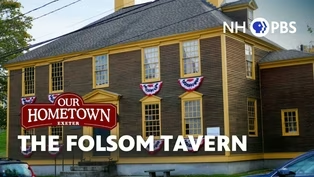
Video has Closed Captions
Clip | 5m 57s | Rebeccah tells us about the beautiful architecture & rich history of the Folsom Tavern. (5m 57s)
Video has Closed Captions
Clip | 4m 11s | Alexis Cargill speaks about the Community Fridge; a self-serve food clearinghouse. (4m 11s)
Exeter | Living in a Vibrant Community
Video has Closed Captions
Clip | 3m 30s | Cathleen Toomey talks about moving to, and living in such a diverse, thriving community. (3m 30s)
 Now Playing
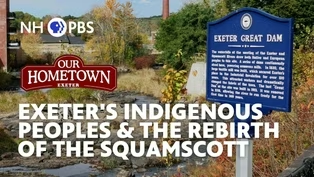
Exeter | Indigenous Peoples & the Rebirth of the Squamscott
Video has Closed Captions
Clip | 6m 28s | Denise and Paul Pouliot tell us about the indigenous roots of many of the area names. (6m 28s)
Video has Closed Captions
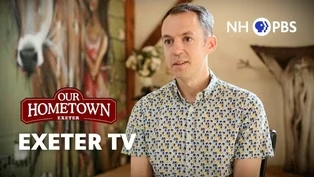
Clip | 5m 21s | Bob Glowacky tells us about the many things that Exeter TV is doing to connect & build community. (5m 21s)
Video has Closed Captions
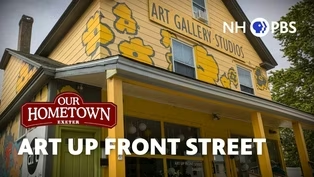
Clip | 4m 39s | Rose talks about the vibrant art community in Exeter, and how she started her studio & gallery. (4m 39s)
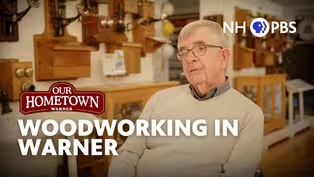
Warner | Woodworking in Warner
Video has Closed Captions
Clip | 2m 10s | Jim McLaughlin shares how woodworking deepened his bond with Warner. (2m 10s)
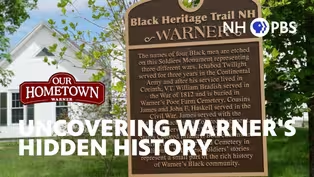
Warner | Uncovering Warner's Hidden History
Video has Closed Captions
Clip | 5m 7s | Discover Warner’s untold Black history with local historian Rebecca Courser. (5m 7s)
Video has Closed Captions
Clip | 6m 22s | Graham Gifford shares how Warner’s telephone museum came to life—surprising all. (6m 22s)
Video has Closed Captions
Clip | 2m 53s | Ian Rogers shares how travel and Warner’s community shaped his independent spirit. (2m 53s)
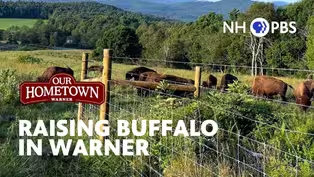
Warner | Raising Buffalo in Warner
Video has Closed Captions
Clip | 4m 47s | Brian & Kira Farmer share why they moved to Warner and raise buffalo on their farm. (4m 47s)
Warner | Painting Warner's Landscapes and Legacy
Video has Closed Captions
Clip | 2m 17s | Artist Mimi Wiggin paints her family’s legacy and Warner’s landscapes and traditions. (2m 17s)

Video has Closed Captions
Clip | 7m 57s | Neil Nevins tells about their non-profit, "Main Street Warner". (7m 57s)
Warner | From Train Station to Print Shop
Video has Closed Captions
Clip | 5m 56s | Jeremy reflects on the vibrant life surrounding Warner’s beloved train station. (5m 56s)
Video has Closed Captions
Clip | 2m 24s | Nancy Martin shares funny, fishy memories from Warner’s kids’ derby. (2m 24s)
Video has Closed Captions
Clip | 5m 1s | The rich history of Warner's fire department. (5m 1s)
Warner | Fall Foliage Festival
Video has Closed Captions
Clip | 2m | Ray Martin reflects on decades organizing the Warner Fall Foliage Festival and service. (2m)
Video has Closed Captions
Clip | 3m 52s | Tim Blagden shares how Warner’s abandoned rails became a community trail vision. (3m 52s)
Video has Closed Captions
Clip | 7m | Apryl Blood and Patty Anderson discussing their roles in the community. (7m)
Warner | Cheddah?,... No, Feta
Video has Closed Captions
Clip | 4m 34s | Author David Elliott speaks about moving to Warner. (4m 34s)
Warner | A Creative Welcoming Community
Video has Closed Captions
Clip | 4m 7s | As a radio guy and author, Matt Esenwine talks about coming to Warner. (4m 7s)
Warner | 4-H Leadership and Community Teaching
Video has Closed Captions
Clip | 5m 41s | Susan Jenna and Abigail R. reflect on decades of 4-H leadership and community teaching. (5m 41s)

Video has Closed Captions
Clip | 3m 15s | Dan Salzer and Jonathon Picard talk about Pemi Baker TV. (3m 15s)
Video has Closed Captions
Clip | 3m | Maryann Barnsley tells us about a childhood dream. (3m)
Video has Closed Captions
Clip | 2m 1s | Katharina Kelsey and her husband made a list, Plymouth checked all the boxes, and so much more. (2m 1s)

Plymouth | The Happiness Quest
Video has Closed Captions
Clip | 2m 34s | Dr. Marie Sanders relates what can happen when an entire town works together to discover happiness. (2m 34s)

Plymouth | Memories, Stories and Cake
Video has Closed Captions
Clip | 5m 41s | Patricia Hoyt came to Plymouth for college, launched her career here. (5m 41s)
Plymouth | Memories of Plymouth
Video has Closed Captions
Clip | 1m 55s | Louise McCormick is a townie. She grew up in Plymouth, and has spent most of her life here. (1m 55s)
Plymouth | Local Foods Plymouth
Video has Closed Captions
Clip | 3m 23s | Marianna Evans talks about Local Foods Plymouth, and how the pandemic helped to create a model. (3m 23s)
Video has Closed Captions
Clip | 2m 21s | Carol Dunn tells about how this amazing town bonded together to save her business on Main Street. (2m 21s)
Plymouth | From Minsk to Plymouth
Video has Closed Captions
Clip | 3m 41s | Jim Lurie tells us how in 1917, his grandfather travelled from Minsk, Russia, across Siberia. (3m 41s)
Video has Closed Captions
Clip | 1m 34s | Bob Gannett speaks about an interesting story unfolding as he was on the radio. (1m 34s)
Video has Closed Captions
Clip | 4m | Terry Fifield has lived in a lot of places, but found that the Plymouth area to be the best. (4m)
Plymouth | Community... on Wheels
Video has Closed Captions
Clip | 6m 14s | Mike Currier talks about the roots of the Plymouth Skate Park. (6m 14s)
Video has Closed Captions
Clip | 1m 45s | Bill Clark talks about, even with growth and progress, Plymouth is a special town. (1m 45s)
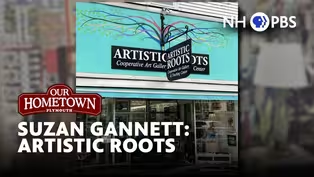
Video has Closed Captions
Clip | 4m 19s | Suzan Gannett talks about Artistic Roots, and the programs and passions that it has inspired. (4m 19s)
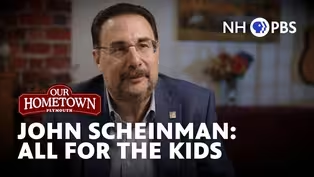
Video has Closed Captions
Clip | 2m 31s | John Scheinman shares how the skills needed in successfully coaching can be used. (2m 31s)
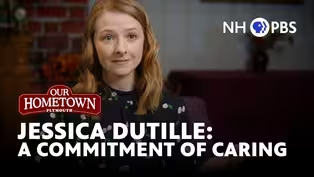
Plymouth | A Commitment of Caring
Video has Closed Captions
Clip | 5m 1s | Jessica Dutille talks about re-building community, after the pandemic changed the world. (5m 1s)
Video has Closed Captions
Clip | 4m 16s | Yvonne recalls growing up in Berlin, and speaking two languages in school. (4m 16s)
Video has Closed Captions
Clip | 6m 41s | Andre speaks to us about growing up in Berlin. (6m 41s)
Video has Closed Captions
Clip | 12m 40s | Walter tells us about Berlin's Skier/Soldier, Paul Petersen, and a love story. (12m 40s)
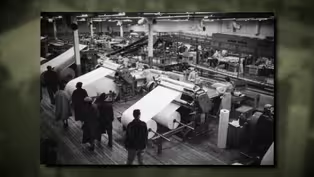
Video has Closed Captions
Clip | 3m 36s | Roland talks about working in every aspect of the paper industry, over 4+ decades. (3m 36s)
Video has Closed Captions
Clip | 4m 19s | Renney tells a couple of great stories about growing up in Berlin. (4m 19s)
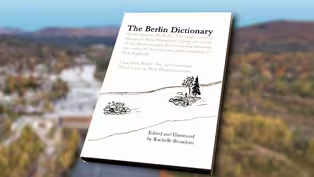
Video has Closed Captions
Clip | 5m 37s | Berlin has a language all its own, and Rachelle decided to compile a dictionary of words. (5m 37s)
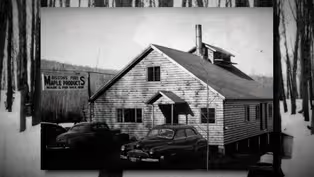
Video has Closed Captions
Clip | 4m 24s | Olive speaks about growing up in Berlin, in a family that owned Bisson's Sugar House. (4m 24s)
Video has Closed Captions
Clip | 3m 5s | Lorna recalls heading into Berlin on Friday nights, for shopping & meeting up with friends (3m 5s)
Video has Closed Captions
Clip | 3m 54s | Moving to Berlin was a dream come true for Haven, as he loved working in the woods. (3m 54s)
Video has Closed Captions
Clip | 2m 43s | Diane talks about going from a 45 year career in the banking industry. (2m 43s)
Video has Closed Captions
Clip | 6m 40s | Dennis tells the story of the history of boy scouts in Berlin, NH. (6m 40s)
Providing Support for PBS.org
Learn Moreabout PBS online sponsorship

- News and Public Affairs

Top journalists deliver compelling original analysis of the hour's headlines.












Support for PBS provided by:
Our Hometown is a local public television program presented by NHPBS