Our Hometown
Exeter
Special | 27m 59sVideo has Closed Captions
What better place to celebrate our country's 250th birthday.
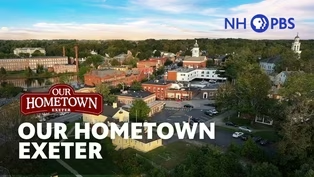
What better place to celebrate our country's 250th birthday, than in Exeter. It's one of New Hampshire's oldest towns, the site of the first documented town meeting, and the first state capitol. Host Becky Rule brings us these stories and more.
Problems playing video? | Closed Captioning Feedback
Problems playing video? | Closed Captioning Feedback
Our Hometown is a local public television program presented by NHPBS
Our Hometown
Exeter
Special | 27m 59sVideo has Closed Captions
What better place to celebrate our country's 250th birthday, than in Exeter. It's one of New Hampshire's oldest towns, the site of the first documented town meeting, and the first state capitol. Host Becky Rule brings us these stories and more.
Problems playing video? | Closed Captioning Feedback
How to Watch Our Hometown
Our Hometown is available to stream on pbs.org and the free PBS App, available on iPhone, Apple TV, Android TV, Android smartphones, Amazon Fire TV, Amazon Fire Tablet, Roku, Samsung Smart TV, and Vizio.
Support for this episode of Our Hometown was provided by With additional production support by What better place to celebrate our country's 250th birthday than in one of New Hampshire's oldest towns?
The site of the first documented town meeting in 1639.
It's where the Declaration of Independence first arrived in New Hampshire.
Because it's the state capital.
Well, it was the state capital during the Revolutionary War.
No, we're not in Concord.
Hello, I'm Rebecca Rule Welcome to Our Hometown, Exeter.
These next four stories come to us with the help of Exeter's own American Independence Museum.
No wonder Exeter looms large in New Hampshire's revolutionary history.
During the American Revolution, Exeter became the capital of New Hampshire because Portsmouth was seen as too vulnerable to the sea and too full of loyalists.
In 1776, when the Declaration of Independence was agreed to, the Continental Congress went to local printer in Philadelphia, named John Dunlop, and said, we want 200 of these printed up and sent out to all the different colonial centers so that they could be read to the population.
When the broadsides all went out to all the different colonies, one of them came here and was read to the citizens of Exeter.
Fast forward 210 years later, a copy of the Declaration of Independence.
We don't know if it was that same copy or not, but it is an authentic Dunlop Broadside original copy of the declaration was found in the attic here at the Ladd Gilman House.
26 of those are known to still exist today, and the American Independence Museum exists initially to make that document available to be viewed by the public now.
In the 35 years since that took place, the museum has evolved to be a much more significant undertaking.
Hundreds of thousands of visitors in the years since it was founded.
Independence Festival every July is attended by thousands who enjoy the re-enactors and historic artisans and fireworks and why does the American Independence Festival take place in the middle of July?
We all celebrated the 4th of July on the fourth.
Well, we celebrate when the declaration arrived here in Exeter, because it took two weeks to get from Philadelphia to Exeter, New Hampshire back in 1776.
So that has for 35 years now been the mission of the American Independence Museum.
Bring people here to walk through halls where people walk to sign the Constitution of the United States.
And every succeeding generation of Americans has had to struggle and work and sacrifice to secure to ourselves and our posterity the blessings of liberty to quote from the founders.
That story of independence is not something that happened a long time ago, was foreordained and forever promised.
It's something that we continue to work on, and our heritage isn't one of this perfect gift, tied up in a bow.
The heritage that has been handed down to us is the responsibility and the obligation to continuously earn that independence, and that freedom.
Well, in 1771, the community of Exeter voted to create a powder house to store gunpowder.
With everything that was happening during the period it was getting, everything was getting all riled up.
People were getting angry at the Crown.
It was December 14th, 1774, and there had been a proclamation by the king called the Powder Alarm.
It was starting to trickle through the colonies.
People were hearing about it, that it was happening.
And Paul Revere was one of those Patriot leaders who rode up here from Boston with the news of this powder alarm, they're going to start taking our weapons, our arms, and specifically gunpowder.
In December of that year, the Patriots, led by John Langdon and Thomas Pickering, went to William and Mary in Portsmouth at the mouth of the harbor, because that's where the British restoring all of the gunpowder, raided the fort.
Six men guarding it at the time, and they stormed it.
There were some shots fired.
No one was killed.
So that was the first real first shot of the revolution was in New Hampshire.
Didn't take everything.
They took some of it.
The next day, John Sullivan came back with his men and they took the rest.
And that was 60 some weapons, small arms, guns, knives, things like that.
And then 16 cannons specifically marked with the stamp of the crown, an act of treason, taking anything marked with the stamp of King George.
They also hauled down the British flag for the first time in New Hampshire, that the British colors were taken down, and then they left some of it.
They rode down on the gundalos back to different places.
Durham, I believe, got some as well.
In Exeter we ended up getting 72 of the 100 barrels of powder they stored in the powder house, the powder that was stored at the Exeter Powder House and other locations around New Hampshire was taken by carriage to Bunker Hill, right before the fighting, and it was used in the battle by our New Hampshire and Massachusetts soldiers.
The powder house is on what's called powder House point.
There is a walking trail you can take to get it.
You can see it from Swasey Parkway.
If you look across, it's still sitting right there.
It's the original brick structure, 16 inch thick walls, all still there was fully restored by the people of Exeter in 1999.
They were determined not to let this iconic landmark of New Hampshire history, not only Exeter, but New Hampshire, go into disrepair.
The capital moved to Exeter in 1775, and it came to Exeter because, although we had waterways, we were a shipbuilding town and could get out to the Atlantic Ocean.
The British warships were too large to travel at the same waterways, so they couldn't get to us, and we were considered safely inland.
When the capital came here.
The Treasury also came here, and Nicholas Gilman was selected to be the state treasurer.
He was a prominent member of Exeter merchant, I think shipbuilder.
Also, when he took the job as treasurer, the most convenient thing for him to do, there was no Treasury building, was to just open up a room in his house to make it the Treasury.
He kept the books, of course, for the state, which was very difficult during the revolution because, it was insufficient revenue coming in.
They didn't have enough to back up what they were paying a lot of the time.
So he was issuing promissory notes because the continental dollars just had little value.
There was really nothing backing them up.
But the main reason people would come here to this building would be to exchange currency during the revolution, every state was like its own little country and printed its own currency.
So if you lived in New Hampshire and you wanted to go to Boston to do business, you had to exchange New Hampshire currency for the currency of where you were going.
So he kept supplies of currency in an iron bound chest in his office.
He was treasurer for the duration of the war.
But when he died, his older son, John Taylor Gilman, took over the job.
So the Treasury Building or the Treasury office was here for quite a bit of the time.
I guess it was wherever the state treasurer was.
The capital moved to Concord in 1808.
So soon when it moved to Concord the Treasury, probably went very soon after.
Jude Hall was a black man who was originally enslaved, just off of Drinkwater Road in, Exeter and on the border of Kensington.
Jude was sold off of the farm to somebody else.
Ran away at 18, enlisted.
He fought at Bunker Hill.
First of all, he's mentioned as being thrown by a cannonball.
He stayed in the entire time.
He kept enlisting.
He was in the third New Hampshire.
The second New Hampshire.
He was at Ticonderoga.
He was kind of at all the big battles at the very end, I think, up in West Point guarding.
Then the war was over.
So he finally came home.
So eight years serving from the very first to the very last.
About 25 years ago, a man named Ed Wall erected a headstone for Jude Hall because Ed was the ancestor of the man who enslaved Jude Hall.
I also realized there were about 30 revolutionary soldiers in that graveyard.
I thought it would be a good idea to make a map of that cemetery, so that people visiting could realize what a treasure it is in town, with 30 Revolutionary War soldiers buried in it.
The historical records say that there was a black section of the cemetery, which is in the far northeast corner of the cemetery, so there are only two stones from the period.
The third one is Jude Hall stone, and that was put in afterwards, because it's historically written that he was buried in the black section of the cemetery near to the crypt mound, which is over there.
So Jude lived on a house on Drinkwater Road and an archeologist has recently gone over there and checked out and found an area which they think is possibly his home site.
It's it's just kind of a sunken cellar at this point.
And he has registered it as a, archeological site in New Hampshire.
Jude did not own that house.
He rented it.
He rented it for a long time.
He had a large family.
And it was a two room house, so.
And it was on a pond in an area called Jude's Pond.
As the Civil War came about, popular sentiment was turning, even though he did all that for the freedoms of the country that we now share.
Three of his grown sons were stolen and sold into slavery in the South.
When the Civil War was coming about.
So he has a really interesting story.
And combine that with the fact that this he was then kind of repaid for his service by having his family stolen and sold into slavery is some little mind boggling.
One of the oldest and most prestigious boarding schools in the country started as the bright idea of John and Elizabeth Phillips of Exeter.
Phillips Exeter Academy opened its doors in 1781 with one teacher and about 50 students.
A modest beginning.
Now enrollment tops a thousand, with a staff of nearly 250.
It is home to the largest high school library in the world.
That's impressive, as is its list of notable alumni, from Daniel Webster to Dan Brown and Mark Zuckerberg and New Hampshire's only U.S.
president so far, Franklin Pierce.
In the 1930s, the school changed dramatically when Edward Harkness donated millions on the condition that they implement a revolutionary learning model.
Instead of teachers delivering information from on high to large classes, small groups of students would face one another around a Harkness table and discuss rigorously.
I do remember walking across it for the first time all the brick, the ivy.
Then every teaching faculty member is required to live at least ten years in the dorm.
And at night at 10:00, somebody would lock their keys in or need some sugar or a fire alarm would go off.
And you were in charge, along with other teaching faculty.
Of in my case, 59 boys in Cilley Hall.
The old private school thing is that there's that what they call the triple threat.
You teach, you coach a sport and you live in the dorm.
I would have interesting, remarkable conversations with these young boys, becoming young men about Shakespeare late at night, or their studies or so, and, and that, that did allow for those moments where you go, wow, this is sort of extraordinary.
The Academy prides itself on, a strong work ethic, rigor, and that's we all work hard, and there are also great kids.
They are.
It's not a job where discipline really is in a classroom.
And the classrooms are small.
They, the maximum is 12 students.
And this fellow in the 30s, I believe, his name was Edward Harkness.
He said, what about a table around oval table with just 12 students?
And that way everybody has an equal voice, and everybody can be heard.
Sometimes you'll hear people say, no one.
No one can hide.
But it's conversation.
It's seminar.-ish.
Student led.
Every classroom has one, and they've got sliders that come out because for test taking it's an enormous typically oak.
Mine's mine's oak.
The students are motivated because they're going to be the ones leading and having the conversation on the reading.
And quite often the teacher in theory, for the most part, will step back and maybe throw out a prompt or two for me.
I've certainly I've I've learned a lot the the students teach you a lot.
The culture teaches you a lot.
So it, it really is in many ways, it's a it's an ideal job for me.
> MUSIC PLAYING < When you think about famous New Hampshire sculptors, the first name to come to mind is usually Augustus Saint-Gaudens.
But there's always somebody in any crowd who remembers a contemporary of Saint-Gaudens equally famous, equally accomplished, two friendly rivals who helped transform public sculpture in the United States.
Everyone in the United States has seen his work and can recognize his work because he sculpted the seated Abraham Lincoln in the Lincoln Memorial in Washington, D.C., and he sculpted the, Minuteman at Concord, Massachusetts.
He was born in Exeter in 1850, and his family later moves to Massachusetts.
He has a studio later in Stockbridge, and he works in New York City, so we share his story with a few other places, but he gets his start here in Exeter.
Dan was described as kind of a dreamy boy, which is a nice way of saying he was he was no student.
His father has no idea what he's going to do with this kid.
Later in life.
He tries to send him to MIT, and he basically flunks out within one semester.
And so instead he becomes a sculptor.
His sculpting career sort of started making small statues that he would sell, and he made so little money on the Minuteman that his father made sure that they had the rights to reproduce it in smaller form.
So you'll see these all over, especially in New England, right after he gets the commission for the Concord Minutemen, for which he was grossly underpaid because he was only in his 20s and he didn't have any major works, he goes off to Italy to study the masters.
Some of it was self-taught, but he also did do a fair amount of study.
In 1920s, the town was looking to build a monument to remember the soldiers who we'd lost in World War One.
They contacted Daniel Chester French and asked him if he would make a memorial statue.
Which he agreed to do, at cost, So a great gift to the town.
That statue was dedicated on July 4th in 1922, which is an odd day for a memorial statue to be dedicated, because even in 1922, when it was called Decoration Day, Memorial Day in May would have been the day that you remembered your war dead.
However, Daniel Chester French was in Washington, D.C.
on Memorial Day of 1922 because he was helping dedicate the Lincoln Memorial.
60 years ago, something strange happened around here, starting in Kensington but spilling over into Exeter with some credible witnesses, including police.
It spawned a book titled The Incident at Exeter.
Later, a few clever folks turned that into a fantastic festival, and I had joined Kiwanis as the town Librarian to get the library out into the community.
And the poor Kiwanis was trying to raise money, and we were just beating our heads against the wall.
And one of our weirder members not me, suggested, you know, we have the incident at Exeter.
So we go back to 1965.
This is the middle of the Vietnam War.
There is a young man from excellent name, Norman Muscarello and he's not going to wait to be drafted.
He has already signed up for the Navy.
He put an ad in the newsletter to sell his car.
Other person likes the car, buys it.
So now Muscarello has no transport and he is hitchhiking home from Amesbury to Exeter.
He notices that there is something in the sky, a light that appears to be following him up 150, and that's kind of strange.
He stands in the middle of the road and flags down the next car, doesn't even try to ask for a ride.
They stop.
It's a nice old couple and Muscarello says, take me to the Exeter police station right now.
Then individual people had called and said, what is this thing that's in the sky?
And now Muscarello comes tearing in and says, this thing practically dived on me on route 150.
So the Exeter police send one of their officers, Officer Bertram, back to 150 with Muscarello.
And by cracky, this thing is still there.
He calls in and says, you know, the kid's right.
It's right here.
I see it, and they send another officer out.
They just watch this thing.
It hangs there for a while, and then it goes straight up in the air and takes off toward the river.
It never lands.
It never makes a sound and never tries to contact anybody.
No, it doesn't suck up any cows or anything like that.
The Kiwanis had our first UFO, weekend in 2009.
The town really was pretty leery about us.
Most of the businesses shut down tight.
But then I realized as time went on, that these people maybe a little strange, but they spend money.
So now if you look at all the windows are just fabulous and the stores just outdo each other, the police have us block off the lower half of Front Street and you barely can walk, and it's wonderful.
Community means, in part supporting each other in the Yankee tradition.
There's no need for public thanks.
Help is freely offered to those in need when they need it.
Anonymously given, anonymously received.
It's a simple concept that can make a big difference in someone's life.
Womenaid is an organization that came to New Hampshire 20 years ago, a group of women raising money to help local neighbors in need.
The original founders realized that they were getting together for wine and coffee and drinks and restaurants every week and wouldn't they make a bigger impact if instead, they used that money to give back into the community for people who just weren't finding help for the needs that they had?
Our mission is to serve members of our community quickly, with dignity, and anonymously so we can turn around a request in as quickly as 24 hours.
If a family's oil tank is empty and the weather's getting cold, we can get that oil tank filled in 24 hours, if that's what the the request is.
We have a network of professionals in the area which we refer to as validators.
There are mental health professionals, school nurses, people who work with unhoused.
They will, identify one of their clients who has a need that they're not getting filled, whether it's for car repair, something medical, something for their housing, or other general resources, they'll fill out the request form comes to our board, which our board is made up of ten all volunteers.
And we do things by email.
One of us, vets it.
Make sure we have all the information we discuss and talk and ask questions.
Maybe more questions.
Back to the validator.
Once we have all the information, we take a vote and if it falls within our mission in our area, we always say yes, but we do keep it anonymous.
For the the dignity and the privacy of the person who's being helped.
Nobody else needs to know the needs we address are something that we can really make a difference a bridge, a gap.
A family has found themselves in a downward spiral and the car broke down and now the parent can't get to work.
Might lose that job.
Just the repair of that car could get the family out of that downward spiral and back on a straight track.
We find that people really want to help in our area.
When we put out a request, the community steps up and supports us.
We feel really carried by the community in Exeter to do the work that we do, and it's meaningful to all of us.
We enjoy what we do, so to have people out there in the community who also enjoy working with us, it's a really great feeling and it's we make a really great team.
Some folks, including me, say fall is the best season in New Hampshire.
Cool air, incredible foliage, no bugs.
What a perfect time for a big outdoor party.
And you're invited.
Now in its 13th year, the Powder Keg Beer and Chili Festival brings together the community and, breweries and restaurants from all over New Hampshire and the seacoast.
And, it's just a great day to come together.
It's on Swasey Parkway, it's fall and it's glory.
It's a it's a great way to spend the day every year.
It's the first Saturday of October from 12 to 4.
The festival's gotten bigger and bigger every year, getting people as far as Boston and Portland, and everyone comes together and helps to put on this festival from, the Chamber and Parks and Rec and DPW and the police and fire and and so on.
It's really a true community effort.
It's a lot of fun.
Typically we have about 3000 or so people show up.
And what do they do there?
They, listen to some great music and they sample as many different kinds of beers and ciders as, people bring.
We have, I think, over 50 breweries coming, hundreds of different things to sample.
There are, I think, ten places who are coming bringing chili.
And there will be a chili competition for the People's Choice for best chili.
And if you're standing at Swasey Parkway and you look across the river, you can see the old powder house and so the powder keg was named after that to try and bring in some of the local history and, connection to, the Revolutionary War.
You will walk in and be amazed at the number of different breweries, number of different, artisans, arts and crafts vendors and so on.
That are there.
The music will be playing.
We do send out a map ahead of time so people know who's where.
And, everyone has a different philosophy.
Some like to, you know, highlight their favorites and go there first.
Others like to go to the furthest brewery and work their way up.
Some like to start in the competition area where the chili is.
I can't say that I have any one suggestion because I've heard them all.
But what I what I always want to recommend is that of course, people, have a plan.
There's a group that, comes in matching Hawaiian shirts every year.
They're are a lot of fun.
There's, groups that have pretzels on strings.
Because I guess you have a pretzel in between drinks.
It tries to cleanse your palate or something.
Whatever it is that gets them there to have fun, there's this great feeling of fun and community pride and support and love when people are leaving.
It's it's it's always a lot of fun.
Thank you to the community for welcoming us, especially those who stepped up, sat down and told us about their town's colorful past, as well as what's happening right now.
We could fit only a few of the stories we heard into this program, but all of them will be showing up online at nhpbs.org/hometown.
Happy 250th birthday America from Exeter, a town with a lot of history, heart and spirit.
I'm Rebecca Rule.
See you around town.
We always love coming into town.
The river going down to the river.
Walking on Swasey Parkway.
And you can always find something great to eat.
Exeter has a really great sense of community pride.
I love that and our amazing school systems as well.
So there's there's a lot to be thankful for.
And that's why it's such a highly sought after place to live.
It's just a wonderful place.
It really is.
Support for this episode of Our Hometown was provided by with additional production support
Preview: Special | 30s | What better place to celebrate our country's 250th birthday, (30s)
Providing Support for PBS.org
Learn Moreabout PBS online sponsorship















Support for PBS provided by:
Our Hometown is a local public television program presented by NHPBS