
Artificial Intelligence Roadshow
Clip: Season 2026 Episode 38 | 9m 22sVideo has Closed Captions
No description
If you are interested in learning more about Artificial Intelligence and what it can do for you or your business, there is a Roadshow coming to the Inn at Notre Dame on Friday September 18th. It's a day to learn and connect with others while better understanding this emerging technology. It's made possible by the CEOs of Indiana Corporate Partnership (CICP), in collaboration wi...
Problems playing video? | Closed Captioning Feedback
Problems playing video? | Closed Captioning Feedback
Experience Michiana is a local public television program presented by PBS Michiana
Artificial Intelligence Roadshow
Clip: Season 2026 Episode 38 | 9m 22sVideo has Closed Captions
If you are interested in learning more about Artificial Intelligence and what it can do for you or your business, there is a Roadshow coming to the Inn at Notre Dame on Friday September 18th. It's a day to learn and connect with others while better understanding this emerging technology. It's made possible by the CEOs of Indiana Corporate Partnership (CICP), in collaboration wi...
Problems playing video? | Closed Captioning Feedback
Where to Watch Experience Michiana
Experience Michiana is available to stream on pbs.org and the PBS app.
Providing Support for PBS.org
Learn Moreabout PBS online sponsorshipThis is one of the best views you can get, especially during the Notre Dame football season.
But I'm here at Innovation Park, just off campus, and you can see this beautiful background behind me, including the Golden Dome.
And I'm here with Dave.
Dave, tell me a little bit about your role at Notre Dame and what we're here to talk about today.
Great.
Thanks, Dave.
I'm part of a group called Industry Labs, which really focuses on leveraging Notre Dame resources for the benefit of the region within 45 minutes of campus.
So that could be working with nonprofits.
It could be working with businesses.
It could be working with large companies, small companies.
But how do we leverage what Notre Dame's got its students, its research, its faculty for the benefit of the community?
And I know that sometimes I had an office here at Innovation Park when I first started my business, actually, and it was great to get that connection because sometimes it can feel.
Notre Dame can feel a little bit like an island, but actually when you do enter into the area, people are very collaborative and very helpful.
It's just sometimes we need to bridge that gap for sure.
And what we find is companies are trying to solve very similar problems.
University as a business, right?
It has operations, it has HR, it has finance, just like any company.
And so what are the things that Notre Dame can do to help those organizations?
And conversely, what are the things that we can do and learn from those organizations that we can then leverage to make the university better?
And I know today we want to talk about artificial intelligence as well, because of the roadshow coming up.
Right.
And so AI is one of those things.
People say it and like we think we know what it is, but it's an entire industry in itself and it's so varied.
So where do we even start with that?
Like what does the road to what's the purpose of it?
What's it hoping to bring to the community?
Yeah.
Well, Governor Braun in April made an announcement announcing this thing.
He's calling in AI, which is basically how does Indiana become a leading state in artificial intelligence.
And that's in terms of how do we use it for the benefit of the citizens of the state, its companies, and its employees.
And so part of the roadshow is really they take that on the road to actually take it around the state to different areas so companies can come understand, how do I work with AI?
What is it?
Should I be scared of it?
How do I get started?
And we've been doing that here locally with companies for the last 6 or 7 months, using students to help companies actually do AI projects.
So some of that will be happening in the roadshow.
But we already started some of that here with Notre Dame.
Nice.
And so what are the details then for people watching?
Because again, it's such a variety of people that watch.
How can they get involved.
How can they learn more about the roadshow and just learn more about artificial intelligence in general?
Yeah, let's start with the latter part.
So the great news is all the major artificial intelligence vendors, be they Microsoft, my former employer, Google, anthropic, OpenAI, all the big AI vendors, they all have a ton of free training on their website.
So you just go out and do a search around AI and training or AI and free training.
You'll find a bunch.
The state sponsored some with Google.
We have these roadshows, which are really more kind of on the applied side of how do you get started as a company, but any individual can start to learn those things.
The things they think about.
AI is really just a very strong prediction engine based on all the data that's ingested.
It knows what the next logical thing is going to be based on what you ask it, right?
What's the next word, what's next logical part of that picture.
And so understanding that it's not the same thing as going out and doing good search and getting all these results back.
It's more about what's what's this thing predicting it's going to go do.
And then so how do I actually understand and kind of validate it.
Right.
Because don't take it as, you know, gospel if you will.
But it'd be smart enough to kind of question, hey, did this thing that come out?
Does it make sense?
Right.
And I think people are you know, they're obviously everyone's worried about anything that's new.
And I think you hear a lot about it, like replacing jobs.
And in some cases it already has.
And I think there's there's such an industry worry about it in terms of like labor and different things.
So is any of that looked at here as part of the Indiana Roadshow, or is it just full steam ahead with with artificial intelligence?
Well, I think it's about how do you how do we be smart about it?
Right.
So people don't want data centers in the backyard, just like they didn't want to factor in their backyard back in the day.
Right?
And yet the data center and the factory are both very similar ones, a digital analog of what the physical world was when we were building things.
So the roadshow talks about how to use it.
Responsibility.
That's one of the key things around Indian AI is a very people centered view of AI.
How are we using it as a tool and assistant, as a partner versus as a people replacement?
Now, there may be some job dislocation that comes out of it, but there's also net new jobs that are going to be created.
There's a new role that's called the forward deployed engineer.
It's a crazy title, but it's basically these how do we help companies actually adopt and use AI?
It's the hottest job in the country that can't hire enough of them.
And the salary is huge.
What we're trying to do with some of these student projects is help equip students to actually go into those sort of jobs, because they've got real world experience in addition to their academic background, to go deliver on that.
And so, you know, most people, when they think of AI, like people are dabbling in things like ChatGPT and, you know, different models like that, Claude, things like everyday uses for it.
You know, I know I use a lot for my business to but for people that aren't necessarily in roles that they can use it.
Why should they really care about AI right now?
Like, how is it going to impact their life?
In some ways, it'll probably impact the way in which they interact with a lot of their services.
So it could be, hey, I'm not talking to a human being initially.
I'm talking to a chatbot first, which can be more efficient.
Sometimes it's not.
They should think about like, how are they ways in which they could use it to be more efficient?
So am I using it to help plan my trip better, or to do some research for a product that I'm buying, similar to the way they would do a search today, but it's much more enabled and much richer.
So that's kind of the personal productivity side.
And then what we're seeing is more and more businesses moving into kind of this agent world.
We're actually the AI is not just returning answers, but doing things right.
It might be sending emails on my behalf.
It might be comparing invoices to make sure that what they said they were going to ship, they actually did ship, right.
We see roles like that over and over again, where it's really about taking waste and inefficiency out in the business to make it more effective.
I, you know, I feel a couple of ways about AI because in one way, it saves me from having to hire a personal assistant for probably 20 hours a week on so many things, especially when I'm driving.
You know, I can tell the things and it can put all of it together for when I arrive at my destination emails or whatever, like that.
But on the other hand, you know, there's so many things about like some of the AI models, when you think about how some of these models have like broken out and like hacked into systems without the kind of creators knowing about it, like there's a there's a part of it that feels a little bit out of our control as human beings.
So how do you try and reassure people of that?
Because it is an unknown whether, you know, we can talk about the positives, but there is a part of it that's a little bit scary for a lot of people because it is such an unknown.
Yeah, I think, and that that unknown has always been the case, whether it was electricity at the beginning.
Right.
Whether it was kind of computers in the early days.
I think the thing to think about in these sort of breakout scenarios is part of what these labs are doing, is trying to actually make these things do as much crazy stuff as they can and see what happens.
Yeah.
So the things that we're using and modifying at all, but the models that we're using on a daily basis aren't that way.
Right.
And so, so to some extent it's a little bit there's a bit of fear mongering.
There's a little bit of we need to be smart about this stuff.
And we also need to make sure that we have the right sort of, sort of controls and guide points in place, which is a lot of what I think Indiana's thinking about is like, what's the responsible ways in which you use AI, right?
How do we teach people about that from the get go?
So that we're all kind of thinking in the same direction on that?
Well, I think it's scary, too, because it's the first time we're creating something that inevitably will be smarter than us.
So, you know, and I've met humans, so it's hard, you know, it's kind of hard in that sense that I think, you know, when you create electricity, it doesn't feel like you're creating something that's beyond us, you know.
But and so again, I know there's just I'm trying to really think from the point of view of people and what they're hearing and all the things.
I'm not trying to give you a hard time, you know.
And so how is Notre Dame specifically teaching students about AI?
Because obviously, even if you're in like your third year here, I mean, it's changed a lot even in that time.
So how are you preparing students to apply it in the real world?
For sure.
So more and more of the colleges are teaching introductory courses around AI.
And then we've got a program here in industry labs that we call the AI Leaders of Tomorrow, which is a paid fellowship program.
We take students and give them extra training and have them do real world applied AI projects with companies in the region.
So the companies benefit.
The students get an amazing sort of resume experience and really a leg up on their hiring competition out in the world and are able to take the theoretical stuff they're learning in the classroom and apply it in real world settings, where maybe the data isn't as perfect when the processes aren't as good, and they can learn how to actually use it in real life.
So tell me a little bit about the road show.
Is it actually happening at a specific time or it's 9:00 in the morning over at the Morrison.
This is one of several locations around the state.
Indiana.
I also has online kind of webinars that people can sign up for.
So just search on in AI and you can find all the information there.
It's kind of put on by the CEOs and corporate partnership, kind of the public partnership around the state of Indiana.
So they're really doing a lot of nice work around workforce development, around trying to educate the population.
And to me, the thing that's most signing is they're trying to make it so that AI isn't just a big company thing, right?
Small businesses can get access to this.
They can hugely benefit from it.
And so how do we help them really get started?
Because once you get started using it and do a few things, you begin to realize you can do more and more of that and start to take waste cost or to your point, like take some of that drudgery out of it so you can focus your time on the things that are more meaningful to you or more meaningful to the business.
Yeah, no.
For sure.
Well, thank you so much.
I appreciate your chat today and I appreciate this view.
It never gets old.
Being here on the campus.
So thank you so much.
Great to have you.
Yeah.
Thanks, Dave.
 New
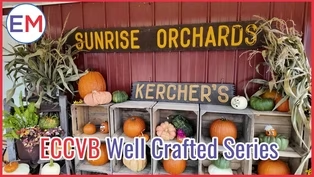
NewECCVB Well Crafted Series - Kercher's Sunrise Orchards
Video has Closed Captions
Clip: S2026 Ep38 | 8m 18s | No description (8m 18s)
Providing Support for PBS.org
Learn Moreabout PBS online sponsorship New Episode
 New Episode
- Drama

Lesley Manville and Tim McMullan return in the final installment of the Susan Ryeland mysteries.

 New Episode






 New Episode
 New Episode

Support for PBS provided by:
Experience Michiana is a local public television program presented by PBS Michiana