
August 6th, 2026
Season 2026 Episode 32 | 28m 45sVideo has Closed Captions
Red Panda Cub, First Settlers, The Road to Home
The Potawatomi Zoo's has a new baby addition. Come along with us as we see the adorable Red Panda cub, explore Indiana's early roots, and share powerful local Underground Railroad history.In This Episode:• Potawatomi Zoo Red Panda – Courtney meets "Big Red," the zoo's adorable new red panda cub, and learns about vital conservation programs for endangered species.• First P...
Problems playing video? | Closed Captioning Feedback
Problems playing video? | Closed Captioning Feedback
Experience Michiana is a local public television program presented by PBS Michiana
August 6th, 2026
Season 2026 Episode 32 | 28m 45sVideo has Closed Captions
The Potawatomi Zoo's has a new baby addition. Come along with us as we see the adorable Red Panda cub, explore Indiana's early roots, and share powerful local Underground Railroad history.In This Episode:• Potawatomi Zoo Red Panda – Courtney meets "Big Red," the zoo's adorable new red panda cub, and learns about vital conservation programs for endangered species.• First P...
Problems playing video? | Closed Captioning Feedback
Where to Watch Experience Michiana
Experience Michiana is available to stream on pbs.org and the PBS app.
Providing Support for PBS.org
Learn Moreabout PBS online sponsorship1234.
Get my shoes in.
Out the door.
Five.
I'm lost.
Six.
Seven.
Eight.
Feels great.
I'm gonna shine.
After I do what I'm gonna do.
I do it again.
Yeah.
Look at the sky with the beautiful color.
But never just for me.
You gotta share it with another.
I got to show, to give.
Let I want singing show.
Take a look and say a beautiful morning that turns into a beautiful evening.
And together make beautiful art.
And if you wanna see that, come along with me.
That's right.
Welcome to Experience Michiana.
We have some great things happening across the area.
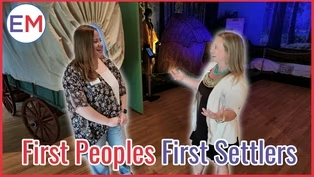
One of the cool things that the History Museum is doing, I know we've been talking about America's 250th, but we need to focus on the people that were right here and settled here in Michiana.
We're talking about the first people and the first settlers.
Check out this really cool exhibit that they have going on.
They're also going to be doing a presentation about Road to Here.
It's all on the Underground Railroad.
You want to make sure that you are here for that one.
But first up we're heading to the Potawatomi Zoo.
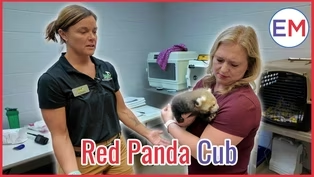
We're going to go inside to the hospital because there's a baby here, a red panda cub.
You got to catch this because I get to hold it.
Okay, I know I've been in the Red Panda exhibit before because it's an amazing experience, but this is a whole nother level because a baby cub is here and I have my friend Jamie with me.
And I have to say, as soon as we walked in, he rolled over and he stretched.
Yeah, she was so cute.
I can't believe it.
Okay, how old is he?
Okay, so he's 53 days today.
And he is.
It's kind of fun to watch these new milestones occur.
Yeah.
So he is just this week starting to stay awake longer between feeds and interact with the stuffed animals that he has in the toys that we've given him.
He's starting to become very playful.
So watching his personality come out now is is really fun for us to have him in this pool.
Yeah, it's a stock tank.
Eventually.
Learn how to climb.
Right.
So yeah.
How does that look for him?
Is that going to come soon?
It's like.
It's like a baby, right?
They first start to crawl, then they start to walk.
They start to climb.
Yeah.
So like if he was with his parents still, he would still be in the nest box with them.
Oh okay.
How long do you usually stay in the nest spot?
Yeah.
They don't start to venture out until around 2 to 3 months old.
Okay, so he lived in an incubator for climate control for the first few weeks of his life.
But then once he started becoming a little bit more mobile, we moved in to a bigger crate.
You can see the stages here.
Yeah.
Okay.
But then as he.
He now is starting to learn to walk.
So I want to give him more space for him to use.
So he there he goes.
Can, you know, have the choice to do what he wants to do and let his, his body learn all the things about.
Yeah, walking and crawling and climbing.
Yeah.
So now he's in this big style I love that.
Yeah.
And he's one of Ryan's babies, right?
He's one of Riis babies.
I think Raya is the one that I got to feed bamboo last time when I was here doing that.
I mean, that's amazing.
And talk about just the conservation efforts that you guys are doing with red pandas and what that means for her now to have cubs.
Yeah.
So actually, it's a really cool story because Raya on when she was born five years ago, she had aspiration pneumonia on the second day of her life.
So we actually had to pull her in hand, raise her.
So I hand raised her.
So, mom, I know, I know, my grandma.
Mom.
Yeah.
So a lot of times hand raised animals aren't as good at breeding and reproducing because they don't learn from other red pandas.
They learn from humans, which sometimes sets them back.
But we were able to when she was four months old, we were able to put her back with her mom and her siblings, okay?
And they accepted her.
And so she still got to learn how to be a red panda from them.
Okay, so when we found out that she had cubs, we were so thrilled knowing that she was hand raised.
And she's also a first time mom.
But then when we found out she had five cubs, that's not.
I was just say that's not happened before from the Red Panda SSP coordinator.
She said, this is a red panda record.
And like a normal red Cheever two two Cubs.
Yeah.
Which meant to have three.
But that impacts the result of that.
Which is why we are down to one now.
Right.
So they were all born significantly smaller than they normally would have been.
And he was the biggest of all of them.
Okay.
So he was at a more normal birth weight than any of the rest of them.
And so yeah, one was born stillborn and then two were half his size.
So they were significantly smaller.
Yeah.
So their chances of survival were slim to none.
And we knew that going into it.
But it was super important for Raya to learn how to be a mom this first time around.
Unfortunately, first time moms, anyways, even if they aren't hand raised, sometimes have throwaway litters.
I know that's not nice to say, but that's the reality.
Yep.
And for her to have five, we wanted to give her the opportunity to try.
And she actually surprised us and did a really good job taking care of them.
And she had those natural maternal instincts right away.
She, she like took her did a good job.
I knew Mama Bear was so proud of her.
So proud of her.
Yeah.
And so now we have this little guy which effectively calling him or.
Yeah, we're calling him Big Brother.
That official name got his name because when we pulled the last remaining two for their chances of survival, there were two of them.
And in the middle of the night, I could not tell them apart when I was feeding them.
And they get fed according to their body weight.
So I had to make sure I had the right cub, the right amount, because they did way different.
Sure.
So I painted their ears one I painted red and one I painted with nail polish blue just so I could tell them apart easily.
Yeah, I feel like we had to do that with my identical twin grandsons.
Like you have to like paint a toenail or whatever.
Do you know which ones?
Which.
Yep.
So yeah, his he was bigger than the other one.
So we just started calling him big Red.
And the other one, Little Blue.
So how do their markings come in?
Because I know he's here next to the stuffies, and he doesn't look like that just yet.
So how does that develop over their lifespan?
Yeah, they it slowly comes in.
I can pick him up and show you.
Can you.
Yeah.
So you can kind of see if you look from the top, all these little tiny little guard hairs are starting to come in.
And that's his more red hair okay.
His tail is starting to get stripes, which he didn't have stripes on it.
So around he's almost two months old.
His mom, when she was about two and a half to three months.
She was really dark at that point.
So okay.
Yeah, it just slowly continues to come in as they get bigger.
His mask is starting to to show up.
He's adorable.
He is such a cutie.
Can I can I touch him?
Yeah.
Oh, it is so soft.
Can I hold him?
No.
What do I do?
What did you told him?
Yeah.
He's not going to break.
He's not going to break.
He's like a puppy.
Yeah.
This is the coolest thing ever.
Okay, now.
Now you can tell people you've held the red pants.
Okay, so now he's back staged here?
Yeah, he's staying in the hospital.
Staying nice and cozy.
Nice and cozy with me, too.
When does he come out to display?
Like, what does that process look like for you guys on making those kinds of decisions.
So every animal is different.
Raya.
We we were able to try to reintroduce her to her family at four months old, but she was also sick when we had her.
He's not he's healthy, okay.
He's meeting all the milestones.
He's growing.
He's doing really well.
They wean at 90 days old.
Okay.
So around that time is probably when we'll try to do some housing with his parents and see if we can reintroduce them.
It might not work, but we're going to try.
Okay.
And if it doesn't work, we do have a backup plan of an exhibit that he could be housed in temporarily until he does get placed at another zoo.
But the hopes is, is that he can be reintroduced to them and and be on habitat with his family so he can learn to be a red panda and grow like a red panda.
And this is just so cool.
This is I know you can't get to do this at backstage all the time, but I get this experience and I have to say, this is pretty amazing.
But you guys, this is not the only baby happening here at Potawatomi.
So you guys have fantastic conservation efforts that you're doing and the reasons behind them making sure that we're well populated with all the different species.
What else do you have?
That's.
Yeah, we I feel like we are always having different babies.
So right now we have four peck lips, our own peccaries, two different moms have given birth.
So there are four.
One is smaller than the other three.
So they're in the habitat.
When they have their babies, they're up and moving around and running around with the herd right away.
So you see them the day they are born.
So they're out there, they're doing well, they're eating and they're thriving.
And then we also have to marmoset babies, our family in our learning center, our marmosets.
That family just keeps growing as well.
So there are twins down there.
They were I think they're a few weeks old now, but you can see them.
They're starting to come off of Mom and Dad's back a little bit and venturing out on the perching so you can get.
We can see when we're out here.
Okay.
They're on exhibit two.
Very good.
Remind everybody what's your zoo?
Hours out are now for the summer because we're still in summer hours.
We are still in summer hours.
Yeah, I know you guys are busy all the time.
Yep.
Come out and see us.
We are open 10 a.m.
until 7 p.m.
through August.
And then in September we will close at 5 p.m.
instead of seven.
Okay, perfect.
Well, this is just fantastic.
I hope everybody you get your zoom membership support everything that you guys do here so we can get more cute little baby comes like this.
Oh God.
It's my favorite.
Are his little paws.
He's been panda pause here.
So cute.
He's starting to get his teeth.
Well, don't bite me.
They're not that sharp.
Okay.
It's good.
I met the history museum today, and they have a really interesting exhibit that's happening, and I have Emily with me, who is the exhibit coordinator.
Thank you so much for joining me.
And you've put together a beautiful display.
And what I especially love to soon as I walked in is we have some big stuff on the floor here, right?
Yes.
We have quite a few big items, not only two wagons, one of them being a full sized 1800s farm wagon, but we also have a birch bark canoe, as well as a recreated trading post counter to kind of showcase what it was like for early pioneers in this area.
And that's what we're talking about.
So first people's first settlers, what kind of range is this?
Expand.
So this expands pre-European contact.
Before LaSalle came here in the 1600s with the Native Americans, primarily the Potawatomi that lived in this area up to just before the Civil War was really getting settled where people were living here, schools were being built, banks, blacksmiths, all types of things.
That's fantastic.
I mean, we're really we're bringing it right back on here, right?
And why is it important for us to talk about that here at the History Museum?
I mean, this is this is where our roots were developed.
So when we were discussing the America 250, we kind of struggled a little bit.
We're not a 13th colony state.
So we were like, well, how can we showcase our area?
And so we thought, what was it like here at the time period just before the Civil War and what it was like after the Civil War, as this land started really becoming settled, as people were able to come out this way, because before the Civil War, people weren't allowed to move out west past the Appalachian Mountains.
I was actually one of the kind of key things that a lot of early pioneers fought the king for.
They didn't want them to move out here because of the Native American tribes.
So that was one of the key contenders for the war.
And once the war was done, people were able to make their way out this way.
And we're talking about the first people who were here, the Native American Indians.
Right.
And we're talking about the Potawatomi tribe specifically.
Specifically, yes.
Okay, okay.
I mean, you guys have some phenomenal artifacts.
Can I ask, how do you get stuff like this?
Sometimes this stuff is donated to us.
Other times, like our wigwam here.
If we want to walk this.
Yeah, yeah, let's see it.
Yeah.
So this is a model wigwam.
These model.
Okay.
Did you build this?
I like, ten years ago.
Not for this exhibit.
Okay.
This has been in our collection for for a little bit at a time, but this is kind of a scaled down version of what a Native American, primarily a Potawatomi home, would have looked like.
Okay.
Wood frame, dried straw over top and then furs skin to kind of keep it warm or waterproof.
So this we worked with the Pokagon tribe that still lives here today.
Yeah.
Recreated a scaled down version so people could see what one of those homes would have looked like.
But our birch bark canoe.
This is this is.
This is real.
This is.
This is real.
This is 200 years old.
Very, very delicate.
But this is how Native Americans would have traveled on the waterways.
So they would have gone to other tribes in the area.
The Potawatomi were allied with the Ojibwe and the Ottawa and kind of the Wisconsin, Illinois, Michigan area.
So they would have traded with those people, and this is the primary way that they would have traveled, because this is much quicker than walking across miles and miles of land.
Yeah.
And what did the river look like back in the 1800s and prior to that?
Lots of trees.
Not as much as like we got like, obviously today it's you can see the river very clearly, but oftentimes to get to different rivers, you would have to actually pick up your canoe and travel across the land just a little bit to get to another river to then continue that way.
Okay.
And that was one of the main reasons for LaSalle coming this way.
He wanted to get to the Mississippi, and the Saint Joseph River connects via Portage.
So people pick up their boats, walk across the land through the Kankakee Marsh that is no longer around, and then travel down the Mississippi all the way south.
Okay.
And so I have to ask, I mean, do you do tours in here because you are full of knowledge.
I love this.
Yes.
So I mean, this is kind of primary what our voyages exhibit is like on a much grander scale.
Artifacts we don't normally bring out, like our canoe or wigwam, or even we have the portage log that marked where early Europeans would get out of their boat and take it across land.
This log is it?
No, it is over that way.
You guys have a log here too?
I love this.
I mean, this is really interesting.
We wanted to kind of make it an immersive exhibit.
So we added these elements where, you know, sit on it.
Yeah, you can sit on it.
Yeah.
It is a real log.
Real.
Don't bring your accent here though.
We're not stopping anyone here today.
No, but we have our little fake fires throughout the exhibit.
So people could really feel immersed in what life was like at this time.
And I'd love that.
You guys have a lot of interactive elements to, especially for the kiddos you want to talk about, like especially the wall there where they can figure out what do they need to survive.
Yeah, so pioneers would have to would take months to come out this way.
And you don't have whether like com or whatever to tell you what the weather is like or you don't know what the lands are going to be like.
There is really writings that kind of taught you what to expect.
Okay.
Very unreliable and you don't know what you're going to happen.
So you may have to pack wagon parks, your wagon you could break down along the way.
Hunting rifles.
You can't carry the amount of food you need to get all the way there, as well as once you get settled, but also woodworking tools, which we do have on display.
So let's go see some of that stuff too, because I see over here, I mean, you have a whole trading space, if you will, right?
Yes.
And selling pelts is a big thing that.
Yes, you know, it's kind of traditionally based in this region, if you will.
Yeah.
So the early French came this way not to settle the land.
They didn't want to build a town or anything.
I mean, they had a fort, but it was primarily for trading with the Native Americans.
And one of the things I was very highly valued was for palps.
This is amazing.
So can I touch these?
Yeah.
These are real pelts that people can touch of animals that they would have found in this area.
So badgers, beavers, foxes, even muskrats.
This looks like a skunk.
It's a badger.
It's a badger.
Yeah.
Wow.
I love that you have something like this so the kids can feel.
Yeah.
And some of these you might be a little bit familiar with or like deer skins, but we do also have a buffalo skin.
So that is a real buffalo giant.
Yeah.
So that's a little buffalo.
Buffalo were much more populated at this time period.
There's even stuff you can smell in here, right?
Yes.
Okay.
What is this?
So we have tea which came in a brick at this time period.
Like the coffee that is raw coffee.
So coffee has to be ruby.
Coffee has to be roasted.
So people will look at this and see that it's green and think, that can't be coffee.
But this is what raw coffee looks like when you get it from Starbucks.
It's pre roasted and created for the same, not the same.
But how long is this exhibit going on for?
This closes on January 30th.
Oh, so still a while.
Yeah, yeah, we just opened in July.
Right.
So yeah, quite a bit of time to come and see it.
And there's more.
I don't want to show you guys everything because you got to see this, but maybe we'll peek a little bit at the wagon to because that's very cool.
But where do you guys store stuff like this.
So we do have an offset storage building as well as some storage on site that we store a lot of these things, some things we've recreated, like some of the like we've purchased spices and stuff for display because I actually have those jars.
Yeah.
So there's definitely some things in here people might recognize that they've kept in their family, but we do have offsite storage that we're able to kind of keep some of these bigger items.
This we recreated just for this exhibit.
Yeah, this is but people locally to have contributed to this.
You wanna talk about that.
Yeah.
So we have a lot of items from the handle Little Children's Museum from Mishawaka no longer around.
We incorporated their collection.
So a lot of the stuff you're seeing here came from that collection.
We also bought the wagon from a local person who lived in town.
It's been in his family for 200 years.
Yeah, they had no use for it anymore.
And we were like, hey, we're looking for a wagon.
And so we got that wagon on display.
And do you guys still have the wagon in the kids area downstairs?
You do?
Okay, because I think that's a great way.
So we're coming up to see there's some interactive stuff.
But if they want to play with the little kids downstairs space.
Fantastic.
If you haven't been here yet, you got to check that out And how can people come and see everything.
Yeah.
So they can come to the history museum and they can either purchase a singular mission to visit us, and they can even tour the Oliver Mansion that we have on campus, but they can also do a joint campus wide ticket and visit the Studebaker Museum as well.
That has some America 250 things as well, and or purchase a membership.
Yeah.
Or purchase membership.
Awesome.
Thank you so much.
I'll see you here.
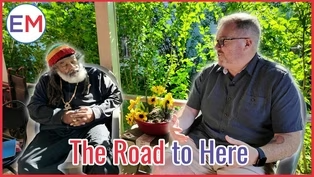
This is the first time I've ever done a segment on Experience Michiana sitting on a porch, but it feels lovely right now.
The weather is absolutely beautiful and I'm here with Brother Sage.
Thank you so much for inviting us here to talk to you.
I know that on August 8th, you have an event coming up at the History Museum.
Can you tell me a little bit about what that is?
I'd love to, but first of all, I would like to acknowledge WNIT and Kelsy Zumbrun and all the staff for bringing us the gentle spirit by the name of Kelly Morgan Burget.
And you stuck with her during the most difficult period of her life, and that really touched a lot of people.
Yeah, we enjoyed it.
So thank you.
It.
And thank you, Kelly.
Because her spirit will always live.
Absolutely.
You know, how did you know Kelly?
Well, few times I've been fortunate enough to be on Experience Michiana.
Yeah, but away from that, we did programs together.
We respected each other.
And I actually met her at the center for history about 20 years ago.
So that's how I knew Kelly and her daughter.
And thank you for carrying that spirit on the season.
The universe and the stars.
Yeah.
And we'll see her again someday.
We sure will.
And you know, I didn't get to meet her that often, but at her funeral, seeing how love she was was just overwhelming.
I mean, she really was such a beautiful light in this community, a gentle spirit.
And thank you.
Yeah.
She was.
And thank you for acknowledging her.
And I know you also want to acknowledge your history at the History Museum.
Can you tell me a little bit about what's happening on August 8th?
On August 8th, from 2 to 330 and maybe a little beyond that.
A cousin I learned 3 or 4 months ago that I had.
His name is Reverend Doctor Michael Nichols.
Out of business in Illinois.
He's pastor of Second Baptist Church.
He's not only an Ampy.
My mother's maiden name was Ampy His name is Nick.
Last name is Nichols, but he is the descendant of the amp tree.
There are four trees with limbs and branches.
And we put it together.
We're worldwide.
And we have nine generations we can report on.
And we're going to share that.
And he took sabbatical from his church duties as senior pastor to research the family name through the Bureau of Statistics, that the Atlantic slave trade.
Different libraries, different genealogical associations.
And he will share along with me, and I'll interview him and also share my side of the family story.
And so for people watching this, you know, what do you think the appeal for them would be?
Because obviously it's about your family.
But there's a kind of broader message that goes across a lot of families, right?
Like, what is it like?
Why would people watching really want to come and watch this at the History Museum?
It's a good question.
Really, the reason is we want to know that African Americans have a proud story also.
And in this case, we've been in this country for a number of years.
We landed in the latter 1600s.
And we've built we've had judges, doctors, lawyers, educators, athletes, mayors.
We've done some remarkable things in this country, and we want to be able to tell our story from our perspective because they don't do that in school.
Very seldom.
You're positive about Mother Africa, the beginning of civilization.
Yeah.
And we will share that with and show how we've evolved and dropped some teaching points that I think people will really enjoy sharing.
And you talk about educating people.
And you were an educator yourself.
You were a principal in East Saint Louis and Illinois.
And what was your time like then and how did you end up in South Band?
That's interesting.
I actually came here to seek employment, which did not work out, but I did a program at the University of Notre Dame that went over really well, and people there saw me and they got me involved, especially folks from Elkhart.
And once they got me involved, doors just started to open up.
I became director of the Urban League.
I also started another television station.
Did TV and radio work together for 12 years, then ended up working with Indot in Northwest Indiana in 13 different counties.
So doors just opened for me, even though the main thing I came here for didn't happen.
Yeah.
And as far as my life is concerned, I've been blessed with a lot of skill development.
When I can work with people, especially youth.
Many youth have touched my life and I appreciate that.
So all that has brought me to the point of being able to describe what I consider valuable.
And that's the beautiful story of being an African American.
I am a proud diaspora, an African American man, and I want to share that with as many people who would like to understand it.
And, you know, I grew up in a different country, so I'm from Ireland originally, and I just moved here 11 years ago, and so I didn't grow up in the educational system here of I don't know what it taught.
You know, I don't understand often the divide, but I know that when you meet people in person, there's very little divide.
But I feel like we're told a lot of things and educate in a lot of ways that kind of wants to separate us and not celebrate us.
And so I think events like this are important, that you can hear it from the actual source and, and believe it because it's true and not just what you're told.
I think not only should we teach them what to think, we should teach them how to think.
And in the case of African American children, very little in education enforces who they are.
They don't know about Mother Africa.
All they ever hear about Africa are the negative things, but there are positive things.
Since Africa was the beginning of human civilization.
Yeah.
Many people have gone there and found how beautiful it is because the highest continent in the world.
So therefore it has natural resources.
A lot of other countries don't have.
Yeah.
So we need to emphasize the youngsters of all cultures, the uniqueness of their cultural edifice, as opposed to not wanting to tell their story.
Yeah.
So and so.
August 8th, you mentioned from two until 330.
Is it a free event then for people to it's free.
It's free.
Not one red cent will be charged.
Yeah.
Doctor, neighbor and I will share with you our experiences.
He's up in age.
Also not as old as I am, because only Methuselah has me.
But I think you'll enjoy what he has to say.
And you'll find it to be very inspirational.
Because we want people in search of truth, to be able to come to spot, to find it.
Like our public library.
And what was the word you said that you used?
That it's an African storyteller.
What is the I'm with known as an African American grill grill.
The storyteller grill.
Okay.
My ancestry comes from Ghana, home of Aesop with the fables.
I'm starting to think, though, if you're a storyteller, the event might go on past 330, you know?
I didn't hear that.
I said, I'm starting to think, considering your a storyteller, the event might go on past 330.
Well, if it does go on beyond 330, we welcome that.
Because when Doctor Neighbor's book comes out in the beginning of next year, he wants to come back and have a book signing.
So we want to build and bring people together, because I think the world could use some peace and some unity in creating that love.
Absolutely.
Well, thank you so much for sharing your porch, sharing your time, and sharing your story.
Thank you very much.
God bless.
So many things to see.
Do experience right here in Michiana.
Thank you so much for joining us.
We'll see you next week.
Want more from Courtney, Dave and Kelly?
Follow us on social media and visit our website for exclusive behind the scenes content, extended interviews, and full length features.
Stay connected and experience it all today.
This WNIT local production has been made possible in part by viewers like you.
Thank you.
 New
NewVideo has Closed Captions
Clip: S2026 Ep32 | 10m 53s | No description (10m 53s)
 New
NewThe Potawatomi Zoo - Red Panda Cub
Video has Closed Captions
Clip: S2026 Ep32 | 9m 14s | No description (9m 14s)
Providing Support for PBS.org
Learn Moreabout PBS online sponsorship
 New Episode
- News and Public Affairs

Top journalists deliver compelling original analysis of the hour's headlines.

 New Episode




 New Season
 New Episode


Support for PBS provided by:
Experience Michiana is a local public television program presented by PBS Michiana