
The Guevara Studio School of Rock
Clip: Season 2024 Episode 19 | 12m 37sVideo has Closed Captions
Lemonade Day Elkhart County, Annual Plant Sale, The Guevara Studio School of Rock
Phone # 574-596-5287 GuevaraStudioSchoolofRock@Gmail.com <a href="https://facebook.com/Guevara.Studio.School.Of.Rock" target="_blank" rel="noopener">https://facebook.com/Guevara.Studio.School.Of.Rock</a> Rock out with Dave as he visits The Guevara Studio School of Rock and takes a spin on the drums! 🥁🎸 Don't miss this electrifying journey into the world of music! #Gueva...
Problems playing video? | Closed Captioning Feedback
Problems playing video? | Closed Captioning Feedback
Experience Michiana is a local public television program presented by PBS Michiana
The Guevara Studio School of Rock
Clip: Season 2024 Episode 19 | 12m 37sVideo has Closed Captions
Phone # 574-596-5287 GuevaraStudioSchoolofRock@Gmail.com <a href="https://facebook.com/Guevara.Studio.School.Of.Rock" target="_blank" rel="noopener">https://facebook.com/Guevara.Studio.School.Of.Rock</a> Rock out with Dave as he visits The Guevara Studio School of Rock and takes a spin on the drums! 🥁🎸 Don't miss this electrifying journey into the world of music! #Gueva...
Problems playing video? | Closed Captioning Feedback
How to Watch Experience Michiana
Experience Michiana is available to stream on pbs.org and the free PBS App, available on iPhone, Apple TV, Android TV, Android smartphones, Amazon Fire TV, Amazon Fire Tablet, Roku, Samsung Smart TV, and Vizio.
Providing Support for PBS.org
Learn Moreabout PBS online sponsorshipSo this is a very unique place that I'm at here in Goshen.
I'm here with Dave at that pronouncing for me again your last name.
Yes.
Guevara Guevara.
Okay, look for me.
If it's not like Murphy O'Brien, I'm just.
It's out of my.
It's out of my usual, you know, being from Ireland.
So, Dave, tell me a little bit about the school of rock that you have here.
Yeah.
so I've been blessed to have the school of Rock, just kind of started the school of Rock, actually, about.
I've been here totally.
I'm going on five months in my studio.
Yeah.
and basically, the studio school of Rock has been open for about two months.
Okay.
Dedicated to community adults, kids, family and kids, just specifically working with drums, percussion lessons and, actually percussion lessons.
also offering guitar, piano and, just an array of basic, skills for students, kids and basically a place, safe environment where kids can, follow that passion, their dreams.
Yeah.
being a musician full time, in many of bands are just was like, getting older and I'm like, I want to give something back where it's it's something for a long, they can take forever throughout their lifetime.
Yeah.
You know.
Yeah.
There's only so much you can leave, you know, from your for yourself.
But when you instill the passion and help kids, then it lasts forever, right?
Correct.
And so tell me a little bit about your history.
Like where are you from and how did you get into music yourself.
Yeah for sure.
so family born and raised in New York, Queens.
And we got back we got here when we were young about actually in the 80s before we were one of the first Latin families in Goshen.
And, since then, music was just kind of always a thing.
I knew I was actually a violinist for about 11 years.
Suzuki Hardcore thought that I was going to take violin was my passion, so I thought I was going to take that all the way of professional.
Yeah.
And then, I noticed that hand I was always getting in school drumming on the desk or something, and the teacher was like, here is.
But but, so I knew that was my kind of passion, my brain.
Yeah.
I wanted to take that to the next level.
And so I always been, just music has always been a part of my life and, been touring bands, several touring bands and many other bands at a young age.
And kind of just work experience with the music and other bands.
it's been a great collective thing, and now I just kind of want to give it back to where people can take it within their own experience at any of their own levels.
Yes.
You take on, and master themselves.
You know, there's always a joke that man can do two things at once, but I say, watch any drummer.
Yeah, he's a drummer.
Is doing about four things like try to throwing in the singing on top of it.
Yeah.
And that's a good exercise to like, you know, and you're so I always have every time I watch a drummer I'm always like, wow.
That's like even when I see somebody like on a keyboard singing at the same time, I'm like, it's hard to master doing them at once.
It's very hard.
It's very hard.
You're doing, you know, you're doing four things at one time.
And then if you throw in another fifth thing on top of it, you're singing, you know, so you're really mastering.
Yeah.
No, totally.
And again, when it comes to say, somebody like me, like I love music, I've, I've always been interested in it.
Never played any instrument.
Yeah.
where do you start from I mean, is it, is it as simple as just teaching what each actual like drum is like?
What?
What each one does or what what's lesson one?
I guess, just getting really comfortable recognizing your your own instrument, I guess.
Yeah.
being able to practice, obviously, like anything is is key.
Yeah.
And, you know how parents say practices is key and super important.
It is, you know, to, to master, you know, just anything, I guess.
Really?
Yeah.
even from learning from mistakes, you don't learn without mistakes or without even trying or so.
there's a lot of things in here with the School of Music that helps kids, adults, youth.
try because of those reasons.
Because one of the biggest challenges, I guess, in life and things is just even following a dream or a passion.
Totally.
You know, a lot of people don't even do that in their lifetime.
And we're so conditioned to, to, to not try to just correct, just do this, do that.
And this is a place, a safe haven place private studio that offers that, you know, you got to make mistakes in life to go and learn in the future to, to be to to better yourself in situations.
And and it is intimidating.
You know I've been it like I'm 40 right.
And for me like one thing I'd love to do is I'd love to be able to sing.
Yeah.
This is just I've never told anyone.
I'd love to be able to sing.
Yeah.
I don't have a good voice.
I mean, I say, I don't have a good voice.
I haven't developed any skills.
I don't have a naturally good voice.
Yeah, no, I sing and I but I love music, I love Irish music.
Irish music is like storytelling, very folky, like, you know.
Yeah.
And part of me is like, how can I go into somebody that first?
And I don't know if you do singing lessons too, I don't, but but I can hear you got the accent, which I love you, but I'm like, lesson one.
It's like, okay, do I have to like, sing for you?
That that vulnerability of having to play for you or like, having to like it's just it is.
It really is such a vulnerable moment to like.
That's why I like the vibe of your studio, that it really is as much about the energy in the room as it is about learning the instrument.
Right?
It is.
I mean, because there's, you know, actually taking when you take it to a professional.
Yeah, you're putting your vulnerability up, up there on stage.
Yeah.
And basically putting your guts there on stage.
Here I am and I'm presenting this show, you know, but it takes sometimes, you know, in life in general, scary moments, right?
To overcome and, to overcome those fears and those types of things to, to provide, entertainment or kind of to provide that gift that you're meant to do or.
Yeah, gift, that talent that you have to share to others.
So what they say about like growth happens where your comfort zone in our growth starts, where your comfort zone is.
Correct.
Yeah.
So that's why I do tell myself push yourself out of that.
So, what else is going on?
Like, do you like school or rock as well?
It's also about having like performances out there, like, yeah.
Do students end up actually being able to perform?
So basically here what this provides is beginning drum lessons, percussion lessons, guitar, piano.
right now I have it set up so people and students can get beginner, lessons or if they're intermediate, wherever they lie in their aspect of levels.
and I'd like to get them in sometime, maybe put together a concert series for the students and all that.
Cool.
right now, what the studio provides for me is this space for the studio as well.
I'm, performer and two groups that you might ask trio.
and on weekends, I'm usually busy getting ready to open up an audio recording studio.
That's the space for for bands.
Then I also do a booking agency and then as well.
yeah.
Any other things that involve music?
Tiny House shows, series that I just did.
And so are you actually had people in here?
I had, I had people in here.
Yeah.
These are like 40, 50 to 40 seats, ten seats this way.
So providing an intimate not they don't want a rock show.
They don't want a big show.
One of a small.
So I was like utilizing the space.
It's maximum packed.
Maximum a maximum capacity of.
Yeah.
just music in the arts.
I also do artwork full time as an artist.
Nice and so, like this.
Found artwork up here.
So you're busy?
I try to stay busy.
Yeah.
So it's like, a little like the NPR tiny desk.
You ever watch that?
I love those I love though.
Yeah, I love those.
Well, talking about students and getting some lessons can can you give me, like, a little bit of a lesson.
Yeah.
Yeah.
With love.
Kind of afraid.
That's all right.
Watch your head over.
Oh, yeah.
Get behind that.
All right.
I'm sure you've seen all all sorts of fan groups.
And what do you feel music wise?
As in a rhythm which is completely fine and great.
And what I want you to do.
Yeah.
What do you feel?
A pattern or rhythm that you feel personally, which is natural.
And that's what I always feel like.
Boom.
Okay.
You know, I don't know why.
That's why.
I just like to mess.
Yeah.
And it's great because everyone in this world has a pulse, has a different, has a different pulse.
So yeah.
And I want people to just following their own pulse.
Yeah.
So it's once I start playing my pulse is going to go a bit faster.
That's good.
That's all right.
Yeah that's okay.
So when it comes to all of these like knowing them like is also they all have a different sound.
Otherwise you wouldn't need more than one.
But yeah.
So is it also learning just the, the different sounds or like.
Yeah.
So basically all drum sets have this is an acoustic drum set.
These are very special because most drum sets aren't internally miked where these have a microphone inside.
Oh cool.
I can just plug in the XLR though directly to the board or whoever's mixing.
but so yeah, any drum kit usually has a different tone where you, you can tune with the drum kit.
Yeah.
To the types and what you, what you like.
But, so I work with different, different drums.
I got another smaller set, cocktail set that I take depending on gig and space where we got to get squirreled into, you know, for.
And you don't want to be too loud, you know, you got to be present, but not overbearing.
Always want to be loud And, no, but yeah, you want to play the room and different for different settings and things like that.
So as I sit here now, as much as I love talking, I'm like, I want to like, I want to hit this.
Okay.
Yeah.
So so definitely how do I even start I see yeah.
So this is what I'm talking about.
There's like so yeah you got options here.
So your right foot wants to go on that.
Keep that get cozy.
Left foot wants to go on your high hit pedal okay.
Yeah.
And then.
Yeah.
There you go.
So let's see.
You can do a pattern or just kind of play what you're feeling right now or, like you were saying that I'll leave my hands to though that.
Yeah.
That.
So.
Yeah.
You'll need your hands too.
So normally on a normal four beat pattern, normally doing on the hi hat 1 2 3 4 with your leg 1 2 3, four, one, two, three.
There you go.
1234.
You can use your right foot.
One.
There you go.
There you go.
I'm off beat.
That's all right.
Now you can use your right hand while you're doing that.
So up on the on the high hat.
Oh on top of it.
Too weak.
Your foot as well.
That's right.
So one.
And then move your left on this one you know.
Yeah.
This is the hardest thing I've ever done at one time I'm actually sweating with just like so.
There you go.
And you can keep that snare closed with your foot all the way down.
Okay.
Yeah.
And then there you go.
Okay.
Okay.
Now take your place in the band.
Oh, yeah.
you sound sound perfectly fine, sweating just for that.
So if people want to get more information or if, kids want to come here or adults.
Yeah.
How do they get in touch with you?
What's the best way?
Yeah.
Best way to get in touch with me is you can look me up on social media.
Yeah.
Facebook Guevara studio, school of Rock.
Yep.
as well.
Instagram.
right now I'm setting up pages for the Instagram for the Guevara studio School of Rock.
I want you to look me up on Facebook, send me a message, reaching by phone or, via email.
Okay.
Not on there.
All on your social media.
Yes, I do the thing when you say because I love dad jokes and dad puns.
How do you do that?
Like, Ba Dum tss oh, yeah.
Yeah.
How do you do that real quick?
the ba dum, is on the snare.
This.
Just do the ba dum and then.
tss Oh, yeah.
So.
Okay, let me see if you want to learn how to play the keyboard.
Practice is key.
oh.
Sorry, that was terrible.
No, that's good.
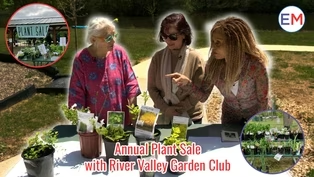
Video has Closed Captions
Clip: S2024 Ep19 | 9m 46s | Lemonade Day Elkhart County, Annual Plant Sale, The Guevara Studio School of Rock (9m 46s)
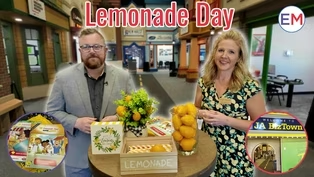
Video has Closed Captions
Clip: S2024 Ep19 | 10m 49s | Lemonade Day Elkhart County, Annual Plant Sale, The Guevara Studio School of Rock (10m 49s)
Providing Support for PBS.org
Learn Moreabout PBS online sponsorship















Support for PBS provided by:
Experience Michiana is a local public television program presented by PBS Michiana