Articulate
Facing Forward
Season 7 Episode 2 | 26m 46sVideo has Closed Captions
Both flutist Claire Chase and architect Mónica Ponce de León love a challenge.
Flutist Claire Chase and architect Mónica Ponce de León are at odds with society’s traditional notions of music and design, but they love a challenge to make something bigger and better.
Problems playing video? | Closed Captioning Feedback
Problems playing video? | Closed Captioning Feedback
Articulate is a local public television program presented by PBS39
Articulate
Facing Forward
Season 7 Episode 2 | 26m 46sVideo has Closed Captions
Flutist Claire Chase and architect Mónica Ponce de León are at odds with society’s traditional notions of music and design, but they love a challenge to make something bigger and better.
Problems playing video? | Closed Captioning Feedback
How to Watch Articulate
Articulate is available to stream on pbs.org and the free PBS App, available on iPhone, Apple TV, Android TV, Android smartphones, Amazon Fire TV, Amazon Fire Tablet, Roku, Samsung Smart TV, and Vizio.
Providing Support for PBS.org
Learn Moreabout PBS online sponsorship- [Narrator] "Articulate with Jim Cotter" is made possible with generous funding from the Neubauer Family Foundation.
(gentle music) - Welcome to "Articulate," the show that explores the inner lives of great, creative people.
I'm Jim Cotter, and on this episode, facing forward and helping change the definition and perceptions of classical music.
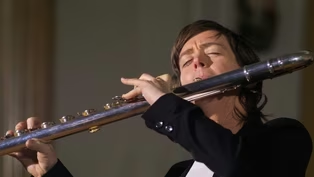
Flutist Claire Chase has come to earn the support of its traditionalists and brought new music to legions of new audiences.
- My musical dream is to be in a world where no tradition or trend is central or dominant and where musics are free to unfurl and evolve, because they're not in walled off gardens or inaccessible concert halls or locked libraries.
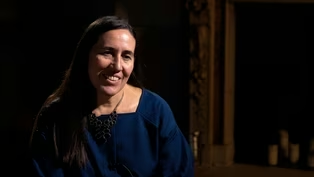
- [Jim] Monica Ponce de Leon believes that everyone deserves good architecture.
She has pioneered the use of technology to make high-end design more accessible to create buildings that are climate friendly and beloved by their communities.
- In the architectural community we have the preconceived notion that you should give certain communities buildings that look, honestly, boring, and that some other communities don't deserve architecture with a capital A.
And my experience has been the opposite.
That those very communities, they want a building, as you say, that represents them.
- [Jim] That's all ahead on "Articulate."
(soft music) (somber flute music) Even when the whole world is telling Claire Chase that she's wrong, she'll listen carefully and wait a beat.
She seems to understand that a little distance can leave room for contemplation.
- The way we listen creates our life.
Listening is the basis of all culture.
- [Jim] Yet Claire Chase has spent much of her own life not listening, at least not listening to the sound of rejection.
An extraordinarily accomplished flutist and music pioneer, an educator unbound by conservator restraints, she is a virtuoso who shares the state with novices.
But in the beginning she heard many more nos than yeses.
Yet she played her way through rejection with an indefatigable optimism.
Perhaps Chase, who the New York Times has hailed as the most important flutist of our time, is listening to something many of us can't hear.
- We're always listening in a conditioned way.
We are conditioned.
And I think if we're doing our work as human beings, we're working on de-conditioning ourselves, but to aspire to listen unconditionally to something that is unfamiliar to us is one of the most beautiful things that we can do, to reach out and try to understand another human being.
(soft flute music) - [Jim] Born in 1978, Chase was raised near the sounds of the ocean in Southern California.
She aspired to become a professional baseball player until a particular piece of flute music changed everything.
She was 13 when her teacher played her Edgard Varese's 1936 work for solo flute, "Density 21.5," combining two seemingly contrary melodic ideas.
The groundbreaking piece ignores the rules and invites experimentation.
It would alter the course of Chase's young life.
And decades later, it would again take her down a new path, which to her was no big surprise.
- One of the most beautiful things about classical music.
And by classical music, I mean all musical traditions that have outlasted, outlived their makers, is that we can go back to a thing that is very old that we think that we know, and we can unknow it.
We can experience it newly.
We can experience ourselves newly, and that uncertainty is actually the gateway drug.
That's what keeps us hooked.
- [Jim] And so beginning in her teens, Claire Chase found herself hooked on music.
Her formal exploration began at the world renowned Oberlin Conservatory of Music in Ohio.
There, she was immersed in the codes and conventions of classical music, playing by the rules in a relentlessly competitive environment.
In time, she felt the need to escape, to experiment, to break some rules.
- My musical dream is to be in a world where no tradition or trend is central or dominant and where musics are free to unfurl and evolve because they're not in walled off gardens or inaccessible concert halls or locked libraries.
- [Jim] And so upon graduating, Chase sought a world where she could unbridle from convention.
She landed in Chicago with $500 and a desire to push the boundaries of concert music.
Connecting with like-minded music makers, she slowly evolved into a sort of indie flute punk.
With the spirit of a troubadour and the scrappiness of a garage band.
This mindset would spark her founding of the International Contemporary Ensemble, an artists collective for new and experimental works.
- We weren't thinking about it in terms of careers.
We were thinking about it in terms of the creative trajectories, the work, the beautiful as yet unknown ideas of other artists in our generation.
And we wanted to be an incubator and a laboratory and a home, a place of belonging for a generation of composers and musicians who were working at the crossroads of different disciplines.
- [Jim] The ensemble played all over Chicago and then all over New York.
Performances that were free and open to the public.
Musically, they were flourishing as they composed and improvised, but making ends meet was proving evermore difficult.
(gentle music) - The group didn't make a dime.
And a lot of the people in my life were asking, people who cared deeply about me were asking me, "What are you doing?
What are you doing?"
And even some founding members of the group, like, "What are we...
This is insane."
- [Jim] But even as the ensemble was working to upend traditional concepts of classical music, Chase realized she would need the support of its traditionalists.
Yet in the first three years of trying to connect with the establishment, she got enough rejections to last a lifetime.
- I wrote 13 grants the first year, not ever having written a grant before.
'cause you don't learn that when you're getting a bachelor's of music in flute performance from a conservatory.
Wrote 13 grants the first year, was rejected for all 13.
I got some practice writing grants.
I wrote 15 the second year, was rejected for all 15.
I wrote 17 grants the third year and was rejected for 16.
- [Jim] But Claire Chase kept going.
She truly believed the world would one day understand.
It was a heady time to be living a creative life in Chicago.
She had many fellow travelers.
- Once I got out of classical music, of the classical music mindset and started meeting people from experimental theater and from free jazz, from improvised musics, I realized I had plenty of company and so many examples.
And so many people who had tenacity and resilience and generosity and humor.
You have to have that audacious dream, however closely you keep it to your chest.
I do believe that that's our human responsibility.
And as artists, we have to tend to that dream life.
- [Jim] With Chase at the helm, the International Contemporary Ensemble grew from a scrappy startup to a key player in the music world.
The recipe was simple, but not easy.
Rather than waiting for audiences to come to them, the ensemble went out into the world, building their audience from the ground up by commissioning and performing hundreds of new works.
It took a while, but the world did eventually catch up with Chase and her cohorts.
In 2010, she made her Carnegie Hall debut.
She invited her fellow ensemble musicians to share the stage and they played to a boisterous audience.
Then in 2012, she was awarded a so-called Genius Grant by the MacArthur Foundation.
The International Contemporary Ensemble had found its groove and its ecosystem of music continued to grow.
In a decade when audiences for classical music were declining, theirs were growing.
But there was a reckoning on the horizon.
15 years in, Chase faced a painful decision.
She had come to the realization that she would either have to leave the organization she had helped create or watch it stagnate.
It was a classic case of founder's dilemma.
A theory that proposes that over time, organizations can become too wrapped up in the vision and personality of their founders.
- I realized at a certain point though, that like the musics that we're talking about, that we hope will outlast the people who make them, that this organization, like any organization that wants to be more than a collection of people, that wants to be an organization that will continue to be of service to the next generation of musicians.
It was going to be necessary for me to remove myself from that.
And to give the organization a chance, one has to lovingly leave.
It was really, really hard.
I would say it was like one of the hardest things I've done in my life.
- [Jim] Not everyone can walk away from the fruits of their life's work, but Chase has never been driven by personal ambition.
She's more interested in her role as one participant in a deeply rooted living tradition.
- This is the beautiful thing about the flute.
It's our oldest identifiable musical instrument.
And so that the traditions of flute playing are our oldest classical cultural traditions.
And the flute that was found in present day Slovenia, that's 43,000 years old.
- Do you feel like you are a part of this 43,000 year-long journey?
- I absolutely think of myself and all of the players as part of that tradition.
And I think that's one of the most helpful ways of dislodging this idea of classical music as a Western European construct, because it's part of a vast and rich and expansive and complex human history of music-making, of classical music-making.
I think it's important to be clear that we are all tiny a speck.
(dramatic flute music) - [Jim] By Claire Chase's own definition, we don't know whether or not the music she's making is classical music, because we don't know what pieces of music will outlive their makers.
It's a mystery and that's part of the joy and the risk.
- I feel that while we have no idea what will withstand the test of time, what we do know is that there are ways to nourish and to resource music that is being made in our lifetime that do give it a fighting chance.
And so multiple performances, multiple divergent interpretations, and multiple listenings in different environments.
All of these things contribute to the evolution of a piece of music.
(gentle flute music) - [Jim] Not too long ago, Claire Chase was an upstart pushing against traditions.
Today, she finds herself peering back at her younger self.
In 2017, she became the professor of the practice of music at Harvard University.
As she fosters self-direction and peer-to-peer learning, it would seem that Claire Chase is becoming the kind of teacher her younger self craved.
- It's so healthy to be around young people who are poking at everything that you hold dear.
It's wonderful.
So, so much of the energy that I, I think, put into the organization through all of those years has transferred to the energy that I'm putting into teaching.
It's opened up a lot of room for me to, well, to play, and to imagine new projects.
Things are brewing.
(soft flute music) - [Jim] But teaching is today, but a tiny piece of Claire Chase's world.
She curates, commissions, plays and organizes, and she's inviting everyone to join in.
In 2013, she returned to the life altering piece that had so captured her imagination when she was 13.
Varese's 1936 work for solo flute "Density 21.5."
Typical of Chase, she wasn't happy merely to play it again.
Instead, she pledged to interrogate it and thus launched a 24 year-long commissioning project that will create an entire new body of his repertoire called "Density 2036" for the year in which it will culminate.
It will also be the 100th anniversary of Varese's work, and it's Chase's intention to play all the music created by the project in one 24-hour marathon.
- Well, the truth is that I have no idea what these years are gonna look like.
The only rule of the project really is that each year I depart from what I knew the previous year.
So obviously, a different group of collaborators, different composers, but also to the extent that it's possible, I don't ever wanna repeat techniques.
I don't wanna repeat trends, aesthetics.
I really want each one to unfurl newly.
- [Jim] Among the now completed works is "Pan."
A 90-minute piece for solo flute, live electronics and mass community participation, that explores ambiguity and the discomfort it brings.
(soft flute music) - The idea of the piece is that it can be done with all ages, all abilities, group of folks in any place that we travel.
And being on stage with folks who've never been on stage before, who have over the course of the week that we rehearsed this chaotic circus of a piece, have learned to mount, essentially an entire opera, and who've learned to play instruments.
They're all instruments that can be played by anybody.
A tuned wineglass chorus, a tuned wine bottle chorus, handheld percussion, we all use our bodies and when I'm on stage with a group of people like that, those are my truly, truly happiest moments.
I'm not performing for someone.
I'm experiencing with a group of people.
(gentle music) It's the best.
- [Jim] Claire Chase has committed her life to the rich history and present possibilities of music and especially those of our own instrument.
And as she works to shape and define the future, she may also be helping us to become a little better at listening unconditionally.
(gentle music) (soft music) Drive down West Olympic Boulevard in Los Angeles, and you will encounter a strange and beautiful structure shimmering like a mirage.
This is not some fantastical vision of the future.
No.
Helios House is a one of a kind, environmentally sustainable gas station.
And it was constructed from some of today's most advanced materials and technologies, and from the values of its creator.
- If you want to produce an architecture that is culturally relevant, then I think you need to figure out how the building can then partake in the construction of culture.
- [Jim] As an architect and academic, Monica Ponce de Leon has been uniquely partaking in the construction of culture for more than three decades, striving to democratize good design to create harmony between technology and people.
(intense music) Buildings are one of the most important technologies in our lives.
In Western society, we spend about 90% of our time inside.
Yet so many of our spaces are just boxes with windows.
Buildings, Ponce de Leon believes, should be an extension of the people in and around them.
It's a belief she developed growing up in Venezuela.
- In Caracas, we all knew who the architects were.
We knew the history of architecture in the city.
Buildings were part of our identity and we thought of them as representing community.
- [Jim] Today, Ponce de Leon has designed structures across the United States and around the world.
In 2016, she co-curated the US pavilion at the Venice Architectural Biennale.
But for her, eye catching design shouldn't just be a luxury for one slice of society.
- And I, of course, deeply believe that architecture is a public good, and that buildings represent the communities that they serve and that they can change the life of a community.
Everyone deserves design.
Beauty, to me is a human right.
In the architectural community, we have the preconceived notion that you should give certain communities buildings that look, honestly, boring, and that somehow those communities don't deserve architecture with a capital A.
My experience has been the opposite, that those very communities they want a building, as you say, that represents them.
- [Jim] This was evident when Ponce de Leon and her team set about designing a library and cultural arts and media center in Pompano Beach, a low income city 40 miles north of Miami.
They wanted the people who would use the building to see themselves in its design.
So they started by listening.
- We had many community meetings where we discussed the project directly with those who were going to be using it.
How do we produce an aesthetic that is unique, that is exciting, that tells the community that this is a public building?
They said to me, "We do not want a Mediterranean style building and we do not want an international style building."
Which means they didn't wanna look like Coral Gables and they did not wanna look like Miami.
(soft music) When people look at the Pompano Beach Cultural Center and Library, they're like, "Wait, that's too fancy."
I hate that term, too fancy for a community like Pompano.
I think that we need to move away from this divide that design is for certain groups and not for others.
- [Jim] For much of architectural history, cost has been one of the key factors in constructing so-called fancy buildings.
Now, new technology is changing that and supercharging Ponce de Leon's goal to democratize design.
Digital fabrication is one such technology, where parts of buildings are prefabricated by computer controlled machines, to produce stronger, more sustainable and often less expensive components.
- [Jim] When I started working in digital fabrication, I felt it was important for us as architects and for us as educators, to make sure that we understand the tools and what the tools can offer through the architectural imagination.
Before the advent of digital fabrication technology, in order to have something custom made, you really had to had a lot of resources.
But by using digital technology, you then make a custom made available to many as opposed to the few.
- [Jim] Monica Ponce de Leon has used digital fabrication to create a range of structures.
From a New York city hotel to that Los Angeles gas station.
When designing the Fleet Library at the Rhode Island School of Design, she used software to make every cubicle a different size to accommodate different body types.
But now Ponce de Leon strives for more than just harmony with her buildings.
Design, she believes can bring balance to our relationship with the planet.
Buildings generate almost 40% of global greenhouse gas emissions as we tear down, construct and use them.
Sustainable design will allow us to continue building our world without simultaneously destroying it.
- Architecture is more sustainable when it's permanent but life changes.
So how do you reconcile the tendency of architecture to be fixed and to be permanent?
And actually, the fact that that's a good thing because then you're not constantly tearing down buildings.
And what I have been doing in recent time is actually thinking about not the present moment for a building, but how do I expect that building to develop over a long period of time?
And we just developed a model for a single family house that allows the family to stay in the house after the kids grow up and move out, by providing multiple points of access but also by providing walls that are movable and doors that are moveable at the outset, so that you can actually sever certain portions of the house and rent those units out when your kids move out.
And then in the future when the parents might actually be gone, the kids might not get stuck selling the house but actually might subdivide it into two units, three units, and actually rent it out as a source of income.
So again, thinking about the possibility of a building not just functioning for the very, very present.
- [Jim] But even Monica Ponce de Leon admits that architecture could only take us so far.
Environmentally conscious design, she believes, needs to be bolstered by official oversight.
- People want to do the right thing.
Legislation makes it more affordable for many more to do the right thing.
Once you legislate wearing a seatbelt, then all car manufacturers have to do it.
Imagine if there was no legislation for a seatbelt.
Those who could afford that as a feature in their car, I'm sure will wear it.
And those who could not afford that as a feature in their car will be stuck without it.
It's the same way in terms of codes for buildings.
If we were able to legislate energy consumption of buildings in a more stringent fashion, I believe that all of those materials and features that we need in buildings would then be more commonplace and therefore more affordable.
- [Jim] None of this work can happen alone.
As Dean of Princeton University's School of Architecture, Monica Ponce de Leon is helping the next generation of architects to imagine and to create better built environments.
- That's what's so unique about architecture as a discipline.
You're always doing something that was not there, every architect.
And as such, we are actually materializing alternatives to the status quo.
So by building something new to show, oh, things don't have to be the same.
Things can be different.
(gentle music) (mellow music) - [Jim] For more "Articulate," find us on social media or on our website, articulateshow.org.
An the next "Ariculate."
Throughout history and across civilizations, the humble shoe, once mere protection for our tender feet has evolved new meanings.
A signaler of class, a marker of status.
Today's shoes are taking us on fresh paths.
Integrating new technology to become more sustainable while helping push the boundaries of human performance.
We'll take a walk in each other's shoes on the next "Articulate" with me, Jim Cotter.
- [Narrator] "Articulate with Jim Cotter" is made possible with generous funding from the Neubauer Family Foundation.
(intense music)
Video has Closed Captions
Clip: S7 Ep2 | 9m 47s | Mónica Ponce de León is an architect for the people. (9m 47s)
Video has Closed Captions
Clip: S7 Ep2 | 15m 56s | Flutist Claire Chase has bridged the gap between old and new. (15m 56s)
Providing Support for PBS.org
Learn Moreabout PBS online sponsorship















Support for PBS provided by:
Articulate is a local public television program presented by PBS39