
Farmington Historic Home
Clip: Season 31 Episode 13 | 8m 22sVideo has Closed Captions
200 years of history at Farmington Historic Plantation in Louisville.
From hosting one of the nation’s most prominent Presidents to having a central role during our nation's most divided time, Louisville's Farmington Historic Home still aims to tell all the history that happened on its grounds.
Problems playing video? | Closed Captioning Feedback
Problems playing video? | Closed Captioning Feedback
Kentucky Life is a local public television program presented by KET
You give every Kentuckian the opportunity to explore new ideas and new worlds through KET. Visit the Kentucky Life website.
Farmington Historic Home
Clip: Season 31 Episode 13 | 8m 22sVideo has Closed Captions
From hosting one of the nation’s most prominent Presidents to having a central role during our nation's most divided time, Louisville's Farmington Historic Home still aims to tell all the history that happened on its grounds.
Problems playing video? | Closed Captioning Feedback
Where to Watch Kentucky Life
Kentucky Life is available to stream on pbs.org and the PBS app.
Providing Support for PBS.org
Learn Moreabout PBS online sponsorshipKentucky is a state known for its rich traditions and connection to our nation's history.
In fact, there's a place in Louisville with more than 200 years of history to tell.
From hosting one of the nation's most prominent presidents for three weeks, and having a central role during our nation's most divided time.
To this day, Farmington still aims to tell all the important history that happened on its grounds, both the good and the bad.
Let's take a look.
[music playing] On the outskirts of Louisville, off Bardstown Road and the Watterson Expressway, a piece of Kentucky history still stands.
Farmington Historical Home is the oldest historical home in Louisville, with deep roots to the state and the nation.
The land was purchased by John and Lucy Speed, and they built this house.
They completed it in 1816, started work on it in 1815.
They lived in cabins for two to three years while the main house was being built.
It's a beautiful structure based on the Jeffersonian design.
John Speed had two children, two daughters, from his first marriage, and then he and Lucy had nine children together.
Nine children lived to adulthood.
The Speed family would go on to influence politics on the state and national level, as well as within the city of Louisville, with the Speed Art Museum, as well as the University of Louisville School of Engineering, being named after the family.
But those roots started right here, as a hemp plantation.
Interestingly enough, hemp was one of the only labor-intensive crops that necessitated a large labor force in Kentucky, hence Kentucky remained a slave state because of the hemp crop.
[music playing] The Speeds primarily sold their hemp to the southern cotton plantations, and they used it for rough bagging to bag up cotton as well as twine.
Most plantations in Kentucky at the time had three to five enslaved people.
Farmington had up to 70.
We know that when the Speeds arrived on this land, they had a number of enslaved people with them.
We think it's around 11 at that time.
And throughout their time here, that number grew.
As the farming and the agricultural land grew, so did the number of enslaved people.
In the years leading up to the Civil War, one man would visit Farmington and see firsthand the effects that slavery had on the nation, a young lawyer from Illinois named Abraham Lincoln.
In 1837, while running a general store in Springfield, Illinois, John and Lucy Speeds' son Joshua met and befriended Lincoln.
The story says that a young Abraham Lincoln walked into his store one day, new to town, looking for a place to stay and looking for all of the fittings for a living space.
And in typical Lincoln fashion, Lincoln tells Joshua, “I am sure this is a fair price.
However, I can't pay that.
I might be able to pay that in December if I'm successful as a lawyer.” At that point, he started talking to him and told him about this space that he lives in upstairs.
And so Joshua was like, “Well, you can live with me upstairs."
And they ended up rooming together for three years in Illinois and becoming really lifelong best friends.
After the death of his father, Joshua returned to Farmington, leaving Lincoln in Illinois during a rough patch in Lincoln's life.
He was going through a period of melancholy, as it was called at the time.
He had just ended things with Mary Todd and was really struggling with kind of the next phase of his life.
Joshua was like, “Why don't you come down to Kentucky, spend some time, take your mind off of things.
And it might be really good for you to just kind of rejuvenate yourself.” [music playing] In the summer of 1841, Lincoln stayed at Farmington for three weeks with the Speeds.
During this time, Lincoln saw firsthand the realities of plantation life.
He was troubled by that.
He wrote about how he was in downtown Louisville and saw enslaved people being shackled and put on boats to be sent further south.
He wrote how that impacted him and how it's an image he would never forget.
But his time here and his relationship with the Speeds definitely impacted his views on slavery.
Twenty years after Lincoln's visit to Farmington, his relationship with the Speeds would play a crucial role during the Civil War.
The Speeds were part of the Union.
They were very staunch Unionists.
So I think that probably helped in their friendship.
They played a key role with keeping Kentucky in the Union and kind of threading that needle, advising Lincoln on what to do at the national level and having influence in Kentucky to keep Kentucky in the Union.
So they did align in that sense of keeping Kentucky within the Union, but they did not agree when it came to slavery.
[music playing] This conflict of ideals, even amongst friends, reflected the U.S.
during its most divided time.
The Speeds were, I think, very typical of how complicated some families were and some viewpoints were during that time.
There are writings where they call themselves slave-owning emancipationists, and that just obviously does not make sense to us.
So I think they justified it as they thought of it as a business, owning enslaved people.
But yet, also spoke about how it was inherently evil at the same time.
[music playing] After the Civil War, Farmington was purchased by the Dreschers, a German immigrant family that then farmed potatoes on the land.
Then, in 1908, the land was sold to the Bischoff family, who also farmed potatoes.
When the Bischoffs sold the land in the 1940s, the house and its surroundings quickly fell into disrepair.
It was then that a group of local citizens decided to renovate and preserve the property.
There were a group of local citizens who recognized the historic significance of the house.
There was a lady named Ambrose Haldeman.
She was actually one of the foremost landscape architects in America and one of the first female architects.
So she formed an organization to preserve Farmington.
She wanted to turn Farmington into a museum where all people could visit, and we could tell the story of Lincoln.
And so she organized a group of people, and they raised money and purchased Farmington.
And it became opened up as a museum in 1959.
Farmington operated as a historical home and museum for decades, but it wasn't until the turn of the century that a concerted effort was made to tell the story of all those who lived at Farmington.
So many of those people have been forgotten.
And so it's really our mission to tell those stories of everyone who lived and labored here.
And that includes the Speeds, but it also includes those that were enslaved here.
You know, Kentucky's history is very rich and varied.
The history of Farmington was an integral part of that.
The Speed family was very active on the local, state, and federal level in politics.
Kentucky as a slave state and the divide we had during the Civil War, where Kentucky was really split on the issue.
[music playing] On this property rests more than 200 years of history that played a central part in the destiny of not only the state of Kentucky but of the United States as a whole.
[music playing]
Video has Closed Captions
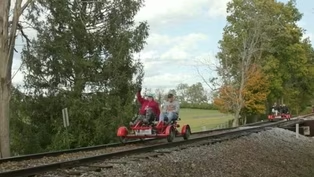
Clip: S31 Ep13 | 8m 7s | Abandoned Kentucky Railroad lines finding new life. (8m 7s)
Video has Closed Captions
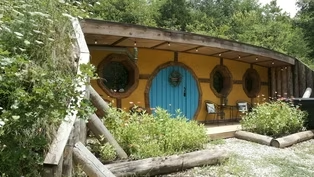
Clip: S31 Ep13 | 7m 59s | Was Kentucky an inspiration for Tolkien's literary works? (7m 59s)
Providing Support for PBS.org
Learn Moreabout PBS online sponsorship











Support for PBS provided by:
Kentucky Life is a local public television program presented by KET
You give every Kentuckian the opportunity to explore new ideas and new worlds through KET. Visit the Kentucky Life website.