
A Shire of Our Own
Clip: Season 31 Episode 13 | 7m 59sVideo has Closed Captions
Was Kentucky an inspiration for Tolkien's literary works?
Explore the possibility that J.R.R. Tolkien found inspiration in what he heard about Kentucky for his vision of the Shire in "The Hobbit" and "The Lord of the Rings."
Problems playing video? | Closed Captioning Feedback
Problems playing video? | Closed Captioning Feedback
Kentucky Life is a local public television program presented by KET
You give every Kentuckian the opportunity to explore new ideas and new worlds through KET. Visit the Kentucky Life website.
A Shire of Our Own
Clip: Season 31 Episode 13 | 7m 59sVideo has Closed Captions
Explore the possibility that J.R.R. Tolkien found inspiration in what he heard about Kentucky for his vision of the Shire in "The Hobbit" and "The Lord of the Rings."
Problems playing video? | Closed Captioning Feedback
Where to Watch Kentucky Life
Kentucky Life is available to stream on pbs.org and the PBS app.
Providing Support for PBS.org
Learn Moreabout PBS online sponsorshipCould the rolling hills of Middle-earth have roots in the rolling hills of Kentucky?
It's a question that's sparked curiosity for years.
Whether or not J.R.R.
Tolkien found inspiration for the Shire through stories he heard from a Kentucky classmate while at Oxford University.
Let's explore evidence on both sides of the idea and why the values that define the Shire feel surprisingly familiar right here at home.
[music playing] [music playing] “In a hole in the ground, there lived a hobbit.” Those were the words J.R.R.
Tolkien wrote on a blank sheet of paper while grading exams at Oxford University in the early 1930s.
Now, at the time, he had no idea what a hobbit was, let alone the stories that would unfold from that first sentence or the immense impact they would have on the world.
Their home is called the Shire, and pre-industrial farmland as far as the eye can see, with tobacco as their main export.
Now, this may sound familiar to our own state.
But to see where Kentucky comes in, we need to learn about a man named Allen Barnett.
[music playing] Allen Barnett was from Kentucky, from Shelbyville, from a farming family, one of four brothers born in 1888.
He got to Oxford with a prestigious Rhodes Scholarship, and he started here in October of 1911, a freshman alongside Tolkien.
They become very good friends.
They're members of the same group, the hard-to-pronounce Apolausticks, which means the merrymakers.
And we still have a couple surviving photographs with him and Tolkien together.
Matter of fact, we probably wouldn't be talking about him had not Guy Davenport mentioned his name in a piece that he writes for the New York Times originally.
[music playing] So, in 1979, Guy Davenport writes an article called Hobbits in Kentucky for the New York Times.
“I was in a casual conversation on a snowy day in Shelbyville, Kentucky.
I forget how in the world we came to talk about Tolkien at all, but I was realized I was talking to a man who had been at Oxford as a classmate of Ronald Tolkien, a distinguished lawyer, Allen Barnett.” “Imagine that,” Barnett says.
“You know, he used to have the most extraordinary interest in the people here in Kentucky.
He could never get enough of my tales of Kentucky folk.
He used to make me repeat family names like Barefoot and Buffen and Baggins and good country names like that.” So there it is, the article from the New York Times that starts this whole question about, “Is Kentucky, and particularly Lexington and Shelbyville, the area around central Kentucky, a source for some, if not many, of the names that are used in the Shire by Tolkien?” Now, can this be true?
Did Tolkien really grill Allen Barnett on his Kentuckian background?
It's clear they were close.
They talked a lot.
Tolkien would have been interested in all sorts of things Kentuckian.
He was interested in place names and how people talked, how they lived.
And what's funny is Tolkien could have got them from here and then transported them back in his mind.
It's hard to say.
And there's also the problem that Tolkien said quite specifically that his Shire was inspired by the little village that he, Tolkien, had grown up in.
He says, “If we drop the ‘fiction of long ago,' the Shire is based on rural England and not any other country in the world.” So that seems to certainly be the primary influence on the Shire.
And the influence of Kentucky, I'm afraid, has to remain a question.
Tolkien wanted the Shire to embody a kind of Englishness.
He wanted his mythology to be a mythology for England.
But in truth, it's become a mythology for much of the planet.
Kentuckians, of course, probably have as much reason to identify with the Shire as anyone does, and those values of community and caring for each other, helping each other, sharing fun together.
It's easy to see why Kentuckians might feel at home in the Shire.
After all, community and the joy of being together have always been a part of life here.
And for some folks, these values have become something you can walk into.
Believe in story.
Yes.
Our goal here is to be Coffee for Imagination and Fellowship and modeled after the Inklings, which is C.S.
Lewis and J.R.R.
Tolkien's little literary society.
[music playing] They would meet and read papers to each other about literary figures, about poets, about novelists, about playwrights.
So they were a club of cultured young men who were trying to promote their own intellectual life as well as have a laugh together.
[indistinct talk in the background] They've created literature that has just stood now on close to a century and just influenced the world in so many positive ways.
And we just really wanted to model our organization to kind of replicate what they were doing over in England with a beverage and a space and with friends.
I walked into Drinklings and met Randy Hardman and said, “Hey, do you like C.S.
Lewis?” He's like, “I'm more of a Tolkien guy.” I was like, “That's fantastic.
I'm a Lewis guy.
Hey, we should do something.” And within a month and a half, we had a Lewis Society and Tolkien Society going.
And so we got together and had the first Verum Fabula Fellowship meeting on the back porch of the old Drinklings location.
And we had 20 people out there for our first gathering.
And I don't know how many books we had read thus far and conversated around, but it was something that was kind of an idea.
And six years later, it is still going strong.
We create this atmosphere.
And then, these Kentuckians, they're like, “Yes.” Like, “I could easily be Bilbo.
I could easily be Merry or Pippin.” You see yourselves in those people because they're real.
They're tangible.
And they have.
it's just part of the human experience.
I think we all, in a sense, are more Hobbiton than we are rangers from the north.
It's stories that tell us who we are.
Stories that remind us why we're here.
Stories that encourage us and inspire us.
Yes, what we do makes a difference.
So that's what myths are.
These important stories that are foundational for humanity.
[indistinct talk in the background] We actually all love.
We all want to live in the Shire because it's food, it's fellowship, it's fireworks, it's laughter.
All those things that we love about the Hobbits, we really know we're meant for.
So people in Kentucky who read the Lord of the Rings and find their own home reflected in the Shire can use that, I hope, to give them strength in whatever they have to do to maintain love and respect for nature and the world at large in their home state.
[music playing] [music playing]
Video has Closed Captions
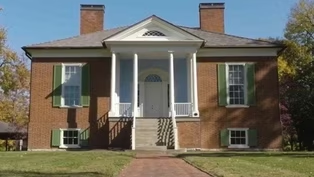
Clip: S31 Ep13 | 8m 22s | 200 years of history at Farmington Historic Plantation in Louisville. (8m 22s)
Video has Closed Captions
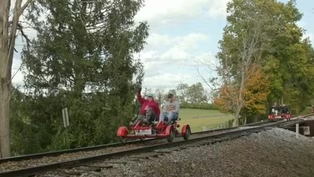
Clip: S31 Ep13 | 8m 7s | Abandoned Kentucky Railroad lines finding new life. (8m 7s)
Providing Support for PBS.org
Learn Moreabout PBS online sponsorship










Support for PBS provided by:
Kentucky Life is a local public television program presented by KET
You give every Kentuckian the opportunity to explore new ideas and new worlds through KET. Visit the Kentucky Life website.