Prairie Sportsman
Fast Forage in the Kitchen: A Prairie Sportsman Special
Season 17 Episode 14 | 27m 46sVideo has Closed Captions
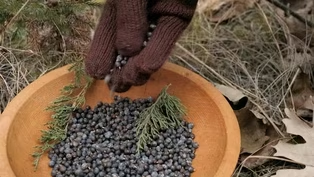
Forager Nicole Zempel explores the culinary uses of juniper on this special episode.
Forager Nicole Zempel explores the culinary uses of juniper on the next episode of Prairie Sportsman, welcoming friends and neighbors into the kitchen to prepare fish, wild game, tinctures and teas using foraged ingredients.
Problems playing video? | Closed Captioning Feedback
Problems playing video? | Closed Captioning Feedback
Prairie Sportsman is a local public television program presented by Pioneer PBS
Production sponsorship is provided by funding from the Environment and Natural Resources Trust Fund and Shalom Hill Farm. Additional funding provided by Big Stone County, Yellow Medicine County, Lac qui...
Support provided by:


Prairie Sportsman
Fast Forage in the Kitchen: A Prairie Sportsman Special
Season 17 Episode 14 | 27m 46sVideo has Closed Captions
Forager Nicole Zempel explores the culinary uses of juniper on the next episode of Prairie Sportsman, welcoming friends and neighbors into the kitchen to prepare fish, wild game, tinctures and teas using foraged ingredients.
Problems playing video? | Closed Captioning Feedback
Where to Watch Prairie Sportsman
Prairie Sportsman is available to stream on pbs.org and the PBS app.
Providing Support for PBS.org
Learn Moreabout PBS online sponsorship(soothing tones) (upbeat music) - [Bret] Today on a special "Prairie Sportsman," Forager Nicole Zempel highlights how to identify and harvest juniper berries.
- Interestingly, they're not true berries.
They're actually cones.
- [Bret] Then she invites her fellow Minnesotans into the kitchen to use foraged ingredients to prepare fish, wild game, teas and tinctures.
- Cheers my friend.
- Cheers.
Cheers to a good harvest.
- Welcome to "Prairie Sportsman."
I'm Bret Amundson.
This week we're gonna do something a little bit different.
Longtime viewers of the show will recognize Forger Nicole Zempel.
She helps you identify various plants and mushrooms found in nature.
Well, this week we're dedicating an entire episode to foraging and how you can use those naturally sourced ingredients to help you accentuate the flavor of your wild game cooking and serve as a foundation for other homemade goods.
Enjoy the show.
(dramatic music) - [Announcer] Funding for "Prairie Sportsman" is provided by the Minnesota Environment and Natural Resources Trust Fund as recommended by the Legislative Citizen Commission on Minnesota Resources, by Mark and Margaret Yackel-Juleen, on behalf of Shalom Hill Farm, a retreat and conference center in a prairie setting near Windom, Minnesota, on the web at shalomhillfarm.org.
And by the Friends of Prairie Sportsman.
To become a friend of "Prairie Sportsman," visit pioneer.org/prairieSportsman.
(upbeat music) - I am standing next to a beautiful eastern red cedar.
It is a species of juniper, of which there are several species of juniper.
This tree is a native species to central and eastern US.
The scientific name actually means that it's a tree from Virginia.
That's just because when people started coming from elsewhere and colonizing, people noticed this tree in Virginia.
Telltale signs you're onto an Eastern Red Cedar are you got the berries here.
That's a telltale sign.
But something I always look at is the bark.
It's actually kind of a reddish, brownish color, and it looks like it's peeling.
This is a female tree, and you can tell that it's female because you're seeing these beautiful blue berries.
Interestingly, they're not true berries.
They're actually cones.
The male tree, it has little brown, tiny cones, and those carry pollen sacs, which in the spring that's gonna release those pollens, and then it'll reach the female trees, pollinate, and then you get, we'll call 'em berries, even though they're cones.
It takes about eight to nine months for these berries to ripen.
But interestingly, there are moments where you're gonna wanna take the less ripe berry.
If you're into anything with home brewing, fermentation of any kind, making wild yeast, you're gonna go for the unripe berry, and they're coated in a little white, powdery kind of substance.
That's the wild yeast.
This whole tree has been used medicinally for centuries, and the whole tree can actually be utilized.
But we're actually gonna highlight for you and illustrate how marvelous these berries are in the kitchen.
So we'll see you in the kitchen.
(upbeat music) Welcome to downtown Granite Falls.
We are here at the lovely YES!House utilizing their kitchen space.
So big thank you to the crew at the YES!House for letting us come in.
Today we are going to uncover the marvels of the juniper berry, and I am here with my friend Kerry, a preservist.
I call him a master pickler, and he is gonna show us how to utilize the juniper berry and pickle some amazing fish.
Take it away, Kerry.
- Thank you, Nicole.
Okay, so the main thing with Juniper Berry is that it is traditionally used in Swedish pickled herring.
So that's what we kind of are tying it into with pickled northern.
This is northern, so we're gonna use some juniper berry along with the pickling spice to kind of create a traditional Swedish type pickled herring, but outta northern.
So the first step is you're gonna take your northern, you cut it into bite-sized pieces, and we're gonna put it into a jar.
And then we're going to put pickling salt in it and cover it with vinegar.
And then that, we stir it up, stir it several times a day for the first day, and once a day after that for five days.
So we'll put the fish in here.
(gentle music) - And so right now you said we are working with Northern.
- Yep, this is northern, but you can pickle basically anything.
You can do crappie, walleye, bass, bluegill.
Okay, so now we're gonna take the pickling salt.
This is measured out one cup, (gentle music) and then we'll cover it with vinegar.
- So I've never been a fan of pickled fish, but I have to say Kerry was kind enough to share some with me not too long ago.
And I loved it.
And I shared it at Thanksgiving with my family, and it got rave reviews, so I couldn't think of a better person to come in and pickle some fish.
- It worked out great.
So there you just top it off with your vinegar and then you're gonna stir it up 'cause you wanna make sure that the salt gets to every piece and every part of the fish.
So what you're trying to do here is you're breaking down the muscle tissue of the fish and the bones.
So you just give it a good stir.
- Does it matter what kind of vinegar you use?
- 5% is the best.
- [Nicole] Okay.
- [Kerry] 5% acidity is where you wanna be.
- So just stir it multiple times on day one, and then once a day for the next five days.
- Next five days.
- Okay, cool.
- So now this goes in the fridge.
When that is done for five days, then we're gonna take it out of the fridge.
You're gonna put it in like a colander and rinse it.
And then you're gonna soak it in cold water for 15 minutes.
And now what that does is that's gonna kind of bring that back, all the tendencies of your fish back into your fish.
- So kind of firm it up a little bit.
- To firm it up again.
It's kind of like taking a steak and letting it rest after you cook it or grill it so those juices come back into it.
Okay.
- So you're kind of doing the same thing with the fish.
- Okay.
- So then after that, then you are ready to make your brine.
So we're gonna start with the California port.
It is what it is.
It's a very high volume alcohol wine that will help to break that stuff down.
So it's gonna be two cups, just pour it into the jar.
(gentle music) And then it's gonna be a cup and a half of sugar.
And then next is gonna be a cup of water, and any water works.
And then I just use a regular pickling spice, and you're gonna put in a tablespoon and a half.
And then this is where we're gonna put in the juniper berry.
So we're just gonna take about five or six of these juniper berries, and you wanna make sure that you slightly crush 'em.
- [Nicole] Okay.
- Or crack 'em 'cause all you're really doing is you're releasing the aromatic oils of the juniper berry.
So there is our juniper berries.
And then we're just gonna stir this up.
- [Nicole] So it only takes a few, really.
- [Kerry] Yeah.
- [Nicole] It's not, okay.
- You don't, 'cause what you're doing with the juniper berry is gonna give you a little citrusy and a little pine flavor.
- [Nicole] Okay.
- To the fish.
So you just stir that up until the sugar is dissolved.
- Then so this brine then becomes part of like the finished.
- Yep.
- Okay.
- Yep, so then when your fish is done, what you're gonna do, this is the finished product.
- Yum.
- So you're gonna take your fish after it's been rinsed and sitting in your cold water for 15 minutes.
What I do is I take a handful of fish and a handful of onions, and you layer it, and you layer that together.
And then once you get all your fish in there, you're gonna have about a half a gallon.
And then you're gonna put your, pour your brine on top of that.
Stir it once a day for four to five days.
You can either leave it in the jar and just leave it that way, serve it that way.
Or you can put it in pint jars if you want to.
And then you can just give a pint jar to a friend.
Or you can keep it or.
- Okay.
And right now we're just gonna.
- There it is.
- We're just gonna dig in.
- Don't mind the cookie storage.
It's actually pickled fish.
- Here let's see then, we'll use this.
So give it a little stir and then?
- [Kerry] And dig in.
- All right, this is so good.
- And I actually think the onions turn out almost as good as the fish does.
- There you go.
(upbeat music) Oh, all right.
Look at that.
Cheers.
- Cheers, bon appetite.
- All right.
This is so good.
That's good.
- Nailed it.
(upbeat music) - I am here with my friend Jessica.
I cook very simply.
Jessica will take something incredibly complex and make it look simple.
She's just an amazing baker, cook, chef.
So thank you for being here with us today.
- Thank you.
- And we are gonna highlight the juniper berry.
Traditionally it has been used as like a seasoning for wild game meat.
And so today we are working with my favorite meat, venison.
So Jess, why don't you take it away and show us what you're going to do with this.
- All right.
So today we are going to braise this venison in a red wine sauce seasoned with juniper.
So to start, we wanna really just rough cut some vegetables.
You don't have to be very precise with this.
It can be very large pieces because it's all just gonna go in the pot and cook with the meat.
You're not going to actually use these later.
They are just seasoning.
So we're gonna do carrots and celery, all rough cut.
And then we're going to stick in a whole head of garlic.
So we're just gonna cut the top off so some of the flavor can come out.
We're gonna throw in a handful of cherry tomatoes.
This acid's gonna kind of help balance the gaminess of the deer.
We of course have to have some onion.
And again, it can be super rough cut.
And then the star of the show is the juniper berries.
Since they're so strong, we're going to use kind of a pinch of them.
Okay.
Also because we've got a lot of very strong flavors going with the garlic and the onion and the juniper berries, we're gonna put a little bit of sweet in to kind of balance.
So we're gonna put in a couple of pinches of brown sugar.
We don't wanna go too crazy with that 'cause we don't want it to start caramelizing in the sauce.
And we're gonna add almost an entire bottle of wine.
If you have a cabernet, that is a good one to use.
And then the alcohol in this is just gonna also kind of help break down kind of that gaminess and any of the muscle that's in the deer meat.
And it's gonna make a really rich sauce at the end.
We're gonna use a little bit of vegetable broth just to add some more liquid to the mix.
So we don't wanna use a chicken stock or a beef stock that's gonna change the flavor of the meat away from tasting like venison.
All right.
And then we're gonna just season both sides of this with salt and pepper, and pat it in.
(upbeat music) And then we are gonna sear this to get a nice brown crisp on both sides of the meat.
(meat sizzling) We'll take that away.
All right.
So we're getting a good sear on this side.
We're gonna flip it, over and we've got some of that nice darker brown going around the edges.
We're gonna let this side sear.
(meat sizzling) All right, and that side is beautiful as well.
- Ah, that's amazing.
- Yeah, so now we're just gonna transfer the meat into all of that sauce.
Just gonna press it down in there.
And then we're just gonna add the lid and stick it in the oven.
We're gonna have the oven set at 300 degrees for about three and a half hours.
And so here's what we've already started, since this does take three and a half hours to cook.
And so we have this.
- Look at that.
- Pan full of beautifully cooked vegetables.
- [Nicole] Oh, and it smells so good.
- And the meat is very tender.
So what we're gonna do now is take some of the sauce from this that's all seasoned with all the vegetables and everything.
And we're gonna put it into a sauce pan.
About a half cup, three quarters.
- Okay.
- Three quarters of a cup.
And now we're going to make a reduction out of this.
So our sauce is starting to boil, and you're gonna want it to get to a full rolling boil.
You're gonna wanna stir pretty frequently.
- [Nicole] Okay.
- 'Cause you are gonna have some of the fats from the meat and whatnot in here, and continuously stir.
And now that we've got a boil going for a while on that, we're going to take about two tablespoons of cold butter, and we're just gonna drop it in.
And that's gonna make the sauce just a little richer.
I'm gonna stir that in while it melts so that the fats don't separate from the liquid in the pan.
And then at this point, we can turn the burner off and just let the butter melt in.
Give it one more little stir, make sure the butter hasn't separated.
And then you're gonna just pour that over the top of all of this.
(upbeat music) - Oh, yum.
- And then we will top this with a little bit of fresh parsley.
- Oh, my mouth is watering.
- Yep.
- Thank you so much.
- There you go.
- I've gotta get a little bit of the meat with the potatoes and the sauce, oh.
- Gotta get that nice dark crust.
- What a treat.
Hmm.
That's amazing.
Jess, I wanna thank you for coming in and sharing your amazing culinary talents with us.
And I look forward to eating the rest of this.
Thank you.
- You're welcome.
Thank you for having me.
(upbeat music) - Well, welcome back to Fast Forage in the Kitchen.
Today we are highlighting the wonders of the juniper berry.
My friend Krishana is an amazing, amazing creator of tinctures.
And so I couldn't think of a better person to have to enlighten all of us on the benefits of some of these plants we're working with as well as how you make your tinctures.
So thank you, Krishana.
- Well, thanks for having me.
When you think of a tincture, I want you to think of an extract.
So like a vanilla extract is just vanilla tincture.
So it's pulling out the essence of whatever herb we're using.
So a juniper tincture is gonna be useful for several different things, both medicinally and then also in preparing food.
And so what we're gonna do today is we're going to tincture it in some apple cider vinegar.
And that is gonna be something that is really useful to do like a marinade or a salad dressing.
- Oh.
- Yeah.
- Yeah, that just sounds good.
- And some people will also use it to flavor drinks, and it'll give it that juniper flavor.
You can use it in place of a gin to make some sort of a mocktail if that's what you're interested in.
So shall we make some tinctures?
- Yes.
- Okay.
So I'm gonna just take the berries, and I'm gonna crush them because what I want to do is increase the amount of surface area that's being touched by the liquid.
So I'll pour these in and just kind of start crushing.
So this is literally going to be an extraction.
I know.
- I just have to, wow.
- Isn't that beautiful?
What does it smell like?
It smells like-- - To me it reminds me of like a sagey.
- Yeah.
- Sagey smell, yeah.
- [Krishana] Yeah.
- Sagey evergreen.
- Yeah, very evergreen, very, very evergreen.
- So you don't wanna pulverize them, right?
You just wanna give 'em a good, kind of a good mash.
- Correct.
I'm not gonna go totally ham on them.
I'm kind of going until I see the seeds.
- [Nicole] Sure.
- So now we're just gonna throw this into a jar, and I chose this size literally only because of, because I had it in my cupboard and because it kind of matches the amount that we're gonna put in here.
So I like to fill my jars relatively full because we don't want there to be a lot of space on the top.
And so if I had less, I might go for something even smaller like this.
If I had more, I would obviously do a larger jar.
Okay, so I've got my berries in there, and I'm just gonna kind of eyeball this.
And this one isn't gonna be all the way full.
So if I were actually at home, I probably would at this point change over to this jar.
It is what it is.
- We work with what we have.
- We work with what we have.
And this is my apple cider vinegar that I'm going to use.
And I just jarred this yesterday, and I made this apple cider vinegar.
- Nice job.
- Thank you very much.
I got the recipe from my friend Nicole, so.
So I'm just gonna eyeball it, two parts to one part.
(liquid pouring) And that should be about enough.
And set that to the side.
An important note, whenever you go to put the lid on your jar, it's very important that you take parchment paper and set that on there first.
Because whatever liquid you're using, if it's the vinegar or the alcohol, it's going to rust away at your lid here.
It'll cause rust.
And when you get to the point where you're ready to strain this, and you notice that you have something wrong with your mixture, so.
- So parchment paper.
- Parchment paper prevents rusting.
- And how long do we let a tincture sit?
- So the the next step that's very important is to shake.
You're gonna shake it about once a day or a few times a week for four to six weeks.
- Okay.
- And if you have a cool dark place to put it, that's great.
I actually, I have a husband who works out in the basement, and I stick this in his workout space.
And his contribution to my tinctures is that he gets to shake them when they're on the shelf.
So if you have a husband that works out in a cold room, might I recommend that for you.
(both laughing) - Thank you, Krishana.
I really appreciate you taking some time to share your passion and your knowledge with us.
And thanks to everybody for watching.
Get out there and explore.
(upbeat music) I am delighted to welcome my friend and fellow forager, Nora.
- Hi.
- And so Nora, you actually, why you're here now is because we're gonna talk tea, and you sparked my interest in tea.
Tell us, how did you start thinking tea?
- Well, I feel like tea is relaxing, and sometimes you can forage it.
- That's right.
Now let's talk about.
- And it can be free.
- Say that again.
- It can be free.
- And because why?
Where's it growing?
- It's just growing in my backyard.
- Right.
You called me over one day because you had seen Creeping Charlie and you were wondering, can this plant be eaten?
Can we use this plant for anything?
- Uh huh, and it turned out to be my favorite tea.
- It's my favorite tea too.
Like it tastes wonderful.
I don't need sugar.
I don't need honey.
Just straight up Creeping Charlie.
- Yes.
- Okay, so we're gonna have some tea, all right?
So we have the Creeping Charlie.
This is loose leaf tea.
And I like it that way because if you grind it up any farther, I dunno, I just, I prefer it loose leaf.
And then these little bags, they're handy, aren't they?
- [Nora] Very.
- [Nicole] You can reuse 'em over and over and over.
- And it can become, and you can use 'em for powder.
You can't use these for powder.
- Are we going to use your little tea ball there?
- Sure.
- Okay.
So I'm gonna go with a reusable teabag.
Put the loose leaf dried Creeping Charlie there.
And I'm gonna just pour mine, and we will let that sit for a little bit.
And then, give it a good little shake there.
And you are packing your tea ball?
- Yep.
- All right.
Can I help you out?
- Thank you.
- And honestly, and tell me if you feel the same way, you can never have too much, right?
- Yeah.
- Like it just tastes delicious.
- Yeah.
- And I like a good strong tea.
- [Nora] Could you?
- [Nicole] Yes.
- [Nora] Help?
- [Nicole] Yes, yes.
- [Nora] Thank you.
- Well, thank you for turning me on to Creeping Charlie Tea.
Okay, so your Creeping Charlie is in your tea ball there.
And I'll get you some water.
- Why thank you.
- Yes, okay, watch your hands (gentle music) - A little more.
- A little more.
- There's never too much tea, am I right?
Creeping Charlie Tea.
- There you go, my dear.
- Especially.
- All right.
(gentle music) It smells good.
- Mine's already smelling like Creeping Charlie tea.
- Yes, and this is a good way too, if you're stuffed up, just inhaling like the steam from the tea, especially with nettle or with Creeping Charlie, it's gonna help loosen your sinuses.
Cheers, my friend.
- Cheers.
Cheers to a good harvest of Creeping Charlie.
- Cheers.
- Oh, yep, cheers.
(upbeat music) - [Announcer] Funding for "Prairie Sportsman" is provided by the Minnesota Environment and Natural Resources Trust Fund as recommended by the Legislative Citizen Commission on Minnesota Resources, by Mark and Margaret Yackel-Juleen on behalf of Shalom Hill Farm, a retreat and conference center in a prairie setting near Windom, Minnesota.
On the web at shalomhillfarm.org.
And by the Friends of Prairie Sportsman.
To become a friend of "Prairie Sportsman," visit pioneer.org/prairieSportsman.
(soothing tones)
Fast Forage in the Kitchen: A Prairie Sportsman Special
Video has Closed Captions
Preview: S17 Ep14 | 30s | Forager Nicole Zempel explores the culinary uses of juniper on this special episode. (30s)
Providing Support for PBS.org
Learn Moreabout PBS online sponsorship New Episode
- Science and Nature

Explore scientific discoveries on television's most acclaimed science documentary series.






 New Season



 New Season

Support for PBS provided by:
Prairie Sportsman is a local public television program presented by Pioneer PBS
Production sponsorship is provided by funding from the Environment and Natural Resources Trust Fund and Shalom Hill Farm. Additional funding provided by Big Stone County, Yellow Medicine County, Lac qui...