
Feeding the American Revolution | Trailer
Preview | 4m 47sVideo has Closed Captions
Explore the Revolutionary Era through the lens of food.
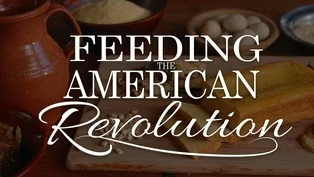
Coming in December 2026, Feeding the American Revolution! A new WMHT documentary exploring history through food. Hosted by historian Nancy Siegel, the film examines how culinary traditions shaped America's fight for independence, using primary sources and cooking demonstrations at historic sites to reveal how the kitchen served as a battleground and a tool for unity, identity & political protest.
Problems playing video? | Closed Captioning Feedback
Problems playing video? | Closed Captioning Feedback
Feeding the American Revolution is a local public television program presented by WMHT
Feeding the American Revolution | Trailer
Preview | 4m 47sVideo has Closed Captions
Coming in December 2026, Feeding the American Revolution! A new WMHT documentary exploring history through food. Hosted by historian Nancy Siegel, the film examines how culinary traditions shaped America's fight for independence, using primary sources and cooking demonstrations at historic sites to reveal how the kitchen served as a battleground and a tool for unity, identity & political protest.
Problems playing video? | Closed Captioning Feedback
Where to Watch Feeding the American Revolution
Feeding the American Revolution is available to stream on pbs.org and the PBS app.
In his diary of February 5th, 1763, John Adams describes a recipe to make a patriot.
In fact, the ingredients that will form a new republic through the fires of the American Revolution are immensely rich and complex.
The resulting cuisine will draw from English, French, Dutch, Spanish, African, Caribbean, and Indigenous traditions.
History will be made not just in the seats of power, but in fields, farms, hearths, and homes.
Join me, Nancy Siegel, on a culinary journey through the heart of the American Revolution, where we learn that what happened around the dinner table is just as important as what happened on the battlefield.
- First of all, food is a good lingua franca.
It's a good way to talk about things because the human condition is if we don't eat, we die.
So we are all involved in food in some way or another.
Whether or not we're cooking it, we are eating it.
And so when you start to look at then it becomes a good way to talk about things.
It becomes a good way to circle to begin to try to parse out different things and different people and different ways that people c And so when you talk about the Revolutionary War, what better way in?
- We love taking time with books in ways that help us think about daily life.
And that's one of the wonderful about the cookbook collection is we don't always get to see what everybody was eating but we can read about it.
- Absolutely.
- One of the best ones in here, I think, is... - Oh gosh, we have Washington cake.
Isn't this fantastic?
Two pounds of flour, a quart of milk, an ounce of butter, three eggs.
I mean, it looks doable.
I think I could make this.
Krista, thank you for welcoming me into your kitchen.
This is a wonderful space.
- Absolutely, thanks for joining me.
We need to first start with creaming our sugar and butter together.
My butter is softening down near the fire.
- [Nancy] What are we gonna bake - [Krista] We're gonna make Washington cake today.
- [Nancy] If ever a founding fig was commemorated in flour, eggs, and sugar, it would be George Washington.
- Absolutely.
- Ooh, this looks delicious.
The idea of a single national cuisine is misleading.
American food grew from many for politics, geography, and shifting tastes, and the mixing of plants and pra from multiple cultures, Indigenous herbalists, and enslaved African cooks who were central creators alongside English, French, Dutch, Spanish, and Caribbean influences.
By the early 1800s, what people called American food was a practical fusion.
Native staples like corn, maple syrup, berries, wild rice and game combined with African crops such as rice, okra, and peppers, and European garden plants, cabbage, peas, carrots, plus thousands of grafted fruit varieties and imported staples and spirits Kitchen gardens brimmed with culinary and medicinal herbs that completed the picture.
 Now Playing
Feeding the American Revolution | Trailer
Video has Closed Captions
Explore the Revolutionary Era through the lens of food. (4m 47s)
Providing Support for PBS.org
Learn Moreabout PBS online sponsorship












Support for PBS provided by:
Feeding the American Revolution is a local public television program presented by WMHT