
Bonus Material | Fellow Warriors: Iraq, Afghanistan, Vietnam
John Musgrave is a Marine veteran who counsels active-duty soldiers and veterans.
From
Bonus Material | Fellow Warriors: Iraq, Afghanistan, Vietnam
Clip | 20m 46sVideo has Closed Captions
John Musgrave is a Marine veteran who counsels active-duty soldiers and veterans.
John Musgrave is a Marine veteran who served at Con Thien in Vietnam where he was wounded. After returning home, Musgrave struggled with survivor’s guilt and depression. Today, he counsels active-duty soldiers and other veterans who are having trouble adjusting to life after their service in Iraq and Afghanistan.
From
Problems playing video? | Closed Captioning Feedback
Problems playing video? | Closed Captioning Feedback
Funding for The Vietnam War is provided by Bank of America; Corporation for Public Broadcasting; David H. Koch; The Blavatnik Family Foundation; Park Foundation; The Arthur Vining Davis Foundations; The...
Bonus Material | Fellow Warriors: Iraq, Afghanistan, Vietnam
Clip | 20m 46sVideo has Closed Captions
John Musgrave is a Marine veteran who served at Con Thien in Vietnam where he was wounded. After returning home, Musgrave struggled with survivor’s guilt and depression. Today, he counsels active-duty soldiers and other veterans who are having trouble adjusting to life after their service in Iraq and Afghanistan.
From
Problems playing video? | Closed Captioning Feedback
Where to Watch The Vietnam War
The Vietnam War is available to stream on pbs.org and the PBS app.
Buy Now
Related to This Clip

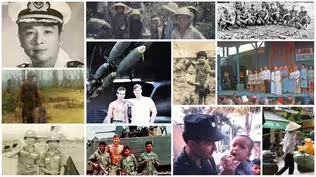

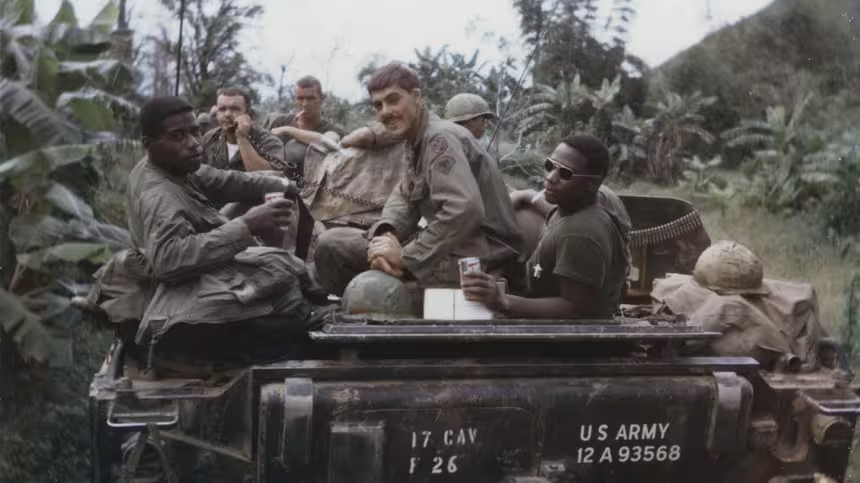
Vietnam Stories
We asked viewers to share their experiences during the events of the Vietnam War era. The response was thousands of videos, photographs, and short stories.Providing Support for PBS.org
Learn Moreabout PBS online sponsorshipJOSHUA MANTZ: There he is.
Hey, Josh.
MANTZ: What's going on?
Good to see you.
Good to see you.
How's everything going?
MANTZ: Our Vietnam veterans, people like John Musgrave, they've been dealing with this for 40 years, mostly on their own.
But they're now emerging here in this barbecue joint in the middle of Kansas to help our returned Iraq and Afghanistan soldiers heal.
This here is as real as it gets.
I know that it's as effective as it gets.
We're literally facilitating a partnership between Vietnam, Iraq, Afghanistan, and letting them talk.
There are several that have been sitting around this table today that, a year and a half ago, I didn't know that they were going to make it.
I've been telling you guys from day one, when we first kicked this group off, we didn't know what would work best and what didn't.
Without question, even though every session's pretty powerful stuff, this is by far the most meaningful.
The moral injuries of combat.
That's what haunts everybody around this table just the same, okay?
So what I'd like to do is start by going around the ta... Eric, we'll start with you.
My name is Eric Tipsword.
I've got 18 years in the army, whether it be active duty or National Guard time.
Three deployments.
I have a hard time, even right now.
I've been back over a year now, this time.
And I still have a rough time around people, crowds, and, like, my own family.
My name is Colin.
I've got 13 years in the military and... five years active duty, the rest is in the reserves.
I've had two deployments.
I've lost some guys, I've been through some shit, as Eric would say.
I go by Tug, period.
(laughter) I've got three deployments.
Lost a lot of guys, saw a lot of bombs.
Even if they weren't on me, they were on my friends.
I've seen it all.
TONY FEASTER: I'm Tony Feaster.
You know, got blown up a few times.
And now... I mean, it's been about a year.
I'm still working at it.
I still stay secluded, to myself.
I'm not close to my family.
I sit in the basement by myself, you know?
I'm trying to learn a little, trying to learn all over again how to fit in.
It ain't working too well.
I mean, I smile and act like everything is good, you know?
You would never know there's something wrong with me until I do what I do, and hurt people, you know?
Steve... I think I'm going on 13 years now.
Combat engineer.
Been to Iraq two times.
This last one was kind of short.
Vehicle got hit, and lost a friend of mine.
And got medevaced out after that.
And just trying to get through things.
Travis Belmont.
I've been in the military for 18 years now.
Deployed twice to Iraq, once to Afghanistan.
Afghanistan, uh, tested every... every inch of my leadership ability as far as being just... the feeling of being out there on your own.
It... I don't know.
It's pretty hard.
This is my first time with the group.
I hoping to pretty much share a lot of... or learn from a lot of my... the guys that paved the way for us... How to deal with just being... just... Like I said, just feeling alone, that lonesome feeling.
That's pretty much all I have to say.
My name's Kurt Bennett.
I was in the Marine Corps.
I started out as a pilot, and I flew 206 close air support missions, killing people, having a great time.
Flying was perfect, man, good shit.
Then I went to the field, and I grew up.
And I lived six months in fear, total fear, every day.
And I wouldn't admit it to anybody.
Come on, a Marine.
I came home, and I had a lot of... I don't call them nightmares, but just things that imprinted in... were in my head, and I couldn't get them out.
I wrote down everything-- the good, the bad, the ugly, the sublime, the ridiculous, the stupid, the smart.
And then I put it away, but it was a transference.
I took all the shit in here and put it out here.
It works, it helps.
If we can survive 40-some years in the wilderness, you can do it.
You can look at us and say, "Jesus, if those guys can do it, it's a piece of cake."
All right.
I went in the Marine Corps when I was 17.
I volunteered for Vietnam.
I was a rifleman.
And served 11 months and 17 days in Vietnam with Delta Company, Third Platoon, First Battalion, Ninth Marine Regiment.
In Marine Corps history, we're called the Walking Dead, because in Vietnam, we suffered the highest casualties of any Marine infantry battalion in the history of the Marine Corps.
I was permanently disabled by my last wound.
And then I began my next war.
And my next war was trying to keep alive after I got home.
I was doing okay while I was in the corps, because I had my buddies with me.
But when I was sent home, then I was by myself.
And I was in a hostile sea, because I was surrounded by people that considered me a baby killer.
I'd never killed any babies.
But I was accused of it.
And that pissed me off.
I was struggling a great deal with survivor guilt.
It was a long, hard fight.
And I was hurting so much.
I tried alcohol as a painkiller.
I tried drugs as a painkiller.
Nothing worked.
I was in so much pain that I somehow had convinced myself that my family and my loved ones would be better off if I was dead.
And that's when I began flirting with my .45.
Because I was convinced that the people that loved me and were struggling to understand what I was going through Would honestly be better off if I just checked out.
And I found myself wanting to do the job that the enemy hadn't finished on the field of battle.
I would like to tell you that you're going to reach a point that it's all going to go away.
But I can't tell you that based on my own experience.
But I can tell you that it's still worth the fight.
In 1969, when I first got out, I began writing poetry.
If I didn't get it out, it was going to kill me.
I knew it would kill me in the end.
It would eat a hole right through my heart, right through my gut.
And I don't mean just talking to yourself.
Talking to yourself don't do it.
I had to get it out on paper.
Poems are like burst, you know?
Like, you don't want to burn out the barrel.
Three to five rounds, short burst, short burst, don't burn out the barrel.
That was my mantra to myself in a firefight.
So poems were like burst.
And every burst was like lancing a boil.
I was purging poison out of my system.
If you keep it in, it's going to do you dirt, guys.
And even worse than that, it'll make you hurt the people that love you the most.
We end up scarring the people that we love with our pain and our frustration and our struggles.
And that's not healing.
That's just passing out the pain to other people.
You know, I don't feel like we're some old guys with some young guys here.
I feel like we're warriors.
Fellow warriors, talking about strategy and tactics.
How to maneuver on this new battlefield that we're in.
How to survive in this new battlefield we're on.
And we need you guys to heal, because God help us, there's going to be another war.
And another one after that.
And those kids are going to need you.
We can't afford to lose anybody else.
We love you guys.
We see ourselves in you.
We admire you.
And we just want you to know that we're not your fathers, your grandfathers, your uncles, your cousins.
We're your brothers.
And as long as there's one Vietnam veteran alive, still struggling, you'll still have a brother on this field of honor.
And that's why Josh and I originally talked about doing this.
Passing on the strategy and the tactics.
So... MANTZ: Well, hey, guys, as we're talking tactics, I think we're going to bring out the chow.
Yes, let's eat.
Another important part of combat.
Keep the conversations going.
If you guys have got to get up and go to the bathroom, go for it.
STEVE: Usually I drive a Husky, you know?
So I'm out doing a rear route clearance, four miles an hour, out in the edge of the road, ahead of everybody, you know?
The day prior to the mission starting, the guy that ran the rollers, the gyrocam and all that, he hurt his finger weightlifting.
So he asked me if I'd fill in his position.
I'm like, "All right, whatever, man, that's fine."
He's like, "Make sure everything comes back fine," you know?
And it just... it didn't even hit me, but then, you know, on the way back from... we'd go out one day and come back the next, same time.
so when people know... Same time, yeah.
Yeah.
That's real smart.
And then we got more lights on our truck than, you know... than God has in the sky.
So they see us coming.
And it was a little shit village.
And they had a big EFP go off.
And it's just smoke everywhere, dirt.
And alls I remember is opening my eyes, and the hayline was just blowing in my face.
And then, you know, one of the vehicles in the chalk behind us we were clearing for, they became the medevac vehicle.
But they got stuck.
So my buddy sat in that truck and expired within ten minutes after I got him out.
Sitting there, covered in my blood, watching my truck burn to the fucking ground.
And it just killed me-- why couldn't I have done some more to help him out medically?
And that always is in my mind.
I was like, "Man, he was so much smarter than me."
I wish I could have helped him so much more.
And maybe it should have been him making it and me not.
You know?
I've said that a million times.
I've been where you're at, buddy, and I know.
I wish there was some way I could just jerk that pain out of you.
MANTZ: Hey, guys?
Hey, Tug's going to... I'm going to turn it over to Tug here real quick.
He's got something for the group.
After a year and a half of going at this stuff.
Yeah.
All right, bear with me, please.
It's called "Letter to John."
"Dear John..." this is my Dear John letter.
(laughter) "There have been many things in this world "that I would not like to be the fault of; "however, I am.
"Well, there is a person at fault for giving strength "through his trials and errors.
"He is guilty and at fault for giving me "a light to wander to.
"I blame him in a positive reflection, "that even though life seems grim, "I know I can be like him.
"Fault is generally a negative word, "associated by guilt of doing wrong.
"However, my intention is to show a man "his fault is constantly illuminating "and holding out his hand not for wealth or gratitude, (voice breaking): however, to offer those that need a hand up..." Go to it.
MAN: Hang in there.
Spit it out.
"This is the strength that binds a veteran in a different fashion "than any ordinary citizen.
"I cannot elaborate any stronger, "for this man is not any bit of ordinary, "nor are the comrades he brings to alter the variety "of situations that may be in one room.
"I never expected a generation of soldiers "whom I always believed to have a way worse war "than my generation to be able to sit "and help so well, "to show us that it's not just any war "that we would relate to-- "it's the ones that forced our souls to tear.
"That even though our will to live is callused and weathered, "we know that they made it, and that is an example to live by."
God bless you.
Thank you, buddy.
(applause) Okay, here's your title.
"Ode to John Musgrave."
I love you guys.
You just helped with my wounds too, Tug, And I really appreciate it, buddy.
This means the world to me.
MANTZ: Hey, let me reinforce what John said here.
It's something that I keep emphasizing every time we have a group session, or I try to.
It's the most powerful system... the most powerful people in the human process are you guys around the table.
Amen.
All right?
The clinical side can take it a step farther, but there's absolutely nothing more powerful than you guys right here, okay?
I'm going to turn it over to John for the last official words here.
Life is worth living.
Any struggle, it's worth it.
We've been through hell already.
We don't need to put ourselves through any more hell now that we're home.
The enemy that we're struggling with now is as deadly as any enemy we've ever faced on the field of battle.
Only it's inside of us.
Curt said a very important thing about it's a day-to-day thing.
One of the things I used to do at night when I was holding my .45 under my chin was I'd say, "John, you know, if you really want to do this, you can do it tomorrow."
And I'd put it back in the drawer.
And if you have moments like that, or you have buddies who are having moments like that, just get another day out of it.
And that next day, it's like being in the grunts.
You put one foot in front of the other.
And surviving the war after we come home is putting one day after another, until we've got it figured out.
I'm so glad that I didn't kill myself when I was 20 years old when I got home from the hospital.
I'm so grateful that I put it off all those nights for all those years.
You know, sometimes when we struggle with a question, we just have to live ourselves into the answer.
I know I could count on any one of you at this table if I needed you.
I know I could count on you.
I know it.
And that's a great feeling.
I feel like you were talking directly to me.
Because I felt... I felt everything you were talking about as far as feeling like being alone.
I've been... I've been to a point where I just almost wanted to quit.
My dog saved my life.
Yeah, my dog saved me twice, just by coming into the room.
And licking my face while I'm just pouring down in tears.
Yeah.
(sighs) So everything you said, it hit home.
It helped me out.
Thank you.
Never surrender, right?
Never surrender.
Thank you.
Thank you.
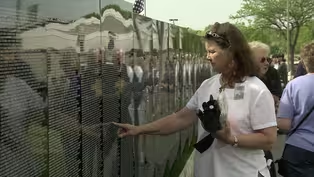
Clip | 30s | Powerful, personal and inspiring stories related to The Vietnam War. (30s)
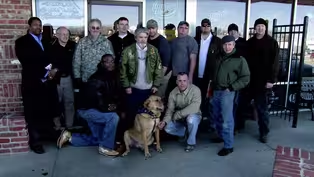 Now Playing
Bonus Material | Fellow Warriors: Iraq, Afghanistan, Vietnam
Video has Closed Captions
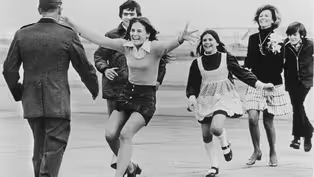
Clip | 20m 46s | John Musgrave is a Marine veteran who counsels active-duty soldiers and veterans. (20m 46s)
Video has Closed Captions
Preview | 30s | America's top critics are unanimous in their praise for The Vietnam War. (30s)
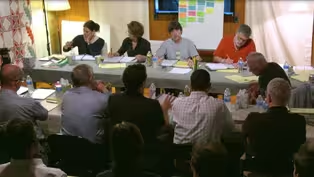
Behind the Scenes | Consulting with Ken Burns & Lynn Novick
Video has Closed Captions
Clip | 2m | Two of the film’s participants discuss working with the filmmakers. (2m)
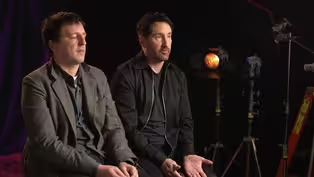
Behind the Scenes | Trent Reznor & Atticus Ross on the Score
Video has Closed Captions
Clip | 2m 17s | Trent Reznor & Atticus Ross discuss composing the film's score. (2m 17s)
Video has Closed Captions
Clip: Special | 3m 30s | The filmmakers discuss their decision to make a film about the Vietnam war era. (3m 30s)
Inside Look | Unsettled History
Video has Closed Captions
Clip: Special | 2m 30s | The filmmakers discuss working with historical experts on the film. (2m 30s)
Video has Closed Captions
Clip: Special | 8m 41s | The filmmakers discuss finding the imagery and recording the score for The Vietnam War. (8m 41s)
Video has Closed Captions
Clip: Special | 4m 31s | The filmmakers discuss filming on location in Vietnam. (4m 31s)
Inside Look | Echoes Of Vietnam
Video has Closed Captions
Clip: Special | 5m 15s | The filmmakers discuss the impact of the Vietnam war era on the present day. (5m 15s)
Providing Support for PBS.org
Learn Moreabout PBS online sponsorship









Support for PBS provided by:
Funding for The Vietnam War is provided by Bank of America; Corporation for Public Broadcasting; David H. Koch; The Blavatnik Family Foundation; Park Foundation; The Arthur Vining Davis Foundations; The...