Articulate
Finding Meaning
Season 7 Episode 10 | 26m 46sVideo has Closed Captions
Timothy Showalter uses music to survive the world. John Jarboe wants to help change it.
Timothy Showalter uses music to share and survive a tumultuous world. John Jarboe wants to help change it.
Problems playing video? | Closed Captioning Feedback
Problems playing video? | Closed Captioning Feedback
Articulate is a local public television program presented by PBS39
Articulate
Finding Meaning
Season 7 Episode 10 | 26m 46sVideo has Closed Captions
Timothy Showalter uses music to share and survive a tumultuous world. John Jarboe wants to help change it.
Problems playing video? | Closed Captioning Feedback
How to Watch Articulate
Articulate is available to stream on pbs.org and the free PBS App, available on iPhone, Apple TV, Android TV, Android smartphones, Amazon Fire TV, Amazon Fire Tablet, Roku, Samsung Smart TV, and Vizio.
Providing Support for PBS.org
Learn Moreabout PBS online sponsorship- [Narrator] Articulate with Jim Cotter is made possible with generous funding from the Neubauer Family Foundation.
(opening music) - Welcome to Articulate, the show that brings you insights into the human condition, from some fine creative thinkers.
(opening music) - I'm Jim Cotter, and on this episode, of "Finding Meaning".
Music has been a salvation for Timothy Showalter, front man and founder of Strand of Oaks.
Writing and recording have helped him through personal tragedy and despair.
- As a kid who was kind of in his own head, growing up for me, as an adult now, I still look for that escape.
And a brief moment when, you can kind of rise above your life and just be like transcended into the song, I guess.
- [Narrator] And soloing with the Bearded Ladies Cabaret, theater artist John Jarboe explores the politics of sexuality and gender in popular culture.
- In cabaret is in a certain respect, I think it is a queer form and it, it is mercurial and flexible and has many different identities because it is a transgressive form, and because it's not opera, or ballet, or theater.
It uh, it shape shifts.
- [Narrator] That's all ahead on Articulate.
(opening music) (Radio Kids by Strand of Oaks) - [Narrator] Timothy Showalter, the creative engine behind the rock project Strand of Oats, isn't one for holding back.
- My favorite kind of music is like, you're standing on the edge of a cliff, like this endless drop in front of you, and there's like a thunderstorm, this horrible storm coming at you, like you're at the edge of such darkness but you kind of stand on the cliff and you're just like screaming at the storm.
Like, "Bring it on."
Like, "I'm going to fight you."
Like, "I'm not going to let you take me."
(rock music) - I'm also very dramatic, so I think ♪ There are colors in the places you can't find ♪ ♪ It's a weird way to say goodbye ♪ - [Narrator] Showalter was born in Goshen, Indiana to parents who valued hard work, and taught their sons to aspire to excellence.
As a kid, young Timothy was obsessed with sports, but his dreams of becoming a pro basketball player were dashed before he hit puberty by the onset of juvenile rheumatoid arthritis.
From then on, music became his outlet.
(rock music) Pearl Jams, The Smashing Pumpkins, and The Smiths were his salvation, and before long, paying the feeling forward became his purpose.
- When I was 15 and I put on a Pearl Jam record or something my life changed and no matter what chaos was happening in my life, that period when I could have that song on saved me from that chaos, and you know, and I think it's, I think it's very powerful, the, and I hope people don't lose it with the amount of exposure we have to media.
You know, that we can find it all the time.
We can download any movie, download any song, find any bit of information now, but there still is that moment of like, magic that all of that access cannot create.
And when you have a record to steal, you know and that happens to me every day.
You know, I've listened to music constantly.
And as a kid who was kind of in his own head, growing up for me, as an adult now I still look for that escape and a brief moment when you can kind of rise above your life and just be like transcended into a song, I guess.
♪ I was rotting in the basement.
♪ ♪ Buying Casio's with my friend.
♪ ♪ Then I found my dad's old tape machine.
♪ ♪ That's where the magic began.
♪ - [Narrator] Showalter has been performing in Strand of Oaks for maybe 15 years.
In that time, he's written candidly about everything from his house burning down, to a near fatal car crash, to his wife's infidelity.
Meanwhile, his sound has bounced all over the map.
♪ Thought I was too old to have dreams like this ♪ ♪ Covers thrown on the floor and the sweat stain my eyes ♪ ♪ This is what it feels like ♪ This is what it feels like ♪ To see the world end in flames ♪ ♪ To see the world end in flames ♪ For the first decade, Showalter stuck fairly closely to his indie folk roots.
Then he began making cathartic heartland rock.
The first evidence of this came in 2014, with the critically acclaimed album "Heal."
It would be his breakthrough record.
2019 brought "Eraser Land", which maintained Showalter's hallmark lyrical depth, while finding more space to breathe.
♪ I get lonely I erase ♪ I get scared then float away ♪ The sun keeps getting lower every day ♪ - [Narrator] In 2020 came the most radical change yet.
"Ambient for Change", an EP of meditative synth experiments written in response to the Black Lives Matter protests during the summer of 2020.
But all of these sometimes radical changes don't seem to have fazed many Strand of Oaks devotees.
- I am just fortunate to have the greatest fan base on the planet, of people that just, I think the closer I get to doing what I want to do, and the more comfortable I am with myself, approaching music and writing songs, I feel like the people who come to my records and listen to them are really aware of that.
- Do you think there's an element to musicians generally, or maybe you specifically that, that that live experience is almost a form of obsessive?
- It is.
- You, you need it and if you don't have it, you have withdrawal?
- Yeah, very much so.
I, I have, you know I have issues in my life of, it's not about ego.
It's not about success or money for me.
There's just something that I'm I think I'm inherently a very lonely person that doesn't feel well connected with the world.
But when I play concerts, especially, no matter how many people are there, I feel like I want it.
I, I want to play bigger and bigger shows simply because the more people are there, the more I can feed off of that reciprocal interaction at a rock show.
And I feel scared when I don't have a tour because I don't know what is gonna- and that's why I always write songs, because if I'm not playing shows I need to have some purpose in my life.
And you know, it is, it is, it is an obsession, I think.
I have goals in my life, you know?
I want to become a big band but I know that's not going to bring me happiness.
Like the success.
I think doing things to its best is what, you know, that's success to me.
Like when I walk out of a show and I saw, you know I got connected eye to eye with somebody at the concert where I knew that they were, they were getting into it as much as I did.
Like when I saw Smashing Pumpkins when I was 16.
And that to me is the connectivity of music and the magic that I want to, I'm always searching for.
- That's a pretty big realization with that.
Success is not our money or power is not going to make you any happier.
It's probably gonna make you more of who you are.
It typically does.
- Yeah, and I think it, you know, and it is, it complicates things.
My father-in-law's a, a fantastic bass player, you know and he's been playing bass for his whole life on a bunch of records.
And he told me once he said, "You know what my goal is?
I want to play "Johnny Be Good" perfectly on the bass."
And I was like, "It's the easiest song in the world to play on the bass."
He's like, "Yeah, it's easy, but I want to play it perfectly."
And I, and that is, you know, some spiritual some spiritual approach thing, cause yeah what is perfect, you know?
And I walk off every night and I think like "I could do that a little bit better."
And you know, it is just like defining the craft even more.
- It's interesting that you have such a craft like attitude towards that, is that from the 10 years of supporting other people that it was effectively learning your trade to a point.
- Yeah, I think it was an apprenticeship.
And you know, I, I got to tour with some of my favorite bands in the world and see, you know see all these different sides of things and how, how to truly entertain.
And I don't think art is precious.
I think sometimes musicians and artists view their it's like, it's this, it's this this vulnerable thing that, you know, you can't like I have some artists get mad if people are talking at their shows or if they're, if they're like not connecting or they're taking cell phone pictures and me, I'm just like "We're all in this room together."
That's enough.
And if you do your job well enough, you know it's your job to connect to those people.
♪ My mind was erased ♪ Blame it all on your fate ♪ If you wanna live then live with me ♪ ♪ And we, we can choose ♪ To make love or to lose ♪ If you're not done dreaming then dream with me ♪ ♪ Put down your mind ♪ Light up and shine ♪ Reach out to me, I feel it ♪ Gonna make you move and ♪ Act like a fool ♪ Quit holding back and waiting for the ending to begin ♪ - [Narrator] The pandemic posed a formidable challenge for Timothy Showalter.
But instead of panicking or letting his idle hands become the devil's play things, he turned work into his favorite hobby, diving headlong into writing new music and performing it however possible.
By November Showalter's new drone supergroup, Lords of the Drift, dropped their debut album.
The Arecibo Message.
The beginning of the group's larger project to explore the sense of comfort that can come from facing head-on the overwhelming nature of existence.
For a man who describes the state of mind during this time as survival mode, Timothy Showalter, seems to be thriving thanks to music.
- That's my one place in my life that I've reserved for when I stop trying to, you know, cause I think I'm a natural talker, and I like to entertain like my dad's a Midwestern guy that could talk to you about anything for ever.
He's just a natural conversationalist, but you know they're all, it's all, my friends always say like when I stopped telling jokes and stopped talking and they catch me sitting and not talking for a second, there's a look on my face where they're like, "Where did you just go?"
I'm like "I don't know where I just went."
And I think when that, when that part of me stops, and I kind of let the dust settle of my constant talking, that's when, you know, there is almost a feeling of like I'm, I keep running and I keep running so fast and not let you know those feelings catch up.
♪ Grind your teeth and cut off all your sleeves ♪ ♪ A few good riffs and a sticky bag of green ♪ ♪ You said before it's not as bad as it seems ♪ ♪ A grown up kid gets to live out all his dreams ♪ ♪ No self control, you keep singing through the scream ♪ ♪ When you wake up, it's closer than you think ♪ (strings music) (Bitter Homes and Gardens by The Bearded Ladies) - [Narrator] When John Jarboe performs cabaret it's often loose and spare, frequent ad-libing and set pieces made from cardboard, but that laxity isn't for a lack of care.
The opposite.
For Jarboe, performance is a life or death endeavor.
- It's live.
It's insistent upon its liveliness.
We're talking directly to you.
And I think more importantly, we're talking in a language that you can speak in as well.
If we didn't acknowledge the absurdity of the performance of normal, that is happening all around us that doesn't include us, we might disappear or we might die.
And many of us did.
- [Narrator] John Jarboe is the founder and artistic director of The Bearded Ladies, a Philadelphia-based cabaret company that has been developing original shows for over a decade.
That "we" Jarboe is talking about is the queer community.
- And the thing that I love about the word queer is that people don't understand what it means.
I think it means in-between it's, it's anti-binary.
It's, it both refers to sexual and gender complexity.
It is a word that is not, not really politically expedient in the way that gay and lesbian have come to be.
And it can be a sort of catchall for people that feel like they don't fit into the strict heteronormative system of the, the binary of man and woman, and even even the idea of monogamy and those kind of things.
And cabaret is in a certain respect of I think it is a queer form and it, it is mercurial and flexible and has many different identities because it is a transgressive form.
And because it's not opera or ballet or theater.
It shape shifts for the time, for the geographic region, for the historical period.
It's constantly changing.
- [Narrator] Cabaret typically features a collection of musical dance or theatrical acts strung together by a host.
The former originated in Paris in the late 19th century as artists started gathering and sharing works in small cafes.
- It started as an interdisciplinary form, artists performing for artists, experimenting, doing what they couldn't do in the more established buildings and institutions and forums.
And then people started trickling in, and they were using, the artists, started using the language of the poor people that were in Montmartre and the, the the vernacular there to make fun of the bourgeoisie.
And the bourgeoisie liked it.
And so the bourgeoisie was traveling from Paris into Montmartre to see, to, to be made fun of basically.
So you get this very liminal form, this form that's existing between the street and a larger institution, that's appropriating, that's transgressive, a little dangerous.
And that intersects two different classes.
- [Narrator] That liminal form for Jarboe is an ideal way to explore queerness and conventional social roles.
Bearded Ladies shows, for instance, often incorporate drag.
♪ What have you put on your hair?
♪ ♪ Tell me what you've done.
♪ What have you done to this hair?
♪ ♪ It was just a setting lotion.
♪ ♪ I'm sorry.
No mommy no.
♪ Just a setting lotion.
♪ I'm sorry.
Please, mommy don't.
♪ - I think that there's a, there's a huge problem with our fight for visibility, especially gay people's fight for visibility, especially I think gay men.
I think people have been left behind and, and things are whitewashed.
And I think the trans community, the gender queer community, bisexual community, have been left behind in lots of ways that I don't think - But is it the role of the gay community to bring them along?
- I think, I think we do better in our fights for justice and visibility and equality to look at our fight for equality as, as everyone's fight.
- [Narrator] Even though cabaret is John Jarboe's tool of choice in that fight, the intention was never to lead a cabaret company.
Starting out in theater in Philadelphia, Jarboe didn't even know much about cabaret, but after a local theater offered a chance to try out the forum, the young Jarboe was drawn to its spontaneity and directness, as well as its ability to disarm and challenge an audience.
- Cabaret is a weapon.
(indistinct) said that it was a poison cookie and that it, it it woke up the sluggish mind.
We talk about our work as if it's a poisoned cookie.
We often like what's the, what's the pleasure here?
What's the bite?
What's the poison?
- [Narrator] The poison in that poison cookie cuts both ways.
Jarboe wants to create spaces where both the audience and performers feel a little dangerous, like something could go wrong at any point.
And the show could unravel a sense of risk, because the risk creates an opportunity for connection.
- What's your name?
- What?
Doug, that's a great name.
And I don't know her name, and I'm not going to ask, 'cause then I'll feel guilty, but she did point you out.
She was like, "Please take him."
and so I'm going to do that, Doug.
Stand up.
- But the trick with rigor and cabaret is that you, you you have to give it life.
It has to be flexible.
And it has to feel like it may fall apart any moment.
I want to feel dangerous, and I want the audience to feel dangerous.
- That this could go wrong at any minute.
- That this could go wrong at any minute, and wouldn't it be lovely if it did?
So I have, I've developed systems of preparing for things that involve, you know, spending a long time, writing a script for a gig that I'm doing or for a show and then memorizing the script or improvising through the script many, many times so that I open all these windows of possibility.
And then when I see the audience, I use them as my script.
And I often say, I know I've done a good job if I can describe the whole front row, if I can describe them in detail and what they were wearing, what they were thinking, who was true, who was too drunk who was sleeping a little bit, who was arguing arguing with their partner.
So if I'm reading the audience like a, like a text I know that I'm listening.
I know that we're actually having a conversation.
- [Narrator] Sometimes those conversations erupt from experiences just before taking the stage, such as one moment in Philadelphia.
- It's not surprising to see drag queens around the city performing now.
We've become much more open as a culture to that idea.
I still have a lot of situations like, at 30th Street Station, a cop, yelled at me for changing in the women's restroom.
And I was like, I'm, "I'm in a dress."
That's what I said.
I said, "I'm a lady.
What's the problem?"
And that was really scary.
And I had some reenactors that we were performing with at Eastern State, complain about my leg hair to me.
And they all had muskets.
And that was kind of scary.
So, I mean, there are moments that feel dangerous, and how you deal with those moments.
Or I, with the cop, I, I was pretty thrown.
It was right before the performance and I walked out on 30th Street Station.
I, I just changed my text.
And I told the story about the cop and the restrooms.
And I said, I would.
I said, I think I said "I don't know what the problem is.
If there was a restroom in between man and woman that said fabulous, I would use that."
You know, so I, and then I had everyone blow a kiss to the cop, and that felt really powerful.
And it felt like I wasn't dismissing him or, or just making fun of him.
- [Narrator] Since its inception, The Bearded Ladies has used cabaret to tackle a range of topics including genetically modified agriculture, masculinity during World War II, and whether it's problematic to celebrate Walt Whitman in the 21st century.
They've even powered through the pandemic with the same improvisational energy that fuels their shows, putting on a 12 hour marathon virtual show in the fall of 2020, and touring around Philadelphia in The Beard Mobile, a mobile performance vehicle for socially distanced shows.
But John Jarboe, doesn't go on stage looking for clear answers.
If anything, it's a quest for more expansive questions.
♪ And the people in their boxes sit staring ♪ ♪ into boxes, and their eyes flash with a ticky tacky.
♪ ♪ as they tap on little squares, they buy boxes ♪ ♪ for their boxes that come in cardboard boxes ♪ ♪ and they throw out all the ticky tacky ♪ ♪ and it piles up just the same.
♪ ♪ Some are teachers and bloggers, non profit executives.
♪ ♪ Some are artists - [Narrator] As the queer community becomes a larger part of the cultural mainstream through shows like RuPaul's Drag Race, Jarboe wants to continue to push the envelope, stretching and bending the range of categories we place on the world.
- I don't always have a problem with what we're talking about, but I, I'm concerned with what we're not talking about, who we're leaving behind, and what the images that we have to put forth into the world to be accepted and visible.
I want to complicate those amyloid images.
As people become more comfortable with drag, drag queens have to become more uncomfortable.
♪ Breaking news.
Truth is over.
Buy a new face.
♪ ♪ Click the boxes.
See your friend die.
♪ ♪ She's in boxes.
Choose the (indistinct) ♪ ♪ Life's so cruel.
Tryna think outside the boxes ♪ ♪ When you're sitting in boxes ♪ And the world is full of ticky tacky ♪ ♪ And nothing feels the same ♪ Little boxes on the bright screen.
♪ ♪ Little boxes made of ticky tacky.
♪ ♪ Little boxes on the bright screen.
♪ ♪ Little boxes all the same.
♪ There's a pink one and a blue one ♪ ♪ And a green one and a yellow one.
♪ ♪ And they're all made out of ticky tacky.
♪ ♪ And they all look just the same.
♪ - For John Jarboe, life really is a cabaret, surprising and unpredictable and best experienced with a willingness to go off script, to laugh and to cry.
♪ Little boxes on the bright screen ♪ ♪ Little boxes made of ticky tacky.
♪ ♪ Little boxes on the bright screen ♪ ♪ And nothing feels the same.
- [Narrator] For more Articulate, find us on social media or on our website, ArticulateShow.org.
On the next articulate, Joseph Conyers in Concert Conversation.
He'll perform pieces from a variety of genres and discuss his vision for what music can be and do beyond the traditional confines of the concert hall.
Join us for the next Articulate.
(orchestral music) - Articulate With Jim Cotter, is made possible with generous funding from the Neubauer Family Foundation.

Video has Closed Captions
Clip: S7 Ep10 | 12m 41s | Theater artist John Jarboe explores the politics of sexuality and gender (12m 41s)
Video has Closed Captions
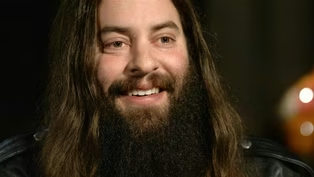
Clip: S7 Ep10 | 12m 56s | Music has been a salvation for Timothy Showalter, front-man of Strand of Oaks. (12m 56s)
Providing Support for PBS.org
Learn Moreabout PBS online sponsorship

- News and Public Affairs

Top journalists deliver compelling original analysis of the hour's headlines.













Support for PBS provided by:
Articulate is a local public television program presented by PBS39