Oregon Art Beat
Finding the Flow
Season 22 Episode 11 | 25m 27sVideo has Closed Captions
Otis Kwame Kye Quaicoe, Claire Burbridge and Daniel Giron.
Otis Kwame Kye Quaicoe wants his colorful, life-sized portraits to make you stop whatever you’re doing, and he wants each painting to tell a story to reveal his subject’s inner power. Artist Claire Burbridge creates huge, meticulous illustrations that reveal the “strange, fascinating and abstract forms” of the natural world. Daniel Giron is an award winning vogue dancer and teacher.
Problems playing video? | Closed Captioning Feedback
Problems playing video? | Closed Captioning Feedback
Oregon Art Beat is a local public television program presented by OPB
Oregon Art Beat
Finding the Flow
Season 22 Episode 11 | 25m 27sVideo has Closed Captions
Otis Kwame Kye Quaicoe wants his colorful, life-sized portraits to make you stop whatever you’re doing, and he wants each painting to tell a story to reveal his subject’s inner power. Artist Claire Burbridge creates huge, meticulous illustrations that reveal the “strange, fascinating and abstract forms” of the natural world. Daniel Giron is an award winning vogue dancer and teacher.
Problems playing video? | Closed Captioning Feedback
How to Watch Oregon Art Beat
Oregon Art Beat is available to stream on pbs.org and the free PBS App, available on iPhone, Apple TV, Android TV, Android smartphones, Amazon Fire TV, Amazon Fire Tablet, Roku, Samsung Smart TV, and Vizio.
Providing Support for PBS.org
Learn Moreabout PBS online sponsorshipSupport for Oregon Art Beat is provided by... and the contributing members of OPB and viewers like you.
[ ?
?? ]
MAN: Color is important.
It just shouldn't be something that is just a beautiful color that is there, it should go with the character of the person, I will say.
WOMAN: I hope when people look at the work, that they get drawn into that flow, maybe bringing people more to their own kind of authentic self, just through -- just through looking.
[ ?
?? ]
MAN: Seeing it for the first time was surreal.
I always knew, the moment I saw it, that someday I would be doing it.
[ audience cheering, applauding ] MAN: Yes!
[ ?
?? ]
MAN: When you are painting a portrait of a person, it's important that you represent the person well.
You also have to show the person's emotions and expressions.
Their image must look powerful enough to motivate someone to feel confidence in themselves.
That's why I like them to be, like, staring at you in a way that you just stop everything you're doing, just look straight to them.
My name is Otis Kwame Kye Quaicoe.
I paint and I draw.
So in general, I'm an artist.
[ chuckles ] [ shutter clicking ] My paintings usually start with photo sessions.
Most of my models I find are mostly in restaurants, people that I meet when I walk around.
This one is cool.
I give them clothes to wear sometimes, because that's my way of adding my idea to it.
Kind of like look away.
Yeah, that's it.
The most important thing is made up during the expression, the emotion, their character.
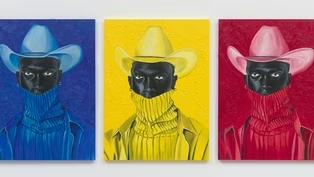
I'm working on a cowboy series because I grew up in Ghana watching a lot of Western movies, a lot of action movies, and a lot of cowboy movies.
[ ?
?? ]
I take a long time when I'm sketching, yeah, because I -- that's where I decide what to add, what to take out.
There are multiple ideas in my head.
And then when you apply it and you stand back and look at it and you think it doesn't work, you move on to the next idea.
It always changes at the end of it all.
Then I start painting.
When I'm painting their skin tones, I work in different shades of blacks and whites, just adding the grays, adding the reds.
Even though I'm Black, I'm not just Black.
There are a lot of reflections from outside forces on the skin.
WOMAN: One of the things I really feel in looking at Otis' painting is he really honors the subjects.
Oftentimes they're friends or people that he's kind of fascinated with.
And he really portrays his portraits in a very humane way, the textures of the clothing and then the dimensions of the figures themselves.
[ ?
?? ]
It always goes back to the old masters, because we see the paintings, and all these people are very powerful people.
There were a lot of Black people that were also powerful, but I never see paintings of them.
So, for me, as an artisan, somebody who is in this era, I feel it's a way of correcting that.
It was just my way of sort of rewriting history.
We also tell our own stories in how we wanted to be seen.
Color is important.
It just shouldn't be something that is just a beautiful color that is there, it should go with the character of the person, I will say.
So when you see the painting, everything just flows through.
You see the pose of the person and you see the color.
It's like -- it just flows well.
[ ?
?? ]
I grew up in Accra, Ghana, West Africa.
I'm the fourth born of six children.
When I started going to the movie theaters and watching movies, all the movie posters were hand-painted, which struck me, and very, very amazing.
So I suddenly felt like I wanted to do this, I wanted to paint.
When I was in my early 20s, I started at Ghanatta College of Art and Design, where I schooled for four years.
I moved to Portland three years ago.
I try to put in a little bit of how we dress back home.
It can be clothes, it can be the room settings.
Because I always like to tell the story from the African side and then the African American side, put them together and tell that story.
[ ?
?? ]
Last years I got a show at the Roberts Projects at Los Angeles.
The name of my show was Black Like Me.
That show was one of the best shows that I've really done in my life.
There were a lot of famous people that I never thought I would see talking to me, how they appreciate my work and they're looking forward to more stuff that I'd be doing in the future.
That show got a lot of attention.
Sometimes when I sit down and think about it, it's so unreal, but it's still happening.
It was a nice experience.
You just have to enjoy that moment, because you work for it, and it's really fun when people appreciate what you created.
GRACE: Otis hasn't given in to this sort of fame.
He is, through and through, a painter, you know, who just wants to be in the studio and get his thoughts out and get the work done.
[ ?
?? ]
I have big shows coming up, and then I have also a group show coming up in Shanghai and a group show also in L.A. and a couple of ones that I can't really talk about yet, and it's going to be big.
[ chuckles ] It's like, am I prepared for this?
Where do I see my future?
You cannot predict the future, but you can always, you know, be prepared for it.
I live in the moment.
I work and try to be better than yesterday or today.
[ ?
?? ]
WOMAN: All the work I do is definitely an evolution, a kind of awakening.
It takes so long to do each piece that it contains many, many messages and stories.
It comes together as a sort of complete world or complete universe when it's finished.
All my work begins with going into nature, spending time there.
[ birds chirping ] Nature is the starting point and it's the end point.
Kind of interesting.
Wonder what kind they are.
I'm just in the middle as an appreciator of everything that I come across.
I've had firsthand experience of a kind of invisible intelligent matrix that links everything, and that is something that I bring back to my studio and pour out in my drawings.
[ ?
?? ]
Once I've gathered the objects, I love to arrange them so light falls on them, they create an atmosphere.
It's putting certain colors together, certain shapes together, and all of that is feeding me.
Ooh, yeah, look at that!
Wow.
I love to use a magnifying glass and really get in there and really study it with my eyes.
And it's really like entering a different world, a different dimension.
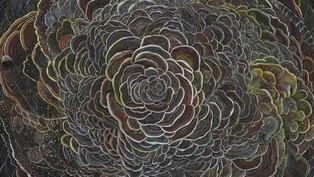
The fungi that I'm drawing right now started to develop these really beautiful dots of mold that are turning into colonies, and this is going really well with my idea of the spiral galaxy, because they're like little constellations that are appearing on the fungi forms.
These are definitely not purely botanical drawings.
The work contains lots of minute observations.
It also contains things that I've made up.
So, really, it's a kind of collaboration of my imagination and beautiful found objects.
[ ?
?? ]
The way I choose the colors is completely instinctual.
I tend to look at the drawing in the morning, sharpen up a load of pencils, and work with those.
But then in the afternoon, I might put all those aside and work with a whole different set of pencils.
[ ?
?? ]
I grew up in the British Isles and anywhere where there's a nuclear submarine base.
My father was a submariner.
My mother would be pretty much left on her own to look after these rambunctious twins.
She knew that if she gave me pencils and paper, that it would keep me out of trouble and I would be perfectly happy for a long time.
Art was really my sanctuary.
It was my private place that I used to go to.
It was the place where I felt secure and happy.
It's still exactly that.
It's a place that I love to be most of all, practicing the arts.
I mean, sometimes I think about my practice, and it seems more like a monk or a nun rather than what somebody might perceive as an artist, the daily routine of it.
It's slow and even and peaceful.
[ ?
?? ]
I hope when people look at the work, that they get drawn into that flow and it takes them away from their conceptual mind, their thinking mind.
Maybe bringing people more to their own kind of authentic self just through -- just through looking.
I think things can have that effect when you ponder them or spend time with them.
[ ?
?? ]
[ ?
?? ]
When I vogue, I feel like I am saying something.
I'm telling you how I'm feeling.
Sometimes I'm feeling flirty, and that really showcases maybe with, like, the way I'm looking at you.
[ dance music playing, announcer speaks indistinctly ] [ crowd cheering ] It's the only dance style where I feel like I can actually say something.
So that's good.
[ crowd cheering, applauding ] ERIC SLADE: Daniel Giron has been a professional dancer in Portland since 2008.
He regularly wins dance competitions up and down the West Coast.
Daniel's specialty is the dance known as vogue.
DANIEL: Voguing, it is a club style.
It's part of the drag ball scene that started in the 1960s.
The style of vogue was inspired by VOGUE magazine.
[ Madonna's ''Vogue'' playing ] You'll see that a lot of the poses are just very still.
It was popularized by Madonna's ''Vogue'' music video... ?
Strike a pose... ?
which actually showcases the old-way style, like you are coming straight out of a magazine.
So the hands were maybe a little two-dimensional.
?
Vogue, vogue... ?
Very elegant, very rich.
It's about giving you the picture, it's about giving you that presentation.
What I do is vogue fem, which comes from the Latinx and Black trans community, and they broke down the hips and the wrists and added the hair and the attitude because they felt like they couldn't really identify with the old-way style.
Vogue-fem hands are very different.
They're very flowy, you've got figure eights, you've got taps, you've got circles.
Yeah, and you're just very playful overall with their movement.
Vogue fem.
All right, if you're here for Vogue Fem, please make a circle in the center of the room for me.
I wanted to teach because I had seen a lot of enthusiastic vogue dancers... Yeah, spread out if you need more space.
I really started noticing, like, how many people were doing it incorrectly.
I've been a preschool teacher for the last ten years, so I do have really good qualities as far as like patience or like breaking things down.
You're going to go single, single...
Single, single, double pump.
It's one thing to go over, you know, how to do hands and how to have all those body mechanics, but if you don't feel it here, if there's no character development, then there's nothing.
Five, six... Go!
[ electronic dance music plays ] I don't know why, but the catwalks across the floor in class really bring it out of people.
I turn up the music really loud, like louder than I'm supposed to, because I know that's going to get it out of them.
Yes!
Six!
Being in this class is like gay church a little bit.
It's a place where, as a queer person of color, I'm able to thrive and feel celebrated, and that's really cathartic.
Lower, lower!
Let's go!
Five, six... MAN: The thing about this dance that I love is just feeling free.
I feel like my best self ever.
Like no one can tell me anything, and I rule the world, really.
That's how I feel.
Five, six!
Five, six, seven... DANIEL: It's loud.
It's a party.
It's a culture.
You have to feel it.
So let's let it out.
This is group one.
[ ?
?? ]
I am originally from Vera Cruz, Mexico.
I've always considered myself a natural mover, but I officially started dancing at the age of 19.
I moved to the United States at age 11 with my parents and my two older sisters.
We moved to Wilsonville, Oregon.
During high school, I was not dancing much, but there was a show on MTV called America's Best Dance Crew.
And where are we from?
ALL: New York City!
And what do we do?
ALL: Vogue!
DANIEL: From this show, I discovered vogue.
Seeing it for the first time was surreal.
I always knew, the moment I saw it, that someday I would be doing it.
[ electronic dance music playing ] ANNOUNCER: Mr. Giron!
Let's go, papa!
DANIEL: When I enter these open-style battles, I am able to showcase not just my vogue, but my waacking and other dance styles that I've trained in.
A little bit of house, a little bit of dance hall.
I just get to fully be myself.
[ crowd cheering, announcer exclaiming ] Throwing shade in ballroom is basically you want to be dancing against your opponent, and you want to do something a little catty.
[ announcer laughs ] ANNOUNCER: Five, four, three... DANIEL: That just showcases, like, ''I'm better than this person.''
Or, I don't know, something that's just letting them know, like, ''Eh, you're not that great.
I'm better.''
It's all part of, you know, the competition and trying to outdo each other.
But at the end of each battle, you hug, it's all love.
No matter how much shade was thrown, at the end of the day, only one person can win.
The House of Ada is my house.
I established that in February 14th of 2014.
You basically want to think of a house, similar to how in breakdancing scene, they call themselves crews.
We're a collective of queer individuals who are artists and who learn from each other and partake in the ballroom scene.
[ crowd cheering, applauding ] ANNOUNCER: Yes!
Being able to carve out a safe space where we can just dance and be happy and celebrate by expressing ourselves is a really beautiful thing.
I'm very proud to say that I have the first vogue class in Portland.
It's really important for me as an instructor to just create a safe space for everybody.
I want people to walk out feeling empowered and knowing that they're making a change by simply being themselves.
Five, six, double time!
There's really no reason for us to hold back on being us, and I think that's the beauty of what my class is bringing.
Yes!
Five, six!
Five, six... [ ?
?? ]
To see more stories about Oregon artists, visit our website... And for a look at the stories we're working on right now, follow us on Facebook and Instagram.
Support for Oregon Art Beat is provided by... And the contributing members of OPB and viewers like you.
Video has Closed Captions
Clip: S22 Ep11 | 6m 37s | Artist Claire Burbridge creates huge, meticulous illustrations of the natural world. (6m 37s)
Video has Closed Captions
Clip: S22 Ep11 | 8m 7s | Otis Kwame Kye Quaicoe paints colorful, life-sized portraits. (8m 7s)
Providing Support for PBS.org
Learn Moreabout PBS online sponsorship















Support for PBS provided by:
Oregon Art Beat is a local public television program presented by OPB