
Flat Iron, A Cut Above & More
Season 16 Episode 7 | 25m 59sVideo has Closed Captions
The sizzling backstory behind the Flat Iron steak and more .
The sizzling backstory behind the Flat Iron steak, a rolling nightmare haunts Nebraska’s highways, helpless terror comes to life in a letter and, racing on the winding roads of the Sandhills … Stories include Flat Iron, A Cut Above, Haunting in the Heartland, With Helpless Terror, and Sandhills Speedway.
Problems playing video? | Closed Captioning Feedback
Problems playing video? | Closed Captioning Feedback
Nebraska Stories is a local public television program presented by Nebraska Public Media
Flat Iron, A Cut Above & More
Season 16 Episode 7 | 25m 59sVideo has Closed Captions
The sizzling backstory behind the Flat Iron steak, a rolling nightmare haunts Nebraska’s highways, helpless terror comes to life in a letter and, racing on the winding roads of the Sandhills … Stories include Flat Iron, A Cut Above, Haunting in the Heartland, With Helpless Terror, and Sandhills Speedway.
Problems playing video? | Closed Captioning Feedback
How to Watch Nebraska Stories
Nebraska Stories is available to stream on pbs.org and the free PBS App, available on iPhone, Apple TV, Android TV, Android smartphones, Amazon Fire TV, Amazon Fire Tablet, Roku, Samsung Smart TV, and Vizio.
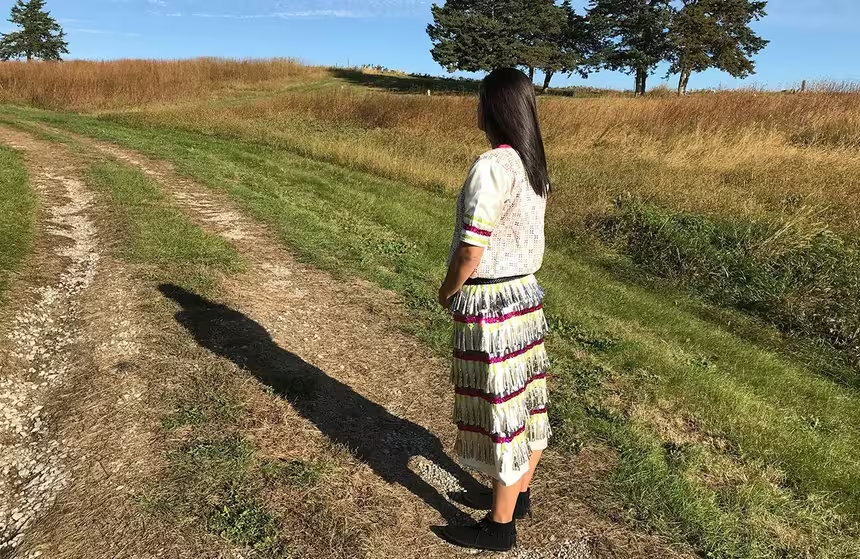
Do you have a Nebraska Story?
Do you have a story that you think should be told on Nebraska Stories? Send an email with your story idea, your name, your city and an email address and/or phone number to nebraskastories@nebraskapublicmedia.org. Or, click the link below and submit your information on nebraskastories.org.Providing Support for PBS.org
Learn Moreabout PBS online sponsorship(upbeat music) -[Narrator] Coming up on "Nebraska Stories," the sizzling backstory behind the flat iron steak.
(upbeat music) A rolling nightmare haunts Nebraska's highways.
(upbeat music) Helpless terror comes to life in a letter.
(upbeat music) And racing on the winding roads of the Sandhills.
(upbeat music) (upbeat music) (upbeat music) (upbeat music) (upbeat music) (country music) - [Jordan] Nebraska, for as long as it's been here, has been a beef state.
(country music) -[Narrator] Here in the middle of the country lies Nebraska.
The beef state, the unofficial nickname that first appeared on license plates in 1956.
In Nebraska, agriculture is the state's top economic driver, and beef cattle production is the largest sector within that.
Nebraskans produce about 25 million head of corn-fed beef cattle a year.
That means there are more than three times as many beef cattle as people roaming around.
(country music) - We've brought in leading experts and leading companies who understand the conversion of muscle to meat, who can really hone in on, "How do I amplify this cut?"
- [Narrator] The University of Nebraska is known for its cutting edge research in many areas.
(machine whirling) The results of those endeavors have found their way into our everyday lives.
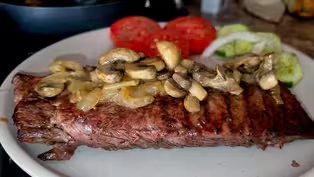
(gentle music) In the grocery aisle, a promising cut of flat iron steak has its origins in seeing potential product left on the cutting room floor.
(gentle music) Researcher Chris Calkins spent 40 years at the university studying fresh meat and analyzing its quality, flavor, taste, and color.
- There was a period of time in the late nineties where the value of beef cattle, the value of the meat was declining and that was cause for alarm.
So I was part of a group who did a project called Muscle Profiling.
(upbeat music) - [Narrator] Funded by the Beef Checkoff, the multi-university research team, worked with the National Cattleman's Beef Association to identify new cuts of meat.
- The goal was to create an encyclopedia of knowledge about all of the muscles in the shoulder and in the back leg of the animal.
So the Muscle Profiling project was designed to identify those diamonds in the rough, the chance to add value and increase eating satisfaction for our customers.
(gentle music) The ultimate outgrowth was to identify approximately 15 different cuts of meat.
(gentle music) Chief among those was the flat iron steak.
We sell approximately a hundred million pounds of those now in the US.
Before the project, none of them were sold as steaks.
(upbeat music) - [Narrator] Jordan Wicks is an assistant professor and meat extension specialist at UNL.
She wasn't part of the study, but she understands the university's role that affect the meat industry.
Part of developing the flat iron was to figure out how to cut around a seam of connective tissue that wasn't so tender.
- The front arm and the back leg, those are usually what we consider a tougher product.
But there's an anomaly when we talk about the flat iron.
The flat iron is actually the second most tender cut and it sits back here on your shoulder.
It'll be tender, it's something that you can put on a steak salad 'cause it will bite with, like, the lettuce.
It's a little bit more cost effective than buying a filet.
- [Chris] We used to think that muscles in the round and the chuck were the ones that allowed the animals to move, and so they did a great deal of work while the animal was walking.
But some of those muscles in the chuck just do this, (upbeat music) and they don't work that hard.
Therefore, they're very tender.
(upbeat music) - [Jordan] There is a caveat to that.
We wanna make sure we don't overcook that one.
That's a very important to cook that to a medium well.
Otherwise, it does start to get a little bit of a livery flavor.
(sizzling) -[Chris] When it comes to the flat iron name, that's actually an old name that's been around for a hundred years in the industry, but it fell out of use.
It has a connotation of an old West steak that is flavorful and tender.
(upbeat music) - [Narrator] The flat iron was officially recognized and hit the market in 2002.
In the two decades since, meat researchers continued to conduct research that positively impacts not only the beef industry, but the consumer as well.
(upbeat music) - [Jordan] Every industry has to make money.
I genuinely think a lot of people in the meat industry are here to serve our global population.
We wanna feed the world.
That is really what we want to do.
(upbeat music) (soft music) [Narrator] Rolling through Northern Nebraska is a 53-foot trailer packed with spine-tingling scares.
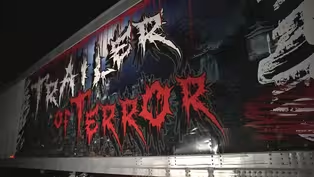
This is no ordinary attraction, it's the Trailer of Terror.
(horn honking) (engine roaring) From the quiet town of Atkinson comes a family with a flair for fright.
What began as playful scares has grown into a traveling spectacle, bringing chills to small towns across Nebraska.
On this particular weekend, the Trailer of Terror rolls into Wausa, Nebraska, ready to test the nerves of all who dare enter.
(wolf howling) [Pam] The Trailer of Terror is different than any other haunted house attraction, first and foremost because it's mobile.
Secondly, because it is family owned and operated.
And lastly, because we want to give back to every community that we participate in.
We do that by partnering with a local nonprofit in each community.
[Miley] Actually, it was my idea to start a haunted house.
I've always wanted it and wanted to know what it felt like.
You know, we've worked out kinks, and stuff that worked, and figured out stuff that doesn't work.
(woman screaming) [Pam] Early experiences with our family, and scaring people, and scaring each, other was a strong influence in building the Trailer of Terror, because of the fun involved.
It's something that has been tradition in our family clear back to my grandparents, my parents.
And then, of course, we carry it on with our kids.
That plays into what we built here.
We decided to use a 53-foot dry van trailer, because when I first had the idea to make the haunted house mobile, I asked my husband, "What's the biggest thing that's legal to take down the road?"
And he answered with, "A 53-foot trailer."
[Chris] She just pretty much told me she had the idea, and told me what she wanted done, and so I started construction.
(jaunty music) It took a lot of work, a lot of brainstorming.
'Cause everything's not straight in here, so it just really was getting things level and straightened out.
(jaunty music) [Miley] For me, it was creativity, finding things, you know, that I thought were creepy.
We had to paint the entire trailer before we put up any walls.
Right this way.
Come see what we got in store tonight.
(jaunty music) [Pam] The great thing about my husband and my brother-in-law, is when I put something on paper, and show it to them they have the carpentry skills to bring it to life.
They made it happen.
(eerie music) [Chris] Just really glad we're up and rolling.
[Pam] We can create a startle by being creative with positioning characters, props, and activating startles.
The Trailer of Terror was a recipient of the NSBAA grant, so we wanted to make sure that that grant money was spent locally.
So a lot of the things that were built and used here in the trailer, we tried to buy as much locally as we could.
The response from rural communities in Nebraska has been great.
We started getting emails and phone calls.
People were curious and wanted to be part of it.
(people chattering) (spooky music) (spooky music) (jaunty music) (jaunty music) Ah, ah, ah, ah, ah, ah.
Ah!
Why'd you let him go?
(jaunty music) Where are you going?
(Kingsley screaming) [Pam] Some of the best reactions that I hear are the ones that are terrified.
I don't know if that sounds a little weird, but we kind of feed off of your terror, your uncomfortableness.
We get a big giggle out of the screams.
What?
[Pam] Just every person that comes through has a different reaction, and fear is fun to us.
-(clown groaning) -Oh my gosh!
[Chris] I love scaring people.
(jaunty music) I like to interact.
(laughing) Changes who I am.
(jaunty music) [Pam] The most rewarding part about bringing this haunted house to life has been the family time.
Our entire family is in it, even extended family.
They say that you never go to work if you're having fun.
And we are having fun.
We enjoy scaring people.
(dynamic music) We are definitely proud of it.
(dynamic music) (mysterious music) Hard work has never been this fun.
Narrator: Beulah Adams had no idea what the skies had in store for her at the end of Easter weekend 1913.
All she knew was that she had plenty to look forward to.
♪ Music ♪ Narrator: This daughter of a well-to-do grain company owner was just starting her career as an Omaha elementary school teacher.
Her busy weekend started at the Brandeis Theatre, watching a stage production featuring nationally-renown actors John Drew and Mary Boland.
♪ Music ♪ Narrator: Sunday meant services at her church" decorated beautifully for Easter" she observed.
After than an afternoon visit with an old friend.
Narrator: Around 6 O clock she headed home to Omaha's upscale Bemis Park neighborhood.
When she got off a streetcar it was raining.
She put up her umbrella and started walking to her house.
Adams continued her story a couple days later in a letter to her mother.
Beulah Adams: I heard a distant roaring such a noise as I can hardly describe, like a large lumber wagon coming toward one on a cobble stone street and drawn by runaway horses.
The noise kept getting louder and louder and coming right at me it was very bewildering.
Then as I came opposite that large tree at the side of the path, the heavy blackness in the southwest assumed a funnel shape.
The wind carried me across in front of the parking and bushes in front of Toff Hansen's place.
I put my umbrella down and lay flat, face downward just two or three feet east of the gutter.
With my hand I held my face and my feelings were similar to those of a child who turns from an impending blow with helpless terror waits for what will come.
The next moment or two all I can remember is the terrible roar and one distinct recollection that I was hit by something on the leg.
I was hit on the head and back too but don't remember of it.
One might think I could hear the crash of timber and falling houses all around, but the terrible roar of the storm drowned everything else.
In just a minute or hardly more, the noise had ceased and I looked up and picked myself up.
All the houses in sight were total wrecks.
♪ Music ♪ Narrator: Adams had lived through deadliest tornado in Nebraska history.
Narrator: A hundred people died in Ralston and Omaha on that Easter Sunday.
Many others injured and homeless.
Nebraska's governor toured the damage the next morning, calling it "like my conception of hell."
Narrator: Today the house Beulah Adams lived in looks a lot like it did in 1913.
So does the park where she laid on the ground, waiting in helpless terror as the tornado passed overhead.
Adams died 44 years later.
It's easy to imagine her thoughtfully living a full life after cheating death successful teacher, church leader, actor, and world traveler.
Beulah Adams: All the rest in the house are in bed, and I guess I'll go too and write more later.
Lovingly, Beulah.
(heavy metal music) (heavy metal music) (softer tune plays) (softer tune plays) [Joe] The Sandhills is one of the prettiest places there is.
I love it here.
I wouldn't live anywhere else.
[Narrator] The Nebraska Sandhills are known for beauty and serenity.
But for one summer weekend each year, they're known for speed.
(upbeat music with engines racing) (upbeat music with engines racing) Well, the Sandhills Open Road Challenge is what we call an open road race.
29 miles up to close to Highway 2, 26 miles back.
Unfortunately, right now it's a pretty rough road.
The faster you go, the smoother it is.
It's a rush.
As far as I'm concerned, always has been.
[Narrator] Joe Shown grew up in the Sandhills.
All these years later he's still here.
He combined his love of place with a dream to start an open road race in Nebraska, working to make it a reality.
In the year 2000, I bought my first Corvette, and I drove the road and I thought, "Wow, that would be really cool to do this."
And I knew that there was an event in Nevada where they closed a public road, to have an open road race.
And so I thought, "Well, if they can do it in Nevada maybe we can do it in Nebraska."
And luckily there were enough people that helped me and glommed onto the idea and supported it, and we got it done.
[Narrator] With 34 cars the first year, the event now sells out each year at 140 entries.
[Joe] I think probably we've had at least 40 states over the years represented and Canada.
Typically it's someone who has a car, that they want to get out, and be able to drive the car without worrying about being apprehended by the constabulary.
[Bill] My friend saw the Loup to Loup online and he entered it, and then his navigator backed out at the last minute.
So I was at work with him.
He said, "I'm going to this race this weekend, I need a navigator.
You seem to like doing silly things.
You want to come with me?"
And I said, "Yeah, sure!"
I was hooked pretty much after one time on the Loup to Loup.
We had a '49 Cadillac one year and two McLarens, two Ferraris, Lamborghinis, lots of Corvettes, Mustangs, Camaros.
As long as it meets the safety qualifications, they're good to go.
It is a time division.
It is not a wheel-to-wheel race.
So you select a time bracket to be in.
Let's say you enter the 110-mile an hour class.
The goal is to average closest to 110 miles an hour.
So the winner is the driver that gets closest to the average.
[Narrator] The festivities start Thursday with a Loup to Loup race.
This is a 21-mile open road course that goes from Halsey to Purdum.
Friday is a mile and half-mile shootout followed by a parade, and car show.
The weekend wraps up Saturday, with the 55-mile Sandhills Open Road Challenge.
The route starts in Arnold, heads north to Dunning, and ends just outside of Arnold.
There are only four drivers who have been a part of the race every year since it started in 2001.
One is Joe, another is Lyle Ekberg.
Lyle Ekberg.
(laughs) What a guy!
Lyle's terrific.
Good guy.
Lyle was one of the first people to sign up for the SORC.
He and his boy, Nick.
Nick was I think 17, 18 at the time.
And they have a 1965 Corvette and it has been a father-son project, and they show up faithfully every year, and it is by far the loudest car that's ever been there.
(laughs) He fires that thing up, you can hear it in Dunning, I think.
(upbeat music with engine racing) (engine idling) (engine revving) (engine blaring) (engine racing) (engine racing) [Lyle] It has always been the loudest car.
There are a couple now, that are getting that way, but this is the loudest, most obnoxious car there is.
[Narrator] Weeks before the challenge, the Ekbergs spend time getting this car ready.
Living in Wakefield, they work together, volunteer together, live next to each other, and play together.
It is pretty good if the kid calls the old man up and wants to go do something with the car, you know, pretty good relationship if you can do something together.
We don't fish or do stuff like that, but we definitely do car things together.
You know, back 22 years ago when we started doing some of this stuff, it was a lot of him teaching me and he still thinks he's a little faster than me and that's okay.
I am, I'm still better.
(chuckles) [Nick] A lot of guys at the open road races, they race both legs, and they've got a navigator that helps them through the whole thing and us switching makes it a little more complicated but, it's a lot more fun that way, I think.
[Narrator] For some car lovers, it's all about the looks.
That's not the case for Lyle and Nick with this car.
[Lyle] Well it was junk.
Been spray painted on the inside.
The motor didn't run.
Had fender tore off of it and everything so, you know, it was junk but the price was right and of course I liked projects.
So I did what you would call frame-off restoration and put it back together to original.
[Nick] Over the years, him and I were having more fun going to races than car shows.
So eventually we just started stripping off all the creature comforts and making it more into a race car, and that's all it is now.
It's not very fun to go a 10-mile cruise in it anymore but, to go racing, that's where it's at now.
[Lyle] Well some of my purest Corvette buddies weren't very happy with me 'cause I took a desirable car and turned it into a race car.
But Nick's comment is, "leave it as a race car."
I mean it could be put to original, but that'd be ridiculous.
It'd cost you more than the car's worth, and this is way more fun.
[Narrator] With the unique landscape as a backdrop, the Sandhills Open Road challenge is one of only a few road races across the country.
[Joe] The thing that really separates the Sandhills Open Road Challenge from the other events is the people in the community.
(Birds chirping) When you come here, you're a hero.
(Birds chirping) Probably almost half of our drivers are housed, with private families in Arnold 'cause there's only one motel.
Well actually there's two, but the rooms are very limited.
[Narrator] In the town of 600 people, those hotels combined for only 15 rooms total.
Not only does the SORC introduce participants to the Sandhills, organizers are proud of the economic boost it provides to Arnold, and surrounding communities.
[Joe] The SORC has been a real boon to the area.
We've exceeded well over a million.
I'd say probably we're in the million-and-a-half dollar range now that contributions that we've made to the local organizations.
Fire department, school, theater, and so on.
We get a lot of scholarships, playground equipment.
SORC is one of the best things that has ever happened to Arnold.
It's just a fabulous organization, and it's wonderful that they bring it to our town.
(engine running) [Narrator] James and Karl Luebbe are in their second year competing at the SORC.
So this is a one-owner car.
I bought it brand new in '79.
Drove it as my daily car for about 10 years and [KarlÑ Put about a hundred thousand miles on it.
Everybody wants a whole lot of horsepower, and a whole lot of car, and 90% of it is driver.
You just gotta be able to get the most out of it, and, we're still working on that.
(laughs) (heavy metal music) (heavy metal music) [Narrator] Mother-daughter team Maryia and Terri Schneider enjoy carrying on the tradition started by their late father and husband, Fred.
Well what we are doing here today is we are gonna do some racing.
We've been doing it for a few years but it's a really nice open road challenge where you're just trying to meet an average speed.
So we're in the 80-mile an hour class so we can still have fun and not have to worry about not making it back.
(laughs) So we're just gonna try and hit our perfect time, without any snafus.
No losing my glasses.
She did that her first year.
No dropping the stopwatch.
Second year.
No not starting the stopwatch Second year No trying to shut a door while you're going down the road and going like this.
First year.
No alarms going off in the car.
Second year.
We had a really exciting couple years (laughing) since we've started driving.
My dad did it for 19 years and then he passed away, and so we've been doing it since then.
And it's been very exciting!
(heavy metal music with engine running) (heavy metal music with engine running) (heavy metal music with engine revving) (music with engine idling) (countdown clock beeps) (engine revving) [Announcer] This is Nick Ekberg and Lyle Ekberg.
(engine revving) And they're from Whitefield, Nebraska.
(engine revving) Twenty-second year.
And every year, they've been in that blue Corvette.
(car engine blaring) We had to be a little nicer to the car this year.
Our rear end's got a couple issues so, we had to take it a little easier than we normally do.
[Lyle] It's going "clunk, clunk, clunk", but we made it, so I know a guy that can fix it.
That's me, of course.
[Nick] It's always good when you can drive the car to the trailer when you're done.
Fuel pump went out.
So, we got off the start line into second gear and then we kind of just lost all our power.
(engine blaring) (tires screeching) It just starts, spit and sputtering.
She drives.
It's her fault.
Yeah.
So, we got over onto the side of the road, and there were some expletives being shared and then, she remembered that we're supposed to wave a blue flag.
So we were (laughs) trying to get the blue flag out.
[Teri] And then we tried to push it more off to the side.
So we were the first ones out, first ones back, first ones off the road.
It was pretty disappointing, 'cause we, have been out, like my dad was out here for 19 years and we've been coming out, so, for 20 years, we finished every single race.
So, now we have that where we got a, did not finish, DNF.
(guitar music) [Announcer] In the 105-mile an hour class in third place, Nick Ekberg and Lyle Ekberg, with the speed of 0.484 seconds slow.
(crowd applauds) There's nothing wrong with third place.
(crowd laughs) [Joe] The scenery along this road is wonderful.
The only thing about it is that when you're driving you really don't have the time to appreciate it.
(laughs) You need to be watching, in front of you and you can't, you can't allow yourself to be distracted.
(heavy metal tune plays) (upbeat music) (upbeat music) - [Narrator] Watch more Nebraska stories on our website, Facebook and YouTube.
Nebraska Stories is funded in part by the Margaret and Martha Thomas Foundation, and the Bill Harris and Mary Sue Hormel Harris Fund for the presentation of cultural programming.
(upbeat music) (upbeat music) (upbeat music) (upbeat music)
Video has Closed Captions
Clip: S16 Ep7 | 4m 45s | The sizzling backstory behind the Flat Iron steak. (4m 45s)
Video has Closed Captions
Clip: S16 Ep7 | 5m 6s | The “Trailer of Terror” is rolling into town! (5m 6s)
Providing Support for PBS.org
Learn Moreabout PBS online sponsorship

- News and Public Affairs

Top journalists deliver compelling original analysis of the hour's headlines.













Support for PBS provided by:
Nebraska Stories is a local public television program presented by Nebraska Public Media