Prairie Yard & Garden
Flower Power
Season 39 Episode 10 | 28m 45sVideo has Closed Captions
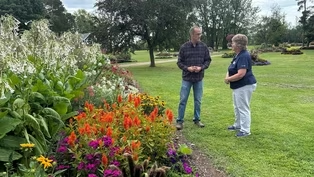
Mary Holm travels to Fertile, Minnesota, to visit Joe Bergeson at the historic Bergeson Nursery.
Looking to maximize color in your yard? Blooming annuals provide amazing flower power, especially when grown with the expertise of Bergeson Nursery near Fertile. Owner Joe Bergeson joins host Mary Holm to explore their stunning display beds and shares practical, expert tips on how you can grow and enjoy a breathtaking display of annuals in your own garden!
Problems playing video? | Closed Captioning Feedback
Problems playing video? | Closed Captioning Feedback
Prairie Yard & Garden is a local public television program presented by Pioneer PBS
Production sponsorship is provided by Shalom Hill Farm, Heartland Motor Company, North Dakota State University, Friends of Prairie Yard & Garden, and viewers like you.
Support provided by:


Prairie Yard & Garden
Flower Power
Season 39 Episode 10 | 28m 45sVideo has Closed Captions
Looking to maximize color in your yard? Blooming annuals provide amazing flower power, especially when grown with the expertise of Bergeson Nursery near Fertile. Owner Joe Bergeson joins host Mary Holm to explore their stunning display beds and shares practical, expert tips on how you can grow and enjoy a breathtaking display of annuals in your own garden!
Problems playing video? | Closed Captioning Feedback
How to Watch Prairie Yard & Garden
Prairie Yard & Garden is available to stream on pbs.org and the free PBS App, available on iPhone, Apple TV, Android TV, Android smartphones, Amazon Fire TV, Amazon Fire Tablet, Roku, Samsung Smart TV, and Vizio.

Visit the Prairie Yard & Garden Website
Do you love gardening? Consider becoming a friend of Prairie Yard & Garden to support this show and receive gifts with your contribution. Visit the link below to do so or visit pioneer.org/donate.Providing Support for PBS.org
Learn Moreabout PBS online sponsorship(bright music) (gentle music) - I am not sure who gets the credit from my love of plants, and especially flowers.
Maybe it was my maternal grandma.
After all, she lost grandpa at a relatively young age and ended up raising 16 children, but still had flowers next to the house.
Maybe it was Ella, my college horticulture major roommate, which led to plants lining our dorm room window sill.
Today, let's meet a man who takes the love and knowledge of annual flowers to a whole new level.
(gentle music) - [Announcer] Funding for Prairie Yard & Garden is provided by Heartland Motor Company, providing service to Minnesota and the Dakotas for over 30 years.
In the heart of Truck country, Heartland Motor Company, we have your best interest at heart.
(gentle music) North Dakota State University through its Field To Fork educational program, providing research-based information on growing, preparing and preserving fruits and vegetables.
Mark and Margaret Yackel-Juleen in honor of Shalom Hill Farm, a non-profit rural education retreat center in a beautiful prairie setting near Windom, Minnesota.
And by Friends of Prairie Yard & Garden, a community of supporters like you who engage in the long-term growth of this series.
To become a friend of Prairie Yard & Garden, visit pioneer.org/pyg.
(bright music) - Several years ago, we did a great show on Grouting Roses in the Northland with Joe Bergeson.
As we were leaving that filming, Joe told us that if he ever wanted to do a show on annuals, to let him know.
Well, producer Mike and I got to thinking that we've done shows on perennials, tree shrubs and fruits, but not lately on annuals.
So I called Joe and took him up on his offer to visit about his annuals and the beautiful display flowers at Bergeson Nursery.
Thanks so much, Joe, for letting us come back.
- Oh, you're welcome.
Thank you for coming back.
- Please tell me about the background of Bergeson Nursery.
- Well, Bergeson nursery was started by my grandma and grandpa, Melvin and Olga Bergeson, in 1937, when they moved back to Olga's parents' home place, which was actually right at the end of this sidewalk.
So grandpa started by selling bare root apple trees and strawberry plants and going out on the road and landscaping.
And then my parents, Paul and Glenda, took over in the '60s, and one of the first things they did is they quit landscaping.
They quit going out on the road.
And another thing they did is they really built the annuals part of the business, selling petunias, geraniums, bedding plant vegetables and perennials.
So they built that part of the business into what it is today, which is actually the biggest part of the business.
- So how many plants do you grow here at the nursery?
- You know, you sent me that question and it blew my mind because I have never actually calculated.
It's in the tens of thousands.
- [Mary] So when do you start the plants?
- [Joe] We start our first seeding in January, and then we seed a few more in February and things really get started in March.
- [Mary] Do you grow all the plants from seed or do you purchase in plants too?
- [Joe] Both.
All garden centers will probably do both.
We start a lot from seed and we also buy in little plugs that we pot up into bigger pots.
- Now, for the people who don't know, what is an annual flower?
- An annual flower is a plant whose only purpose in life is to bloom, bloom, bloom for the first summer and then die.
The main advantage is that you get color all summer long.
With perennials, most perennials have to take time to store energy to survive the winters, so they don't bloom all summer.
Annuals just bloom nonstop throughout the year.
Another advantage that I find is that you can use a rototiller (laughs) and clear out your bed and you can completely change the design and the color scheme every single year.
- So what is considered a shady location?
- That's a very difficult question because there is all sorts of shade, many different types of shade.
You've got dry shade, you've got moist shade, you've got shade from a tree, shade from a building, the the shade that you throw at your homies, and, (Joe and Mary laugh) sometimes all you can do to know whether a certain type of plant will thrive in your shady spot is to try it.
- [Mary] So what are some of your favorite plants to use in a shady area?
- The big three annuals for shade, impatiens, coleus and begonias.
Those three plants are some of the plants that we use the most in this gardens, not only in the shade.
A lot of the newer varieties of Impatiens, begonias and coleus can also grow in full sun.
So those three are great plants for color all summer long, whether it's sun or shade.
- [Mary] Can you use them in combos too or are there other plants you like in combination with those big three?
- [Joe] There are a few that work in the shade, especially perhaps a German ivy is a great spiller vine for shady spots.
But there is something very effective about just having one plant or one type of plant in a basket, just all impatiens, and it makes a ball of color.
It's very effective to do that.
The one combination that we've been experimenting with is using some of the vigorous cutting grown coleus mixed in with something called a whopper begonia, which is an ultra vigorous begonia.
And if you plant them in a planter when they're all small, as they grow, they mix together a little bit, and the bright yellow leaves of a coleus called wasabi mixed with the bright red of a whopper red begonia can be a very effective combination.
- [Joe] Joe, how can people know when they go into the Garden Center, which plants to buy for their shady areas?
- [Joe] Sometimes it's best to just ask the owner, but often, garden centers like us, we have a whole separate greenhouse where we displayed the annuals that are best for shade.
When in doubt, look for those big three, the impatiens, coleus and begonias, and that will be the shade-loving annual area.
- [Mary] Can you rely on just the tags?
- [Joe] The tags help and in fact, a lot of times what it says on the tag will be fairly accurate.
- [Mary] Well, this is absolutely fabulous, but can we see some of your sun areas too?
- [Joe] Absolutely.
(bright music) - This is a tomato, a vegetable or a fruit?
I get asked that question sometimes.
If you're a botanist, a tomato is a fruit.
It's actually a true berry.
But as a nutritionist, we consider them to be vegetables on the menu.
Interestingly, until the 18th century tomatoes were considered to be poisonous, and fortunately we discovered that they're highly edible and they're very good for us.
They're high in vitamins A and C and also potassium.
They also are colored by a compound called lycopene, and lycopene has been shown to reduce our risk of certain types of diseases, including cancer.
You can use tomatoes in a lot of different ways on your menus, so try to be a little versatile with how you use tomatoes.
Try making gazpacho, which is a cool soup.
Add slices of tomatoes to your pizza.
And if you have too many tomatoes, consider canning them or making juice or freezing them, but always use research-tested recipes when you're doing food preservation.
(bright music) I'm Dr.
Julie, bringing the field to your fork.
Until next time.
(bright music) - All right, Mary, well, here is one of our sunny beds.
- So what is considered a sunny exposure?
- A place that gets a lot of sun, (Mary laughs) and it's a much better problem to have to have a lot of sun.
There are so many plants that love to grow in sunny spots, and sometimes you just have to try it to see if there's enough sun, but not all sun is the same.
The sunlight from 11:00 to 4:00 p.m.
for instance, that's better sunlight than sunlight in the early morning and late evening hours.
It's stronger, it does the plants more good, so you can get by with fewer hours of sun if it's in those intense direct sunlight times.
- So now I'm gonna put you on the spot.
What are some of your favorite plants to use for the sun?
- And and how long do we have to talk?
(Mary laughs) Because again, like I said, there's so many, you get so much more color, so much more easily in the sun.
And we'll talk about petunias later because those are mostly for containers that we like to use those.
But for plants in the ground, some of our favorites include Celosia.
This is a taller orange Celosia called Sunday Series Orange, and it looks like flames.
We love socia, it's rock solid and handles the sunlight just perfectly.
A plant that I think people should plant more, I'm surprised at how little we sell of them because they're not blooming in the greenhouse when you have, see the little four packs, but it's annual rudbeckia.
This one is called Sunspot Yellow Bicolor, and I just love the character in the vivid yellow color that rudbeckia gives.
- [Mary] What is this tall plant here as a background?
- [Joe] That is one of my favorite annuals for height.
And it's amazing to think that those huge plants were sold in little four packs this spring, and we plant them at least two feet apart.
It's called Nicotiana, Only The Lonely.
It's a form of Nicotiana called Woodland Tobacco.
So yes, it's related to tobacco, but the nice thing about that besides those beautiful drooping white blossoms is the fragrance that it releases in the evening.
- [Mary] What is that beautiful brown plant there?
- [Joe] It almost looks like cattails, and that's actually an ornamental millet called Jade Princess Millet.
The first ornamental millets that they came came up with were the Purple Leaf Millets.
There was one called Purple Majesty.
And to tell you the truth, it was ugly.
It looked like a single purple corn stock with purple leaves.
But this Jade Princess, they've bred them into a dwarf, well branched plants, and I think they're an attractive accent.
- Well then, what is the plant that's behind you?
Because that's an unusual bloom and color.
- That is Cleome.
That is another plant that is a great source of height as an annual.
So we use it a lot to fill space in the center of flower beds, and it loves the hottest, driest spots.
Some people call it spider plant and some people think it looks like fireworks.
And that's another one that for some people it does reseed.
- [Mary] And who is this Right here in front of us?
- [Joe] That is an Ornamental Kale.
It will grow best in full sun.
However, it does like cool temperatures.
As the temperatures cool going into fall now, the center of that plant will develop a rich purple coloration, which is the main feature of that plant.
- [Mary] It reminds me of a cabbage.
- [Joe] It's directly related to cabbage.
(Mary laughs) - Well, this bed is just gorgeous.
What are your favorite plants to use for sunny hanging baskets?
- Sunny hanging baskets.
There are a lot of options.
The winner for hanging baskets is always petunias, and the number one petunia is always vista bubblegum, the queen of trailing petunias.
So it's hard to beat petunias for hanging baskets.
- I've heard the term thriller, filler and spiller.
What are some of your favorite plants to use that fit each of those bills in a container?
- Oh, good question.
So thriller, filler and spiller.
Thriller, we have to say, is probably the the height, the thing in the middle that gives you a good accent.
If you have a big enough planter, I love using purple fountain grass in the middle 'cause it's just such a nice accent.
In terms of filler, I'm not sure whether they're talking about the color filler or just some sort of miscellaneous filler.
But again, petunias are great there.
There are so many options.
And then spillers, again, there are too many options to even talk about.
There's trailing Babiana.
The one plant that's, I love using, I guess you would call it a filler, although it's got a lot of color, is lobelia.
When I was growing up, lobelia, it's gorgeous, you know, brilliant, almost blue blossoms, but it had a bad reputation because the first time you let it dry out, it would look ratty after that.
They are coming up with better varieties of lobelia that are more resistant to summer heat, and they're really nice for adding that blue color that's so hard to get.
- [Mary] Is there something that people can do to keep their baskets and planters looking nice all summer?
- [Joe] That is an entire topic, and the number one secret is never letting them wilt.
A planter, especially petunias, Calibrachoa, whatever, often they'll look ratty after they are allowed to wilt.
To prevent that, you start by using a big enough basket.
For our petunias, we use a minimum of 12 inch, and that even is a little too small to stay ahead of the watering on a big trailing petunia, so mostly we use 14 inch baskets, and then you just have to make sure to water them thoroughly and deeply.
Especially once they grow and get big in the hot days of August, some baskets might need twice a day, because every blossom, every leaf is constantly transpiring water.
Now, having said that, the other secret is, especially with trailing petunias, fertilizer.
They really do like to be fertilized a lot, maybe once a week with a water soluble fertilizer such as miracle grower jacks.
They respond well to that, and I've had petunias that I've almost given up on 'cause they were not looking good.
Maybe I had let them dry out, but once I started fertilizing them again, it doesn't take them long and they start growing out and looking good again.
- Do you use some granular fertilizer to start also?
- Good question.
Yes.
We use the specific granular fertilizer that is a time release fertilizer.
The major brand name is Osmocote.
So in every petunia basket, we start out with a maybe a tablespoon or two of Osmocote.
But then we also continue to water with the Miracle-Gro Jacks Water Soluble Fertilizer throughout the summer.
I would say it's important that for certain types of plants like begonias and impatiens, I would skip the Osmocote.
They don't need as much fertilizer as a petunia.
And I have to talk about my wife's favorite sun loving annual, which are Zinnias.
We call that the cartoon flower just because, I don't know why, they look like a cartoon.
They're such a cartoon of a flower, and they're such bright colors and vibrant blossoms that, this year we tried starting zinnias from seed that we put right in the ground and let them grow up and they're doing great.
- [Mary] But they're so beautiful.
Do you cut them?
- [Joe] You can absolutely cut them and use them as a cut flower and they will continue to bloom all summer long.
- [Mary] Well, that's good to know.
I see so much beauty and color here.
Can we see more of your display beds?
- [Joe] Oh yes, let's go.
(bright music) - I have a question.
Why are my shade trees changing color in the late summer rather than the early fall?
- That's a really great question.
So shade trees may be turning color prematurely because they experience some type of stress earlier in the growing season.
That might be flooding.
So if there were standing water at the base, those roots might have gotten a little stressed out.
But it could also be residual stress from previous growing seasons.
So quite a few times you may see some drought year over year and that can stress a tree out, so they might drop those leaves a little early.
It might also just be simply a cult of our difference.
So behind me, there are quite a few different maples, and you'll see that they are in various stages of turning color for the fall.
Some have already gotten a brilliant red color while others are still green, and that, again, is just totally normal.
Another thing that can cause trees to change prematurely is damage.
So if you go to the trunk of the tree and look and you see some mechanical damage, like a weed whip or a mower might have damaged that bark, that can stress one side of the tree.
So you might see leaves turning on one side versus the other.
That can also be environmental too.
So typically we see leaves changing from the top of the crown low, to lower down or from a sunnier side, say the west or southwest side versus on the northeast side of the tree.
So you can enjoy that color change anytime it comes.
(bright music) - Mary, I wanted to show you one of my favorite sun loving annuals and that is Amazon Neon Purple Dianthus.
I just love the vividness of that color.
- [Mary] Do you have specific color combinations that you like to use?
- [Joe] Well, I, in a way I just like a lot of vivid color, and yes, contrasting colors like this, for whatever reason, this year I ended up with a lot of purples and yellows and pinks and yellows together.
- [Mary] Do you plant the same plants each year in each bed?
- [Joe] For the annuals, definitely not.
We try to just use whatever inspires us and whatever we have left in the greenhouse.
- [Mary] Do you use or grow specific plants for the beds or do you use leftover plants from the greenhouse?
- [Joe] That's a great question.
In almost all cases, we use the leftovers.
I find when I'm cooking, it always turns out best if I use what I have in the kitchen already.
And as a nursery greenhouse, we have plants leftover and we often pick from those.
However, this one right here is one of the few plants that I love so much that we have a special seeding of Amazon Neon Purple Dianthus for Joe or for the gardens.
(Mary laughs) - Well, I've had some dianthus sometimes over winter.
Do these ever over winter?
- That's a great question.
And this one actually does not.
It is a true annual, and people are confused by that because it looks like garden flocks.
And in fact there's a garden flocks called ultraviolet garden flocks that is the exact color in blossom form, and that is a perennial.
But no, this one does not come back.
- [Mary] This is beautiful.
But can we see another one of your display beds?
- I want to show you the hay rack bed where we can talk about Whopper Begonias, another one of our favorites.
Mary, this bed of Whopper Begonias has far exceeded my expectations, and I wanted to use it to tell you about these fantastic plants.
Whopper begonias, I think of them as fibrous begonia, those little mounds of color on steroids.
(Mary laughs) The biggest mistake I've made with them is putting them in the front row of a bed and thinking that they will be the shorter plant.
And no, by the end of the summer they are huge.
People ask me, is this bed mounded up in there?
And it is a little bit, but not more than about a foot.
So these are pushing three feet tall.
That hay rack planter bed, we carefully constructed a a planter in there with putting wood and those petunias are planted in that planter.
But these whopper begonias have just taken over.
- [Mary] Do they normally get this big?
- They can get at least two feet tall.
And another thing I wanted to mention, Begonias, you think of that as a shade plant, right?
Whopper Begonias, we love them in full sun, but I will tell you, for a few weeks after you plant them, they really look like they're not happy.
Like they're not getting, like they're getting too much sun, leaves burn a little bit.
And what we found is that once they grow enough to touch each other, and it's kind of important to plant them fairly close together, for that reason, once the plants touch each other, it's almost like they start to shade each other and then they are just completely fine and rock solid for the rest of the summer.
I would put whopper begonias at about a 10 to 12 inch spacing.
- Well, they're fabulous.
Do they bloom all summer?
- All summer long?
- How do you fertilize here in the beds?
- We mostly just fertilize at planting using a water soluble fertilizer.
Once in a while I'll sprinkle a little ammonium sulfate in a bed here or there, but I don't think I did that with this one.
- [Mary] Do you use special soil when you're doing your beds?
- [Joe] We like to mix in a lot of Minnesota bog peat in our annual beds.
Plants seem to love that.
It is peat from Swamp Blends in Minnesota.
- This is absolutely fabulous.
And, but I need to ask, do you have any trouble with critters?
- A little bit.
I, yes, we've got deer, we've got rabbits, and for the deer, I spray liquid fence.
I mix up a three gallon backpack sprayer.
I drive around in the golf cart and cover everything with that sprayer, including my vegetable gardens.
With the rabbits, you know, that helps a little bit for the rabbits too.
I have a little pet trick for the rabbits, and my theory is that the fact that we don't spray our lawn for dandelions really gives them something else to eat besides my flowers.
I really get a kick out of seeing a little bunny rabbit hop out of my flower bed and start munching on a dandelion in the lawn.
Mary, I wanted to show you how not only begonias can take a surprising amount of sun, but the other shade plants, impatiens and coleus, we have them out planted out here in full sun as well.
Now, part of it is that there are certain varieties of impatiens and coleus that can handle more sun.
When you're shopping for impatiens and coleus, the ones that are sold in the four packs, they need to be in the shade, but the more expensive ones often can handle more sun.
They're special varieties.
With the impatiens, there's a brand name called SunPatiens.
That's kind of the Kleenex of sun-tolerant impatiens because it's so easy to just say SunPatiens.
However, it's not the only series.
We also have one called Solarscape Impatiens that we actually grow from seed just as good as the SunPatiens.
And we've used a lot of those out here in full sun, and it's just one of our favorite plants for color.
And behind it there is a coleus.
That's one of the coleus called wasabi that does just fine in full sun.
- [Mary] A lot of times the coleus will be blooming and you're supposed to deadhead.
I don't see any blooms on there.
- [Joe] They've been breeding them.
So these sun-tolerant coleus, coleus will bloom in response to getting too much sun, especially if they're the ones that we start from seed in the four packs.
But they've been breeding them to be less likely to do that.
You still see some blooms, but not nearly as many.
- I even see petunias out here.
- This is the first year I tried mixing petunias and sun-tolerant impatiens just for fun.
And it worked pretty well.
- [Mary] This bed is absolutely beautiful.
If people come to visit, do you have a map of what's growing where?
- Yes, every bed has a number, and we have a garden guide available.
Even if we're not open, people can visit anytime, pick up a garden guide in the front office and search for the number signs and it will kind of tell you what plants are in that bed and a little bit about them.
(bright music) - How late do you stay open?
- [Joe] We don't have an official closing date.
So after Labor Day weekend, we're not officially open, but usually Monday through Saturday, we're here.
People can come and visit the gardens at any time.
- [Mary] Do you offer tours or open houses too?
- [Joe] Every year we have our big open house event in August where we have food and music and things like that, but I encourage people to visit the gardens anytime they want 'cause it's more peaceful on another day.
- [Mary] How can people find information about Bergeson Nursery?
- [Joe] I have to say the best source of information is our Facebook page.
We post a lot on there and it's also really easy to contact me there.
However, if you're not on Facebook, you can sign up for our spring catalog, which is free.
Send us an email, visit our website, anything like that.
- Joe, thanks for the wonderful information you've given us and for letting us come out and see this gorgeous place.
- Oh, you're so welcome, Mary.
Thank you for coming.
(bright music) - [Announcer] Funding for Prairie Yard & Garden is provided by Heartland Motor Company, providing service to Minnesota and the Dakotas for over 30 years.
In the heart of Truck Country, Heartland Motor Company, we have your best interest at heart.
(bright music continues) North Dakota State University through its Field To Fork educational program, providing research-based information on growing, preparing and preserving fruits and vegetables.
(bright music continues) Mark and Margaret Yackel-Juleen in honor of Shalom Hill Farm, a nonprofit rural education retreat center in a beautiful prairie setting near Windom, Minnesota.
And by Friends of Prairie Yard & Garden, a community of supporters like you who engage in the long-term growth of this series.
To become a friend of Prairie Yard & Garden, visit pioneer.org/pyg.
(bright music)
 New
NewVideo has Closed Captions
Preview: S39 Ep10 | 30s | Mary Holm travels to Fertile, Minnesota, to visit Joe Bergeson at the historic Bergeson Nursery. (30s)
Providing Support for PBS.org
Learn Moreabout PBS online sponsorship

- Home and How To

Hit the road in a classic car for a tour through Great Britain with two antiques experts.











Support for PBS provided by:
Prairie Yard & Garden is a local public television program presented by Pioneer PBS
Production sponsorship is provided by Shalom Hill Farm, Heartland Motor Company, North Dakota State University, Friends of Prairie Yard & Garden, and viewers like you.