
Fraction Action - Sherrie Y. Wilkins - Fifth Grade
4/7/2020 | 57m 6sVideo has Closed Captions
Learn how to divide fractions through movement, dance, and song.
Learn how to divide fractions through movement, dance, and song. Created by NJTV in partnership with the NJEA and the NJ Department of Education, NJTV Learning Live remote learning classes are for grades 3-6, taught by NJ public school teachers. One-hour lessons include math, science, English language arts, social studies, physical education and more.
Problems playing video? | Closed Captioning Feedback
Problems playing video? | Closed Captioning Feedback
NJTV Learning Live is a local public television program presented by NJ PBS
Fraction Action - Sherrie Y. Wilkins - Fifth Grade
4/7/2020 | 57m 6sVideo has Closed Captions
Learn how to divide fractions through movement, dance, and song. Created by NJTV in partnership with the NJEA and the NJ Department of Education, NJTV Learning Live remote learning classes are for grades 3-6, taught by NJ public school teachers. One-hour lessons include math, science, English language arts, social studies, physical education and more.
Problems playing video? | Closed Captioning Feedback
Where to Watch NJTV Learning Live
NJTV Learning Live is available to stream on pbs.org and the PBS app.
Providing Support for PBS.org
Learn Moreabout PBS online sponsorshipMore from This Collection
NJTV Learning Live is a class for fifth graders taught by NJ public school teachers.
Galloping through Art Movements - Jason DeMaria -Fifth Grade
Video has Closed Captions
Students will identify artworks from art movements throughout the 19th and 21st centuries. (56m 24s)

National Holidays: Why Celebrate? -Jason Glezman-Fifth Grade
Video has Closed Captions
Students will explore the national holidays that are celebrated in the United States. (58m 46s)

Spoken Word Poetry - Thais Jackson - Fifth Grade
Video has Closed Captions
Students will learn the craft of writing, listening, and performing Spoken Word Poetry. (57m 27s)

Coordinate Planes with Corey Plane -Lauren Proda-Fifth Grade
Video has Closed Captions
Students will learn how to graph points on the coordinate plane to create and read maps. (57m 1s)
Design a Creature - Maria Montroni-Currais - Fifth Grade
Video has Closed Captions
Students will analyze attributes of ecosystems and then create a brand-new creature. (53m 38s)
ASL: Language & Community - Amy Andersen - Fifth Grade
Video has Closed Captions
Students will learn the three dimensions of American Sign Language. (55m 26s)

Decimal Dash! - Melissa Winters - Fifth Grade
Video has Closed Captions
Using a variety of sports statistics, students will compare, add, and subtract decimals. (56m 59s)
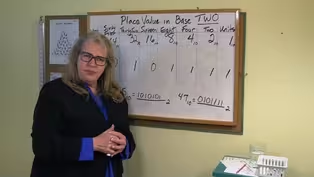
Exploring Place Value - Kristin Baker - Fifth Grade
Video has Closed Captions
Students will examine the structures of the Base Ten and Base Two place value systems. (56m 57s)
Close Reading - Tanya White - Fifth Grade
Video has Closed Captions
Students will explore how to closely analyze a text using the Close Reading method. (56m 2s)

Survival at Morristown - Christopher Kopitar - Fifth Grade
Video has Closed Captions
Students will learn about the Continental Army's survival during the American Revolution. (56m 37s)
The Elements of Drama - Maleesa Lamatina - Fifth Grade
Video has Closed Captions
The students will learn basic terms for the elements of drama. (55m 38s)

Descriptive Writing: Snacks - Christine Skalka - Fifth Grade
Video has Closed Captions
Students will learn how to write a descriptive paragraph, using their favorite snack food. (57m 57s)
Providing Support for PBS.org
Learn Moreabout PBS online sponsorship>> My name is Mrs.
Sherrie Wilkins.
I am a fifth grade teacher.
Today we are going to apply and extend our understanding of how to multiply and divide fractions.
Wait a minute.
Do not run away from me.
We can do this.
Okay, so what does that really even mean?
We are going to learn how to divide fractions.
Repeat after me because there's positive vibes only.
♪ I will divide fractions ♪ ♪ I will divide fractions ♪ ♪ I will divide fractions ♪ Wait a minute.
How do you divide fractions?
Hold on, pause.
Let me ask my 12 year old.
She's super smart.
Aylani.
Come here for a minute.
We want to know, how do you divide fractions?
>> I know how to do that.
All you have to do is find the reciprocal for the second fraction, or... ...flip the last guy and multiply.
>> Really?
>> Don't believe me?
Ask my friends.
>> Really?
What do you say, Annabelle?
How do you divide fractions?
>> Oh, that's easy.
Just flip the last guy and multiply.
>> Seriously, that was amazing.
And you, Maya?
What should we do?
>> You could just... flip the last guy and multiply.
>> You gymnast girls might be on to something.
>> I know.
Flip the last guy and multiply.
>> Wow.
[ Laughs ] To divide a fraction, you'll flip... the second guy, and then you multiply.
>> So that sounds simple enough.
So there's two math words that I want to talk about, okay?
The two math words that I want to discuss right now are fraction and reciprocal.
I am going to write those words on the board while you grab something from around your house to write with or a sheet of paper.
It can be a pencil, pen, marker, notebook, scrap paper, or your handy-dandy notebook if you have one.
So go ahead, you grab those things while I write that information on the board.
Okay?
So, what are you waiting for?
Go grab it.
[ High-pitched static ] Fraction.
F-R-A-C-T-I-O-N.
Fraction.
The next math word is reciprocal.
R-E-C-I-P-R-O-C-A-L.
Reciprocal.
Do you have your paper and pencil ready?
Because now we're going to take some notes.
A fraction has two components.
I'm wondering if you know what they are.
I'm going to give you a hint.
But do you know the components that make up a fraction?
I do -- do you?
If not, it's okay, it's okay.
I'm going to give you a hint.
Watch me.
So I'm going to put the fraction bar on the board like this.
And I always say to my students... ♪ The fraction bar means divide ♪ ♪ The fraction bar means divide ♪ You're probably like, "Wait, why is she singing?
Why is she saying this to me like this?"
Because, in my head, like, I'm a rapper, like, in my other life.
In reality, I'm a rapper.
So I like to sing, I like to write rhymes, I like to write poetry, and I like to rap.
So, a lot of times, when I'm thinking, like, things come into my head like a song or a rap.
So when I start to sing or dance or do a chant or a rhyme, say it with me.
♪ The fraction bar means divide ♪ ♪ The fraction bar means divide ♪ ♪ The fraction bar means divide ♪ So do you know what the two pieces or components of a fraction are?
I'm going to give you a hint.
And if you know what they are, go ahead and say them out loud.
I'm going to put an N on the top of my faction bar, and on the bottom of my faction bar, I'm going to put a D. An N and a D. Any clue what those two letters stand for?
These are the two components that make up a fraction.
On the top of the fraction, we call that a numerator.
Can you say that?
Numerator.
N-U-M-E-R-A-T-O-R.
That is the numerator.
On the bottom half of our fraction is the denominator.
D-E-N-O-M-I-N-A-T-O-R.
So, on the top of our fraction, it's called a numerator.
On the bottom is the denominator.
Fractions are a part of the whole.
So the top of the fraction is the... numerator.
The bottom of the fraction is called the...denominator.
So let's talk about the math word flip.
All of my daughter's friends said, in order to divide fractions, you have to do what?
Flip the last guy and multiply.
So the math word for flip is called reciprocal.
>> Can you say that?
Reciprocal?
Say it with me.
I know it's one of like a funny word you probably never, ever heard of before, but we're learning it today.
It's called reciprocal.
Okay?
Reciprocal is the math word for -- I like to say that it means to... It means to flip.
A short, sweet way to describe what the word reciprocal means, it means to flip.
It means to change the numerator with the denominator or the denominator with the numerator.
So a reciprocal means to flip.
So in order to divide fractions, what do we have to do?
Of all my daughter's friends told you.
What do we do to divide fractions?
♪ Flip the last guy and multiply ♪ ♪ Flip the last guy and multiply ♪ ♪ Flip the last guy and multiply ♪ ♪ Flip the last guy and multiply ♪ ♪ Flip the last guy and multiply ♪ ♪ Flip the last guy and multiply ♪ ♪ Flip the last guy and multiply ♪ ♪ Flip the last guy and multiply ♪ ♪ Flip the last guy and multiply ♪ ♪ Flip the last guy and multiply ♪ ♪ Flip the last guy and multiply ♪ ♪ Flip the last guy and multiply ♪ ♪ Flip the last guy and multiply ♪ ♪ Flip the last guy and multiply ♪ ♪ Flip the -- ♪ So that was "Flip the Last Guy and Multiply" by yours truly.
So let's talk about what that actually means mathematically.
What does it mean to flip the last guy and multiply when it comes to our fractions?
Let's review.
The math word reciprocal.
Say it with me.
Reciprocal.
One more time.
Reciprocal.
Now you say it, okay?
Say it by yourself or to the secret friend in your head.
[ Laughs ] Good, reciprocal.
The math word reciprocal means to flip, the change the numerator with the denominator.
So we have the fraction 1/2.
To find the reciprocal of 1/2, it simply means to change the numerator with the denominator.
They switch positions, they flip.
So the reciprocal of one half is what?
2 over 1, or 2.
So let's do a couple of these on the board.
Let's think of a couple of fractions to write on the board to find the reciprocal of, because in order to divide fractions, you have to know how to find the reciprocal of the last guy.
You're probably like, who is the last guy, Mrs.
Wilkins?
The last guy is the second fraction, okay?
So let's practice first finding the reciprocal of a couple of fractions on the board.
Are you ready?
Do you have your paper and something to write with?
Let's try it.
So I'm going to write a few fractions on the board.
Remember, a fraction has a numerator and a denominator.
So let's take the fraction 2/3.
We want to find the reciprocal.
The reciprocal is made by just flipping the denominator and numerator.
So the reciprocal of 2/3 would be 3/2, or 3 over 2.
Let's try another one.
Let's take the fraction 10/12.
The fraction 10/12, to find the reciprocal, what do we do?
How do we find the reciprocal of 10/12?
What do you think?
We're going to take the numerator and switch it with the denominator.
So the reciprocal of 10/12 would equal -- or be -- 10 -- I'm sorry, 12 over 10.
You got it.
So finding the reciprocal of a fraction is just that simple.
You're taking the numerator and you're switching it with what?
You got it -- the denominator.
I am going to play my song for you again, and I want you to try a few examples on your own.
Okay?
Try your best.
I will be back to review them with you, but take a few minutes and try to find the reciprocal of these fractions.
And remember, the reciprocal is like you have in your notes -- to change the numerator with the denominator.
Are you ready to try a few?
Yes, you got this.
Remember, positive vibes only.
Kiss your brain, you're smart.
You got this.
So let's try a few.
Get your paper, your pencil, and let's get ready to try.
♪ Flip the last guy and multiply ♪ ♪ Flip the last guy and multiply ♪ ♪ Flip the last guy and multiply ♪ ♪ Flip the last guy and multiply ♪ ♪ Flip the last guy and multiply ♪ ♪ Flip the last guy and multiply ♪ ♪ Flip the last guy and multiply ♪ ♪ Flip the last guy and multiply ♪ ♪ Flip the last guy and multiply ♪ ♪ Flip the last guy and multiply ♪ ♪ Flip the last guy and multiply ♪ ♪ Flip the last guy and multiply ♪ ♪ Flip the last guy and multiply ♪ ♪ Flip the last guy and multiply ♪ ♪ Flip the last guy and multiply ♪ ♪ Flip the last guy and multiply ♪ ♪ Flip the last guy and multiply ♪ ♪ Flip the last guy and multiply ♪ ♪ Flip the last guy and multiply ♪ ♪ Flip the last guy and multiply ♪ ♪ Flip the last guy and multiply ♪ ♪ Flip the last guy and multiply ♪ ♪ Flip the last guy and multiply ♪ ♪ Flip the last guy and multiply ♪ ♪ Flip the last guy and multiply ♪ ♪ Flip the last guy and multiply ♪ ♪ Flip the last guy and multiply ♪ ♪ Flip the last guy and multiply ♪ ♪ Flip the last guy and multiply ♪ ♪ Flip the last guy and multiply ♪ ♪ Flip the last guy and multiply ♪ ♪ Flip the last guy and multiply ♪ I have the same fractions that you had on the screen.
Let's check our work to see how well we can find a reciprocal together.
Take your pencil, your highlighter, your marker, your crayon, whatever you're using to write with, and you may fix anything that you feel you need to rethink.
So we are going to be finding the reciprocal, because, remember, before we can divide fractions, you have to know how to find the reciprocal.
Reciprocal means to switch the numerator with the denominator.
So 4/5.
If I switch the numerator with the denominator, 4/5 -- what did you put down on your paper?
I end up with 5/4.
Number two -- 1/2.
We are finding the reciprocal.
What is the reciprocal of 1/2?
2 over 1, which is the same thing as 2, because, remember, earlier I told you... ♪ The fraction bar means divide ♪ ♪ The fraction bar means divide ♪ So 2 over 1 is the same thing as 2 because 2 divided by 1 is 2.
7/4.
The reciprocal of 7/4 would be... You guessed it, 4/7.
3/7.
Let's find the reciprocal of 3/7.
I am going to change the numerator and the denominator.
I end up with 7/3.
Which, look, I have a bigger number over top of a smaller.
A math word to describe that -- it's called an improper fraction.
Number five, 7/8.
What is the reciprocal of 7/8?
8/7.
Now, number six is different.
Do you notice that?
That's a whole number.
So the first thing I want to do with 6 is I want to first change it into a fraction by putting a 1 as a denominator.
So 6 is the same thing as 6 over 1.
Now I'm ready to find the reciprocal.
What is the reciprocal of 6 over 1?
You're right, you've guessed it.
It's 1/6.
Here's another one like that.
5 as a whole number.
The first thing I want to do is write 5 as a fraction by putting 5 as the numerator and then 1 as the denominator.
5 over 1 is the same thing, or equivalent, to 5.
So let's find the reciprocal of 5 over 1.
The reciprocal of 5, or 5 over 1, is... 1/5.
Let's look at number eight.
5/9.
What is the reciprocal of 5/9?
Quite simple, we're just going to flip these.
We're going to change the numerator with the denominator.
I end up with... 9/5.
And number nine, 1/8.
What is the reciprocal of 1/8?
I end up with 8 over 1, which is the same thing as what?
8.
Because, remember, earlier I told you... ♪ The fracture bar means divide ♪ ♪ The fraction bar means divide ♪ Say it with me.
♪ The fraction bar means divide ♪ 8 divided by 1 is 8.
So that means 8 over 1 is equivalent to 8.
Kiss your brain, you're smart.
You did it.
So that was amazing.
Let's take a quick break though.
I am a huge brain nerd.
I love to learn about how the brain operates.
Like, it's something I always love to do.
So I want to do a few brain break exercises that I would do if I were in my classroom.
And, yeah, I know we're not in my classroom today.
We're actually at my house in what I like to call our office or our homeschool room.
My daughter, who told you all about how to find the reciprocal fractions, she and her friends you saw are gymnasts.
So she goes to the gymnastics school to be able to train as a gymnast full-time.
So she's homeschooled.
So this is normally where I would teach her or we'd get work done.
So let's do a few brain break exercises, all right?
So you have a left and a right hemisphere, or sides, of your brain, okay?
So one thing that you can do really quickly if you're sitting is just cross your legs.
Okay, cross your legs.
Or you can sit like you used to sit when you were in preschool or kindergarten.
Well, they used to call, "Everybody sit crisscross applesauce," and you could cross your legs, or you can just put them over each other, crisscrossing your legs like so.
Okay?
That's a quick way to give your brain a jolt.
Another thing that you could do is you could put your hands out to the side like this and wiggle your fingers like butterflies.
I always say butterflies.
And then come together like so.
Stand up, try it with me.
Have your butterflies hover over top of each other.
Keep them flying.
That feels so good already.
Okay.
Now cross your hands together like this and bring it in.
So you could either stand up and do that, or you can do it right where you're sitting.
So cross your arms out like this, stretch, and get your butterflies going.
And put them like this, hover over top of each other.
Now they're gonna give each other a big hug.
Cross and bring the arms in.
Oh, that actually feels really good.
So those were a few brain break activities.
Also, if you have ski mittens on hand -- Normally, when I do math in the classroom, and sometimes here for Aylani, I like to put on a little classical music in the background because that's also good for when you're doing math, as well.
So less hop right back into it.
You all are actually doing superduper amazing.
I actually want to show you something, if that's okay.
I know I told you my daughter was a gymnast, so I want to show you something.
So come with me.
So we are in Aylani's room.
All right?
We're going to borrow a few of her medals to demonstrate how to divide fractions.
Aylani has been training to be a gymnast since she was 5 years old.
So I am going to borrow a few of her medals here today to demonstrate how we multiply and divide fractions.
And all of her friends who also reminded you how to flip the last guy and multiply?
They are also amazing gymnasts, as well.
So I'm going to take two for my numerators and two for my denominators and bring them back when I'm done.
So here's another fun fact.
I know that the brain loves the colors red, yellow, blue, and green.
So when I take notes in my handy-dandy notebook or on the board, then, most times, I like to use the colors red, yellow, blue, and green because then I know my brain is highly attracted to these colors.
Don't believe me?
Well, let's think about it for yourself.
Let's think about some of the famous places that you love to eat at and some of your favorite snacks.
In my family, we love to go to Chick-fil-A.
Think about Chick-fil-A's logo.
What color is it?
Red.
And think about Aylani's favorite snack.
And maybe some of you love this one, too.
The packaging is blue -- Oreos.
And your favorite sodas that some of you like to drink.
The bottles are green.
Mountain Dew and Sprite.
It's green.
Now, why do you think they do that?
It's because they want your brain to be drawn to their products because the brain likes the colors red, yellow, blue, and green.
Now another one.
Let's think about the Golden Arches.
The Golden Arches are what color?
McDonald's has Golden Arches.
It's red and yellow.
So when you take notes in your notebook, use the colors red, yellow, blue, and green because your brain is attracted to those colors.
Got it?
Good.
Before we use these gymnastics medals from Aylani's collection, I'd like to tell you a little bit about them.
I actually love traveling and watching all the girls compete in gymnastics.
So she earned these two from the Pink Invitational, which is a really great meet for a good cause.
All of the money that they earn is donated to those individuals who are battling cancer.
Another fun, exciting fact is, for every score of a 9.0 that each gymnast earns, they donate an additional dollar in that gymnast's honor to those individuals battling cancer.
Isn't that awesome?
This meet, she earned these from the Star Struck Invitational, which is held right here in Atlantic City, New Jersey.
Superduper awesome and so much fun to watch.
So we're going to use these medals to build fractions.
We learned that there are two parts of a fraction.
Do you remember them?
What are the two parts of a fraction?
The numerator.
And the denominator.
I also told you that... ♪ The fraction bar means divide ♪ ♪ The fraction bar means divide ♪ Say it with me.
♪ The fraction bar means divide ♪ So we have our numerator and our denominator.
Let's build another fraction.
What is the number at the top of our fraction called?
You guessed it.
It's called the numerator.
The number at the bottom of our fraction is called the denominator.
So now we're going to use these medals to build some fractions.
Are you ready?
Great.
Let's try it.
So I'm going to build the fraction 2/3.
2/3.
Which number is the numerator and which number is the denominator?
2/3.
2 is our numerator.
And 3 would be our what?
Denominator.
2/3.
Next, I'm going to build the fraction 3/4.
3/4.
Which number is our numerator and which number is our denominator?
You guessed it.
3 is our numerator.
And 4 is going to be our denominator.
So now we have built two fractions that we're going to work with -- 2/3 and 3/4.
So we are going to divide 2/3 and 3/4 by applying the rule that we've learned, and hopefully, by now, that song is stuck in your head.
So we are going to try to do 2/3 divided by 3/4.
2/3 divided by 3/4.
And what's the rule for dividing fractions?
♪ Flip the last guy and multiply ♪ ♪ Flip the last guy and multiply ♪ ♪ Flip the last guy and multiply ♪ ♪ Flip the last guy and multiply ♪ Now let's talk about, in this numerical expression, which number would be considered our last guy?
Okay.
The last guy we are referring to is going to be the second fraction.
Or, mathematically, it would be called our divisor.
Don't forget that the math word for flip means reciprocal.
So we are going to find the reciprocal of the last guy.
So our second fraction in our expression is called the last guy, or the divisor.
So we're gonna flip the last guy and multiply.
So now let's find the reciprocal of the second fraction.
We find the reciprocal by exchanging the numerator with the denominator.
So the reciprocal of 3/4 would be 4 over 3 or 4/3.
Now that we found the reciprocal, how does it go?
♪ Flip the last guy and multiply ♪ ♪ Flip the last guy and... ♪ Multiply.
So I'm going to change my division symbol to a multiplication symbol.
Now we are going to apply multiplication to finish the problem.
To apply multiplication, it's quite simple.
We're going to do numerator times the numerator and denominator times the denominator.
So you multiply what I like to call across, you follow the arrows.
Numerator times numerator, denominator times denominator.
Great.
Let's try to do this together.
So what is the process for dividing a fraction?
We had 2/3 divided by 3/4.
We identify 3/4 as the second fraction or the last guy, as the song says.
Or, mathematically, we'd call that our divisor.
So now we know who our last guy is, we then found the reciprocal -- say it with me -- reciprocal of 3/4.
The reciprocal of 3/4 is... 4/3.
Now we apply the multiplication.
What is 2 times 4?
And what is 3 times 3?
Applying the multiplication will give us our final answer.
So let's do 2 times 4, which is what?
8.
And 3 times 3, which is... 9.
So our final answer is 8/9.
That means that 2/3 divided by 3/4 equals 8/9.
Amazing.
You guys did it.
You're smart.
Let's build another fraction together.
So I have 2 as a numerator... and 4 as a denominator.
And 3 as a numerator... and 7 as a denominator.
So now I want you to try... 2/4 divided by 3/7.
2/4 divided by 3/7.
I want you to give it a shot.
All right?
Listen to the music, follow the rules, and you give it a shot.
♪ Flip the last guy and multiply ♪ ♪ Flip the last guy and multiply ♪ ♪ Flip the last guy and multiply ♪ ♪ Flip the last guy and multiply ♪ ♪ Flip the last guy and multiply ♪ ♪ Flip the last guy and multiply ♪ ♪ Flip the last guy and multiply ♪ ♪ Flip the last guy and multiply ♪ ♪ Flip the last guy and multiply ♪ ♪ Flip the last guy and multiply ♪ ♪ Flip the last guy and multiply ♪ ♪ Flip the last guy and multiply ♪ ♪ Flip the last guy and multiply ♪ ♪ Flip the last guy and multiply ♪ ♪ Flip the last guy and multiply ♪ ♪ Flip the last guy and multiply ♪ Now let's get another reminder from one of Aylani's friends.
Gia, how do you divide fractions?
>> That's easy, Mrs.
Wilkins.
All you have to do is... flip the last guy and multiply.
>> Great.
Let's see how you did.
The first step in dividing 2/4 divided by 3/7 is to find the reciprocal of the last guy, or the second fraction.
So I'm going to find a reciprocal by changing my numerator and my denominator.
So how does the song go?
♪ Flip the last guy and multiply ♪ ♪ Flip the last guy and multiply ♪ So, now, after I find the reciprocal of the second fraction, now I'm going to apply multiplication.
We apply multiplication by doing now our new numerator -- numerator times numerator.
And denominator times the denominator.
What do you get?
Let's multiply.
2 times 7 is... 4 times 3 is... What did you get?
Here's what I got.
2 times 7 is 14.
4 times 3 is 12.
I have 14/12 or 14 over 12, which mathematically will be called an improper fraction because there's a bigger number as our numerator and a smaller number as our denominator.
Great job.
Did you get 14 over 12?
If not, it's okay.
We're going to try a few more together.
Let's read the directions together.
"Work out these fraction divisions.
Your answer can be left as an improper fraction and does not need to be in its simplest form."
♪ Flip the last guy and multiply ♪ ♪ Flip the last guy and multiply ♪ ♪ Flip the last guy and multiply ♪ ♪ Flip the last guy and multiply ♪ ♪ Flip the last guy and multiply ♪ ♪ Flip the last guy and multiply ♪ ♪ Flip the last guy and multiply ♪ ♪ Flip the last guy and multiply ♪ ♪ Flip the last guy and multiply ♪ ♪ Flip the last guy and multiply ♪ ♪ Flip the last guy and multiply ♪ ♪ Flip the last guy and multiply ♪ ♪ Flip the last guy and multiply ♪ ♪ Flip the last guy and multiply ♪ ♪ Flip the last guy and multiply ♪ ♪ Flip the last guy and multiply ♪ ♪ Flip the last guy and multiply ♪ ♪ Flip the last guy and multiply ♪ ♪ Flip the last guy and multiply ♪ ♪ Flip the last guy and multiply ♪ ♪ Flip the last guy and multiply ♪ ♪ Flip the last guy and multiply ♪ ♪ Flip the last guy and multiply ♪ ♪ Flip the last guy and multiply ♪ ♪ Flip the last guy and multiply ♪ ♪ Flip the last guy and multiply ♪ ♪ Flip the last guy and multiply ♪ ♪ Flip the last guy and multiply ♪ ♪ Flip the last guy and multiply ♪ ♪ Flip the last guy and multiply ♪ ♪ Flip the last guy and multiply ♪ ♪ Flip the last guy and multiply ♪ ♪ Flip the last guy and multiply ♪ ♪ Flip the last guy and multiply ♪ ♪ Flip the last guy and multiply ♪ ♪ Flip the last guy and multiply ♪ ♪ Flip the last guy and multiply ♪ ♪ Flip the last guy and multiply ♪ ♪ Flip the last guy and multiply ♪ ♪ Flip the last guy and multiply ♪ ♪ Flip the last guy and multiply ♪ ♪ Flip the last guy and multiply ♪ ♪ Flip the last guy and multiply ♪ ♪ Flip the last guy and multiply ♪ ♪ Flip the last guy and multiply ♪ ♪ Flip the last guy and multiply ♪ ♪ Flip the last guy and multiply ♪ ♪ Flip the last guy and multiply ♪ So, for these problems, you do not have to simplify or put them in its simplest form.
That's for a later lesson.
Let's review and do some together.
So we have 2/3 divided by 1/2.
Let's remember what the rule is.
The rule says... ♪ Flip the last guy and multiply ♪ So where's the last guy?
1/2 would be our last guy, so we rewrite 2/3 times -- and now what is the reciprocal of 1/2?
The reciprocal of 1/2.
The reciprocal of 1/2 is 2 over 1.
So now that we found the reciprocal, let's apply multiplication.
So I'm going to do 2 times 2, which is what?
4.
3 times 1, which is what?
3.
So our final answer is 4/3 or 4 over 3.
Let's try number two together.
3/4 divided by 1/3.
What's the role for dividing fractions?
♪ Flip the last guy and multiply ♪ ♪ Flip the last guy and multiply ♪ So where's the last guy in 3/4 divided by 1/3?
Who is the last guy?
1/3 -- the second fraction or your divisor.
So now I am going to find the reciprocal of 1/3.
What is the reciprocal of 1/3?
The reciprocal of 1/3 is 3 over 1.
So now we're going to apply multiplication.
The rule is... ♪ Flip the last guy and multiply ♪ 3 times 3 is... 9.
And 4 times 1 is... 4.
I know that, when there's a bigger number over top of a smaller number, that's called an improper fraction.
But today we're not going to put them in simplest form.
That's for another lesson.
Let's try number three together.
1/5 divided by 1/3.
First, you want to flip the last guy.
The last guy is our second fraction.
Now that we find the second fraction, what is the reciprocal of 1/3?
3 over 1.
Now let's apply multiplication.
Numerator times the numerator, denominator times the denominator.
3 times 1 is... 3.
5 times one is... 5.
So our final answer is 3/5.
Let's try number four.
2/5 divided by 2/3.
Hey, Helena, what's the rule for dividing fractions?
>> When you divide fractions, you have to... flip the last one and multiply.
>> You're right.
2/5 divided by 2/3.
The second fraction is our divisor or our last guy.
So I'm going to find the reciprocal.
What is the reciprocal of 2/3?
You guessed it, 3 over 2.
The rule is to... ♪ Flip the last guy and multiply ♪ So I'm going to keep my first fraction the same.
The reciprocal of 2/3 is... You said it.
3 over 2.
Now let's apply multiplication.
2 times 2 is 6.
5 times 2 is... 10.
So our final answer is 6/10.
You're doing great.
Let's try two more together.
3/8 divided by 2/5.
Where is our last guy?
Which number are we going to find the reciprocal of?
2/5.
So I'm going to keep my first fraction, which is 3/8, find the reciprocal of 2/5.
What is the reciprocal of 2/5?
5 over 2 or 5/2.
3 times 5 is... 15.
8 times 2 is... 16.
So our final answer is 15 over 16 or 15/16.
Let's do the last one together.
Thank you for staying with me.
You guys are persevering and pushing through.
1/7 divided by 4/9.
The second fraction we're going to find the reciprocal of.
Keep the first fraction of 1/7.
What is the reciprocal of 4/9?
Good.
The reciprocal of 4/9 is... 9/4.
Now let's apply multiplication.
1 times 9 is 9.
7 times 4 is 28.
So our final answer is 9/28.
Great.
Thank you for persevering and pushing through.
>> Now let's take what we've learned and apply it to a real world problem.
Let's solve a word problem together.
I always tell my students that the average person needs to read a word problem three times before we solve.
So let's do our reads together.
And as I read it, I want you to write down the most important information that is given to you in the word problem that we're going to need to solve.
I like to have a handy-dandy highlighter to highlight the most important information.
Also, a good thing to always pay attention to in addition to the numbers is the last sentence.
The last sentence in a word problem is almost always going to tell us what we need to find.
Okay?
So let's go ahead and do a close read of the word problem together.
Are you ready?
I want you to write down the most important information from our word problem so that we can solve it together.
Let's try it.
Here comes the first read our problem.
"Isabella has 5 pounds of trail mix.
She divides the mix into 1/4-pound servings.
How many 1/4-pound servings does she have?"
"Isabella has five pounds of trail mix.
She divides the mix into 1/4-pound servings.
How many 1/4-pound servings does she have?"
So take a look at the last sentence.
The last sentence is very important.
It always tells us what we need to find.
The last sentence reads, "How many 1/4-pound servings does she have?"
That's what we need to find out.
Okay, now let's talk about the most important information in the problem.
Is her name important information?
No.
Her name could be Bella, Mella, Stella, Della, Slella, Lella, Buddha, Botta, Suda, Kata, Matta -- hey!
Her name could be anything.
Her name is not important information.
So here's a quick tip.
When we are writing down our numerical expression that we're going to use to solve, we're going to pull out the most important information in the problem exactly as they tell it to us.
So let's look at it again.
Let's read it again together.
Are you ready?
And I want to see if you can tell me the most important information in the problem.
We are going to write our numerical expression exactly the way they give us the information in the problem.
Let's read it.
"Isabella has 5 pounds of trail mix.
She divides the mix into 1/4-pound servings.
How many 1/4-pound servings does she have?"
Okay.
So it says she has... How many pounds of trail mix does she start with?
Let's write it down on our papers.
She starts off with 5 pounds of trail mix.
Now go back to the problem.
Let's take a look at it.
There is a clue word that tells us, obviously, that this problem is divide.
What is the clue word here that tells us that we are going to be performing division?
It says what?
It says "divide."
So go ahead and put your division symbol in.
Okay.
It says she divides the mix into how many pound servings?
It says 1/4-pound servings.
Okay?
So now we have our numerical expression.
Now can we apply the rule that we've learned?
What's the rule?
Tell me.
My daughter and all of her friends also shared that rule with you, as well.
♪ Flip the last guy and multiply ♪ ♪ Flip the last guy and multiply ♪ Now, where's the last guy in this particular numerical expression?
Which number is the last guy?
It's going to be the second number.
In this case, the second fraction would be our last guy.
So, remember, we learned that the word flip means to find the reciprocal.
All right?
So what is the reciprocal of 1/4?
Let's apply the rule.
Flip the last guy.
Here's our last guy, the second number in our numerical expression.
And the word "flip" means to find the reciprocal.
What is the reciprocal of 1/4?
You got it -- 4 over 1.
So how does it go?
♪ Flip the last guy and... ♪ ♪ Flip the last guy and... ♪ So let's change our division symbol to a multiplication symbol.
Now, the number 5.
How can we write the number 5 as a fraction so that it has both a numerator and a denominator?
Right now, it's a whole number.
We want to write it as a fraction.
Can be 5 over 1.
Now we have our related number sentence, our related expression, for 5 pounds divided by 1/4.
Now let's go ahead and multiply.
I'm going to take my numerator times my numerator and my denominator times my denominator.
So what is 5 times 4?
What's 5 times 4?
20.
So I'm going to put 20 as my new numerator.
And what is 1 times 1?
You got it -- 1 So we end up with a final answer of 20 over 1, which is the same thing as 20.
20 over 1 is the same thing as 20.
Now let's go back to the problem.
Where here we find what it is that they're asking for us to do?
Which part of the word problem tells us what we need to answer?
Let's take a look at the problem.
The problem's last sentence says, "How many 1/4-pound servings does she have?"
We just did the math.
We ended up with 20 over 1.
20 over 1 is the same thing as 20.
So how many 1/4-pound servings does Isabella have?
You're right.
She has 20 1/4-pound servings to be able to share with her friends.
Hopefully she's sharing with her friends, I don't know.
Maybe she's sharing with the neighborhood.
Maybe she's serving or volunteering.
Maybe she's serving at a homeless shelter.
Maybe she's going to church and just passing them out to the congregation.
I don't know.
The problem didn't tell us that.
That's not important information.
But how many 1/4-pound servings does she have?
She has 20 1/4-pound servings.
Kiss your brain.
You did good.
So, again, my name is Mrs.
Wilkins.
I'm a fifth grade teacher and I'm not really a rapper.
In my head, I'm a rapper, but I'm not.
I just like to write rhymes and I like to teach math.
And sometimes, when I teach math, it just comes out like that.
So thank you for staying in this entire lesson with me.
You did so amazing at finding the reciprocal or flipping the last guy and multiplying.
You are absolutely amazing.
So, I hope you remember that song and you -- you just -- Hopefully, it's stuck in your brain, that you just go around the house all day singing the song like... ♪ Flip the last guy and multiply ♪ ♪ Flip the -- ♪ You're in the shower like... ♪ Flip the last guy and multiply ♪ You at the breakfast table like... ♪ Flip the last guy and multiply ♪ ♪ Flip the last guy and multiply ♪ ♪ Flip -- ♪ And then you're on the Zoom with your teacher like... And everybody's like, "What is she doing?
What is he doing?"
But you're like... ♪ Flip the last guy and multiply ♪ ♪ Flip the last guy and multiply ♪ ♪ Flip -- ♪ [ Laughs ] So I'm hoping that song is stuck in your head.
If there's anything I can do to support you, please let me know.
But, again, dividing fractions is simple.
You rock at this.
Before I leave you today, let's talk about how you can divide fractions at home and continue to practice.
If you do what I did and go to the handy-dandy web site called Google.
You type into Google "divide fractions."
Once you type in "divide fractions," you're going to find tons of different resources and worksheets that you can use or copy the problems right into your paper, on the back of an old piece of mail, whatever you have at home, or what I like to call your handy-dandy notebook.
You can use items from around your house, just like I used Aylani's gymnastic medals to be able to build fractions that have a numerator and a denominator.
You can also ask your mom, dad, grandmom, whoever it is that you live with to make up some fractions for you, and then you can write them down in your notebook and you guys can divide fractions together.
All you have to do is remember to flip the last guy and multiply.
Thanks for hanging out with me today, guys.
My name is Mrs.
Wilkins and I am a fifth grade teacher.
Love you.
♪ Flip the last guy and multiply ♪ ♪ Flip the last guy and multiply ♪ ♪ Flip the last guy and multiply ♪ ♪ Flip the last guy and multiply ♪ ♪ Flip the last guy and multiply ♪ ♪ Flip the last guy and multiply ♪ ♪ Flip the last guy and multiply ♪ ♪ Flip the last guy and multiply ♪ ♪ Flip the last guy and multiply ♪ ♪ Flip the last guy and multiply ♪ ♪ Flip the last guy and multiply ♪ ♪ Flip the last guy and multiply ♪ ♪ Flip the last guy and multiply ♪ ♪ Flip the last guy and multiply ♪ ♪ Flip the last guy and multiply ♪ ♪ Flip the last guy and multiply ♪ ♪ Flip the last guy and multiply ♪ ♪ Flip the last guy and multiply ♪ ♪ Flip the last guy and multiply ♪ ♪ Flip the last guy and multiply ♪ ♪ Flip the last guy and multiply ♪ ♪ Flip the last guy and multiply ♪ ♪ Flip the last guy and multiply ♪ ♪ Flip the last guy and multiply ♪ ♪ Flip the last guy and multiply ♪ ♪ Flip the last guy and multiply ♪ ♪ Flip the last guy and multiply ♪ ♪ Flip the last guy and multiply ♪ ♪ Flip the last guy and multiply ♪ ♪ Flip the last guy and multiply ♪ ♪ Flip the last guy and multiply ♪ ♪ Flip the last guy... ♪ Divide fractions.
So you will be able to divide fractions by the time we are spending -- Wah, wah, wah.
Wah, wah, wah.
Studio.
Yes.
We got to get in studio, get these raps recorded, you know what I mean?
[ Chuckles ] You know what I mean?
My album about to drop.
>> Hold on.
Don't stretch it yet.
I got to move this out the way.
>> You know what I mean?
I got this, son.
I'm experienced.
♪ Flip the last guy and multiply ♪ ♪ Flip the last guy and multiply ♪ ♪ Flip the last guy and multiply ♪ Yes.
♪ Multiply ♪ ♪ Flip the last guy and multiply ♪ [ Laughs ] You ready?
>> Whenever -- Are you ready?
>> What does that mean?
♪ Flip the last guy and multiply ♪ Wait a minute.
♪ Flip the last guy and multiply ♪ ♪ Flip the last guy and multiply ♪ ♪ Flip the last guy and multiply ♪ ♪ Flip the last guy and multiply ♪ ♪ Flip the last guy and multiply ♪ ♪ Flip the last guy and multiply ♪ >> [ Squeals ] >> ♪ Flip the last guy and multiply ♪ ♪ Flip the last guy and multiply ♪ ♪ Flip the last guy and multiply ♪ ♪ Flip the last guy and multiply ♪
















Support for PBS provided by:
NJTV Learning Live is a local public television program presented by NJ PBS