
Fred's Flying Circus and more
Season 13 Episode 4 | 26m 10sVideo has Closed Captions
Fred's Flying Circus, College World Series organist Jerry Pawlak, a wildfire firefighter
Fred's Flying Circus - Fred Schritt began creating whimsical, brilliant characters that he mounted on tall poles outside his shop. , College World Series organist Jerry Pawlak - has spent the last decade as the organist at the College World Series, a profile of a wildfire firefighter, and a coffee shop helping foster kids - the proceeds go to young employees aging out of foster care.
Problems playing video? | Closed Captioning Feedback
Problems playing video? | Closed Captioning Feedback
Nebraska Stories is a local public television program presented by Nebraska Public Media
Fred's Flying Circus and more
Season 13 Episode 4 | 26m 10sVideo has Closed Captions
Fred's Flying Circus - Fred Schritt began creating whimsical, brilliant characters that he mounted on tall poles outside his shop. , College World Series organist Jerry Pawlak - has spent the last decade as the organist at the College World Series, a profile of a wildfire firefighter, and a coffee shop helping foster kids - the proceeds go to young employees aging out of foster care.
Problems playing video? | Closed Captioning Feedback
How to Watch Nebraska Stories
Nebraska Stories is available to stream on pbs.org and the free PBS App, available on iPhone, Apple TV, Android TV, Android smartphones, Amazon Fire TV, Amazon Fire Tablet, Roku, Samsung Smart TV, and Vizio.
Do you have a Nebraska Story?
Do you have a story that you think should be told on Nebraska Stories? Send an email with your story idea, your name, your city and an email address and/or phone number to nebraskastories@nebraskapublicmedia.org. Or, click the link below and submit your information on nebraskastories.org.Providing Support for PBS.org
Learn Moreabout PBS online sponsorship(soft bright music) - [Narrator] Coming up on Nebraska Stories, the whimsical world of Fred's Flying Circus.
The music man behind the College World Series.
Fighting fire with fire, and a small business with a big mission.
(upbeat music) (soft whimsical music) - [Keith] It seemed like the more cars went up, more people would stop, and take pictures.
People from all over.
We've even had some people in foreign countries stopped by and wanted to take pictures of them, and have us talk to them about it.
We just had a guy from, I think it was Russia, not too long ago, or Yugoslavia.
Yeah, Yugoslavia.
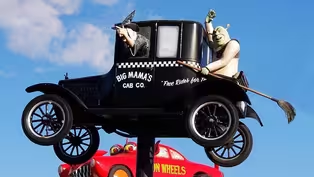
- [Narrator] What people are traveling to see, is a collection of whimsical sculptures perched above the Grand Island Body Shop.
- [Karen] They are actual cars, the characters are made out of the rebar, chicken wire, and concrete.
But the actual cars, they don't have motors in them, but they're very heavy.
- [Narrator] These high flying characters, owe their existence to the perpetual creativity of Fred Schritt, who was also the body shop owner.
- [Karen] He went to work at Green's Body Shop.
He was 14 years old and he loved it after that.
Then he went to work for Schupin's.
He worked six days a week, and then in the evenings, he'd go out and paint airplanes to make extra money.
- [Narrator] Fred was the kind of person, who just didn't like sitting still.
And so, the same year he opened his body shop on the east side of town, he began building and racing custom motorcycles.
(upbeat rock music) After a long successful career in racing, Fred finally hung up his helmet at the age of 70, but he still needed something to do with his spare time.
And that's when a little input from his grandson came in handy.
- [Karen] He had an old wrecker out there, so then my oldest grandson, Jordan, had suggested it looked like Mater from the show "Cars".
- [Mater] Ha, you're funny.
I like you already, my name's Mater.
(clang) - [Lightning] Mater?
- Yeah, like, tuh-mater.
But without the tuh.
- [Keith] He got the idea of making a wrecker out of it, and then chopped it and did his hot-rod thing that he liked doing to it, and making a crazy face on it.
And ended up making the wrecker, and then he decided to put it on a pole.
And so, he ended up talking to this sign company next door, and they, he hired him to put in a pole and lift the car up and welded it to the pole.
And the rest is history (chuckles).
- [Fred] But after I built the first car, Peppermint Kid, well, everybody liked it so well, it made me happy and they was happy.
So, I built another one.
And everything I build, people like it.
So, it's actually just like stuff going on, building a house or building.
- [Karen] Top of the building, he built Snoopy and you know, the Red Baron, and his house.
And then the German, that was, like an old '65 Volkswagen.
And he chopped the end off, and he made a tail for it.
And then he made a German, shooting at Snoopy.
And the bullets were made from old spark plugs.
Anything he could find, he would use on his vehicles.
- [Keith] One car is from the Coney Island.
There's a restaurant in Grand Island, called the Coney Island.
And George is the owner, and that's George driving the Coney car.
(light big band music) - [George] My dad and him go way back.
He's been a long-time customer.
He's like one day, he goes, "Hey, I wanna build you a Coney car."
"Okay, what do you mean, Coney car?"
"I'll put you on a pole, with the rest of the characters."
I said "Okay, do what you wanna do."
He didn't want me to look at it, 'til it was about done.
"Don't look at it," so I said, "Fine."
He goes, "That's you, everybody says, that's you George up there, that's you."
(George laughs) Yeah, he got me.
You know he was a giving guy.
He was big on the Humane Society, helping the dogs and all that.
And a lot of good stories about him.
- [Narrator] Over the years, Fred had many four-legged friends but a favorite, was his yellow lab named Buddy.
And it was Buddy who inspired Fred to create the only car that isn't at the body shop.
- [Karen] He took it out there, and donated it to the Humane Society.
And they said that year, that they had record breaking sales of people adopting animals, because people would go by and they'd see it.
It was way up in the air, the car.
Little kids would want to go in and see the dogs.
(light piano music) - [Keith] Then after most of the cars were up, one of his friends and him, decided they were going to make a sign out front that said Fred's Flying Circus.
I'm not sure exactly how they came up with the flying circus.
- [Narrator] Between 2009 and 2015, Fred built nearly a dozen cars, but a chronic heart condition caused him to dial back his work.
- [Keith] After Fred's health, when it wasn't so good.
He started making these characters, just the characters to put on the beam between the poles.
On one beam, there is the Guitar Man, Smurfette, Tweety Bird.
And then he decided he was going to do a Minion.
'Cause he seen the movie about the Minions in one of the cartoons.
And he thought they were pretty neat.
- [Narrator] But the Minion was to remain unfinished.
As Fred passed away in early January of 2016.
- [Keith] We talked about finishing it.
- [Karen] And that's about probably a good three years.
- [Keith] So, I finally got the nerve up to go back there and start messing with it, and finally decided how to go about it.
And I finally started on it, took me a while to finish it.
I mean, it's such a small character, but he was a master at it.
He could've had that probably done in a weekend, where it took me a few months (chuckles).
(hopeful piano music) - [Karen] We called it Fred the Minion.
And that was the last thing that we put up.
- [Narrator] After seeing Fred's collection of work, it may surprise you to know Fred never considered himself an artist.
- [Keith] Actually one day he was talking about that.
"I'm not a very good artist.
"I can't even draw.
All I can draw is stick people."
Just because he couldn't draw a picture of a person, or their face.
I looked around and I was like, "Fred, you're an artist."
(gentle music) (upbeat rock music) - [Narrator] Baseball fans from across the country, travel to Omaha each summer to watch college baseball's best, play the game.
-All right, guys.
-Yay.
[Dennis] There's one guy in the ballpark, though, who's more focused on what fans hear, than what they see.
(bright organ music) -Go Bulldogs.
-Go Bulldogs.
- [Narrator] Jerry Pollak is a player, who never takes the field.
He's the organ player - a guy who can score big with the fans not by hitting a baseball, but by hitting just the right notes, at the right time.
- I feel the crowd, and I know if they're really into the game and doing a lot of cheering and stuff.
And I'll play appropriate songs for that.
And that's what I try to do.
- [Narrator] Jerry was born in Chicago in the early 1940s appropriately, the same week and in the same city, where the first organ music was played at a major league baseball game.
He came from a musical family, and started taking lessons when he was about six, but not on the organ.
- [Jerry] Started on the accordion, took piano lessons 'til I was 16, and discovered girls and the music went away.
But I reinvented myself at age 23, when we started with the organ.
- [Narrator] Jerry says he was fascinated by the organ, and eventually got good enough to play publicly.
- [Jerry] Well, the restaurants in Chicago in the day, in the 50's and the 60's had organ bars, and I went to a couple of those places and I said, you know, "I think I can play better than the guy who's there."
and walked into my first restaurant that I played at for 16 years, and did a little audition.
And he says, "Our organist just quit, you got the job."
- [Narrator] His work with the Burlington Railroad eventually brought him to Nebraska.
And a decade later, when the College World Series moved from it's long time home at Rosenblatt Stadium, to the new TD Ameritrade park.
Longtime organist, Lambert Bartak who had played at the world series for 43 years, decided not to make the move.
- [Jerry] He didn't want to move here.
And they were doing auditions and I went to the audition, and they hired me right on the spot, so to speak.
Yeah, so that started 10 years ago, and I'm still here.
- [Narrator] Bartak's words of wisdom for the new organist in the seat were limited.
- [Jerry] I did talk to him a couple of days before I started here and he just says, "You're a professional, you'll figure it out."
- [Narrator] And that he did.
Jerry's two week summer job, during the College World Series can include some very long days.
He's usually at the ballpark a couple of hours before the first pitch.
And if it's a double header, or the game goes into extra innings, he might not make it back to his hotel until well after midnight.
Only to get up the next day and do it again.
The job has its perks though, including a great seat for the games.
- [Jerry] I have a fantastic view.
I'm on the fourth floor above home plate.
I can see the whole field.
- [Narrator] A seat any baseball fan would love.
But even though Jerry's played for a hundreds of games and seen some great ones, he doesn't consider himself a baseball fan.
- Truthfully I'm not.
I'm not a sports fan.
I grew up with a musical family and we did music, and none of my family plays sports, so.
- [Narrator] Jerry does pay close attention to each game though.
He's all business, when he's in the booth.
- [Jerry] Basically, this is a show, it's entertainment.
It's a show.
And my job is to entertain people.
- [Narrator] He does that, by relying on his years of experience to play the right song.
He has what he calls his Bible close by.
It's filled with many pages of sheet music, but he's played so long, he doesn't really need to have a sheet of music to help him get to where he wants to take the song.
[organ plays] - [Jerry] I used to use sheet music, and the sheet music is written by somebody else.
And I've, I would rather interpretate the song to my own feelings, than play somebody else's arrangement.
- [Narrator] So, Jerry let's what's happening on the field guide what he plays on the organ.
For example, if it's raining, Jerry's always ready with a song.
"Raindrops Falling On Your Head", "Stormy Weather", "Here Comes That Rainy Day".
- [Narrator] But every baseball organist knows there is one song, at one time, each night during which they better be on their musical game.
- The seventh inning stretch is the reason, the most important reason why I'm here.
Everybody likes to sing, "Take Me Out To The Ball Game".
("Take Me Out To The Ball Game" plays) - [Narrator] And when the whole crowd is standing and singing to his music.
- I feel great.
The louder they sing, the greater I feel.
(bright organ music) - [Narrator] So, what could Jerry possibly do to top that feeling?
(bright organ music) (bright piano music) How about shopping?
Or actually playing three afternoons a week, for the shoppers at the Von Maur department store, in Lincoln.
Here, he trades his fun-loving organ music, for some softer background melodies on the piano.
(melodic piano music) - [Jerry] It's a whole different venue, being at the College World Series Park, with all the background noise and everything that I have to play, this is more intimate.
The atmosphere here is more intimate.
I get to meet people.
They walk by and, want to talk about the piano, or song that they want to hear.
Sometimes they sit in the couches here, and I ask them if they have a particular song that they liked to hear, and it's a little more rewarding, a little more personal, than it is in the big park.
- [Narrator] Whether it's the cheers from a large crowd, or a smile from a single shopper.
For Jerry, it's all about the people enjoying his music.
- My favorite thing is when somebody is walking down the aisle, in and out of the store and they're dancing, more or less, walk-dancing to the music.
That's the most thing that I appreciate.
(upbeat piano music) - [Narrator] And his fans appreciate him.
Whether it's in the aisles of a clothing store, or in the cheap seats at the ballpark.
Jerry Pollack's music is a big winner in Nebraska, and so is he.
- When I enter the room, usually I'm the guy, the techs in the room call me at The Legend, but I don't feel that way.
I'm just here to do a job, and have a good time, and hopefully the audience has a good time as a well.
(bright organ music) (upbeat rock music) (rotors whirring) (suspenseful music) (fire crackling) (suspenseful music continues) (music intensifies) (music calms) - [Chief Nathan] We've learned in the past 10 years, that fire's not always bad.
We have understood that we can control fire with fire, and it has a huge impact on the regrowth, and the forest of our areas.
I'm the Fire Chief for the Gering Fire Department.
We are in Cedar Canyon Wildlife Management Area, which is about seven miles southwest of Gering, Nebraska.
You know, Wildcat Hills is a gorgeous area, unlike anywhere else in Nebraska.
(sharp orchestral music) It's a span of hills and different bluffs, and buttes that start somewhere in Wyoming-Nebraska border, and go closer to Bridgeport.
We've seen fire behavior that we haven't seen in the past.
About two or three years ago, we had the idea, that maybe we can create a fire exercise and bring people in from around the area, to help put some type of team, and firefighters that are truly qualified to manage this fire.
We're getting our firefighters out here to recognize the terrain.
They're getting in the ability to see what they're up against in the event that we do have a large fire that comes through here.
We have 27 engines from Pueblo, Colorado; Colorado Springs, Cheyenne, and Laramie.
Imperial, Madrid, Keystone, Lemoyne, Ogallala, Bayard.
And then we have Nebraska state overhead, from emergency management, and Nebraska National Guard, State Fire Marshal's Office, and Nebraska Forest Service.
(orchestral music continues) We really found a need that we need to have some aerial resources in Nebraska.
- [Operator] The aero-applicator should be coming in already.
- [Chief Nathan] So, can I pick them up direct, or do you want me to come to you?
- [Operator] No, you can pick those up direct.
- [Chief Nathan] Communication is always the biggest issue we run into.
Statistically, you've seen a lot of firefighter fatalities and injuries result from communication issues.
So, we're trying to really beef up our understanding, and our training, and communication with aircraft.
- [Operator] Release Flowers 23.
- [Pilot] Go ahead Flowers.
- [Chief Nathan] Hey, I just gotta ahold of ops.
They gave me permission to take this applicator, start pre-treating this canyon by us.
- [Pilot] Copy that.
(bright violin music) (water rushing) (engine roaring) (bright violin music continues) (water flowing) (music continues) - [Chief Nathan] When you see growth, and overgrowth of fuels, and when we're talking fuels, shrubs, grasses, trees - the minute that they become more dense in drier seasons, if there is a fire that's affected the area, let's say it's caused by lightning - you're gonna have that fire move into those fuels at a much faster rate, at a much hotter environment, that it's gonna decimate the whole forest.
So, when you're able to produce a low intensity fire, thin the forest out, and put fire on the ground.
Ponderosas react in a way that is gonna release its seeds.
It's gonna drop on the ground, and regenerate a lot healthier.
The grasses are going to come back greener, for the elk, for the sheep, for the deer that are in this area.
The shrubs are going to be decreased, so that way we don't have that really hot fire behavior move through the land.
You know, and the fire service is a family.
Every single firefighter that's on the ground, 98% of them are volunteers in every community in Nebraska.
You belong on a fire department, you're a firefighter.
(upbeat instrumental music) (upbeat guitar rock music) (coffee beans rattle) - [Miah] If you look at that demographic there's a whole host of negative outcomes that are associated with it, but I think the thing that really stood out the most is there's a fifty percent unemployment rate in that demographic.
We started this bike shop coffee shop as a means to provide workforce development for young adults who've been impacted by the foster care system.
(bright guitar music) (steamer whizzes) - 16 ounce iced coffee.
- [Miah] Our bottom line is not profits, our bottom line is the programming.
So the program that we provide is financial literacy, we provide personal budgeting help, we do cooking and nutrition classes we do mindfulness meditation, we have a book club, we do academic tutoring, we do some art therapy projects.
There's just a lot of things that we do to kind of supplement the job stuff.
- [Vallory] You want to get a filter from underneath there and then I'll get the rest of it.
- [Miah] I really think Vallory is one of my favorites, just because, you know when she came here she was homeless.
Her anxiety was so great that she wouldn't talk to people.
And like would not answer you.
- [Vallory] I really look at this place as like my family.
LIke we're not related by blood but we've all been through so many similar things and even here it's been a journey together and, especially my bosses, they're my main support group.
I can ask them about anything and they'll help me.
- [Miah] Getting her here, and just seeing, what a like, engaging, intelligent person she was, that was just exsisting in this world by herself.
And so she gradually starts to come out of her shell, and then she starts to really become a great barista, and then you start to see the leadership qualities in her.
- Is it expanding?
Yep.
You blossomed that perfectly then.
Changed my life completely.
Completely.
- [Miah] I think, as a society, we're kind of making it seem okay for them to be a disposable demographic.
We know that young adults age out of the foster care system, and we know the negative outcomes that they face, but it's something that continues to happen.
The only conclusion to draw is that we view them as a disposable demographic and I think that's something that- it really makes me angry, and you know, it's something that I want to make sure that we fix.
(group laughs) (upbeat rock music) - [Narrator] Watch more Nebraska Stories on our website, Facebook, and YouTube.
Nebraska Stories is funded in part by The Margaret and Martha Thomas Foundation.
Video has Closed Captions
Clip: S13 Ep4 | 7m 24s | Fred Schritt began creating whimsical, brilliant characters that he mounted on tall poles. (7m 24s)
Video has Closed Captions
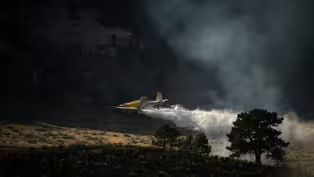
Clip: S13 Ep4 | 6m 21s | Volunteer and career firefighters train on wildfire suppression in WIldcat Hills (6m 21s)
Video has Closed Captions
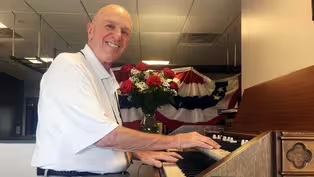
Clip: S13 Ep4 | 8m 23s | Jerry Pawlak is the organist for the College World Series (8m 23s)
Providing Support for PBS.org
Learn Moreabout PBS online sponsorship















Support for PBS provided by:
Nebraska Stories is a local public television program presented by Nebraska Public Media