
Freighter Technology
Clip: Season 1 Episode 5 | 7m 29sVideo has Closed Captions
Freighter Technology | Episode 1005/Segment 3
The 740-foot-long and 78-foot wide CSL Welland regularly traverses the Great Lakes transporting more than millions of pounds of grain from Thunder Bay, Michigan, to Quebec City, Quebec. Safely navigating a ship that size and weight through locks that are just two feet wider than the ship, around obstacles and in rough weather is made easier with the help of freighter technology.
Problems playing video? | Closed Captioning Feedback
Problems playing video? | Closed Captioning Feedback
Great Lakes Now is a local public television program presented by Detroit PBS
Freighter Technology
Clip: Season 1 Episode 5 | 7m 29sVideo has Closed Captions
The 740-foot-long and 78-foot wide CSL Welland regularly traverses the Great Lakes transporting more than millions of pounds of grain from Thunder Bay, Michigan, to Quebec City, Quebec. Safely navigating a ship that size and weight through locks that are just two feet wider than the ship, around obstacles and in rough weather is made easier with the help of freighter technology.
Problems playing video? | Closed Captioning Feedback
Where to Watch Great Lakes Now
Great Lakes Now is available to stream on pbs.org and the PBS app.
Providing Support for PBS.org
Learn Moreabout PBS online sponsorship- [Narrator 2] Many people who live and vacation along Lake Ontario and the St.
Lawrence river stop and stare in awe when massive commercial ships pass by.
Artists paint and photograph these freighters and lakers or cargo ships, built for traversing the Great Lakes, and marketers use their likeness to promote the Thousand islands.
But not many people know what it takes to keep a ship, its crew, and the environment safe during a voyage.
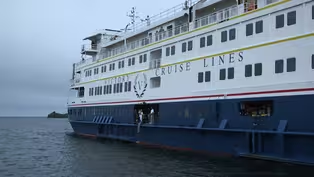
(soft orchestra music) Built in 2014, the CSL Welland is one of the biggest carriers of grain on The Great Lakes.
In its five holds, it can carry around 31 thousand metric tons.
That's over 68 million pounds of grain!
The boat picks up its cargo in Thunder Bay, Michigan, and carries it through Lake Huron, Lake Erie, And Lake Ontario before delivering the grain to Quebec city.
- If you want to look inside, you can actually see the grain.
We unload Quebec, we turn around and we go right back to Thunder Bay.
We've got these big overseas ships that come over and they load up the grain and they take it overseas - [Narrator] Moving all that cargo takes power, But the Welland was designed for low fuel consumption and a reduced environmental footprint.
- The main engine is a 6-cylinder, that's a HEMI Engine, it's over 11,000 horsepower, so that the engine is burning the heavy fuel 380.
I don't know if you know about the fuel.
You got the gasoline, you got the diesel, after that you got different kinds of heavy fuel.
You got 90, 180, as long as you're going down to the bottom of the distillation plant, that's the bottom quality of fuel so it's cheap to use, but we use low-sulfur most of the time, again, to protect the planet, too, the environment.
That fuel need to be heat to almost 100 Celsius to be able to be injected to the the main engine, to have a proper injection.
Otherwise, if you try to inject that thing at the normal temperature, it's going to be the nightmare, you're going to block everything.
- We used to use 40 tons of fuel a day.
We're down to less than 20 a day.
So we've taken 20 tons of fuel a day with all that smoke in the atmosphere and taken it out.
So yes, we are way advanced in the environmentally.
We are environmentally friendly company.
It takes 270 trucks, I believe the numbers 270 18 wheelers on the road to match one ship, that we do in five days.
There's no comparison.
We don't run no fuel compared to what 270 trucks would run.
So, we are as environmentally friendly as you can get.
- [Narrator 2] Canada steamship lines hires a company that disposes of all garbage ashore.
They ensure that nothing goes in the water.
The CSL Welland is named for the Welland canal, which connects Lake Erie to Lake Ontario via a series of eight locks.
Over the 27-mile length of the canal, these locks raise or lower boats a total of 326 feet.
The ship is 740 feet long and 78 feet wide, the widest ship that can pass through the locks of the Welland Canal, which are only two feet wider than the hull of the boat!
To safely position ships, locks in the Welland Canal use a hands-free vacuum mooring system.
Vacuum pads, or suction cups, mounted on steel arms attach to the sides of the ship and move with the ship as the vessel is raised or lowered in the locks, keeping the ships a fixed, safe distance from the lock walls.
After communicating with the captain, the operator deploys the hydraulic arms that attach to the vessel.
Each vacuum pad provides up to 20 tons of holding force.
Every automated lock has six vacuum pads.
The hands-free system shaves off approximately seven minutes per lock.
This system eliminates traditional mooring methods of attaching the ship by ropes to the canal walls, which can be time consuming, labor intensive, and potentially dangerous.
(upbeat orchestra music) New technology aboard ship has also made navigating through the Great Lakes safer and easier.
3-D Navigation systems have replaced traditional radar.
These systems use GPS to pinpoint, with incredible accuracy, the location of the ship, and obstacles surrounding it, no matter what the weather.
The Welland has two electric thrusters, fore and aft, that-in conjunction with the main engine, make the ship highly maneuverable.
They're powered by generators, and the propulsion system is monitored in a single control room near the engines.
- About 85% of the engines and generator is done from these two computers.
These are the brain, the neuro center or the brains of the engines and generators, actually of the whole engine room.
They control the power management system for the generators, power distribution, and at any moment, we can change over and go to the main engine.
Tells us all the temperatures, parameters, everything.
If something's getting hot, we'll have an alarm.
If some pressure's low, we'll have an alarm.
Pretty much everything's monitored from inside here, the control room.
This is the master control panel with all our breakers for the stern thruster, bow thruster, and our three generators, and any big consumers, where motors kick in or whatever, all run off this board here.
- [Narrator 2] U.S.
and Canadian lakers operating in The Great Lakes Seaway System are under the control of captains and senior officers who are trained pilots, familiar with local geography, weather, currents, and sailing conditions; and licensed by, in the United States, the U.S.
Coast Guard, and in Canada, by Transport Canada.
Both agencies oversee pilot qualifications, training, licensing, and service standards.
Charting a safe course through the Great Lakes Seaway System has changed dramatically over the past 20 years.
- The safety of the crew is number one.
Safety to the environment would be number two, and then basically, it's the safety of the ship and CSL's Assets.
Everybody wants to be safe.
Everybody wants to get the job done as safely and efficiently as possible.
- [Narrator 2] Improvements to communication systems, better weather forecasting, and strides in technology make marine shipping one of the safest transportation alternatives.
Video has Closed Captions
Clip: S1 Ep5 | 4m 55s | Rising Waters | Episode 1005/Segment 2 (4m 55s)
Providing Support for PBS.org
Learn Moreabout PBS online sponsorship New Episode
- Science and Nature

Explore scientific discoveries on television's most acclaimed science documentary series.
 New Episode
- Science and Nature

Capturing the splendor of the natural world, from the African plains to the Antarctic ice.


 New Episode








Support for PBS provided by:
Great Lakes Now is a local public television program presented by Detroit PBS