
Northwest Profiles
Friendship Dance
Clip: Season 26 | 8mVideo has Closed Captions
Northwest tribes gather in Spokane to sing, dance and drum in the traditional ways
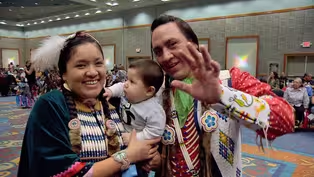
Once a year, five Northwest tribes gather in Spokane, to sing, dance and drum in the traditional ways of their ancestors. The winter event teaches young people the traditional songs and dances of the regional tribes. Traditional songs and dances like the Prairie Chicken, the Snake Dance, the Cup Dance, the Round and Owl Dances, the Whip Man and Scalp Dances and the Hangman’s song.
Problems playing video? | Closed Captioning Feedback
Problems playing video? | Closed Captioning Feedback
Northwest Profiles is a local public television program presented by KSPS PBS
Funding for Northwest Profiles is provided by Idaho Central Credit Union, with additional funding from the Friends of KSPS.
Support provided by:

Northwest Profiles
Friendship Dance
Clip: Season 26 | 8mVideo has Closed Captions
Once a year, five Northwest tribes gather in Spokane, to sing, dance and drum in the traditional ways of their ancestors. The winter event teaches young people the traditional songs and dances of the regional tribes. Traditional songs and dances like the Prairie Chicken, the Snake Dance, the Cup Dance, the Round and Owl Dances, the Whip Man and Scalp Dances and the Hangman’s song.
Problems playing video? | Closed Captioning Feedback
Where to Watch Northwest Profiles
Northwest Profiles is available to stream on pbs.org and the PBS app.
Providing Support for PBS.org
Learn Moreabout PBS online sponsorship>>Once a year, five Northwest tribes gather in Spokane, to sing, dance and drum in the traditional ways of their ancestors.
(Francis Cullooyah) We have the Spokanes, we have the Coeur d'Alenes, we have the Kalispels, we have the Colvilles, and the Flathead people... you're going to see those drums come together.
This is what this dance is all about... friendship.
To bring us back together so we can share our songs once again.
>>The Friendship Dance was started 20 years ago by two elders, Robert Sherwood and Peter Campbell, with the support of the Northwest Museum of Arts and Culture.
Their wish was to have a winter dance that would teach young people the traditional songs and dances of the regional tribes.
Traditional songs and dances like the prairie chicken, the Snake dance, the Cup dance, the Round and Owl dances, and Whip Man and Scalp dances, and the Hangman's song.
(Francis Cullooyah) All those dances where people generally asked, 'Why did we do that?'
'What's the significance of that dance?'
So we explain these particular things at this Friendship Dance.
(Gabby Correl Jr.)
When I sing, I really love to watch the dancers.
From the youngest to the oldest.
And the dancers, the harder they dance, makes me want to sing even more, sing harder, sing louder.
Because they are dancing not only for themselves in prayer, but they are dancing for their people in prayer.
These songs are in prayer of our ancestor's ways.
>>One traditional favorite is the Snake Dance.
(Gabby Correl) The Snake dance originated when our warriors would come back from battle and they would stop at the edge of the encampment.
And the lead warrior would stand out at the lead of the rest of the warriors.
And they hear a song, and you'll see that warrior, he'll talk to the other warriors about the battle that they just came from.
And in the Snake dance they'll be in an orderly fashion like a snake, of how they dodged the arrows of a rival tribe or dodged bullets of the Calvary, or whatever battle they were in that day.
(Francis Cullooyah) I can remember listening to our elders doing war dance songs.
It is just something that you respect.
Something that you take to heart.
As it goes, I still dance traditional.
You go to a general Powwow and you don't see many of these dances being done there.
Powwows now days are pretty much generic.
They have contest dances and they do a lot of contemporary things, where as in the old days the dances were pretty much grounded.
They were really dances that had something to do with the animals spirits, the songs that come from the mountains.
>>That's why, traditional gatherings like the Friendship Dance are vital to keeping the old ways alive.
(Gabby Correl Jr.)
When I walked in today and saw the drum groups that were there, it lifted me.
It lifted me to know that these singers that are her, they were taught from their people and they're here to share that.
>>Drum groups, traditionally comprised of extended family members, usually form for life.
(Francis Cullooyah) It's a continuation of our lifestyle.
It brings you closer to yourself, your traditions, the simpler ways of life that it must have been at that time.
>>Many dancers wear traditional regalia, handmade by family members, in the colors of their tribe and family.
(Gabby Correl) You'll see different designs on the regalia.
You'll see some of them wearing their family logos that's been handed down from generation to generation.
They wear it in honor of their ancestors of their people of their tribe.
>>A few special individuals are honored at the Friendship Dance for their lifelong dedication to the Native community.
This year, Jim Wynne, a Spokane Elder was so honored... Along with Gabby Correl, also of the Spokane tribe.
(Francis Cullooyah) Today, to hear the songs, it is an honor because it is so important for us to be who we are...the continuation of that lifestyle and that tradition.
 Now Playing
Video has Closed Captions
Clip: S26 | 8m | Northwest tribes gather in Spokane to sing, dance and drum in the traditional ways (8m)
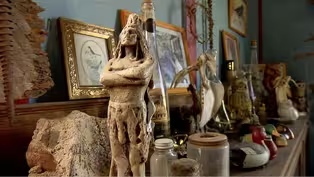
Clip: S26 | 6m 22s | Hoarders become historians at White Spring Ranch near Genesee, Idaho (6m 22s)
Video has Closed Captions
Clip: S26 | 6m 42s | Valley residents share a passion for their past (6m 42s)
Clip: S26 | 7m 9s | Follow aNorth Idaho resident Mark Cramer down some of the region’s toughest rivers. (7m 9s)
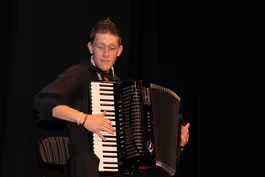
Clip: S26 | 7m 34s | International Accordion competitor Sam Thomas of Spokane (7m 34s)
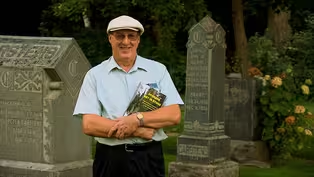
Clip: S26 | 6m 48s | Historian Dick Jensen turns the spotlight on Spokane’s often overlooked yet historic stone (6m 48s)
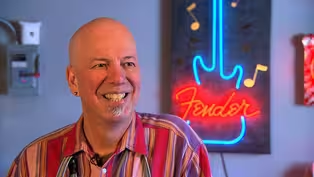
Clip: S26 | 7m 9s | Glass bender with Ken Yuhasz, a multi-media artist from Spokane, whose specialty is neon. (7m 9s)
Video has Closed Captions
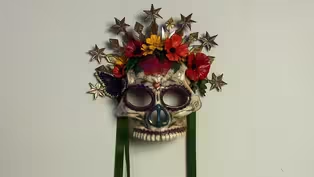
Clip: S26 | 6m 11s | Meet an artist that creates transformational works of wearable art. (6m 11s)
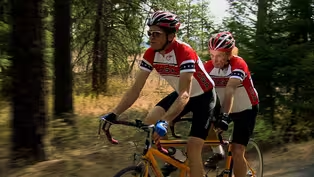
Video has Closed Captions
Clip: S26 | 7m 3s | Blind cyclist Bryant McKinley has vision to win (7m 3s)
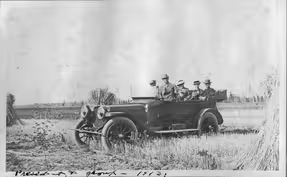
Video has Closed Captions
Clip: S26 | 6m 3s | Discover a time when Deer Park, Washington was at the core of a massive 1910 business vent (6m 3s)
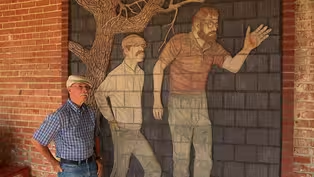
Video has Closed Captions
Clip: S26 | 6m 38s | Medicine Hat, Alberta artist sculpts brick murals depicting religious and historic scenes (6m 38s)
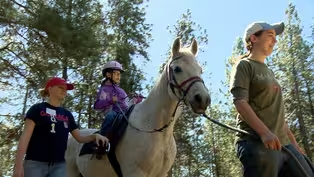
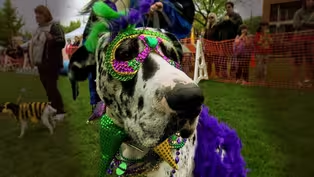
Preview: S26 Ep5 | 30s | Therapy on Horseback, High School Fitness Club, Dog Days in CDA, Palouse Family Museum (30s)
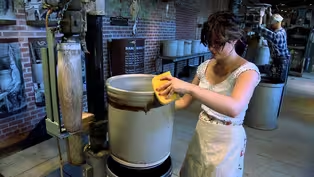
Preview: S26 Ep4 | 30s | Medalta AB pottery, Encaustic Artist, Spokane Valley Heritage Museum, George Flett (30s)
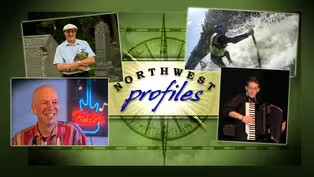
Preview: S26 Ep3 | 30s | Bright Lights, Big Rivers, Accordion King, Monumental Guide (30s)
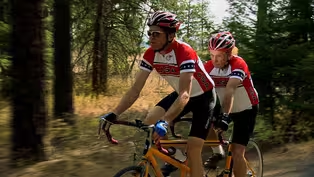
Preview: S26 Ep2 | 30s | Historic Arcadia Orchards, Mask-maker Annie Libertini, Tandem Cyclists (30s)
Providing Support for PBS.org
Learn Moreabout PBS online sponsorship











Support for PBS provided by:
Northwest Profiles is a local public television program presented by KSPS PBS
Funding for Northwest Profiles is provided by Idaho Central Credit Union, with additional funding from the Friends of KSPS.