Articulate
From Isolation To Ovation
Season 6 Episode 8 | 26m 45sVideo has Closed Captions
Classical pianist Leif Ove Andsnes and librettist Royce Vavrek
Leif Ove Andsnes has awesome musical powers, yet in person he is quiet and contemplative. Because, he says, the piano is his true voice. Royce Vavrek doesn’t court controversy, but it seems to follow in his shadow. The celebrated opera librettist and lyricist says if his work provokes, it’s not to advance any personal agenda.
Problems playing video? | Closed Captioning Feedback
Problems playing video? | Closed Captioning Feedback
Articulate is a local public television program presented by PBS39
Articulate
From Isolation To Ovation
Season 6 Episode 8 | 26m 45sVideo has Closed Captions
Leif Ove Andsnes has awesome musical powers, yet in person he is quiet and contemplative. Because, he says, the piano is his true voice. Royce Vavrek doesn’t court controversy, but it seems to follow in his shadow. The celebrated opera librettist and lyricist says if his work provokes, it’s not to advance any personal agenda.
Problems playing video? | Closed Captioning Feedback
How to Watch Articulate
Articulate is available to stream on pbs.org and the free PBS App, available on iPhone, Apple TV, Android TV, Android smartphones, Amazon Fire TV, Amazon Fire Tablet, Roku, Samsung Smart TV, and Vizio.
Providing Support for PBS.org
Learn Moreabout PBS online sponsorship- [Announcer] Articulate with Jim Cotter is made possible with generous funding from the Neubaur Family Foundation.
(inspiring classical music) - Welcome to Articulate, the show that helps us explain who we are to ourselves, and to others.
I'm Jim Cotter, and on this episode, From Isolation to Ovation.
Leif Ove Andsnes has awesome musical powers, yet in person, he's quiet and contemplative, because he says the piano is his true voice, and he's constantly listening for and to music so that it can speak to him and others.
- I was just so happy to find somewhere where I could really express myself, because I wasn't very good at expressing myself in other ways.
- [Jim] And as Tori Marchiony reports, Royce Vavrek doesn't court controversy, but it seems to follow in his shadow.
The celebrated opera librettist and lyricist says if his work provokes, it's not to advance any personal agenda.
- I think that it's important that we give the audience agency to make up their own minds.
So I think that yeah, my work is often a little ambiguous.
Moralizing is not, it's just not interesting.
- [Jim] That's all ahead on Articulate.
(inspiring classical music) (classical piano music) Leif Ove Andsnes seized the world through music, and over his almost four decades on the stage, the greatest discovery of this world-renowned Norwegian pianist may well be how to unite a room full of strangers by tapping into something divine.
- That is magic.
And then you can't explain with words what is going on anymore.
- [Jim] Andsnes was born and spent his childhood on the island of Karmoy, off the west coast of Norway, and from early on his parents, both music teachers, recognized and nurtured their son's unusual gifts.
- I loved from the very start to play for other people.
I'm extremely grateful that I got this talent, and that I discovered quite early on that when I played the piano, people were actually listening, and they seemed to rather enjoy it, and that inspired me and found out that this was my language.
- Did you ever play anything besides classical music?
- Yes.
In fact, I also have, I have a quite diverse background in music, because I played euphonium in the school band.
- [Jim] That's right.
- My father was a band conductor.
And I would say when I was 10, 11 years old, I was as fanatic about brass band music as I was about piano music, in fact, because it was a very social thing to do, as well.
- You ended up marrying a horn player, so proof in the pudding, right?
- (laughing) Yes, yes.
- The ultimate social instrument.
- Yes.
- [Jim] That horn-playing life partner is Ragnhild Lothe, and today, they and their three children live in Bergen, Norway's second-largest city.
But before embracing family life, Andsnes spent 20 years married to another, his piano.
This relationship started to get serious in his teens when he met the Czech-born piano Jiri Hlinka.
Hlinka insisted that if Andsnes really wanted to realize his potential, he needed to commit, now.
So at 16, Andsnes moved 100 miles from home to study with Hlinka at the Bergen Conservatory.
It was here that he began to understand what it meant to be all in.
- You have to be a nut.
You have to be a fanatic about, this is what I want, and I'd sacrifice everything for this.
At least for some years between the age of 15 and 20, there wasn't much life outside the piano.
I mean, this was.
- And did it feel like a sacrifice at the time?
- Yeah, sometimes.
But I was, you know, I was also quite a shy boy from an island on the west coast of Norway, and I was just so happy to find somewhere where I could really express myself, because I wasn't very good at expressing myself in other ways always.
Of course, I mean I wasn't, I had friends, and that.
But when I came back to the piano, I felt, okay, here I can really open up.
(classical piano music) - [Jim] This growing comfort with who he was and his ability to commit to an idea have stayed with Andsnes, and he's reveling in dedicating sometimes years to exploring, performing, and understanding individual composers, Rachmaninoff, Debussy, Sibelius.
- And I've always liked that, to have a project, that I often worked with certain recordings, I had a Liszt period, I had a Schubert period, Haydn.
So I think it's necessary to focus.
- [Jim] But one composer in particular has been ever present in Leif Ove Andsnes' world, his compatriot, Edvard Grieg.
The great Romantic era pianist and composer lived and worked in Bergen, and today he and Andsnes are probably the most well-known sons of this picturesque port city, with many regarding Andsnes as the keeper of the Grieg flame.
Andsnes helped commemorate the 100 anniversary of Grieg's death in 2007 with a CD and documentary called "Ballad for Edvard Grieg".
In the film, he performs some of his favorite Grieg pieces including a breathtaking rendition of "The Ballad in G Minor", surrounded by Norway's famous fjords.
The project also served to demonstrate how much of Grieg's music is deeply rooted in Norwegian culture, and Nordic folklore, and alive in the very souls of Norwegians today.
(solemn piano music) We do like the mythology, the idea of, Grieg works from folk melodies, and then he puts Grieg harmonies on them, and which came first, the chicken or the egg?
Is Grieg intensely Norwegian because we've had time to make him Norwegian, or was he Norwegian to begin with, you know?
- That's always the question isn't it?
He has become such an icon for the Norwegian culture, but I think so much of that was his invention, his harmonies.
And he took some folk music, and of course if you are Norwegian and you've grown up with that music, like I've played these pieces since I was five years old, then maybe you have a different relationship to that than when you come to it all, but on the other hand, Gilels apparently discovered this music when he was in his 60s, and he made a beautiful recording for Dutch Gramophone with Grieg lyrics pieces.
So you can give a lot by discovering this, and get this late love in your life as well.
- Right, but also I think we're fed that idea of the majesty of the fjords, and when you hear the piano-- (laughing) No seriously, when you hear the, I mean, when I hear the piano concerto I see towering cliffs.
See, we like the idea that that brings out, and you've sort of fed into that, taking a piano to the top of a mountain for the centenary of his birth, and that was really saying the landscape is here for you to hear this music.
- Well, and actually there is a force of nature very much in this music, I think.
I think that's one of the strong things about it.
(gentle piano music) - [Jim] And there's a force of nature in every new musical project Leif Ove Andsnes embarks on.
He takes on new projects only when he feels he is truly ready, and for the first half of his career, one composer loomed too large to touch, Ludwig Von Beethoven, who wrote some of the most intense, extraordinary, and intimidating music of all time.
But in 2010, fate intervened to let a 40-year-old Andsnes know it was time.
During the week-long stay in Sao Paulo Brazil, he was confronted with Beethoven's first and second piano concertos several times a day, every time he got into the elevator of his hotel.
But instead of being driven mad, the repetition sparked an epiphany.
- I was thinking, I heard new sections all the time, and just this section, I thought oh that's amazing, actually, how he goes from that harmonic transition, or the character there, or the humor, it's so surprising.
And I thought, this is the most amazing music.
I now have to do this.
And it wasn't like I didn't know the pieces, but just hearing these very short fragments did something.
- And out of sequence?
- Just getting, isn't it like that often, though, that the greatest musical impact-- - Revelations.
- Revelations can be made by very surprising situations.
- [Jim] From 2012 to 2015, Andsnes dedicated himself to Beethoven, recording each of the composer's five piano concertos, performing them across 108 cities in 27 countries, and ultimately releasing a documentary about the entire journey.
And though in the popular imagination, Beethoven is often remembered as grumpy and severe, Andsnes said the man he spent all that time getting to know was first and foremost profoundly idealistic.
(gentle piano music) - It's almost like it's preaching, and that grand feeling in the slow movements.
I didn't really understand or appreciate it earlier, and now I find it one of the most touching things, because it's just never about himself, is it?
It's about something bigger.
(gentle piano music) And there is no self-pity in this music, I mean, when you think about the life he had, enormous difficulties, his handicap, he turned deaf.
All that, it's always somehow music which looks to the light, and to the hope.
I think that's very touching.
But there's no theater here with Beethoven.
There's no, he doesn't hide behind anything.
- Did you have to deal with any of your own cynicism to play this?
Because-- - Yeah.
- In ways, he's kind of naive.
He never gives up believing in the greatness of humanity, or the possibility of the greatness of humanity.
- Yeah.
- And that's a very child-like, I don't mean childish, but that's a very child-like purview on the world, the fact that everybody's capable of goodness, everybody's capable of greatness, everybody's capable of doing good.
We just have to encourage them.
- And we live in a time of so much cynicism, don't we?
And we are ironic about everything, and my generation, we can hardly talk to each other without using irony.
So it really, it takes time to understand that incredible honesty.
(gentle piano music) - [Jim] For the first few years of his Beethoven journey, Leif Ove Andsnes thought he understood what the concertos were all about, until in 2015, he found a new level of understanding.
He stopped performing to return home when his wife gave birth to their twins prematurely, and then on the final show of that tour his replacement dropped out.
Fortuitously, the concert was in Bergen, and when he knew all was well at home, Andsnes performed.
Then, as he played the last movement of the 4th Concerto, something awoke inside of him.
- It was an enormously emotional experience, and just that ending of the 4th, which is so ecstatic, it's like he wants to fly, and he goes off, and I always have wondered what does he do there?
It's just G major, D major, it's just so simple, but he creates some kind of ecstasy through the rhythm, and the sound, and he flies up.
And now in this situation that I was in, it was, I've never been so touched in my life after a concert.
Music got so directly to me.
Suddenly I have three children, and that child-like beauty was just sometimes in Beethoven's music, I didn't see so clearly before.
There's enormous tenderness there, actually.
- [Jim] In the years since his Beethoven odyssey, Leif Ove Andsnes has delved headlong into the works of two contrasting composers, Frederic Chopin, who wrote almost exclusively for the piano and created some of the most lyrical and melodic music ever for that instrument, and Jean Sibelius, the thorny Finn who's reputed to have once said of the piano "it does not interest me, it cannot sing".
Yet these disparate composers find a new life and vigor, and a new musical voice, in the hands of Leif Ove Andsnes, the now 50-year-old former shy boy from the west of Norway.
(inspiring piano music) (audience applauding) (inspiring classical music) (uplifting music) - [Tori] Royce Vavrek has been known to stir the pot.
For the past 10 years, he's reveled in bringing diverse shades of humanity's ugliness to the stage.
From adultery and murder, to kidnapping and torture.
- I've always been sort of a rabble rouser, a troublemaker.
- [Tori] Vavrek is a librettist.
He writes the lyrics for operas, and he's one of the most eclectic and most successful of his generation, part of a cohort dedicated to making sensational thought-provoking opera for the 21st century.
Take his latest three-part work, "The Wild Beast of the Bungalow".
- It's about a girl who is gifted a mermaid in a jar, and she proceeds to abuse it until one night it offers this sort of graceful gesture to her, that you hope will have changed her, but she ends up just going back to her abusive ways.
And there was something about the way that I approached that.
It feels so authored from a place of right directly in the middle of my heart.
There are all these little references, and strange elements that feel that they borrow from my childhood.
- [Tori] Vavrek's own childhood was fairly conventional, growing up in rural Alberta, Canada, a young Royce preferred writing in his room to tending the family farm.
- I had no desire to participate in farming.
That was something that I knew from a very early age was just not necessarily for me, but I never had any sort of negative thing where I was like I do not wanna be like my mom or my dad or my brother or sister, I just kind of did my own thing.
- [Tori] Royce was an imaginative child who would recruit his siblings and cousins to perform in his homegrown shows, but backyard playtime wasn't enough and soon, movies became his window into the world beyond his small hometown until one day, at 13, he stumbled upon a film that changed his worldview.
Lars Von Trier's "Breaking the Waves" is the story of a twisted husband who, after becoming paralyzed in a work accident, demands that his wife, Bess, sleep with other men in their small, devout Scottish town.
Years later in 2016, Vavrek would adapt "Breaking the Waves" into a much-talked about opera.
- There was something about that emotional ferocity that just completely blew my mind.
I remember renting it on VHS, and I took it to my friend's house, and we watched it on a tiny little television, and I for some reason, my memory is that my nose was like right up against the glass.
But I remember this very uncomfortable but singular viewing experience, and it really, really changed my life.
- [Tori] But as a teenager he had no inkling of what was to come, yet he understood that he had discovered something important.
From then on, Vavrek abandoned stories with moral certainty and happy endings and set about writing the most provocative tales he could think up.
By the end of high school, he had written 17 plays, some of which were put on at his school, St. Joseph Catholic.
But young Vavrek's shows, one about a murderous nun, and another about a pig who gets plastic surgery, caused a stir in his conservative surroundings.
- The Catholic Women's League in my local town had heard that I was performing some controversial material and wrote a letter to the principal of my school, and to the priest, and were begging him to reprimand me, and my mom saw this letter on a pew at the local parish, and she became so incensed, because she was like none of these people, none of these women, have seen my son's work, it's just on hearsay and they just have no idea, and so she took her name off the church cleaning list because of that, and my parents were remarkably, remarkably supportive, although my mom, I remember when I told her that I was writing a piece about abortion, she sort of had a moment, an emotional moment, where she was like well why can't you just write about sunflowers?
I said well, I could write about killer sunflowers or something like that.
- [Tori] This was the start of a long and winding path for Royce Vavrek.
First he went to film school in Montreal, but caught the musical theater bug after a weekend in New York City taking in Broadway shows, and at 22, he moved there to study at NYU, where he found himself in the right place at exactly the right time.
- There was an advertisement that came over the musical theater writing forums that suggested that there was this opportunity for people who were interested in contributing to the operatic forum, and so I found this community of young composers, David T. Little, Missy Mazzoli, Du Yun, Paola Prestini, who were all really eager to contribute dramatic stories to the music theater form.
- [Tori] Vavrek and his close cohort of peers have spent the past decade shaking up the opera world, unexpected plots with flawed characters that audiences love to hate, and sometimes hate to love, like "Angel's Bone", his Pulitzer Prize-winning collaboration with composer Du Yun, in which a broke, struggling couple finds hope for redemption when they discover two angels that have fallen to earth.
They kidnap the angels, and enslave them to turn around their own wretched circumstances.
Vavrek's libretto explores both the mindset motivating captors, and the dark effects of their actions in a heart wrenching portrait of human trafficking.
- I try to do as much research as possible.
If you don't know what you're writing about it's sort of your duty to really dig in, and to try to learn as much as humanly possible about that experience.
But you also have to give yourself, there's a time when you need to put the books away, and the media, and all of those things, and let this character live in your imagination, and let it spill out into the work that you're creating.
- [Tori] In 2016, Vavrek faced a particularly intensive research project when he was trying to write an honest story about President John F. Kennedy.
That opera, "JFK", set the night before he was assassinated, shows a man mourning his sister, Rosemary, recently debilitated by a failed lobotomy, while he faces mounting pressure from a country in the midst of social revolution, all the while, haunted by his own personal demons.
- We tried to create a figure that wasn't this god, that was just a normal man who happened to be the president of the United States and have this crazy event happen that just shook the world, but really, opera is an emotional art form, and I think that trying to find the courage, the emotional current in the life of JFK and in that blink of an eye moment was really the answer to our opera.
I think that it's, there's something really beautiful about the warts, as they say.
- [Tori] This is part of the philosophy that drives Vavrek, and his collaborators.
They push the boundaries of the forum with stirring novel stories that have the power to engage a younger generation with more cynicism and more media options than ever.
- I think that it's important that we give the audience agency to make up their own minds, so I think that yeah, my work is often a little ambiguous.
Moralizing is not, it's just not interesting.
- [Tori] His approach is working.
Vavrek's operas are attracting ever-larger audiences.
In 2021, he and Missy Mazzoli are slated to bring their twisted storytelling to the Metropolitan Opera in New York, the world's greatest stage, and a place that, at one time, Vavrek wouldn't have even dreamt of.
- I saw my first opera when I was 18 or 19.
Opera for me was this elitist form, so it was this thing that, people arrived with huge ballgowns, and tickets were so expensive, and those chandeliers at the Met, my goodness.
And so they were sort of the antithesis of my farm upbringing.
But it's interesting now that I am, I'm so desperate to make opera for everyone.
- [Tori] And making opera for everyone means meeting head-on the human condition and all its glory and misery.
Royce Vavrek makes stories that others couldn't, or wouldn't, by refusing to write off any character for their thoughts, feelings, words, or even actions, he forces audiences to question their own values, to judge others a little less quickly, to listen a little more deeply.
- [Jim] For more Articulate, find us on social media, or on our website articulateshow.org.
(bright classical music) On the next Articulate, Zenos Frudakis has spent the last 50 years sculpting life out of bronze, aiming to best capture the likenesses and spirits of his subjects, and to shine a light on those who have helped foster change in the world.
I'm Jim Cotter.
Join us for the next Articulate.
(inspiring classical music) - [Announcer] Articulate with Jim Cotter is made possible with generous funding from the Neubauer Family Foundation.
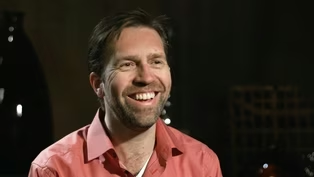
Leif Ove Andsnes: A Norwegian wielding hammers...and strings
Video has Closed Captions
Clip: S6 Ep8 | 14m 55s | Classical Pianist Leif Ove Andsnes (14m 55s)
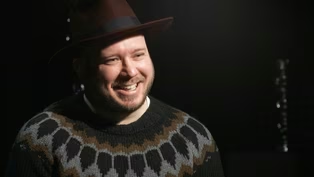
Royce Vavrek: Forthright at the Opera
Video has Closed Captions
Clip: S6 Ep8 | 10m 28s | Librettist Royce Varek (10m 28s)
Providing Support for PBS.org
Learn Moreabout PBS online sponsorship

- News and Public Affairs

Top journalists deliver compelling original analysis of the hour's headlines.













Support for PBS provided by:
Articulate is a local public television program presented by PBS39